Hi Ro,
Always good to have skilled people looking over my shoulder. :)
Actually, you might be misinterpreting some of what you're seeing, and I also suspect we do things differently here.
First of all, here in the US, we run 120 volts for most circuits.
The wiring you're seeing is extremely common in residential construction here in North America. It's known as "NM-B" (non-metallic, variant B) and is often sold under its brand name, Romex. The yellow (12 guage) and white (14 guage) jackets you're seeing is a plastic sheath, inside of which are the insulated wires: black for "hot" (or +), white for neutral (or -), and a bare copper wire for ground. Commercial construction calls for metal conduit here, but for houses, NM-B is just fine.
Notice all of the white jacketed wire coming out of the box, up the wall, and into the attic. That's the rest of the wiring for my house.
Here's a little video clip from the wire manufacturer's Web site that shows Romex wire being "bare" inside the wall framing. (Calling it "bare" isn't really fair, because it does have a flame resistant PVC jacket that protects it.)
The blue tube is a "raceway" that already contains a 6 guage 240 volt cable for a back yard spa that the previous owner of the house had put in. The spa is gone, so I will be using that wiring for my mini split air conditioning sytem.
In nearly all cases, the wiring for each outlet and switch goes into a box mounted to the sides of the studs. Rather than doing that, I'll be mounting my boxes on the surface of the finished walls. That's the reason for my not having any boxes on the studs of the room.
I hope that clears things up a bit. :)
--Keith :mrgreen:
120volts, ah. We got 230volts over here :)
The wires did look thin, but with 120v it seems ok.
It's good to see the insulated wires are molded into a flame resistant PVC jacket. Wrong wiring/hot cables are common fire starters. It "looked" bare to me, again I'm not familiar with US code and wiring. Whenever I see wires without PVC protection I'm alerted. But a PVC jacket prolly will do fine. Thanx for clearing.
Is it "strong" enough to protect from hamerblast or a screw trying to get through?
That blue "raceway" seems just like a flexible tube, which is exactly what's being use here too. PBC tubing are protected for impact, fire, aging. Flexible tube is harder to pull wires through. Besides, it make a "clean" look, no wires running criss-cross.
0,2$
For nail protection, we use small metal plates on the face of the studs where the wire would be close enough to penetrate it... But, in truth, conduit is superior protection, and that's why it's standard in commercial construction.
--Keith :mrgreen:
I returned a couple of days ago from a weeklong Walt Disney World vacation, during which I paid Marc (guitardad72) a visit and helped him with his stucco. 8)
Note to self: Just before the flash goes off, suck it in.:roll::lol:
Today I spent a few hours working on the fireblocking. I'm done with one the sides -- I have three more to go. No pics yet -- I'll share when I've got more to show.
Hopefully I can nibble away at it throughout the week. I need to get that inspection scheduled soon! :shock:
--Keith :mrgreen:
Progress to report!
I finished the fire blocks. I covered my plan for this on page 75 and I finally finished it up this weekend.
In short, I used 3" batts of Thermafiber SAFB "pinched" to about 1½" using a sheet of 5/8" firecode drywall jabbing into it halfway across its width.
The pictures help to tell the story.
This one shows the area above the door on the inner leaf... On this wall I fastened the drywall to the face of the studs and top plates, pinching the insulation against the outer leaf ceiling.
This one shows the southeast corner. For the south wall I attached the drywall on top of the 2x6 nailing edge that spans the top plates, so it's a bit higher. Again, the insulation is pinched against the outer leaf wall.
I ran into trouble making a strip of drywall narrow enough to fit in the area along the laundry room, which has a smaller gap than the rest of the perimeter (about 8" instead of 12+"). So for this 8 foot section of wall, I will triple-up on the 3" batts to result in a complete fill of Thermafiber SAFB insulation. That is an acceptable fire break according to California Building Code.
I did an interesting test yesterday -- I'm surprised I hadn't thought of doing this before. I placed my ear firmly against one of the studs and I knocked on the nearby framing members. Hitting a stud of the same framing assembly, even if it is a different wall of the assembly, was very noticable, and sometimes even almost deafeningly loud! But knocking on an opposing frame's stud resulted in very slight or even zero noise on the "listener" stud! 8)
Separate frames are the way to go! :twisted:
After finishing the fire blocks, I was able to remove the temporary "bridge" pieces connecting inner leaf to outer leaf frames. My inner leaf no longer squeaks when leaning on the studs -- something that I figured would go away once the sheathing goes up, but the fire blocks are holding the inner leaf really steady so it doesn't sway at all anymore. :-)
As I type this I am awaiting my framing and rough electrical inspection! I'm less confident about this one -- I have funny feelings about missing some things on the electrical piece. We'll see what happens! My last inspection was just five days short of six months ago, so I didn't have a choice -- I need an inspection this week in order to keep the permit from lapsing! :shock:
Wish me luck on today's inspection! 8)
--Keith :mrgreen:
Stucco...yuck. I had to do a 20x10 wall myself and i though i'd need a shoulder replacement after...lol Come to think of it, all this labor is really causing alot of aches and pains i hope wont interfere with my drumming. I haven't played in a few weeks been so busy.
Anyways, Sharward... Thought that cavity between you wall frames was going to be filled totally with glass or rockwool? Did code still require the fire break at the top if you do fill it completely in???
I had planned to do a complete fill, but I can only seem to get 3" batts locally. I already bought 19 bags of it. To do a complete fill would require probably 50 bags.
Anyway, great news -- I just passed my framing and rough electrical inspections!8) I was questioned about a few things, but after a bit of explaining (my plan to use surface-mounted boxes, etc.) I had the inspector's initials on my card within just a few minutes! 8)
I also got a good reminder that I need to have a horizontal firebreak about halfway through my long walls... A complete fill of one stud bay will do the trick.
My draftstops were accepted without hesitation. :twisted:
He noticed the PVC pipes in the gap in the floor at the doorways... When I told them they were for termiticide treatments every five years, he reacted with a bit of a chuckle: "We don't live in Hawai'i!" ;-) He then made a comment about some people really thinking ahead on things... Not sure if he's impressed with my ingenuity or if he just thinks I'm a fruitcake... Maybe a bit of both. :P
I'm now off to return the drywall lifter to Stickhouse's contractor. He needs it for a job. He says I can get it back when I'm ready for it, provided he's not using it. 8)
--Keith :mrgreen:
Hey Sharward,
Just thought I'd share something that a supplier of mechanical ventilation systems told me. He said that even though I'd be using an efficient heat recovery system, I would lose way too much energy when using such a system with such a small room. He said these systems are designed for an entire home, not for a room that is only 1350 cubic feet.
He recommended that I not use this and recommended a fan system (which was honest of him since the fans cost significantly less). Of course the issue with that is how will I get fresh air, and then how can I avoid the energy loss. (my goal is to avoid having to run heating and air-conditioning to my basement room since it's not too bad down there at the moment).
I know that you were planning on using one... don't remember if you were going to have heating and air conditioning as well though. So just wanted to share that with you in case you wanted to consider how cold or hot it might get in your room and maybe ways you to avoid that. Ideally, I guess it's best to have fresh air being supplied a little above the minimum required.
The company that gave me this info was Airiva. I've also sent an email to Fantech to see what they say about it. I'll let you know..
Tom
Awesome, Tom! Thanks very much for the tip! I'm very close to making that purchase, so I'll definitely look into this further before committing.
Or maybe I'll just ride your coattails. :lol:
--Keith :mrgreen:
I was certainly busy yesterday... Not busy doing manual labor, which always seems to lend itself to a feeling of more accomplishment than what I was doing.
I was busy yesterday thinking... Thinking about my mini-split air conditioner plan. Thinking about my ventilation plan. Researching the latest models of mini-splits on the market today. Dreaming about ducting.
Yeah, I know it's not as sexy as framing or electrical, but very important nevertheless!
I've always advocated having a solid plan before beginning to construct... And I pretty much have one, which was instrumental in my being granted my building permit back in August of 2005. However, before beginning a phase of work, I always stop and think about the approach, anticipate obstacles, and sometimes tweak the plan to fit the new discoveries.
Those who have followed this project since the beginning know about my plan to use a mini-split air conditioner for my cooling and a heat recovery ventilator (HRV) for my fresh air requirements. That basic plan is still intact, but I'm making some refinements that will save me money and make the installation a lot easier than I had initially planned.
Certainly, TomM's comments above lead me to reconsider my intent to use an HRV. I'll probably stick with the HRV idea, but I will talk to someone at Fantech before I make my purchase.
I posted back in August of 2005 that code requires me to have 15 cfm of fresh air per person. I also read today that 20 cfm per person is considered "standard" for a conference room. I figure I need about 100 cfm net maximum performance out of my ventilation system, assuming the room is loaded with 5 people who are much more lively than people sitting still in a boring business meeting. The Fantech VHR1404 (or equivalent) with 6" ducts still seems like a good fit. (The smaller VHR704 model with 4" ducts just doesn't have the capacity.)
The fan has three speeds, so I expect the unit will be running on the lowest speed most of the time... However, for the times that I do have multiple guests or just need to flush the room out of its stale air, the higher fan speeds will do that quite nicely.
I was also stressing a bit about penetrating the ducts to the outside. I really didn't want to have to cut through my stucco and risk water intrusion at the ports. Roof-mounted aren't really a viable option to me as DIY, given my tile roof. Then, while I was perusing Fantech's site, I saw this little beauty:
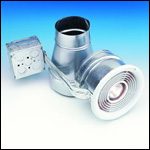
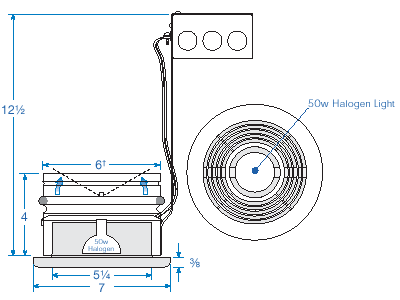
[url=http://www.fantech.net/accessories1.htm]Recovered from web.archive.org — originally hosted at http://www.fantech.net/accessories1_03.jpgRecovered from web.archive.org — originally hosted at http://www.fantech.net/accessories1_03.gif
Fantech's Combination Exhaust Grille and Light (VLC64)[/url]
Never mind the 6" to 4" reducer, as I won't need that piece... But look -- it's a combination 50 watt halogen light fixture and vent grille! They're even UL rated for use in wet locations! 8)
I figure that I can use two of these over my front porch, where I already have two 6" round recessed light fixtures, which I can simply remove and then be left with two perfectly sized round holes! :twisted: They come equipped with dampers that flip open when air flow is sucked away from the grille. I'll obviously have to remove the damper on the one for exhaust, and perhaps use an in-line damper a little bit downline.
Unless anyone raises an objection, I'm really pleased about this approach, as I won't have to cut through stucco or have any more ugly ports on the house. :D
Now, back to ducting... I'll probably use this type of ducting for the fresh air supply run...
Master Flow 6 In. Metalized R6 Insulated Flexible Duct (F6IFD Series)
...plus a combination of 6" flexible and rigid uninsulated duct for the exhaust air run.
I know, I know... Rod's gone on record recommending against flex ducting... :roll: ...I figure I can get away with it in this case, since it's just for fresh air (not A/C) and exhaust, and I can afford some air flow drop due to the static pressure associated with this type of ducting.
Back to the mini-split... I've discovered that there are now much more energy efficient mini-split systems on the market today than there were just a year and a half ago when I first found the Mitsubishi Mr. Slim units. They've gone from 12.3 SEER to 16 and even 17 SEER! I'm looking seriously at the Sanyo 09KHS71 system, spending the extra couple hundred dollars to get the heat pump version.
I had originally intended to hire a pro to do all of the mini split work, but I'm now planning to purchase the system online and run the lines myself. I will have to hire a pro to do the final hook-up and charging. This will give me the opportunity to be as meticulous as I need to be about seals and placement of the lines. I won't bore you with all the details, but I've got a brilliant plan to allow for maximum air-tightness while also preserving the integrity of the drywall at the penetration points. :twisted:
Today I'm going to head out to the building supply to see if I can buy some of what I need, and I'll probably be spending thousands of dollars via the Internet this week! :shock:
--Keith :mrgreen:
Hi Keith, things are looking good!
Here's $.02, since you miss me so much :) ... why not go with the 8 inch fan, it's not that much more expensive than going with a 6 inch system, and you will have extra capacity if you need it ...
you can always turn down the fan, but you cannot make it bigger if it turns out your long duct runs and bends (which are what concern me) have too much static pressure.
personally i'm using an 8 inch fantech fan ... i just finished installing and wiring it over the weekend. i'll try to get pix up as i'm actually pretty proud to share this one.
i did fire it up before completing the installation, and it moves some impressive air.
you can still use the same kind of grilles over your porch.
anyway i don't really know much about HVAC, but i'm thinking when in doubt, go bigger if it's not that much cost difference.
Dan
Actually, as far as HRVs go, the baby model (704) has 4" ducts and all the others have 6" ducts. This sales sheet shows the capacity differences.
I'll consider upgrading to the VHR 2004 though... Better to have it and not need it than to need it and not have it, eh? :roll:
Thanks, Dan. :-)
I just got off the phone with A M Royal. I just purchased the Sanyo 09KHS71 9,000 BTU Heat and Cool Mini Split Air Conditioner (16 SEER 8)) and a 50 Ft. Insulated Copper Line Set which is pre-flared with connectors on it 8) for $1,569.90 with free shipping! :D That's officially the most expensive single expenditure for this project. (The concrete was more expensive, but that was split up into numerous transactions.)
I still need to make a decision on the ventilation system (Dan and Tom have given me reason to need to be careful about that one). I'm also buying a very nice insulated condensation drain hose that should be long enough for me to cut into two pieces and use for both systems.
--Keith :mrgreen:
Keith,
I haven't done enough research, so i'm not sure about this, but double check how you calculate your CFM required. The units are sized to ventilate an entire house. So if the unit is 100CFM, and that's for 17,600 cubic feet (as in this example: http://www.fantech.net/hrv_erv.htm), it just seems odd that you would have the same requirement for a room that is like 1/14th the size!? If the unit works at 100CFM for 17,600, wouldn't it be the same as 1400CFM in a room with 1250 cubic feet? That many air exchanges would make your inside the same temp. as your outside pretty quickly even with an efficient HRV.
Do you know if the fantech units (or whatever you are going to use) has an off switch? So you can make sure the system isn't running at all when no one is in the room? I would think this is still OK for code since it's operation would be the same as a window (ventilation when needed).
One thing that was recommended to me was a duct heater to help the HRV...but I have no clue about them. Also, Fantech recommended that I get the 704 version saying that it's suitable up to 1500 square feet. (my room is only 180, so i'm still a little worried about such a difference). Especially since the other company suggested I not use an HRV at all.
Tom
It does seem like overkill to ventilate a single room with a whole-house ventilation system. However, y'all need to keep in mind that I am using mechanical ventilation as a operable window substitute. I'm also basing my need, perhaps extremely, but still appropriately in my opinion, on the optimal maximum amount of fresh air I will need to keep several humans comfortable for extended periods.
One time I was in a fairly large rehearsal room at a horrible studio in Sacramento... The walls were lined with old carpets and there was no ventilation at all in the room. "Stuffy" doesn't even begin to describe the feeling after we had been in there just a short time. "Illegal" is another word for it. ;-)
Also, a lot of CFM equivalent is lost due to static pressure associated with long duct runs, grilles, and turns. My system will have all of the above. The small model definitely won't cut it. The medium one would probably be OK most of the time, and the large one would probably be OK all of the time. The duct sizes are the same between medium and large, so I'm leaning towards the large.
--Keith :mrgreen:
Crap. I got rear-ended on the freeway on the way home tonight. :evil:
Fairly ow impact. Pretty young woman standing outside her car parked on shoulder. Honda stopped in traffic front of me past that. I stopped. Corvette stopped behind me. Large delivery truck got distracted by pretty woman, skidded and slid into Corvette, which slammed into my RX-8, which pushed slightly into Honda.
Low damage but I'm stiff.
Pics later.
Sharward,
Glad to here you are alright, you could be feeling a lot worse then "stiff" right now.
Reminds me of years ago in a small town I used to gig in, the town news paper wrote a story about how many car accidents were happening at a main intersection. Two ladies decided to sun bath on there porch, many male drivers got distracted and many driving accidents happened as a result. The police had to ask these ladies to stop sun bathing in sight of the road. This also happening in a bigger town, down the street from me but in a big town the news was not as big.
I guess us "guys" should learn when to and when not to look, but it's so natural. I will not begin to describe how many pretty ladies, well ladies, hmm well sometimes women not acting lady-like I've seen while gigging that have completely distracted me from playing music.
Anyways, maybe above statement will get your mind wondering off some where's else and help distract you from any resentment feelings you may have for the driver who rear ended you.
Like I said could have been worse, let's not let this slow your studio build down now shall we :twisted:
Marc
Thanks for the well-wishes, perspective, and stories, Marc. :-)
I took three 200 mg Advil tablets last night. I'm feeling pretty good right now. Maybe I'll go to the orifice ;-) in the morning after all.
--Keith :mrgreen:
The bad news:
I feel really stiff this morning. :?
The good news:
I always feel this way in the morning! :lol:
Honestly, I've felt worse after some active studio construction days. ;-)
The Advil seems to be doing its thing and doing it well. I'll still take it easy though.
But please don't let that squelch y'all's sympathy. :twisted:
Now, if you'll excuse me, I'll be tending to body repairs of a different sort... :roll:
--Keith :mrgreen:
glad to hear youre ok... i had my own scarry trip on the way in this morning... i slowed down to stop for traffic (downhill) and the dakota right behind me didn't... :shock: skidded right into the other lane and slid sideways down the road (right behind me!), he finally hit the bank(hill) on the other side of the road... just really glad no one was on in the other lane, they would've been hit head on... the guy driving the truck seemed to be fine, he put it in reverse and climbed out of the ditch... still scarry!
moral of the story... DRIVE SLOWLY ON ICE! (EVEN WITH 4WD!)
Glad to hear you're OK, Shahwood..... (LOL, only kidding, I live in Maine, that's how a Mainer would pronounce your name....)
I agree though, don't let it slow down your build....
I thought my front damage (not pictured) was limited to license plate, plate frame, and mounting bracket... However, upon closer examination by the body shop, there are hairline cracks on the bumper cover which will necessitate its replacement too. :roll:
It could have been a lot worse, obviously. I'm lucky.
But it's still a pain in the ass. :evil:
Oh, and it looks like I've crested 150,000 views. :) Although I'm quite certain that the vast majority of those are non-human [rul=http://en.wikipedia.org/wiki/Web_crawler]bots and spiders[/url], so I don't really get too worked up about that number. Part of my "real" job is Web analytics, so I know full well how much those darned things can inflate page view counts.
--Keith :mrgreen: