"I think the main problem of moisture is because of the septic system in the ground"
Then that is a potentially unhealthy[septic=sewer] and completely different problem all together with ;)
For the time being, the wall seems to be ok, at least nothing seems to get through in the studio, I've applied the anti-moisture material on most of the studio, and even on the floor, so i could have myself a pool in there :D
Anyways, the specific wall with the problem now has about half of centimeter of anti-moitsure material.
If i see that the moisture appears again, then want it or not, i'll break everything apart on the outside to fix the problem.
I have a few questions if anyone can be bothered with this.
I've seen a lot of people in this forum, using plastic vapor barriers on top of rockwool, and a lot of people using fire retardant cloth as a studio cover.
1. Doesn't the idea of a flame retardant cloth and a flamable plastic layer cancel each other out?
2. Is the vapor barrier just for moisture, or to keep rockwool particles within the wall?
3. Is the cloth alone, capable of witholding the rockwook particles inside the wall?
4.If i don't put any chicken wire on top of the rockwool, won't it appear a bit saggy as time passes? i.e. on a ceiling where gravity is more apparent. I've seen lots of posts here that don't use chicken wire, that's why i'm curious about this.
5. Which came first, the chicken or the egg?
:mrgreen:
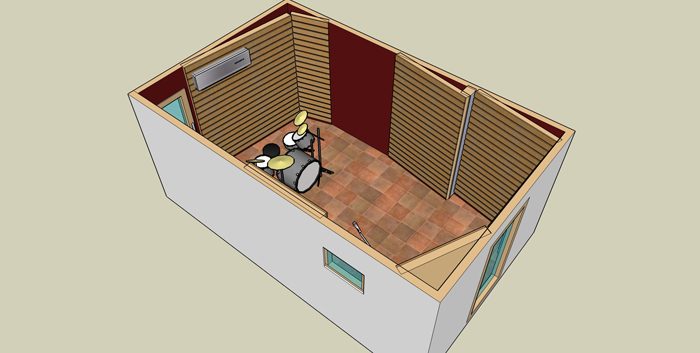
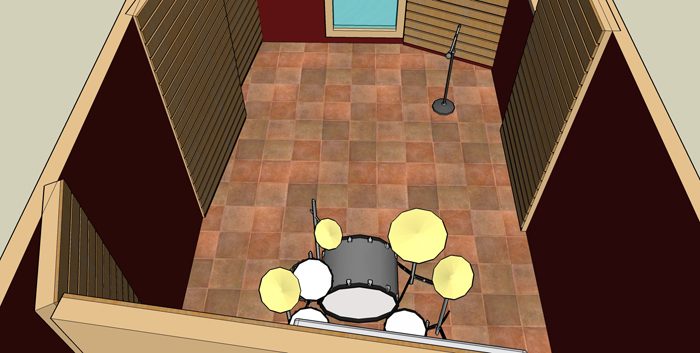
Ok, I think i'm done with the Live Room Final design, though I am between two final designs.
I've posted them as jpegs, my sketchup file is 945Kb and the allowed size is 500Kb :? ?
Any way to upload this differently, or optimize the file?(I've deleted all unecessary textures)
I think with my first idea, the room will sound more live, but with the second idea the early reflections will be minimized when recording drums.
The ceiling will be flat and totally absorptive, Perhaps I will also put a cloud above the drumset, (any comments on this?), cause of the low ceiling I want to avoid standing waves and early reflections between the floor and the ceiling. The door infront of the drums leads to the control room (the one next to the mic) and the one behind the drums leads to a lounge-storage room.
All of the walls will be filled with super chunks, lots of rockwool.
If you have any comments by all means share. :)
Thanks.
Is anybody watching this thread? Perhaps I should try posting on a new thread, or other forum?
I don't know if I'm not giving enough information about my build so as to not qualifying for an answer, but it would be great if I actualy had any conversation with someone to share views.
Anyways, there's no point in posting if no one's watching... :roll:
Maby I'll just put some pics when the studio is finished on my building thread and that's that.
Nevertheless great forum, I spend my entire day in here, I'll try to copy examples from other studio builds in here.
cheers.
Hello There
From my little experience, if you want a live room sound, try to avoid as much as possible absorptive walls. that means, try to have as many hard surfaces as possible.
For the ceiling, it could also be hard surface, and just make an absorptive cloud over the drumkit, because a 100% absorptive ceiling will eat a lot of room liveness than you really think.
Thats my advice
Thanks Javier,
The room height though is 2.32 meters, won't that cause flutter and comb filtering with early reflections?
Btw, I've spent some time on your website a few days ago, and I was truly impressed with the sound quality of your work.
Excellent stuff, it reminded me why I'm doing this. I've not had a studio for a year now and I forget how it is to strive for great music and great sound.
The music player on the site takes alot of time to load though and I wanted to hear the next tracks so much, but it took so much time and it got on my nerves :P
Is the quality of the compressed tracks really high?
cheers.
Thanks , glad you liked my work
I believe the web player plays the music in the format I upload it, that means, if i upload a 320kbps mp3, you will hear that
About the ceiling, yeah, thats a very low ceiling, that could mess with your cymbals when miking them, but hey, we always have limitations in our rooms and we have to give away something to get something in exchange, In your case, sure, thats a really low ceiling, and its hard to get a really live sound room with such a low ceiling like that.
Its that ceiling height you mentioned the current ceiling before the inner leaf? or the final height counting the inner leaf?
Another idea could be:
Walls and floor 100% reflective (play with angles like in your slots, but ive seen that even slot walls, absorbs a decent amount in general). And play with something 50/50 in the ceiling, like, make a pattern with a absorptive surface, then go hard, and so on.
Another thing to consider is, instead of making all of the walls slot resonators, you could build diffusers all arround, that would give you a nice diffuse room sound without eating more liveness
Now, all my advices are considering that you want a live room sound. If you can live with a safe sounding room, then your original plan looks and sounds fine
Hi Javier,
That's the ceiling height of the inner leaf. Basically I would love to have a live room (being a drummer and all) but that's the only live room I have, so I'll have to compromise cause I want other sounds to be recorded dry, like Guitar amps, Vocals and so on. I will go with the first option that you suggested with more slots.
If i put wooden skyline diffusers behind the drums, won't that make it more live but affect the drums mostly?
I'm also thinking of puting a cloud above the drums just to be safe, I'm scared of any phase problems that might occur there.
I think that should work
Also, if you build inside out, you could make ceiling modules like i mentioned earlier, like puting an absorptive module over the drumkit
I've just calculated the cost for the Skyline diffusers for the rear wall.
It comes around 1000 Euro!! :shock:
I guess that's a big No No for me :cry: darn they look so cool
I guess I'm gonna stick with the original first design.
What about QRD diffusors? One or Bi dimentional. they arent that hard to build tho
I mean, my whole point is, these slot walls and everything works and look good, pretty hype. But, the best drum sounds i've gotten during my carreer were in very tall almost untreated rooms with concrete walls (with untreated, i mean a couple of diffusers, a small slot resonator panel, and some foam panels hanging out of the 6m ceiling) Those really were great Live diffuse sounding rooms. So, anything with more absorption will sound safer. you get the idea
Yeah, I remember once playing at a coffee place where the ceiling was about 6 meters with a wooden roof.
The sound without any mics was Out Of This World.
NO Absoption, NO diffusion.
My room on the other hand without any treatment sounds plainly awful, so that's why i've went with the slot option.
It seems to be working for everybody here, even in small rooms. Like you say it seems safer.
This diffuser seems to need less wood so less the cost to make it.
It's in chinese... but look at the pwetty pictures:P
http://www2.atword.jp/disco3/category/diffusor-project/
Since I have an absorptive ceiling do you think a unidirectional diffuser would be better, as to keep the sound bouncing in the horizontal range?
That omnifussor is very impressive to the eye though.
I could ask my wood worker if he's up to the challenge to make some of those for the back wall.
Performance wise and cost wise, which one do you suggest the most?
If I put diffusers, won't I have to still leave gaps between them for the low freq absorption to be better?
cheers
Nice, I'll see how much the additional cost is going to be, I hope it's within reason.
If not the slots are already in the price we agreed with the woodworker. I'll ask him if he's able to do a diffuser in place of the
rear slots.
Anyways It's 6 o'clock in the morning here :mrgreen: enough research for today.
I've also been refurbishing 2 old speakers today and my back is killing me.
I'm glad that the final live room design is over and done with, thanks for your help Javier! Now on with finalizing the details in the control room now! Sketchup day tomorrow!
Gnighty. :)
Thought I'd post this as well, cause I'm not getting any answers in the electrical & wiring section... :(
I'm about to order my plugs for my wall plates and im in somewhat of a dilemma.
From what I've seen on this forum, usually theres a wall box in the live room which ends up as cables in the control room. which are connected directly to the audio equipment.
I was wondering if I could use 2 identical wall plates. One in the live room and one in the control room.
And i.e. connect an XLR cable from the control room wall box towards a mic preamp, instead of the live room wall box being connected directly to a microphone preamp or patch bay in the control room.
To me this seems more tidy, especially from the moment that my equipment will keep evolving in the future.
Though I'm worried about signal degradation from all the connection points..
This is the only thing keeping me from ordering the plugs and continuing with my work.
Looking forward to your answers.
Cheers,
Vakis
If you use two identical panels, your connectors in the CR will be backwards: you'll have male where you need female, and vice versa. Just install a proper patch panel, and buy your self a bunch of patch cables.
- Stuart -
Thanks for your reply Stuart,
Yes that would be the concept, souldn't have said "identical", mirrored is a better term.
I was wondering if there would be any degradation with this option cause I'm basically adding another connection point.
I'm a bit hesidant in the patch bay option cause my knowledge with patch bays is limited..
I'd like to hear your opinion more on this subject if you can.
-Do I get a patch bay that supports analog and digital signals?
-What type of patchbay do you suggest and why
-Also is one patchbay rack enough?
-What seems to be the "status quo" here in cable management?
Looking forward to hearing your answers. On the subject of studio "organisational connectivity" I'm finding difficulty.
Thnk you.
Vakis
Arguably the most common way of patching audio is with a TT bay (Bantam). Something like this:
http://www.neutrik.com/fl/en/audio/204_ ... tlist.aspx
Personally, I'd get a bay that allows you to select normalling on each pair, but you'll most likely end up with practically everything normalled. The general rule in video post where I live is that "signals flow downhill on the bay", which is a neat way of saying that the outputs from equipment are on the top row of each panel and the inputs to it are on the bottom row. Some might disagree, but whichever way you select, be consistent across the entire facility.
The digital/analog issue is also taken care of: most good quality bays support AES/EBU signals. If it works for digital, then it will also work for analog. Just make sure you mark them clearly (maybe with a different color ink, or something) so you don't sit there for hours trying to figure out why it doesn't work when you plug the digital out from your DAW into an analog input for the headphone amp.... :)
- Stuart -