Bless Rod's heart for trying not to embarrass me... ;-)
He sent me a private message...
rod gervais wrote:
Buddy,
a thought -
although your method of handlng the suction and coolant lines - along with the electrical feeders for your condenser unit was unique - it isn't code compliant with the electrical code (to run the ectrical feeder in).
it isn't an accepted electrical raceway or conduit as required by the NEC........
Just thought I'd mention it here privately.........
Sincerely,
Rod
Rod, in case you're not aware (and I'm hoping this makes it OK!)...
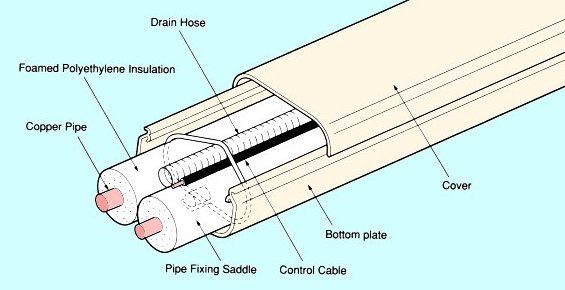
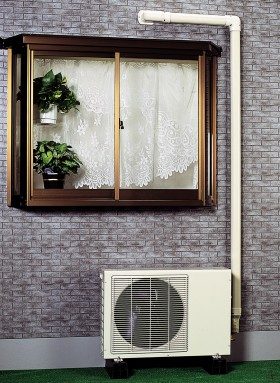
I was inspired by [url=http://www.inaba-denko.com/eng/products/slimduct/sd/index-top.htm]this product:
Recovered from web.archive.org — originally hosted at http://www.inaba-denko.com/eng/products/slimduct/sd/images/sdsample.jpgRecovered from web.archive.org — originally hosted at http://www.inaba-denko.com/eng/products/slimduct/sd/images/top-1.jpg[/url]
I'm using flex weather-resistant conduit for about 20 feet on the outside run, with compression fittings to transition indoor NM-B (a.k.a. Romex) to the conduit. I stripped the jacket off the Romex just past the point it enters the flex:
The NM-B wire (yellow jacket) is inside the attic. The opposite end (flex conduit) is slipped into the PVC downspout pipe.
Here's the other end, where the flex conduit exits the downspout pipe and enters the disconnect and the outside unit.
My understanding/assumption (I could be wrong...? :roll:) is that everything I have in the downspout pipe would be legal if it were exposed to the elements, and the downspout pipe just keeps everything neat and tidy.
If I have to pull the electrical lines out, that'll really suck... :x
--Keith :mrgreen:
If I were the inspector I would question this based on the following:
The code allows that material to be exposed to the weather - BUT - when it is exposed to the weather it is capable of being inspected to verify that it hasn't received damage of any kind.
The exception would be it's entering a protective structure andI believe the transition is supposed to take place at a box........ which I do not view aluminum downspout as meeting.
I also believe that the Romex stripped of it's jacket is not supposed to be run through the liquid tight NM.......... again I believe it's ok to a JB - but not directly into the NMC unless it meets the following (Taken from Mike Holts Code Forum)
I believe that itworks this way:
This type of romex installation, although commonly done is not CODE compliant because 314.17(B) says,in part: "Where raceway or cable is installed with metal boxes or conduit bodies, the raceway or cable shall be secured to such boxes or conduit bodies."
This requires that the type NM cable be secured to the box, which is not possible because the cable is enclosed in EMT and there is no way to install an approved box connector on it.
There are only 2 places in the CODE where type NM cable can be connected to an enclosure without the use of a cable connector.
The 1st is the exception to 314.17(C) where type NM can enter a single gang nonmetallic box if the cable is supported within 8 inches of the box and the sheath extends into the box at least a 1/4 inch.
The 2nd would be the exception to 312.5(C) where a group of NM sheathed cables are permitted to enter the top or an enclosure through a raceway between 18 inches and 10 feet in length provided:
1)The cable sheath extends at least a 1/4 inch beyond the lower end of the raceway.
2)The raceway is properly supported.
3)The cables are fastened not more than 12 inches beyond the upper end of the raceway.
4)Conduit fill requirements are followed.
5)Fittings to protect the cable from abrasion are installed on both ends of the raceway.
6)The raceway is sealed to keep vermin and debris from entering the raceway.
7)Derating factors are applied.
The limitations of 312.5(C) give guidance to the allowable length of raceway used to protect type NM cable from damage.Therefore it is reasonable to say that the limit for the length of raceway used for physical protection of NM is 10 feet.If the need for protection exceeds 10 feet, a splice box should be inserted between the cable and the raceway, and a change in wiring methods must be made, as required by 300.15
Seeing as your run exceeds the 10 foot limitation - I think it's a problem.
Sincerely,
Rod
I want everyone to know that I'm smiling right now, even though I'm facing possibly having to undo some work, spend some money, and end up with a less attractive outcome. Why am I smiling? Because I'm sure there are many observers thinking, "Ha! It's about time Keith got a taste of his own medicine! :lol:"
I just want everyone to know that I can dish it out and I can take it too. :twisted:
That being said...
Wahhhhhhhhhh! :-(:evil:
I do have a couple of appeals before I give up on this.
As I read that, Rod, I honetly can't help but think it doesn't really apply to my situation.
Here's my take (admittedly possibly off base): I'm not really using "raceway" for NM-B wire. Remember, I stripped off the jacket at the point it enters the water-tight flex using a compression fitting that secures the cable. I'm thinking that interpretation of code applies to either a loose drop-in of Romex, with or without the jacket stripped off.
I have a couple of original construction raceways at my service panel: one for miscellaneous additional circuits being dropped down from the attic into the panel, and one that connects from the panel to a two-gang box in the garage for future expansion of a 240-volt circuit for electric vehicle charging as required by city ordinance (since the house was built in 1999/2000 when prevailing thought was that electric cars were in our future). Each of those raceways are less than 10 feet long and I think it is expected that NM-B (Romex) would just be dropped into them, unstripped.
Am I all wet on this? (Last ditch effort, on my knees, begging for mercy! ;-))
The point about not being able to inspect the contents of the plastic (not metal) downspout is a good one and it does concern me. :roll:
My hope is that this will fly, or would maybe be a "wobbler" that an inspector would pass in spite of any possible/arguable technicalities that pose no safety hazrds. (I'm not proclaiming that there aren't any safety hazards -- I'm hoping (cont'd.)
The point about not being able to inspect the contents of the plastic (not metal) downspout
That wins. If the inspector wants to fail you, he will.
If it were me I would 1st make darn sure the wire is safe in there BUT you can't see it... so you or inspector will have no way of knowing whether the covering of and the cable got through the downspout with out damage. I doubt it would happen but you will have no way in the futre of seeing if the cable gets damaged either.
If I was sure cable was safe then I would
Change nothing, roll the dice, see if inspector calls foul.
Believe me I would make sure that cable is safe, this would be my deciding factor. I know I might seem to want to take a short cut here and there BUT I'll never skimp on making sure electrical is installed safely. Having watched you work and realizing your eye for details on the forum my guess is you got a good install BUT that's up to the inspector.
Worse case would be you fail... and on next inspection you pass. The inspection fail I caused on my build cost $40.
Just my opinion.
Marc
Change nothing, roll the dice, see if inspector calls foul.
Bring photos to permit center, consult with inspector over counter, follow their advice
Undo everything, run PVC electrical conduits with junction boxes at each end and at mid point (or whatever you recommend).
Keith,
Well, I know what would hapen if I was the inspector......... but then again - the companies I work for say if I was a building official no one would ever work in my town........
If I was the inspector it wuold come out for no other reason than that this is not an approved raceway.
Proabably also because on the other end of this asembly(in the attic) the MN-B exiting the assembly into the box no longer has a jacket and cannot be identified (individual cables made to run through conduit or raceways have individual identifiers on their bodies - jacketed wires only have it on the jacket.) And, although you personally might know and understand what all of that is if you run across it onthe other side - that doesn't mean that someone 4 or 5 owners down the road will.
I also would have a concern about the method of attachment - raceway manufactured for the purpose is attached at the body of the raceway directly to structure - then the materials are placed into it - and then the cover is snapped into place........ you have fasteners passing from the outside face through the assembly and then through the the back into the structure..... I have no way of knowing if expansion contraction against this element could have any effect on anything within the case.
My last point is the point that was made recently (and I have made it myself in the past) that PVC waste piping used to run wires within is not approved for that use, and even if used for low voltage wire it can be rejected.
It isn't that it can hurt the wire - it isn't whether or not the wire is safe within it - the point is that one would not normally identify this as containing wire carrying current of any kind - liv or low voltage........
SO you could have someone - 40 years down the road (and no it is not acceptable to say - But I'll never sell this place- ) start cutting through these things with a sawsall for quick demo not realizing that there was hot lines within........
could be even in your case if someone were to plant bushes around the base so it was less immediately clear that something strange ran into this.
So for those reasons I would fail you and require you to fix it properly.
That having been said - I dunno....... you can always take your chances and see what it gets yo - but with the understanding that mearly passing an inspection doesn't make you code compliant.
Sincerely,
Rod
Aw, dammit...
Looks like I'll be redoing all this crap. :-(
Rod, and Marc, I really appreciate your help and opinions on this.
The one ironic thing I can't help but point out is that when I run this new electric conduit, one still won't be able to inspect the wires within it for damage... :roll:
Looks like I'll be buying some of that trunking I referenced above.
I only wish you caught me before I did the finishing touches, including the paint job... :roll:
--Keith :mrgreen:
See conduit installed 4 years ago on for my condensor below,
AND my wife says (I should say) "nanny booboo".
Note the the 5 gallon bucket which gets filled daily of water from the evaporator inside air handler. There is a water pump installed to air handler drain.
BTW Keith I just backed traked in yout thread and found last diagram of your HVAC system. If the Mini-Split is in you room where does the water/condesation run off too... I got a few more questions for you on you're HVAC but I'll post later on my own thread.
Marc
Condensation drain hose is a special foam insulated hose. It's 65 feet long. I intend to cut it into two pieces and run one piece from indoor unit to the garage vent near the studio main door. The other piece will run from (presumably, unless the plan changes on this, stay tuned!) HRV in the laundry room out the same vent hole.
Not sure what I'm seeing in that picture, Marc. (Thanks for posting!) Are you showing me combination refrigerant/electrical trunking, similar to what I did?
And what's "Nanny-booboo?" I need to know the context/meaning so I can respond properly. ;-) Is that "It's about time he got a taste of his own!"?
I can take it. :-)
--Keith :mrgreen:
Condensation drain hose is a special foam insulated hose. It's 65 feet long. I intend to cut it into two pieces and run one piece from indoor unit to the garage vent near the studio main door. The other piece will run from (presumably, unless the plan changes on this, stay tuned!) HRV in the laundry room out the same vent hole.
Keith,
Just a couple of quick questions:
- is this hose going to be hooked up to a condesate pump?
- is thre a trap at it's connection point at the equipment?
- is the air handler unit and (or) the HRV above finished space below?
- if the answer to the last question was "yes"
then, are you aware of the fact that code requires a secondary drain pan and drain OR that a hydraulic switch be installed in the primary drain pan capable of switching off the unit in case the condensate primary drain fails?
Secondary drains must run to daylight in a place certain to be seen daily so as to notify you that there is a problem.
Rod
- is this hose going to be hooked up to a condesate pump?
No -- the plan is to run it downhill towards where it will penetrate to the outside, so a pump shouldn't be necessary.
rod gervais wrote:
- is thre a trap at it's connection point at the equipment?
Actually, according to page 15 of the mini-split installation manual, it says "Never form a trap in the course of the hose." This is at odds with code. I wonder why they would include that in the manual... :? Any ideas?
rod gervais wrote:
- is the air handler unit and (or) the HRV above finished space below?
- if the answer to the last question was "yes"
then, are you aware of the fact that code requires a secondary drain pan and drain OR that a hydraulic switch be installed in the primary drain pan capable of switching off the unit in case the condensate primary drain fails?
Great information and question, Rod. 8)
The current plan (which I need to post more details about, but for now...) calls for the HRV being placed high overhead within the laundry room, so yes, it is above (actually in) "finished space."
There's nothing in the HRV installation manual that indicates anything about secondary a secondary drain pan... :roll: ...I know, that's not an excuse. :x
I'm now considering an attic installation of the HRV unit. Normally the manufacturer doesn't recommend that because of its possible exposure to freezing temperatures; however, it rarely gets below freezing in my part of the world, and when it does, it's always very early in the morning at a time that I'm extremely unlikely to be using the room/unit.
We do have brutally hot summers though... :roll:
Note that my awesome telescoping attic ladder would make inspection and/or maintenance of the HRV unit quite easy. 8)
If I do this, would code allow me to have a secondary drain pan drain into the secondary drain pain of my forced air unit (FAU)? I know for a fact that it has one, with its own PVC line to the outside...
Thanks again for all your help, Uncle Rod! 8)
--Keith :mrgreen:
And what's "Nanny-booboo?" I need to know the context/meaning so I can respond properly. Is that "It's about time he got a taste of his own!"?
OK I had to ask my wife again cause I never said this Nanny-Booboo at any time in my life, she wanted to respond, I said type and:
Well, Marc said this morning "You want to hear something funny? Well you may not find it funny. Do you remember Sharward? He's ALWAYS (let me emphasize the word always) pointing out people's mistakes/what's not to code. Well, Sharward used rain gutters as conduit and Rod called him on it."
So, that prompted me to say to Marc, "Are you going to say na-nee na-nee boo boo?".... kind of like kids do when they're "teasing" each other, in a fun manner. I was just joking when I said it to Marc, but I guess he felt the need to post it. :-)
A pretty creative idea... sounds like something Marc might've tried on his own. Hehe.
Really she said "you should post..."
Now for completely trivial info:
My wife said this "na-nee na-nee boo boo" with he same melody I would have said (as a child) "na-na na-na na na", rhythm of 4- 8th notes and 2- 1/4 notes, 1 bar long and repeating with pleasurable annoyance. IN ear training class when I was doing my BA of music we used this "teasing" melody as a memo-phonic technique to recognize a minor 3rd interval (3rd 8th note or "na" is a minor 3rd down). This teasing melody is used by children all around the world with variation on the word/sound used, minor 3rd stays the same. We, of the Western World have grown up listening and performing music with a 12 tone system, dividing an octave into 12 notes. Some cultures only divide the octave into 7 notes and some like Arabic divide the octave into 24 notes using 1/4 tones which sound out of tune to "us". Since Arabic and most cultures of the world sing this "teasing melody" it is arguably the most popular melody in the world. :roll:
Not sure what I'm seeing in that picture, Marc. (Thanks for posting!) Are you showing me combination refrigerant/electrical trunking, similar to what I did?
Yup and the drain line from air handler. The conduit is galvanized and 3 sided, fastened to the exterior wall. It passed an inspection... I'm not saying it meets code... but an inspector signed off on it.
And Happy Easter to all,
Marc
Na-na na-na na na, Na-na na-na na na, Na-na na-na na na, Na-na na-na na na, Na-na na-na na na, Na-na na-na na na, Na-na na-na na na, Na-na na-na na na,Na-na na-na na na, Na-na na-na na na, Na-na na-na na na, Na-na na-na na na, Na-na na-na na na, Na-na na-na na na, Na-na na-na na na, Na-na na-na na na, Na-na na-na na na, Na-na na-na na na, Na-na na-na na na, Na-na na-na na na, Na-na na-na na na, Na-na na-na na na, Na-na na-na na na, Na-na na-na na na, Na-na na-na na na, Na-na na-na na na, Na-na na-na na na, Na-na na-na na na, Na-na na-na na na, Na-na na-na na na, Na-na na-na na na, Na-na na-na na na, Na-na na-na na na, Na-na na-na na na, Na-na na-na na na, Na-na na-na na na, Na-na na-na na na, Na-na na-na na na, Na-na na-na na na, Na-na na-na na na, Na-na na-na na na, Na-na na-na na na, Na-na na-na na na, Na-na na-na na na, Na-na na-na na na, Na-na na-na na na, Na-na na-na na na, Na-na na-na na na....
Come on, sing-a-long, clap your hands and stomp your feet... it's fun...
Na-na na-na na na, Na-na na-na na na, Na-na na-na na na, Na-na na-na na na, Na-na na-na na na, Na-na na-na na na, Na-na na-na na na, Na-na na-na na na, Na-na na-na na na, Na-na na-na na na, Na-na na-na na na, Na-na na-na na na, Na-na na-na na na, Na-na na-na na na, Na-na na-na na na, Na-na na-na na na, Na-na na-na na na, Na-na na-na na na, Na-na na-na na na, Na-na na-na na na, Na-na na-na na na, Na-na na-na na na, Na-na na-na na na, Na-na na-na na na, Na-na na-na na na, Na-na na-na na na, Na-na na-na na na, Na-na na-na na na, Na-na na-na na na, Na-na na-na na na, Na-na na-na na na, Na-na na-na na na, Na-na na-na na na, Na-na na-na na na, Na-na na-na na na, Na-na na-na na na, Na-na na-na na na, Na-na na-na na na, Na-na na-na na na, Na-na na-na na na, Na-na na-na na na, Na-na na-na na na, Na-na na-na na na, Na-na na-na na na, Na-na na-na na na, Na-na na-na na na, Na-na na-na na na, Na-na na-na na na, Na-na na-na na na, Na-na na-na na na, Na-na na-na na na, Na-na na-na na na, Na-na na-na na na, Na-na na-na na na, Na-na na-na na na, Na-na na-na na na,
OK, I get it now. :-)
I know it as "nanny nanny BOO-BOO, stick your head in DOO-DOO" -- something I heard an awful lot directed at me as a tot. :-( (I have issues! ;-))
My wife knows it as "neener neener NEE-NER." (Repeat)
Marc, your wife is the coolest! 8) (But you already knew that.) I'm so glad I had the privilege of meeting her. :-)
And your explanation of "the universal teasing melody" was awesome! I've always wondered why music around the world sounded so different, and now I know... Kind of! Obviously I could use some education in this... :roll:
No wonder the world can't get along with each other... The only music we have in common is used for taunting! :shock:
Aren't I being a good sport about all of this? :roll:
--Keith :mrgreen:
i often use the melody from nah nah nah nah nah as a way for my music students to identify a minor third interval. (from the third to the tonic)
perfect fourth is the wedding song, minor second jaws theme, octave somewhere over the rainbow, major sixth my bonny lies over the ocean. etc.
...and I'm DEEP in doo-doo with the need to redo much of my heat pump install! :x
(How's that for bringing us back on track? ;-))
Rod, in case you missed it, I answered your questions and provided some information yesterday.
--Keith :mrgreen:
Eh Doo Doo, (urh sorry couldn't help it)...
What looks like your last diagram of HVAC design is:
Last posting of Sharwards HVAC Design
Man of man you are planning on 4 HUGE silencers on the ducts as they enter and leave the room. Is that still the plan?
As I looked through thread pages pre and post your HVAC plan it looks like the silencers in the room are going to be soffit like, hanging from the ceiling, built the width of the room back and front corners and will be lowering the ceiling height. Is there a reason why you decided not to build the silencers in between your inner and outer layer of ceilings? Looks like you could at least get part of the silencers (in the room) up in between and above your inner ceiling joists and save some ceiling height.
Or let me guess... you are going for complete over kill.
Marc
Yes, that is the plan, or was at the time.
Bear in mind that there weren't many (any?) silencer designs prior to mine before I posted mine.
Actually, so far my silencer plans have mostly just been written about, not actually drawn up (except for placement).
As I get closer to building them, I was thinking of making them smaller (but just as thick and beefy). I just need to be sure they don't compromise my low end TL too much, which is why I had figured they'd need to be large. Just as air gaps in mass-air-mass designs yield better low end TL performance, so too does the size of the silencers, or so I figure... :roll:
You're right about maybe being able to put them between the leaves, Marc. That is something that, believe it or not, I hadn't thought of doing before now. My inner leaf joists are going in the same direction, so that may be the way to go after all. :-) I'm going to give that some serious thought.
Right now, though, my focus is on correcting my mini split installation snafu and finishing the install on the interior.
--Keith :mrgreen:
it says "Never form a trap in the course of the hose." This is at odds with code. I wonder why they would include that in the manual... :? Any ideas?
The code say to provide traps as required by the equipment manufacturer - so I your case they aren't required.
The current plan (which I need to post more details about, but for now...) calls for the HRV being placed high overhead within the laundry room, so yes, it is above (actually in) "finished space."
Equipment installed inside of the building and visable within the space does not require this - it is only equipment concealed from view - i.e.:above ceilings.
OK, cool... I'll plan to put it in the laundry roo, and if I change that plan I'll be sure to do the secondary pan thing.
And I'm glad to the clarification on the trap! :-) I hope my inspector is as knowledgable as you! (I know, he/she is probably isn't!!! :roll:)
--Keith :mrgreen:
[url=http://sallycarlson.blogspot.com[/url]I'm back in the ER with my mom...[/url] :-(
My poor mom... :roll:
My poor me... :evil:
Someone stop this friggin' rollercoaster... I want off.:x
if it's any consalation - even if you had a room and bed you probably wouldn't sleep anyway! Hang in there Shar. We're all praying for you and Sally.
All the best,
Andy
My wife said this "na-nee na-nee boo boo" with he same melody I would have said (as a child) "na-na na-na na na", rhythm of 4- 8th notes and 2- 1/4 notes,
Wouldn't it be a doted eighth and a 1/16th note combination?
nan--neenan--neebooooo boooooo :-)
And Shar, just caught the latest entry in the Blog for your mom. Hang in there, friend.
Wouldn't it be a doted eighth and a 1/16th note combination?
nan--neenan--neebooooo boooooo
Well OK your're swinging it with the doted 1/8ths, but then the last half of bar would still be quarters.
Key point in writing melodies for everyone and pop songs... KISS
Counting...
Straight:
na-na na-na na na
1--an--2--an--3--4
Imagining the swinging dotted 8th's:
nan--neenan--neebooooo boooooo
1-----an--2-----an--3--------4
Just in case someone needs a visual:
1