Small Home Drum Studio

Started by alierrett on 13 September 2012. 107 replies, 2012–2013. In the Library under Build diaries. Key posts in this thread.

Originally posted at johnlsayers.com, topic 17803.

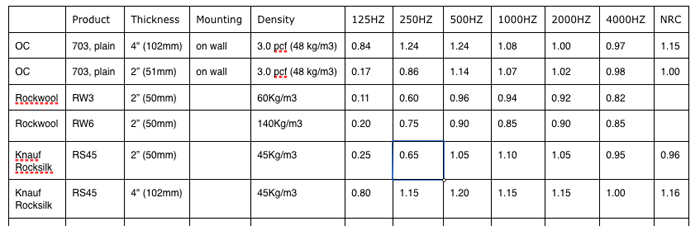
Thanks for the quick reply Stuart. I've managed to find a few other options with a lot of looking around. We don't seem to have too much choice here in the UK. However it looks like the 4" RS45 might be a good option, what do you think?
Insulation Coeficents.png
Looks like the Knauf Rocksilk RS45 is the best stuff: very similar to 703. Should work very well. - Stuart -
Soundman2020 wrote:
Looks like the Knauf Rocksilk RS45 is the best stuff: very similar to 703. Should work very well.
Thanks Stuart. Should I use that for all of it. Cloud, walls and Superchunks?
Yup! :) If that's the best stuff you have access to, then that is what you should use. Theoretically, you could test the acoustic response of your room (with REW), and try to figure out what frequency ranges are causing the most problems, then choose specif products that have the right characteristics, and put them in the right location for each problem, as needed... but in reality, there won't be a huge difference if you just use the same product for everything. You only need to do the analysis thing if you are a perfectionist, and want to tweak every last microbel and millihertz! - Stuart -
Soundman2020 wrote:
You only need to do the analysis thing if you are a perfectionist, and want to tweak every last microbel and millihertz!
Well I am a perfectionist :) but with this room I don't think it's worth it Thanks Stuart, just got to work how much insulation i'll need now
Hi Stuart, i'm just look at the construction of my cloud and looking back through the posts i'm wondering why we went for 2" of insulation above and the hard back and 2" below the hard back. Rather than just 4" below the hard back. Is it better to do 2" above and below, or would it be better to just to do 4" below? Thanks
Is it better to do 2" above and below, or would it be better to just to do 4" below?
More is better! :) If you can fit in 4" below, then go for it, but still put the 2" on top: That's a nice large area up there, in a useful place, so adding absorption up there helps. - Stuart -
Thanks Stuart that's great One other questions. You said to use thinner plastic for the the ceiling and cloud than the superchunks. Will 3mil thick be thin enough? Thanks
I would go even thinner than that. You can buy a very thin plastic, more like a film really, that painter's use to protect furniture and things while they are painting. It's very thin (less than 1 mil, I think), and not too strong, but is ideal for this. The purpose is just to stop the fibers falling out over time (and messing up your equipment) but without affecting the acoustics too much. You should be able to find that stuff in the paint section of your Home Depot. - Stuart -
Ok thanks. I'll keep looking, really struggling to find that kind of thing here in the UK at the moment. I'll keep looking though and see what i can find
Hi, Just found this . Does that look more like it?
Looks like it should work! As long as it will stand up over time without degrading, then that's all you really need. It needs to be thin so that it does not reflect high frequencies too much, and it needs to stay in good shape to keep the fibers in place, but apart from that pretty much anything should work (as long as it does not release toxic vapors or some such!). - Stuart -
I just received all the materials over the weekend so i'm now ready to start my build. I'm going to make the cloud first so that I can work out how much it'll weigh and therefore what hooks to get etc. I've weighed the two pieces of mdf and plywood together and they weigh just under 50kg. So I would think that with the framing and chains/wire they wood weigh about 60kg or so (I'll weigh the whole lot once I've built it). Do you think 8 of these (1 on each corner and 4 on the ceiling) will be strong enough to hold the weight of the cloud? Thanks
Soundman2020 wrote:
build the room first, test it with zero treatment, then put in the basic treatment and test again ("basic" meaning bass traps, first reflection points, and cloud). Based on the results of that, you can see what has improved, what has gotten worse, and what issues you need to address. Then you can decide on how to use the slot walls.
Hi Stuart, I've finished making all the framing for my studio now. Just going to start putting in the basic treatment now. This may sound stupid, but where exactly are my first reflection points in my room?
Those are the points where the sound emitted by the speakers bounces off a surface and gets directly to your ears. Usually on the side walls and on the ceiling above the desk, and also possibly the front wall. There's an easy way to find them, known as the "mirror trick". You need an assistant and a mirror: Set up your speakers and chair in the exact positions they will be when the room is finished, and get your assistant to hold up the mirror against the walls and move it around all over. Any place you can see either of the speakers reflected in the mirror, is a first reflection point. It needs treatment. - Stuart -
Hi Stuart, I've finished my studio now and done another REW test. I'll also probably upload some photos in a bit Could you have a look at the REW file and let me know what you think. You can download the file from here Thanks
I'm very confused by that latest REW file: The "soundcard calibration" curve is unreal! Unbelievable. And the SPL curves are nothing at all like the ones you posted before. Something went wrong, some place. This is the original "Empty Room" graph, from back in November:
Image not preserved: alierrett-original_er.jpg
And this is the "empty room" graph from the new test:
Image not preserved: alierrett-now-er.jpg
Here's your original calibration curve:
Image not preserved: alierrett-original-cal-curve.jpg
And here's how it looks in the new file:
Image not preserved: alierrett-now-cal-curve.jpg
If that really is your calibration curve, then there is something drastically wrong with your DAW: You need to get that fixed first, then repeat the tests, since the data just doesn't look valid at all. - Stuart -
Oh dear that's not good. Ok, I used a different interface this time which is why it's different to the tests i did the first time, which is why I redid all the tests. How will I redo the tests? I can't exactly take the treatment down again.
Fortunately, I still have the original REW file of the untreated room, with valid data, so all you really need to do is to re-do the final test using an interface that works. Then I can compare the two. Do you still have the interface you used originally? If so, then use that: it was working fine, pretty accurate, and gave good, valid data. - Stuart -
Soundman2020 wrote:
Do you still have the interface you used originally? If so, then use that: it was working fine, pretty accurate, and gave good, valid data.
I don't unfortunately, I was borrowing it from a friend and don't have access to it now. I bought one that was exactly the same but it's broken after only the second use I'll try and see if I can borrow the same one or maybe buy a new one
Hi, I had exactly the same problem with my Motu Audio-Express... the same calibration curve I SOLVED IT by: -turning off the 48v phantom power -connecting the "Line Out 4" to "Line In 4" -in the REW "Preferences", I lefted the "Input Device" and the "Output Device" at "Analog 1-2". I hope I helped you John
That's interesting, i'll have a try and see if that solves it. Surely fixing the calibration curve won't help with any of the old tests though?
alierrett wrote:
Surely fixing the calibration curve won't help with any of the old tests though?
In my opinion the safest way is to do a new calibration to your new sound card and new measurements to your room as it is now, in order to understand the acoustic issues you need to take care of. I follow your effort and I wish you the best results! - John -