Hi, my name is Alastair Errett and i’m a session drummer based in Derbyshire in the UK. I have a bedroom in my house on the second floor that I turned into a studio last year so I could record sessions from my house. I consulted quite a few people on the design of the room and researched it a lot before setting out. Unfortunately having done what people suggested to me elsewhere the room still doesn’t sound very good. I came across the forum a few days ago and having had a good look around you guys seem to be very knowledgeable and so I figured I would ask for some help. As far as budget goes i’m happy to spend up to £400 or so to get it sounding good. However I could be persuaded to raise that a little more if you think it would help. After all there is no point in spending money on gear if the room sounds awful.
The purpose of the room is to be able to get the best drum sound I possibly can to enable me to record from home. So I would like to get the best acoustic sounding space I possibly can. Sound Isolation is not an issue as I live in the middle of nowhere and do not have any neighbours to worry about. I’m just trying to alter the acoustics of the room
Room Details
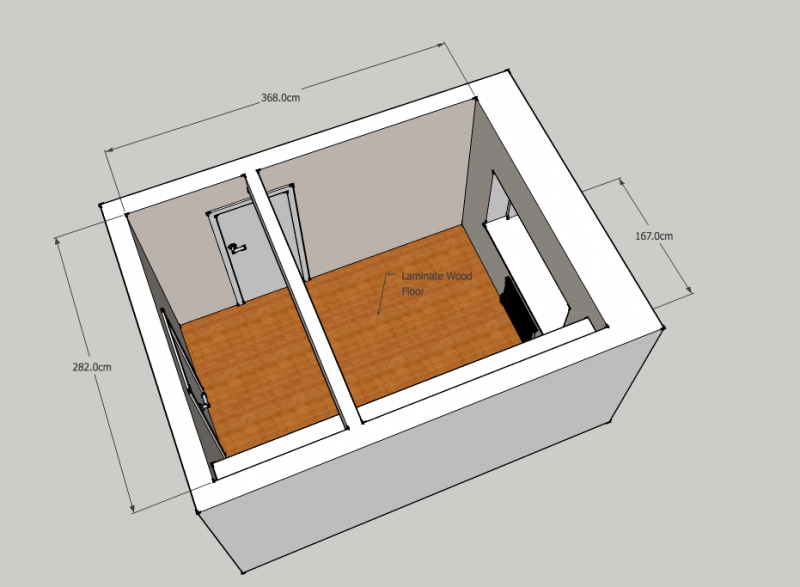
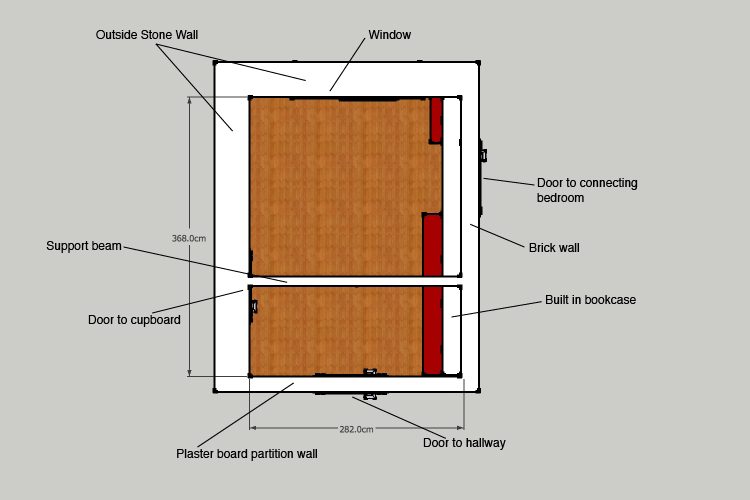
The room is 3.68m(L) x 2.82m(W) x 2.45m (H)
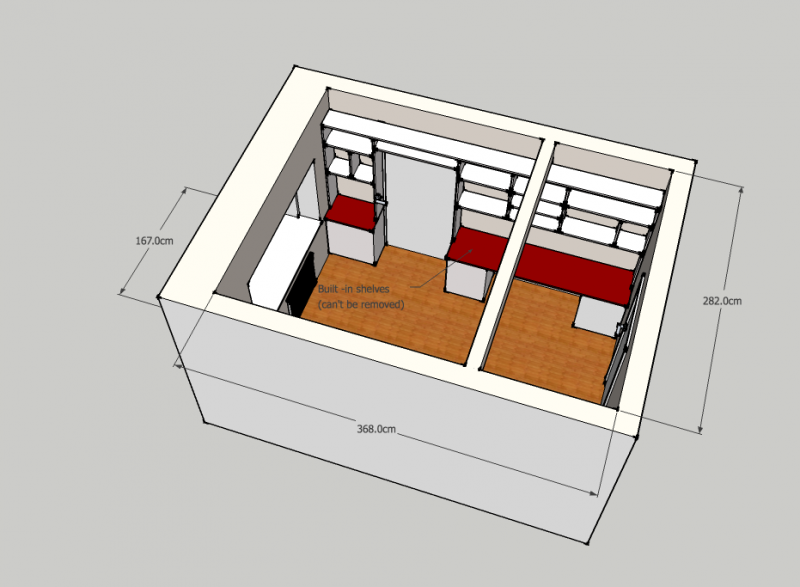
Two of the walls are stone one is a plaster partition wall and the other is a brick wall. These are labelled on the images below. The ceiling is again plaster board over the ceiling joists and the floor is a wood laminate floor is 8mm thick with a 6mm fibreboard underlay on top of the floor boards. The large inside wall is covered in a built in bookcase which I cannot remove. I could fill the alcoves with insulation of anything that might help if needed but I cannot remove it unfortunately or alter it in anyway
I’ve attached images below to help you see the layout of the room.
Following advice I had got from people I treated the whole ceiling with 4 inches of earthwool RS60 and then covered with fabric panels. I also made 8 inch bass traps to cover two corners of the room (I can’t cover at the corners as there is a bookcase in the way). These changes have improved the sound of the room a little but not made a massive difference.
I currently have big db boosts in the mid ranges, particularly between 500 and 600Hz. This makes the snare drum ring really offensive and means I have to cut loads out of the mid range to even get a bearable sound or extremely dampen the drum to make it very dead sounding. Neither of which I really want to do, so if I can solve this by altering the acoustics of the room that would be great
Questions
I’m assuming the main issue is that I haven’t treated the walls at all so the reflections are probably coming mostly from the walls.
There is a large window at the edge of the room. Is this a problem acoustically?
I realise that this room is tiny and that it’s extremely difficult to get a decent sound in a room of his size, but is there anything I can do to at least flatten the response of the room?
Is there anyway of me getting a frequency analysis of the room to help you guys out?
Let me know if you need anymore information and thanks so much for your help
Studioabove.pngStudioshelves.png
Image not preserved: Studiowindow.png
Studio Without Treatment-01.jpg
File not preserved: Studio Without Acoustic Treatment.skp
Well, here's my first idea (not always the best). :roll:
First of all, forgive my use of imperial measurements, but it's just what I'm used to. Whatever the equivalent product is in metric will do you fine, even if it differs a little in length or width. For densities, though, use similar.
You actually have a decent room proportion going on, with reasonable modal distribution. That's a good start.
But it's not the "reflections from the walls" that are your biggest problem -- it's the bass response, which is always extremely distorted in smaller rooms.
I don't think the rockwool on the ceiling (or your 8" traps) is doing you much good -- it's not dense enough, and in the case of the ceiling, it has no air-gap behind it. Instead, use Owens-Corning 703 or equivelant fiberglass (3lbs/ft3--what's the conversion?) wrap it in cloth and mount it in a 1x lumber wood frame with at least a couple inches of air-gap behind the back of the fiberglass. The more air gap, the lower the bass absorber will go in Hertz (as well as height!). We want the former and not the latter. So as much as you can spare up to 7.5" would make sense to me. I wouldn't do more than that because you want to walk around comfortably without ducking! Additionally, that'll take care of the quick high-end reflections down from the ceiling just as well as the rockwool was, while being much more broadband, and getting to the lows that distort your room response the most.
The bookshelves might be another good candidate for 703 panel fittings--use the cubbies and shelves as pre-made frames--though those boxes are gonna be tuned to particular frequencies (bad), and they'll be more or less subdivisions of each other (also bad), so I'd fill them with rockwool that's 50 kg/m^3 (even the stuff from your ceiling if it's that density!) in order to damp that resonance as much as you can. Then close off each cabinet with pieces of the rigid fiberglass cut to fit across the surface (after being wrapped in cloth). Do the same with the space under each desk where your feet would go.
Do one of the wall with the door too in the air-gap fiberglass panelling I recommended for the ceiling. Make sure to plan properly so the door can still swing open!
Then you'll have both a decent amount of bass trapping and three absorptive boundaries and corners facing three "live" boundaries. That would probably make for a decent amount of reflectivity in the mid- and high-end to sound reasonably live, but would prevent rays from bouncing back-and-forth more than once. and causing too much blurring of the image.
The panelling on the ceiling and wall should go all the way to the corners, too, to involve as much of the other boundaries as possible.
If you want to go extra fancy, you make more 703 panels that straddle the ceiling and wall corners the way your rockwool boxes do--but faced with a layer of the heavier, semi-rigid fiberglass instead of low-density rockwool stuff.
The paneling on the ceiling would also be a decent way to mount lighting, though it might be getting too close to head-height to be comfortable.
You also probably want to orient the drumset along the long axis of the room. However, the overheads might sound asymmetrical... in which case, you'd probably have to build a panel on the "left" wall (facing the bookshelves), and of decent depth, to balance out the image.
Regarding the glass, don't sweat it yet. You may want to build a standing gobo-type absorber in the future to set in front of the first reflection point on the window wall when you're recording, remove to look outside when you're just practicing... but it's not low hanging fruit, yet. The other stuff is more important, and easier.
Anyway, that's my unscientific, unthought-out analysis. Others?
Hi alierrett, and welcome! :)
I'm wondering what the actual problem is: you mention a ringing around 500 to 600 Hz, so clearly this is not a modal issue: too high for that. Some type of flutter echo, maybe? Or maybe something in the room has natural resonance around that area?
It's hard to say what might be going on without actually hearing it, so we need something objective to go on.
What I'd suggest you do first, is to download REW (Room EQ Wizard) from Home Theater Shack, and use that to do an analysis of your room, then post the data file here so we can play with it and see if we can figure out what the real issue(s) is(are).
Also, maybe you could post a brief sample of you playing the drums. Set up a single high quality mic in that room (a U47 or C414 if you have one) at maybe six feet or so away from the drum kit, not close to the walls, to get a decent amount of room sound. Record a couple of minutes of different styles, just a few seconds of each.
- Stuart -
Oh yeah, Alastair -- I defer to any recommendations Stuart makes over mine. He's helped me with two designs already and knows far more than I do. But I'll still try my best.
Stuart -- do you think that 500 Hz stuff could be coming from the bookshelves? Wavelength would be 59-69cm, which many of those shelves have as one dimension...
R.
Sorry about that, Reed! I didn't see your post before I replied: I had the tab open for many hours before getting back to it... :oops:
Stuart -- do you think that 500 Hz stuff could be coming from the bookshelves? Wavelength would be 59-69cm, which many of those shelves have as one dimension...
Very possible. Those shelves are probably doing multiple things at once, unpredictably, and your idea of just filling them with absorption might be the best way to go. There's probably all sorts of strange diffraction, diffusion, and resonance things going on there. It would be very interesting to see the REW analysis of that room, since I suspect that 500 Hz is probably not the only thing happening in there, by any means! :)
- Stuart -
Hi guys thanks for you help so far, just need answers to a couple of questions.
I don't have a large diaphragm condenser or know anyone that I could borrow one off. However I have a Shure Sm81 and Two SE Electronics SE3's. Or I can hire a pair of C414's for £50. Would it be better to hire the AKG's or use one of the ones i already have?
I also need a SPL meter. Could you let me know which of these would be best please?
Radioshack SPL MeterMercury 600.652 SPL Meter
Thanks
The SM81 is probably fine. It has pretty flat response. It's cardioid (not omni, which is what you really need), but the idea is to just get an idea of what the room sounds like, so it should be plenty good enough for that.
Either of those meters is fine. The Mercury looks pretty good, and has all the features you need: both A and C weighting, as well as slow and fast response. Getting good reviews as well. I'd go for that one, I think.
- Stuart -
Looking forward to hearing a sample, Alastair. Let us know where in the room the mic was positioned, pointed, and where the drums were in the room, so we can "imagine" our way into your room...
Ok thanks guys. I'll order that SPL Meter and then do a take of the drum sound and get the REW Analysis too. Will probably be a few days before I can get this done though
Hi Guys, the Mercury SPL meter I ordered arrived today but it doesn't have a line output. Can I do the tests without that or do I need to send it back and get a different one?
Sorry this is taking so long. I'm finding this bit a little confusing :)
Hi Alastair-
You shouldn't need a line out on your SPL Meter. The SM81 will be your weapon of choice for REW. The SPL meter is a self-contained unit.
What are you planning on using the meter for? You never really said in your post.
R.
In the help file I downloaded from the REW website it said I needed a SPL Meter.
That's only if you want to calibrate REW so that it gives accurate absolute level readings. You do not need to do that if you just want to analyze the acoustics of the room, since you only need relative level readings, not absolute ones.
Some meters also do have a direct out for the mic, which is good for use as a measurement mic in some applications. But that does not apply to you.
So like Reed said, you can just use your SM81 connected directly as the input channel to REW. That's all you need.
The sound level meter is very useful for measuring and calibrating your room, but you don't need it for the REW analysis.
- Stuart -
Ah ok, Thanks for clearing that up. I was a little confused :) I'll probably send that back then since I won't need it.
Should have the REW analysis for you tomorrow morning
I'll probably send that back then since I won't need it.
Ummmmm.... I think you missed the point! You will still need it! Just not for calibrating REW. You will need it for several things during your build, and for calibrating your system once the build is complete, and for checking the calibration and levels occasionally afterwards. And probably for other things, too. I use mine all the time, and would be lost without them. The human brain has no way of determining absolute levels, since our "point of reference" adapts to the circumstances. So your meter is the only method you have of determining various things you need to know about your studio, mics, instruments, sessions, etc.
- Stuart -
Haha, ok fair enough, I'll keep hold of it then. Just doing the acoustic analysis now so i'll upload that once it's done
Update: Tried getting an analysis of my room today, but after hours of trying it turns out you can't use firewire interfaces with REW on OS X 10.5 or later. So i'll have to borrow a USB interface off a friend and do the test next week sometime
Unfortunately, I'm a Mac user as well, and never had much luck with REW. I bought a very expensive program, SpectraFoo, but because of it's price-tag I don't think it's appropriate for you. However, with REW, try just using your internal sound processing system instead of your outboard unit and you should be fine (headphone port and mic "in"). Don't obsess over the possible colorations of your onboard converters and whatnot; I know the REW manual makes a big deal out of it, but any aberrations in your testing equipment pale in comparison with room coloration, which commonly consists of ≈30 dB swings across the frequency spectrum! :twisted:
Stuart, or others: Any other ideas for us Mac users?
Take special interest and care with your measurements below 500 Hz. That's what's most important.
R.
Stuart, or others: Any other ideas for us Mac users?
Sell it and buy a REAL computer? :shock::!::lol::lol::roll::yahoo::shot: (OK, sorry: that was a cheap shot! )
Seriously, I'm not too clued up on Mac software, since I use mostly Linux and PC systems. Can't help you much there. Sorry.
try just using your internal sound processing system instead of your outboard unit and you should be fine
That's probably OK, as long as you always use the same system for ALL your measurements, both now and in the future. I think I've said this before; it's not so much the absolute values you are looking for with the treatment analysis, but rather the changes that you achieve with each round of treatment: For isolation testing, you most definitely need something that accurately measured objective, absolute values, but for treatment measurement, you can probably get by on something that isn't calibrated to provide absolute readings. It's the relative changes that are important, so you can see what is working and what isn't at each stage.
The problem comes if you change your system: If you ever switch from the cheap two-dollar Mac pre-amp and five-dollar Mac digitizer circuit, to a professional XX-hundred dollar pre-amp and thousand dollar interface, then you can no longer use ANY of the previous readings for comparison, since you have made a major change in the signal chain. I have no idea what claims Apple makes for the response curves of their "mic in" connector, but I'm pretty sure that it doesn't get very close to what even a semi-decent piece of pro equipment offers! :)
One thing you could do, is to test it: Send some full-spectrum pink noise out of a good pro interface, into the mic connector on the Mac, and see what you get. Might be interesting to see just how good/bad it is. I suspect that it might be fine in the mid range, and not so fine on the lows and highs.
But anyway, the point is that as long as you don't change your system while the studio is being built, and always use it in the exact same way, with the exact same software settings, then it might be OK.
Take special interest and care with your measurements below 500 Hz. That's what's most important.
Very true! And likely the area where the Mac interface is least accurate.
- Stuart -
That seems to be the result of the sound card calibration process, showing how your sound card itself is responding through a loop-back cable. It seems to be accurate to withing 1/2 dB from 200 Hz to 20 KHz, and even down at 30 Hz the response is only 3dB down. Looks good enough to me. Time to measure your room response now!
- Stuart -
I gotta say -- having not tried REW since about 2003 or so, I'm impressed how much REW has improved in terms of user interface! Looks MUCH more user-friendly!!!
Apologies for talking crap.
Looking forward to the room reading! Plus don't forget to make us a sample recording of drums (no compression or EQ of course).
Here you go, this is the REW analysis of my room. Let me know if you need any more information
You can get the REW file from here
I will record and upload a sample of the drums tomorrow once I have set them back up
Thanks