Real stones.but rather thin. They are often used in buildings, simulating real stones (well they are, but not thick)
Puting them directly on the drywall, will make the exposed studs look weird becausetheywill not be at the same level..the stud will be, well, 4" above
Might be a dumb suggestion, but maybe you could do the biggest "beefing up" job ever: adding about six additional layers of drywall inserted between the studs will get you a surface flush with the front face of the studs, then you can stick your rocks to that.
It will take some more money and time, but it should work, as long as the floor can handle the load...
You'll also have some amazing isolation on that wall: Nine layers of drywall, plus the rocks. Wow! Mass law rules!!!! :)
- Stuart -
(PS. In my defense: it's late, it's been a tough day, I'm tired, and I sometimes make dumb suggestions under those conditions... :) But you never know: it might just work! )
I think exposed timber frame between a lower profile stone panel will look good.
Just sand and varnish the frames 1st.
A little bit like a log and stone cabin :mrgreen:
Stu.
Hmmmm.
I already know my partner's answer "i rather have the 3rd leaf" :lol:
Actually, how bad could it be?
What If I put stones leaving a gap , like making a slot "stone" resonator? That will look cool as well. maybe even puting a light inside and all the gaps will "glow"
What about that? I guess it will have the same effect than a normal inside out slot wall....
Huh??
What about that? I guess it will have the same effect than a normal inside out slot wall....
Unfortunately, it won't. The dimensions of the slots and slats are critical. Each slot is basically a tuned Helmholtz resonator, so if you change the thickness of the slat by adding a sliced stone to the front of it, you'd need to also adjust the gap size and/or the depth of the air space behind to compensate, and get it tuned back to the same frequency.
But... stones are irregular and rough, not smooth and sharp edged like wood slats. I doubt that you could get the air slug to vibrate very well in an irregular shaped hole with rough edges, so I don't think they'd work as resonators at all, or at best, very inefficiently.
I think you'd just end up with a reflective wall with holes in it, but not a functional slot resonator.
Maybe André or Eric or one of the other acoustic experts can comment on that.
- Stuart -
Ok you won!
We are making big holes on the existing insideout wall, and then put new drywall (2 5/8" layers) on top of the studs.. then.. stones finally!!!
Xspace, you think we should put a thin metal grid before the stones, on top of the drywall ? or the mortar should stick to the drywall good enough?
we'll gain 4" of airspace plus a true 2 leaf msm system
cheers
Xspace, you think we should put a thin metal grid before the stones, on top of the drywall ? or the mortar should stick to the drywall good enough?
I think your stone installer should be able to handle this. Only thing I would add is that you want to make certain that the mortar does not come into direct contact with the sheetrock/gypsum. This can, due to the water in the product, saturate and deteriorate the panels and may change the panels ability to support the stone for any length of time. Especially with large portions of the panel removed.
Basically installing a moisture barrier before you install the grout/mortar base.
You are talking to the stone installer :)
OK, so basically, I should put a plastic sheet before the metal grid !
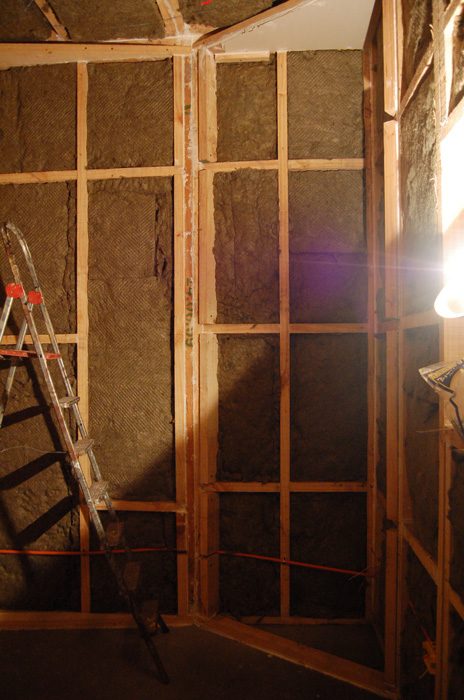
I dont have pictures, but we removed the inside out drywall (most of it) and installed two brand new sheets of drywall in front, in other words, like stuart mentioned, we converted it from inside out to "normal" (caulking when needed)
I'm wondering if maybe a fiber-cement backer-board might be a good idea. The kind they sell for bathrooms, grooved to give it a better base for tiles. Not too expensive, easy to mount, adds more mass to the wall, etc. That should give the stone a good firm base, and it is designed to take adhesive, moisture, etc. Might be worth thinking about. In addition to the plastic, of course. First the plastic, then the backer board, then the stone).
- Stuart -
Thanks for the suggestions guys
I read the paper you posted and the only thing i dont get is the "building paper", what is it like? so ican find something similar. is it for moisture only? In that case, why wont the plastic do that job as well?
Plastic will deteriorate.
If you guys would move over here where I live I can tell you what we are looking for :)
It's a tar saturated heavy paper. Whatever product a real tile layer might use to establish a barrier between the two , that is what you should use.
If you do not know anything about installing a brick facade then you really need to talk to someone that knows. You already understand how complicated things can be and how easy it is to screw it up when you do not pay attention.
Get someone local and talk to them, they know the words I cannot translate :)
I'm wondering if maybe a fiber-cement backer-board might be a good idea.
Durarock = fiber cement backer board.
Here comes the issue. You have to cut holes in it, just like you did in the sheetrock, right?
I mean , yes, it's the product to use...but it RE-establishes the barrier you cut out of the wall when he cut holes in the THREE layers of sheet rock? Not as thick, but it leans towards the same issue?
No. I didn't. I did cut holes on the "inside out" drywall... and i converted that wall to a normal stud wall, by puting new drywall on top of the studs like anyone would do
Guys,
I found out a special "glue" designed for tiles on drywall. it replaces mortar and whatever u put before. in other words. you directly glue the stones/tiles/ceramic on the drywall
Guys,
I found out a special "glue" designed for tiles on drywall. it replaces mortar and whatever u put before. in other words. you directly glue the stones/tiles/ceramic on the drywall
It can be useful for others too that you give a name or link or some more in-depth explanation.
:mrgreen: Suppose that people start answering: Hey I found/know a solution to your problem .... (nothing further)
That looks like what we call "kleefcement" (Dutch), literally translated: "glue cement".
This material is also used to fix gypsum boards directly to brick walls (with from these big dots of that glue allowing to line them up on, and flatten old and damaged brick walls).
Here in Belgium we standard build houses with bricks (there's a saying here: "every Belgian is born with a brick in his stumach")
In a worst case situation, there are also gypsum boards for bad-rooms (water/moisture resistant) on which gluing tiles is standard practice and there are other panels as well which can resist water and moisture better than standard gypsum boards.
Update!
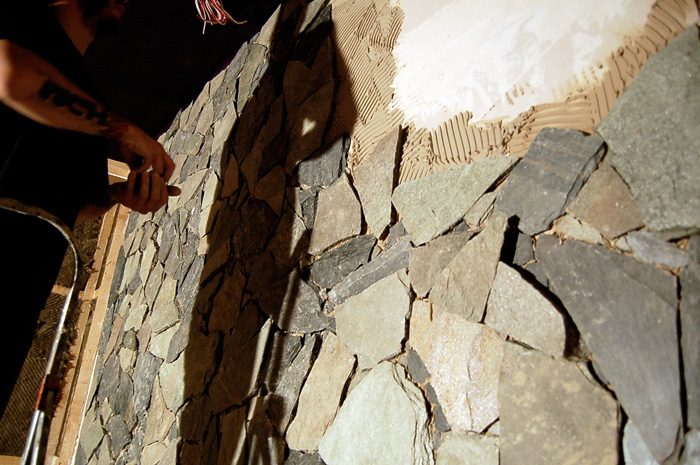
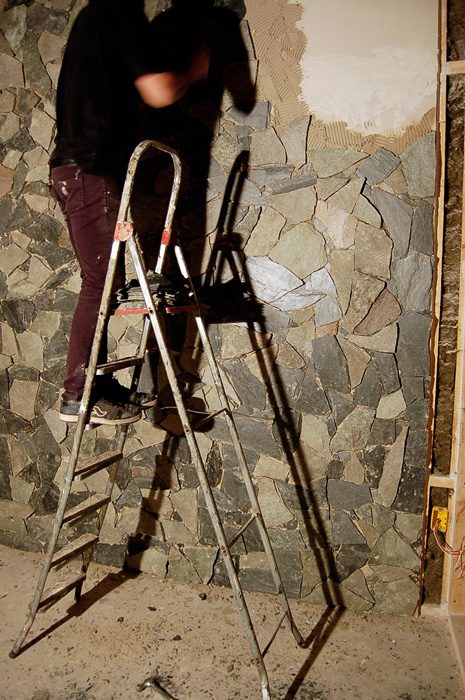
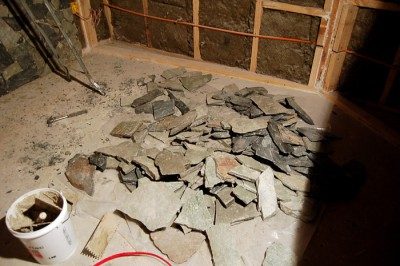
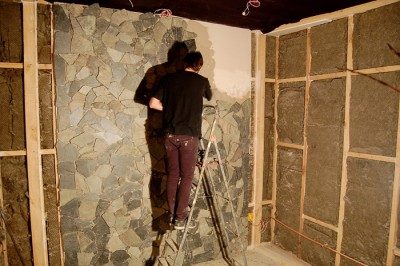
Stones are now on the wall!!!
Finally.
It was a PITA to install. because we used real stones, cut into irregular sizes, so triying to lay them on the wall in a aesthetic way. was very, very difficul
But it looks great... also, we are going to stain the stones and they look AMAZING! one easy way to see how they will end looking is to poor water on them . they get a nice green color
Cheers