Homosote is a soft fiberboard. It's the board they use for notice boards and often comes with one side painted white so you can mount it on the wall and stick notices on it with drawing pins
-------------
(Spam signature deleted by moderator. And the poster will also be deleted if he keeps on trying these stupid tricks)
John, how does a hanger like the one you posted in sketchup file at the beginning of this thread compare to a trap panel or your standard broadband rear wall absorber when being used as a rear wall absorber?
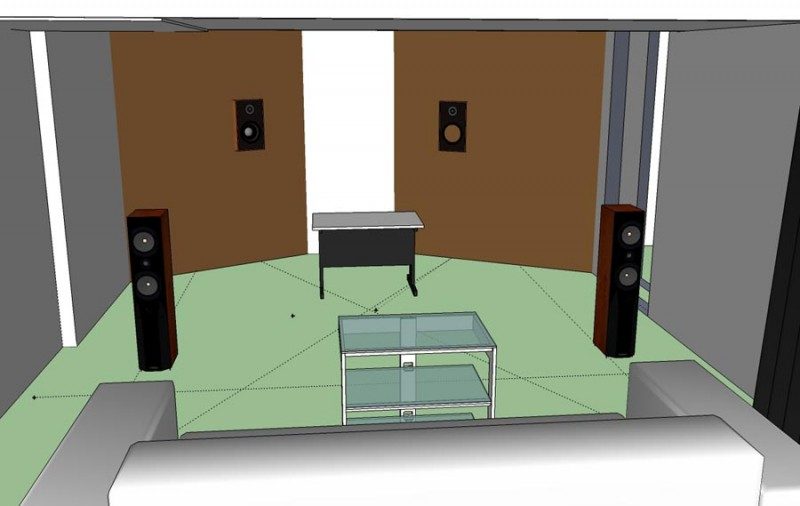
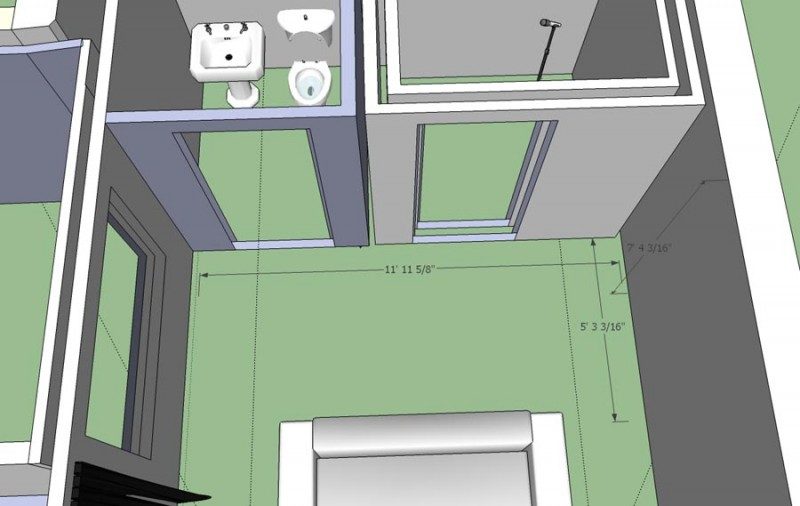
I am trying to decide how to treat the rear of my control room. As you can see, the bathroom and iso booth are at the rear. SO, I could put panels up ON the doors and wall spaces, but I am liking the more elegant option of hanging something in between the couch and the rear wall/bathroom&closet doors. Would it be best to build a hanger like the one you posted in this thread, build trap panels, or hang broadband absorbers back there?
Just a couple of notes if you need them: My control room will be about 22.5 feet from the front to the rear wall/bathroom&closet doors. I am planning on doing corner bass traps as well, in the rear, as well as in the front until I can soffit mount my monitors. Also, I might do a soft ceiling, but if not, it will be finished drywall with ceiling clouds. Also, I will probably be using the couch area as a mastering location, so my head would be pretty close to whatever is behind it.
Studio design11- couch perspective.jpgStudio design11- back of control room.jpg
You are showing a THREE LEAF SYSTEM for your iso booth! :!::shock: Why? Are you aware of how that will make your isolation WORSE for low frequencies? I would suggest that you reconsider that, and make it into a two-leaf system.
- Stuart -
You are showing a THREE LEAF SYSTEM for your iso booth! :!::shock: Why? Are you aware of how that will make your isolation WORSE for low frequencies? I would suggest that you reconsider that, and make it into a two-leaf system.
oops!! your right! I've been through so many drafts of designs, I didn't even realize I drew up too many walls on this one! Thanks Stuart! ...actually, what if I do 7 leafs? :o
btw, I addressed my question to John, but yours as well as anyone else's wisdom is more than welcome!!
I addressed my question to John, but yours as well as anyone else's wisdom is more than welcome!!
When it comes to hangers, John's the man! He's the guy who understands them best, and there isn't much along the line of theory or research about them to go on. But they do work!
- Stuart -
Oh I'm sure they work great.. I know that John has mentioned them specifically for use as corner absorbers and ceiling treatment. And you can see how they are implemented inside of false wall cavities. So I'm just wondering if they work equally well as rear wall absorbers when actually used as a rear wall absorber and if so, why it would be worth it to build one of those as opposed to a regular broadband absorber when they would cost way more to build and take up more depth space.
There's your answer! :) Depth of absorption on the rear wall is a good thing, always. Some of John's designs have a couple of feet at the rear, and he has mentioned seeing other studios with absorption going back many feet... The deeper you have it, the better, in general. A 4" layer of 703 spaced out a couple of inches from the wall with superchunks in the corners is not bad, but there's no way that can compete with 24" of hangers across the entire wall.... :)
- Stuart -
I hear ya.. So are you saying that because the Hanger is a deeper design, that trying to match its depth just with insulation in a regular broadband absorber that is as thick, would end up being more expensive because of the amount of insulation required, whereas the Hangers take advantage of the depth by being angled, and therfore, not as much actual material is necessary? wow that was a long run-on sentence.
One more great thread that makes me want to try the hangers technique ;-)
(By the way, I guess those hangers' inner panels are called "Pavatex" in Switzerland (any other Swiss around who could confirm?).)
I was thinking of using thin (3-4mm) MDF for mine - I saw some today that is normally used on door backs here in Turkey. After reading the thread I can't see how it could be worse than 6/12mm OSB...?
Hi all - just a quick question re acoustic hanger installation. John says "hangers should be ... spaced 6 to 8 inches apart". Is that measured from center to center of the panels, or from edge to edge ? With a panel that is 2.5" thick, that difference will affect how many panels I can hang in my space.
I would think that more panels increases the absorption/diffusion effect, so I want to put as many panels into the space as I can, but I don't want to cross any line where they are too close together. Does anyone have a recommendation based on their experience ? 6" from center to center leaves 3.5" of air gap between panels. Is that enough ?
Depends what part of the room you are talking about. If you are talking about hangers under speaker soffits, then hang them close so you can get plenty in, with just a small gap between (surface to surface, maybe an inch). The idea is that they hang freely and do not touch each other, or anything else. But if you are talking about hangers across the rear wall or above a fabric ceiling, then that's a bit different: AFAIK, John recommends starting with one hanger at the mid point of the room, then dividing the gap distance in two and hanging another one there, then divide by two again and hang more there, etc, until you can't get any more in without them touching. The theory is that you are placing them at the peak half-wave point, then quarter wave point, then eighth-wave, etc.
- Stuart -
Stuart -- thanks for the reply. I am in fact talking about hanging them across the back of the room. I had not come across the recommendation to start in the middle and divide the gap in half until no more will fit without touching. Interesting. But that sounds like it would potentially result in panels being pretty close together, closer than 6 to 8 inches. Maybe as my next step I should figure out what the spacing would be if I start in the middle and divide, but stop when I get to a center to center distance of approx 7 inches.
Does anyone else have input on this approach ?