Hi John,
Maybe I'm blind 8) but I can't find any information about your acoustic hangers...???
What dimensions are they and what kind if wood and wich kind of insulations(fibreglass or rockwool) etc.etc.
I was planning some in my new studio:
viewtopic.php?f=1&t=11766
I have enough space left and right on the back wall to place hangers but I'm not sure which dimension and how many? I need trapping from 60 till approx 260 hertz
Can you help me John??
Thanks in advance and regards from Holland,
Mic
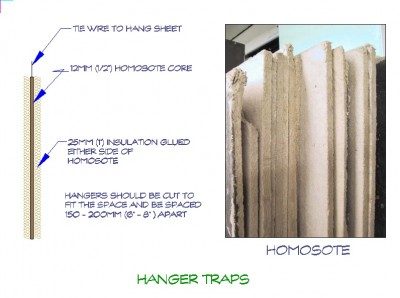
Homosote is a soft fiberboard. It's the board they use for notice boards and often comes with one side painted white so you can mount it on the wall and stick notices on it with drawing pins. :)
and yes - you can use rockwool or whatever you've got ;)
i still don`t understand the way hangers work.
i another forum i read something about a variable impedance trap.
Is a hanger something like this?
how does it work, and how can you calculate it?
cheers
Mika
Many thanks John and Ro.
Ro: I just finished a floor with the green boards under it, these boards are only 100x50 cm, so to small. And I seen to many of them now, still have green dots in my eyes. :mrgreen:
I gonna use soft board instead(Dutch = zachtboard)I'll hope that's good too.
Thanks John and Ro.
I made the hangers and now waiting for the 2.5 cm Rockwool.
I replaced the link in the start of this post with the good one..... :?
i still don`t understand the way hangers work.
i another forum i read something about a variable impedance trap.
Is a hanger something like this?
how does it work, and how can you calculate it?
cheers
Mika
I just want to bring it up
Does anyone have technical infos about how a basshanger work?
Is it just a porous absorber with high destiny?
Why hanging? And when hanging what effekt would be used for absorption?
Why wrap it with insulation? damping vibrations?
Or does anyone know a book about these topic?
Please help me to bring light into the dark.
cheers
Mika
Mika - I know of no reports or articles explaining how the hangers work.
The only explanation I know of is that each hanger has it's own resonant frequency and when it's note is formed in the room it resonates in sympathy and the insulation dampens the resonance. How true that is I have no idea :)
Hi john
Thanks for your reply.
So when its a resonating pannel, it must be possible to use any kind of wood or other materials, not just soft fiberboard!?
In this case the kg/m² gives the resonantfreq ?
At the SAE Site is written, that big pannels are for low freq, and small for mid. freq. How can this be, when the same material, with the same kg/m² is used?
Another point is, that when we talk about resonance, it must be a tuned absorber. I can`t feel good with using a tuned absorber, when i don`t know the tunig freq. :roll:
I see you used this hangers often, so do you have any testdata about it?
I will not belive that YOU just plan the bassmangement in a room with more luck than proper calculations :shock:
So please share your secrets in this subject.
cheers
Mika
OK Thanks. :)
When there is no testdata, i will think about a way to make them by myself in a free time.
Anyobody here with sugestions how to test it, to get the best data as possible?
I think this will be intresting for alot of people :wink:
cheers
Mika
I seem to recall similar comments from Eric Desart on another forum, about there not being much research on hangers, and the little bit there is being inconclusive. If I recall correctly, the general consensus on that thread was: "Nobody has really done much science on them, but we all build them because they work and the room sounds good". Or something like that.
It just goes to show that acoustics is still partly about art and experience, even though there is also a lot of science about it.
So the mystery continues: Everyone agrees that they work, but nobody really knows much about how or why, in terms of solid numbers and solid science... And the stuff that IS known about them by folks like John, has been earned by years of hard work and real-life experience, so they keep most of what they know under wraps, for obvious reasons!
Maybe hangers would make a great subject from some smart student of acoustics, looking for a thesis subject...
- Stuart -
definitely Stuart, excellent research paper material.
I remember that thread with Eric - no one could actually say how they worked.
I mentioned watching oyster cages hanging in the bay and watching the wake from the boats wash into the cages and disappear. I suspect that's kinda how they work.
Now there's an idea! Oyster-cage acoustic bass traps! :):yahoo: The aesthetics might be a bit strange, though.... :shock:
Seriously, that sounds like a good explanation. I'd never really thought of it like that, but it makes sense. The energy is somehow dissipated and/or diffused, and/or maybe even diffracted by the hangers.
John, maybe this is a question that you don't want to answer (understandably!), so just ignore it if that's the case: but in your experience, does changing the orientation and separation of the hangers change the amount of absorption, or the peak frequency of absorption, or some other parameter? And if so, how? I mean, does increasing the spacing between hangers make them absorb better at lower frequencies, or higher, or no change? Do they absorb better when the are "face-on" to the incoming waves, diagonally across their path, or oriented "in-line" with the waves?
- Stuart -
Stuart - as I see it there are two ways to use them, thus mount them.
In the model I gave the corner hangers is the corner trap method where the sound goes into the corner and the hangers get bigger and more massive as you go into the corner and the sound has to to return the same way.
The other use is in a ceiling where I place them in the modal points - ie. one in the middle (1/2) then one in the 1/4, 1/8, 1/16 till you run out of room. Plus you may also be going in two directions at once for opposing walls.
Thanks John! That makes a lot of sense, and gives me a first "empirical" rule about hangers: If they work best at modal points, then they must be velocity-based, not pressure-based. Interesting! That certainly does shine a little light on an otherwise dark subject. It makes me think they must be acting something like wave-guides.
Much appreciated.
I'm going to have some free space up in the rear ceiling-wall corner of my room, and I'm thinking about hangers for there. Either hangers or a large horizontal superchunk: I haven't quite decided which.
- Stuart -
I like "cheaper"!!! :)
A quick question: Are hangers more (or less) effective in tri-corners (wall-wall-ceiling) than they would be in normal wall-wall corners? I guess they should get the normal extra 6dB boost (18 total), like any other tri-corner treatment, right? I'll have some nice deep spaces in my rear tri-corners, that would be ideal for hangers, I think.
- Stuart -
Yeah, I guess I wasn't to clear about that! I'm thinking out loud about my room, but not explaining my thoughts too well...
What I mean is this: Imagine a bunch of hangers that don't stretch all the way from the floor to the ceiling, and are only 50% of the room height. So if the room is 2m high, then let's say that the hangers are only 1 m high, for argument's sake.
Is it better to have that "bunch of hangers" located part way up the wall, away from the ceiling and floor? Or is it better to put it at the top of the corner, next to the ceiling?
I suspect that the best position would be up top, where I expect it would get the extra 6 dB boost in effectiveness due to having the ceiling there too.
The reason I ask is because of the HVAC ducting that I need to get into and out of my room: The only place I can bring it in is in the rear corners, which limits the size of the space where I can put hangers, and thus limits the maximum length of the hangers. But I can move the ducting up or down slightly, if the hangers would be more effective in one location than another.
I guess that still isn't very clear! Maybe I should just do a quick sketchup to explain it better, but that will have to wait. It's way past my bedtime, I still have work to do! :(
- Stuart -
oh - ok - I've always understood the bigger the hanger the lower the frequency. Tom Hidley would build a 35ft square room (so much for modes) and then add an inner shell (cloth covered most of it) with a 3 -4 ft space behind which he would fill with hangers of all sizes. Same for the ceiling. He was claiming flat response i.e. flat reverbtime @ .4sec down to 20hz.
check this out
Thanks John! That makes sense. OK, so I guess I'll see if I can re-figure how to make my hangers as large as possible, but a depth of 3-4 feet at the back would be nearly half the depth of my entire room! :shock: I really need to get a bigger house... I have maybe 4 inches to spare across the back wall, widening out to maybe 18" at the top (above head height). That's where my hangers will go, but I also have to have HVAC ducts in there...
I think I need to post an updated SketchUp model, so you can see where I am right now...
Tom Hidley was also the guy who pioneered concrete soffits, so I guess that makes him something of a role model for me! Concrete soffits and hangers.... hmmm... Now if only my room would end up sounding even half as good as one of his.... :)
- Stuart -