Hello guys,
I've spent several weeks researching on the best options to build my room within a room budget studio on my garage. I've read countless PDF's, word docs, forums, eBooks... you name it. But unfortunately I didn't find this forum before.
I'm in the middle of the building process. The garage is not connected to any proper housing, just some more garages side by side and everything is built on bricks, with the exception of the roof, which is just a thin layer of plastered concrete and some huge bims supporting the structure.
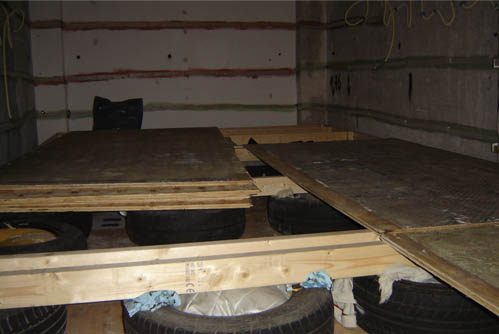
At this very moment the floating floor is built with 2x4 studs resting on tires filled up with clothes and old mattresses covered by two layers of 18mm plywood. All walls are covered with rockwool for extra insulation). Next would be building up the walls, using the 2x4 studs with plywood technique again.
I've read most threads regarding garages and room with in a room construction that have been posted in this forum (that's taken me quite some time) and noticed that literally everybody added rockwool between the studs prior to nailing the plywood.
I feel like the BIGGEST idiot that has ever posted here since I realize I didn't add any rockwool at all between the studs in the floor. It just didn't cross my mind at any moment. How could this have happened? Panic is taking over my whole nervous system.
The plywood is lying 30 cm. away from the concrete floor. This is quite an advantage in terms of spring diffusion vs mass considering most people don't lift their floors that high but I'm extremely worried about the absence of rockwool on my floor and wanted to know from you if I can leave it ike this or if I will have to remove every single one of the 450 screws I used.
Pictures attached.
Please let me know as soon as you can. It's very urgent.
Many thanks in advance. Your help is greatly appreciated.
Alex.
Hello fellow Dutchman :)
[dutch]Ik zou zeggen, trek de hele zooi er uit en begin met een goed plan.[/dutch]
Right.
coming here and logging in was step one in creating a GOOD studio, even on a tight budget ;)
Have you come across the "float or not" topic yet? (it's even a sticky). Start there.....
[dutch]Jeemig, dat schept een "band"[/dutch]
(remark about the tires; doesn't translate into English)
Hey Alex,
Sorry to hear about your tiny little absentmindedness, but I'd have to go with Ro's comment (in Dutch)... you're still relatively at the start of your project. And unscrewing the 450 screws is far less annoying than having to cope with a studio for years to come that doesn't suit your needs and/or ruins your recordings. I'd definately open up the floor again and get it sorted out properly.
Good luck / veel succes!
Thanks a million for replying so quick, guys. Really appreciated. You are absolutely right. Even when it can't stop me from felling like the biggest turd in the whole universe, the fact is that I should consider myself lucky for having figured this out not too late. It's just 400 screws, it can perfectly be done in two days and I'm gonna do it, no doubt about it. So forget my former question and let me ask you about the tires. I've noticed that the whole structure bounces quite a lot and if somebody walks, the vibration can be felt at every part of the floor. This makes me think the tires might not be such a good idea after all and I should replace them for something more consistent (since I'm gonna have to remove all the wood anyway... this would be a piece of cake). But I'm afraid they don't sell neoprene at any major handy store here in amsterdam (I mean Gamma or Praxis, for those living in Beatrix's kingdom) so I had two options in mind:
- The rubber carpets they use for putting underneath washing machines.
- The rubber tiles they use for gardens, to prevent certain things from getting in contact with water in the floor.
What should I use?
Please bare in mind that my budget is extremely limited: 2000 euros for the whole thing MAXIMUM.
Many thanks once more.
alex.
You could put wheels in the tires (kidding!)
If the sole purpose of the tires at present is to acoustically decouple the floor, why not use those Auralex neoprene u-boat things on your floor joists instead? It will get more sturdy that way and easier to work with, I guess. And the company I pointed out to you in the hyperlink is right around your corner in the Dutch capital. But if you need a much raised and acoustically decoupled surface to work with, you could also consider them thick and heavy garden rubber tiles... several layers that is. Dunno 'bout the costs, but probably not very cheap.
Wow, Edo, you are truly quick. Thanks for that. I think the rubber tiles for garden purposes are quite a decent option as they are very thick and strong but I'm not sure about longevity. Has anybody already tried this option?
thanks
alex.
Alex,
I would advise to stop for a moment, breath and take a few days of reading this forum and Rod's book. Yes it's for sale at boll.com :)
a MUST HAVE.
Floating a floor, is that a good idea? If you read this forum, you should come up with the answer already.
You should, ATLEAST have a bit of knowledge and understanding on how to properly float a floor. It needs to spring, but not too much. etc.
The tires could work (can't really say), if the amount and dead (+live) load is right. It needs testing for sure. Tho I'd stick with more conventional and proven techniques. That is, IF you need to float ye floor (there's a pattern here...)
U-boats from Auralex are one thing, not necessarily a good thing. Again, if you read this forum you should know why or why not.
Trust me, THIS is the one resource you need in combination with Rod's book (btw Rod is an active member here so go ahead and make his day.. BUY the frigg'n book already :twisted: )
Veel succes!
Hi Ro,
Thanks for the advice once more. Any input is really appreciated. I've already stopped to get some more info before I carry on. But I cannot wait for long and spend several weeks investigating. I've read so many books already and they all have such different appeals to the same issues. I honestly find it very frustrating. I mean, what I love about audio technology and recording in particular is that, besides from the laws of physics, there is no CERTAIN way to do something. Everything is debatable. Some guys tell you that you need the most expensive gear while some others shout out that you can get a gorgeous sounding record with a cheap 4 track recorder and two SM57's.
Actually, my favourite records have been mean with such crappy resources you wouldn't believe it (I didn't, until the musicians who made them told me how they actually made those records).
When I decided to build my studio, I was very clear I didn't want anything too fancy or perfectionist. It's always been clear it would a low budget thing. I've looked for info based on that principle.
I could spend months in forums, books, etc and I would always find so many different ways to doing my tiny 7 m by 3 m garage LOW BUDGET home studio.
I quit my job a month ago in order to have the time to get this done.
What I'm looking for is some definite answers that would allow me to carry on.
I've read many different threads and now I don't know anything anymore. Some guys seem to have achieved decent results with the wooden frame, while some others claim that everything is useless unless the floor is made out of some concrete.
I know I need a floating floor because the garage next door is PACKED with old motorbikes and my neighbour likes tuning and running them quite often.
I'm more confused than I was before, I have to confess. But I will keep on looking.
Would somebody dare to bring some light into the dark caverns of my endless uncertainness?
Thanks.
alex.
I forgot to add where I got the idea of building the floating floor on top of a bunch of old tires.
One of my favourite producers, Bosco Mann, from DAPTONE RECORDS, built a home studio using this technique. And people can say whatever, but the records this guy makes on top of that floor are simply brilliant. Check this video out:
http://www.mtv.com/overdrive/?id=1567452&vid=169799
Cheers
alex.
The gentleman in the video also said he stuffed the tires and surrounding area with clothing (he actually mentioned underwear) and cloth leftovers. Not doing that and just using bare tires would depart from his "design" radically from an acoustic perspective.
I would think the tire concept could work in theory. The risk is there are unknowns in the properties of the material that could make the whole thing have little or no effect. That's the nice part about commercial solutions for this type of thing. the properties are well documented so you know exactly how much material to apply to get the proper balance between weight load and springiness (is that a word?) to ensure the desired result. With the tires you may accidently hit that balance and it will work great. Or you may do all that work and have no isolation. The question is, do you feel lucky?
Indeed!!! The very same studio. Believe it or not, that's the studio where the best old school (I mean, really old schooL!!!!!) Soul and Funk records are being made nowadays.
Go to their page and have a listen: www.daptonerecords.com
As a side detail, the tracks of the ultra million seller "back to black" (Amy Whinhouse) where made in there.
By the way, Rian, I also used a ridiculous amount of clothes and all sorts of cloths and mattresses.
However, after reading much further in the forum I came to the conclusion I will have to remove the tires anyway. Not because I don't believe is a proper solution but only because, now that is built, I'm not happy with the result. It's just too bouncy and I'm a heavy beating drummer. Everything I'd record on top of that floor will have the bass drum all over the place.
So I'm going for Neoprene.
Does anybody know how much should I use? The frame is 6,8m by 2,8m and I used bims of 100 cm x 50 cm to build it. There are 14 bims (same type as frame) settled horizontally to sustain the floor weight. Please see the picture.
Many thanks in advance.
alex.
If by "I'm going for neoprene" you mean the suggested Auralex U-boats then the manufacturer (out to sell these things obviously) states they are to be placed every 30 centimeters.
I've seen a couple of posts where the moderator of the forum recommends EPDM instead of neoprene, based on longevity.
I can easily find relatively cheap EPDM but the same doesn't go for Neoprene. Gotta call a couple of suppliers.
I'm reading a very good post by the same guy, about the importance of measuring the weight to determine the amount of rubber to use.
Does anybody know where to find a weight chart for Underlayment (plywood) and the above refered bims?
thanks in advance.
alex.
Alex,
tell ya what - just cause I like ya - I'll give you my best advice....
tear out the floor and don't put it back.
The auralex u-boats are a joke - you have no technical data on then and don't really know exactly how to load them - but even if you did - a floating wood deck is just a big drum head - and can actually create a resonator that decreases your isolation if not build correctly.
You can't afford (either from a schedule or a budget point of view) to do this - so don't bother.
Wrong can be real bad.
Besides which - why do you think you need an isolated floor?
You are already on a concrete deck sitting directly on top of the ground (which tends to damp things pretty weel to begin with) in a structure that is alread physically isolated from the buildings around it.
If you can here and asked for basic direction on how to get going with this space - a floating floor would not even have been close to making the list.
Rod
Thanks a lot, Rod.
In most of the books I read, the floating floor was considered part of the "room within a room" structure, which is what I'm going to build.
The reasons why I think I need a floating floor are two:
- The garage next door. The guy runs heavy motorbikes everyday, besides from the fact that there are cars coming in a out all the time.
- Buildings around. There are plans for demolishing / rebuilding 6 of them. They are standing 20 / 25 meters away. I'm afraid the vibrations produced by this process will ruin my recordings.
On top of that, imagine I just leave the deck / frame on top of the concrete and build the whole thing from there. Is it guaranteed the garages next to mine won't hear my band playing?
I know I'm being quite a pain in the ass for all the readers of this thread but I'd rather come across like that than spending all this time, effort and money for nothing.
Thanks in advance.
alex.
The man gave you a qualified answer, yet you still want this contraption?
What books have you seen this in? Multi dollar studio? It just doesn't happen in a typical residential environment.
You may actually can benefit from a floated floor, but what it takes to reach your desired target isn't in those tires, per se, and will not be gotten from a wooden joist system.
"It's always been clear it would a low budget thing. " /quote
Alex,
It sounds like you know what you want to do, so why not just do it? You have done your research and decided on your course of action. You have asked, and received advice from the folks here. What you do with it, is entirely up to you. Second guessing yourself at this stage appears to cause you a great deal of stress. Stress is not a good thing.
It does seem that you want confirmation of your plan, as opposed to ideas for planning.
I have not been able to watch the video that you linked, as it states that "copyrights restrict us from playing this video out side the United States"...
however, if great albums are being cut at a studio build on old tires, then you should get your build underway. The sooner you finish construction, the soon you can get to cutting some award winning albums.
Please keep us informed of your build. There are many people that follow these forums and would appreciate learning from your experience.
Regards,
Thanks a lot vonrock. But before I reply to your message let me say something to Xspace, who replied just before you.
I would thanks you as well, but I prefer not to. By replying the way you did, as we say in Portugal (where I come from), "you just missed a great chance to remain silent".
The reason I came to this forum was because I needed advice from people with more experience / insight. Kind of when I used to ask my dad about the meaning of something back on the 80's, when I was a kid. I would expect me dad to tell me the meaning of the word comprehensibly (he's older, therefore wiser) and not with arrogance or bitterness.
The kind of comment you wrote is the LAST thing I need, believe me. So from now on, feel free not to reply anymore.
Coming back to you vonrock, you totally got the point! I only posted here because the basis of my construction plan (the floor) didn't work as expected once it was built. I had done research before but the floor was such a disappointment that I started questioning the whole thing. And the stress element is pretty much in the front line, it's true. I don't have much time nor money to get it done and the more I read, the more confused I become. Some people leave comments here as if they'd knew all the answers but we all know sound recording ain't no math. There are no formulas. So yes, there are the laws of physics but there are dozens of different appeals to get along with them.
My girlfriend, who doesn't even know what a dynamic microphone is, gave me a precious advice when she told me: "at a certain point, you have to stop reading and kind of follow your intuition based on what you read until that point. All that input is driving you mad and the studio will never be ready". Wise words. Just as wise as yours, vonrock. Your message felt like fresh air after many hours of heat and it corresponds to the kind of feedback I needed. Thank you very much.
Meanwhile, I will read no further. I'm floating the floor on the deck that I already built. I just took the plywood away (300 screws that surprisingly enough, didn't cause my back to break down!) so tomorrow I'm filling it up with Rockwool. By the beginning of next week I'll get a few rolls of EPDM and put it under all the studs of the frame. Two layers, 1.1 cm each.
I'll share some pictures.
Regards,
alex.
I forgot to add where I got the idea of building the floating floor on top of a bunch of old tires.
One of my favourite producers, Bosco Mann, from DAPTONE RECORDS, built a home studio using this technique. And people can say whatever, but the records this guy makes on top of that floor are simply brilliant. Check this video out:
http://www.mtv.com/overdrive/?id=1567452&vid=169799
Cheers
alex.
They refer to one room that had this done to it. Not the en"tire" studio/building.
In any event, it's a drum booth.
Now you have more information to work with then you had before.
.......let me say something to Xspace, who replied just before you.
I would thanks you as well, but I prefer not to. By replying the way you did, as we say in Portugal (where I come from), "you just missed a great chance to remain silent".
The reason I came to this forum was because I needed advice from people with more experience / insight. ........and not with arrogance or bitterness.
Looks like another very accurate observation. Good luck with your project
As for the DAPTONE discussion, I honestly think there is nothing to be discussed. Listen to their records. They kick ass like no million dollar super fancy studio does. And by the way, they are not only tracking drums in there. They track EVERYTHING except the vocals and piano / organ.
For those who didn't manage to play the video from the link I posted, here's the same video on youtube:
http://www.youtube.com/watch?v=4wmdDYUFfMM
Good luck!
thanks
alex.
So, Alex...
You want real advise or just wanna hear your plans rock!?
It's, in the end, all up to you. No doubt. If you "feel" like doin' right, then that's the plan.
I myself am quite anal on going in-depth before going-in. I always study before acting. If I don't feel save, I won't bother. Learning the goods prevents you from making mistakes.
(I'm not saying your plan is a mistake, neither was x-space)
I strongly advise you to learn a bit more about construction sound-rooms. Especially about floors. It might be a good idea to get THIS book too.
Ignorance is a bliss after all....