Over here in the Netherlands it's is not very common to have HVAC in houses, so I do not know anything about it! :?
What do I need for a typical 2 room studio (live/control)? Where do I have to create the ducts/inlets/outlets? :? What about the fan...what type, how big? Do I need gas/water/drain? :oops:
Is there a cheap DIY way to all this? I do not wanne spend a lot of money on this. I'd rather have a hot room that sounds nice...you know :D
Any informative websites to check out?
Thanks,
Erwin
Erwin, as far as I know there is no cheap DIY way to do acceptable air conditioning in a small studio - the least expensive window mount AC units would run about $250-300 US if bought in the US, I'm not sure what they would cost in your area. Besides, those types of units don't lend themselves well to sound proof rooms, because they need to exchange air in order to cool it.
There is another type of unit, known as a "mini split", where the compressor/heat exchanger are outside, and connected through the wall with a pair of tubes that can be up to maybe 40 feet long, to an air handler that mounts inside on the wall. These will, as far as I know, only treat one continuous room area so a 2-room studio would require two. They start at about $900 EACH, and even though they aren't cheap they can be pretty quiet. Here are a couple of links to illustrate -
http://www.mini-split.com/http://www.mini-split.com/
HTH... Steve
hey Steve, I Have a Mitsubishi guy coming over to asses my install, seems the only one I can get without a contractor is the Freidrich unit. (That is quiet enuff in my book)
But man for a difference of 32dbA or 22dbA with the unit running, I am willing to spend the extra cash for the extra silence. Will report how it turned out.
Heck that makes the A/C quieter than a new G5 (35dbA)
Bryan Giles
Thanks for the info!
Those split systems seem to be cool 8)
How would I use them to also get the oxygen needed for 4 musicians and myself? Can they be combined with some sort of ventilation? Guess I also need separate ducting and a fan for that?
Erwin
Congratulations, you've just discovered the "down" side to the mini splits - I had not seen this aspect mentioned in respect to the mini-splits, but was going to mention it here - you saved me the trouble.
As far as I know (I've not used these) there is no provision for fresh air, they would be kind of like using a window-type unit that is set for Recirculation instead of Fresh air.
That being the case, I would think that it would be almost as cheap to put in a full-fledged central air conditioning system - this would combine functions of fresh air exchange and cooling, probably even heating for some more cash. Finding one with a really low speed setting would make the system run quieter at normal conditions... Steve
Call you neighborhood contractor.
I Know up here in Michigan they stopped selling to people who were not licensed contractors.
Before, i could go to the local Furnace or ductwork dealer and get all I needed. I used flex duct instead of metal ducting back in those days.
Home depot still sells the ductwork, but not the furnaces/air compressors/evaporators/air handlers
Bryan Giles
Erwin,
I imagine your nights are usually cool there in the Netherlands, yes? If you had a way of getting that cool night air inside, a very well insulated room could stay cool for the rest of the day, as long as the doors are kept shut and you don't let the sun in.
Typically all the acoustic insulation in a studio makes it very thermally tight as well. Maybe a simple fan ventilation system kept open and running just during the night might be an inexpensive alternative?
Of course, if you have a lot heat producing gear, this approach won't work very well.
Thomas
You're right! My room is extremely soundproof (100dB inside and below 30dB outside!) It has cost me lots of money but it works just great.
I can record all night if I want to (and I do), while I live in a populated area.
The thermal isolation is also great. It takes a while before heat gets in from the outside. BUT...heat produced inside stays in for a whole week.
Most heat is not produced by gear but by musicians :shock: if you ask me :D
So the biggest issue to me is cooling/fresh air during the day.
Erwin
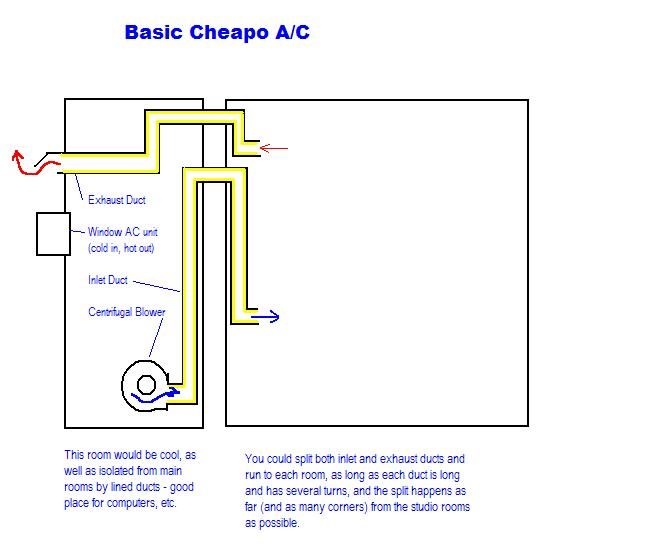
Do you possibly have an adjacent room outside the studio that is NOT soundproofed and could be fitted with a cheaper, window-type AC unit? If so, it might be possible to build some baffled ductwork (with a quiet "squirrel cage", or Axial, fan) in/out of the studio and that room, and use a window AC set to "fresh air" mode - just a thought... Steve
As a matter of fact: next to these two rooms is the outside world!
I could dedicate a small area in one of the rooms to build a tech room (1mx1m) in which I could fit some units(?) that get the air directly from the outside. Is this an option?
Erwin
Cool idea Steve.;)
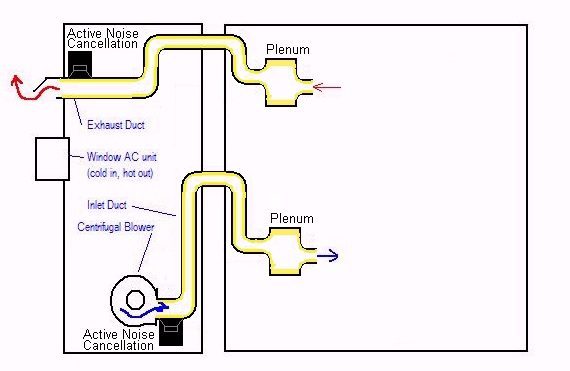
I would also suggest using curved angle sections to reduce turbulence noise. For a given airflow there is a tradeoffs between fan speed and the length and cross sectional area of the duct. Longer narrower ducts require higher fan speeds. In some cases it may be better to use a shorter duct with a lower fan speed because a high fan speed may raise the noise level more than the longer duct attenuates it.
HVAC systems are also excellent candidates for the active cancellation systems I described in the studio design forum! http://www.johnlsayers.com/phpBB2/viewt ... 035a0894be A fairly small unit could very effectively prevent low frequency noise from traveling down the duct (like the noise generated by centrifugal fans). A plenum at the other end would attenuate the high frequencies.
Thomas
Hey guys...looks like we're gonne get to the DIY part after all!! :D
This looks great!
Now if I had an AC unit that could do heating too, the setup is complete!
Stupid question maybe: what's a plenum?? :?
Btw...Tomas, I read this post about the active noise cancelation but for me this is way too complicated :roll: . I think I'll go for longer ducts and a more powerful fan to be sure to minimize noise.
Anyone know any formulas/calculation methods to determine duct sizes and length? Fan power/ air speed? What about AC capacity in kW for two rooms 75 m3 each? How much air (m3) would you normaly refresh per hour?
Still lots of :?: , but I feel it could all work out!
Erwin
Here is a little more about plenums. http://www.johnlsayers.com/phpBB2/viewtopic.php?t=653
As far as the active noise filter, this isn't something most people could build themselves. I was thinking more along the lines of a commercial unit that you would buy and install in your duct system. I'm not sure if anything like this is actually available. If not, maybe this is another business I should get into?!! :D
Thomas
Erwin, I'm not quite sure how this escaped me, sorry I didn't get back sooner - here's a possible unit for your situation. I would recommend getting a unit big enough to be able to run on lowest speed for noise reduction - so room size recommendations should be nearly doubled for quiet operation. (Take your total room square footage, double it, and shop for a unit rated for that size - )
Also, for maximum efficiency I'd put the inlet to your centrifugal fan as close to the cold air outlet of the AC unit as practical -
I'm wondering now about air pressures and venting the cool-room to outside instead of thru the AC unit. Eventually I may find the answer to that- I'm going to try and find an AC guy that's not so paranoid about his job that he'll actually TALK to me, LOL...
https://www.brandairconditioners.com/cg ... 8J34A.html
They don't say what voltage this unit runs on, but it's capable of heat/cool.
The only thing I know so far about quiet air for studios is that it should be down around 250 feet/minute. The noise from moving air, according to Alton Everest, increases by somewhere between the 4th and 5th power of velocity - so slowing the flow makes a huge difference in noise level.
If you actually build something like this, you could also build your own duct silencer - kind of a "slide trombone" affair, with a tunable cavity. Something like I've drawn here... Steve
Thanks Steve,
Today I recieved a proposal/quotation of a local contractor and guess what....They came up with the same sort of solution as you mentioned!! 8)
The only difference is they use a split unit to heat/cool the buffer room and they propose a direct fresh air inlet for this room too. I'm wondering if it's as effective as your idea, what do you think??
By the way...estimated cost incl. installation $9000,- :shock:
Erwin
Might be as effective (hard to tell when you're still as ignorant as I am) but certainly more expensive. The split units are about twice the cost of the wall units like I linked to, and still don't give fresh air capability on their own. The wall units have a control for fresh or recycled air, if you set it to fresh and position your inlet/outlet to the studio rooms as I mentioned, you should be good. If you do my idea, I'd get some medium density foam and mount the AC unit floating in the wall to minimise structure-borne noise.
Interesting that they should come up with the similar idea - did you prompt them, or did they think of this on their own? Or, maybe I'm only 98% as dumb on this as I thought... Steve
:D
I didn't prompt them! It was their own proposal.
One of the things that could be important in your proposal is the tuning of the flow from the wall unit and the supply fan. If they are not exactly the same you can get over/under pressure in the buffer room which could cause more wear to one or the other device. (It's a sort of closed system).
With the split system the supply fan can get free air from outside cause it's an open system.
Nothing scientific just my thoughts... :?:
Cheers,
Erwin
Yeah, like I said I have a LOT more to learn about AC - I do know that balancing pressures is one of the "biggies", just not sure how it's done yet. I think with dampers in the ducts, not sure.
The tuning device I drew would be used after everything is balanced, that way whatever frequency the main noise is at could be absorbed to cut the noise level significantly... Steve
Just a (major) update - I've since learned from Rod Gervais (thanks Rod, thanks to your help I may upgrade my AC knowledge from "moron" to "woefully inadequate" :?
Do NOT oversize AC systems for studios - if anything, they need to be UNDERSIZED a bit . As Rod has pointed out (and I actually listened) a studio generally has better heat insulation (due to sound proofing construction) than normal spaces - so, even though there may be a bit more gear making heat, using a large AC system will cause the system to "short cycle", or run for shorter periods of time. This, by itself, might not be such a bad thing; except, when that happens, the system doesn't get a chance to de-humidify the space (this requires a longer run-time), which is 'WAY NOT COOL, so to speak - humidity encourages mold and other nasty things - not to mention, if you have pianos or guitars or other stringed instruments stored there, they ALL need a RH of around 43-45% - This is also a requirement for keeping unhealthy organisms at bay.
In order to accomplish this, you would need to run either the AC or a stand-alone de-humidifier 24/7 in some areas (the entire east coast USA, for example) -
If Rod (or other knowledgeable AC people) want to add comments here, please do - however, if you have a QUESTION I would prefer that you start a new thread rather than make this into a 9-page ramble - Thanks... Steve
Has anyone actually checked the chiller room principle with official HVAC contractors?
I've contacted a few others since my last post and some say this could give you serious problems with freezing of the AC unit :(
Any comments/knowledge??
Erwin
All I know is that I ran this idea past Rod Gervais, who is VERY knowledgeable on ALL phases of construction, having built everything from outhouses to major hotel chains and both movie and recording studios - he saw no reason why it wouldn't work.
Beyond that, the only personal experience I have that's close is this: My house has no central heating system, only a wood burning fireplace and some (useless) baseboard heaters - I have to sleep days 2 days a week, so don't need too much heat or light - I blacked out both windows in our bedroom and installed a slightly larger than normal AC unit in one of the bedroom windows last year.
When I'm not sleeping in there, we leave the bedroom door open and place a fairly large fan just inside the bedroom door on the floor, blowing out and upward down the hall - this keeps the entire house comfortable in hot weather, and the AC unit has worked just fine even though I need to change the mount for a bit more tilt to improve drainage of the drip pan.
Naturally, it would take more than this for sound isolation of any serious level; but for a bedroom (I sleep with ear plugs) that's not a concern.
In a sense, the bedroom is my "chiller room", and the hallway is my duct-work.
Sometimes the answers you get depend on the perceived financial impact on the person answering - smelling profits has been known to change more than one person's answers... Steve