Hi, in my ongoing soundproofing project in my house I have built a floating room within a room which was built on top of rubber blocks to isolate it from the floor. I left a 1/4" space between the bottom of the drywall and the floor which we filled with acoustic sealant as was suggested.
The acoustic sealant that was available here was Lepage Bulldog Grip PL Acoustic-Seal. That's what we used.
What a mess. It's in between the bottom of the drywall now and the floor. How do you cover the acoustic sealant so it doesn't catch everything and get all over everything? It is also offgassing and stinking up the whole place. It never dries so it is just goo now lining the bottom of all the walls. I guess I could put some gaff tape over it or something but that hardly seems like a nice way to finish the room off. This stuff is horrible. I wish I had just used some regular caulking.
Any suggestions are greatly appreciated.
Post us a detail of exactly what you built - then perhaps we can tell you what you're doing wrong.
Rod
Hi Rod.
it's a floating room within a room wood stud with 2 x 5/8" drywall floating on rubber blocks on the original floor. We left a 1/4" gap between the bottom of the drywall and the floor and have filled this space with acoustic sealant as I described.
This acoustic sealant is horrible stuff and if something touches it, it sticks to it and comes off in long strings of goo all over the place. And it's off-gassing toxic fumes. It apparently doesn't dry so I guess this is the way it will stay. It's 2 days old and hasn't formed any kind of skin on it or anything. I guess I'll have to put some kind of tape over it or something. To try to remove the stuff would be a nightmare. I either used the wrong stuff or I missunderstood the application of this stuff because I can't imagine anyone wanting to use this in this application.
I need to figure this one out pretty quick. We are going to put carpet down and some trim, but this stuff is going to get all over everything it touches. Plus the toxic off-gass. Kripes, what have I done?
if it comes down to it, maybe you could use some kind of kitty litter or that vomit powder stuff to try to congeal the sealant and then remove it? Just a thought.
Have you checked with the manufactuer to make sure that there is not any kind of hardening compound you have to use to make it set up?
Is your acoustical sealant black/dark grey colored?
The first 12 tubes I used were, and they were a bear to clean up. I finally discovered that paint thinner worked wonders. You might try it.
Is your acoustical sealant black/dark grey colored?
yeah its black. it's not just the clean up I'm having the problem with though. It's the off-gassing and the what I understad will be a permanent stickyness to anything it touches.
Rod:
What's a ' backer rod ' ? And are we supposed to use it?
This stuff? http://doityourself.com/store/8105611.htm
(I couldn't find any backer rod thinner than 3/8")
Les Ismore:
Can't you cover it with floor/wall molding?
Caulk - including acoustic caulk - is not intended to be installed with 3 point contact.
This means (for example) the floor - the bottom of the drywall and the framing behind.
For caulk to work properly - 2 point contact is required - this means just the floor and the drywall..........
here's a link to a manufacturer who makes backer rod as small as 3/16". for 1/4" joints you want a 3/8" backer rod.
http://www.sandellmfg.com/SPEC%20DATA%2 ... %20Rod.pdf
This way you don't have this large mass of limp caulk that wants to keep migrating "south".
As far as the smell goes - it will eventually go away - just make certain the room is well ventilated or a while.
If you did not use a backer rod - this problem won't just go away - you can always try to block it in with baseboard - but then the base has to run tight to the floor and you may introduce a flanking problem you didn't want.
Rod
Caulk - including acoustic caulk - is not intended to be installed with 3 point contact.
This means (for example) the floor - the bottom of the drywall and the framing behind.
For caulk to work properly - 2 point contact is required - this means just the floor and the drywall..........
here's a link to a manufacturer who makes backer rod as small as 3/16". for 1/4" joints you want a 3/8" backer rod.
http://www.sandellmfg.com/SPEC%20DATA%2 ... %20Rod.pdf
This way you don't have this large mass of limp caulk that wants to keep migrating "south".
As far as the smell goes - it will eventually go away - just make certain the room is well ventilated or a while.
If you did not use a backer rod - this problem won't just go away - you can always try to block it in with baseboard - but then the base has to run tight to the floor and you may introduce a flanking problem you didn't want.
Rod
I'm sorry Rod, I don't quite understand what you are saying. On the one hand you are saying that it should NOT have 3 point contact, only 2. On the other hand you seem to be saying that it SHOULD be having 3 point contact, or else it will just migrate south.
I did not use any backer rod, Rod. (hehe)
My friend was suggesting that we just find some high quality tape and tape over the outside so as to seal it in but still not have anything solid so as to introduce flanking. Most tapes seem to turn into goo though eventualy.
What do you think about that?
Do you know how long this shit off-gasses?
I have to say that after dealing with this stuff if I was to do it again there's no way I would use this. I would just get some best quality acrylic caulking
that has some drying properties.
It's too late now as it's in there and it aint' coming out.
I'm sorry Rod, I don't quite understand what you are saying. On the one hand you are saying that it should NOT have 3 point contact, only 2. On the other hand you seem to be saying that it SHOULD be having 3 point contact, or else it will just migrate south.
Les,
I said you need backer rod - with it you have 2 point contact (touching the backer rod is not considered a "point" because the foam expands/contracts with building movement). 3 point contact is a problem - both from the perspective of what you're dealing with now - and because it can cause failure of the caulk joint itself.
I did not use any backer rod, Rod. (hehe)
Then I wish you good luck - because your problem probably won't go away.
My friend was suggesting that we just find some high quality tape and tape over the outside so as to seal it in but still not have anything solid so as to introduce flanking. Most tapes seem to turn into goo though eventualy.
Seeing as I have never been in your situation I have no advice to give - you can try what your friend suggests - once again - good luck.
Do you know how long this shit off-gasses?
Well that depends on exactly how much stuff there is involved - you filled a joint that was what? 2 layers deep by 1/4" high ? SO1 1/4" x 1/4"+/-? Thats a lot of caulk (remember it should only be about 1/4" x 1/4" 2 times - you are supposed to caulk each sheet seperately - with backer rod for each application)......... perhaps you could call the engineering department of the manufacturer -
Typically the smell goes away in a few days........... perhaps there was a bad batch of caulk as well........... contacting the manufacturer sounds like the best bet for you to get the answer to your question.
I have to say that after dealing with this stuff if I was to do it again there's no way I would use this. I would just get some best quality acrylic caulking
You could do that - but don't blame the car for hitting the tree -
You did this wrong - sorry to say it - but it's the truth - and now you blame the caulk......... and it wasn't the caulks fault - in the future - perhaps you should check the proper installation methods before using a product.
It's too late now as it's in there and it aint' coming out.
Ok - once again - tis your choice - I can understand you not wanting to redo your work..........
Rod
All good points Rod.
I thought I had researched it properly and knew what I was doing. Obviously that was incorrect. I remember seeing many threads here about using Acoustic Sealant but none that mention backing rod etc. I guess I must have missed that. Too bad.
I guess this is what happens when you let guitar players around contruction materials.
Anyway if it wasn't so difficult nay near impossible to remove the stuff I would and start over. But this stuff doesn't want to leave. It wants to spread. I can imagine that if we were to try to remove it, it would be one huge mess. Right now the room is almost finished and looking pretty nice.
One question I would ask you is:
The gap at the bottom was supposed to be 1/4" all around but it varies a little bit. In some places it's a bit thinner and in a few places it's a bit thicker. The thickest gap is maybe 5/8" at one small spot. You were saying that this stuff wants to settle down or "migrate south" as you so eloquently put it.
If we put a high quality tape on the outside to seal it from the carpet etc. that would give it extra support on the outside. Do you think that would be enough to maintain it from falling down? (there is nothing on the inside of the wall supporting it)
Thanks for your knowlegable input.
If we put a high quality tape on the outside to seal it from the carpet etc. that would give it extra support on the outside. Do you think that would be enough to maintain it from falling down? (there is nothing on the inside of the wall supporting it)
Les,
If I were facing what you are I would probably try to head in a different direction.
1st question is this - what are you doing for a finished floor?
2nd question - what are you going to do for baseboard / wall finishes.
Tell me the answers to those 2 questions and (if my assumptions on your answers if right) I think I might have a solution for you.
By the way - what do you mean when you say that there's
nothing on the inside of the wall supporting it)
Are you refering to the room side - or the framing side - because on the framing side I would expect there to be a bottom plate stopping it from running out.
Rod
Thanks Rod,
Question #1: wall to wall carpet
Question #2: we'll probably do some baseboard trim, but not touching the floor.
When I say there is nothing on the inside of the wall supporting it, I mean the framing side. The bottom plate 2x4 is 1" off of the floor suspended on rubber blocks every foot and a half apart. the whole wall and ceiling structure is supported on these rubber blocks.
Les
Les Ismore:
How about a 1x3 baseboard all the way around right to the floor, then install carpet, then install the real baseboard molding higher than the carpet.
BTW, I was just at home depot in the caulk section looking around for backer rod, but didn't see any in my 5 minute glance around. I didn't ask anyone either.
Rod Gervais:
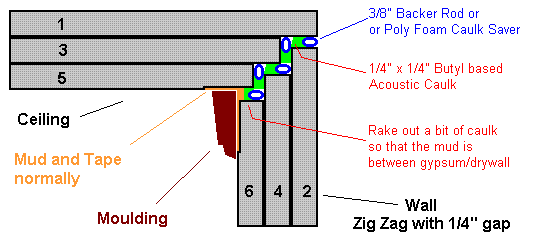
Please let me know if I have this right
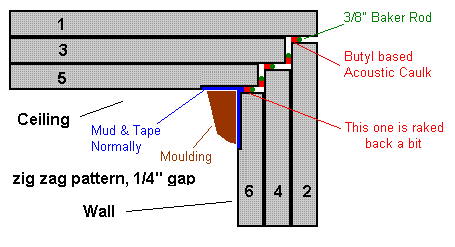
Recovered from web.archive.org — originally hosted at http://www.bobgolds.com/BuildWall2_zigzag2.GIF
This is the old one:
Recovered from web.archive.org — originally hosted at http://www.bobgolds.com/BuildWall2_zigzag.GIF
Z,
the top drawing is on the right track - BUT - you want the backer rod pushed to the back of the drywall sheet - and then fill the void that's left.
This will give you (effectively) a 1/4" x 1/4" joint.
Make sure to try to push the backer rod in evenly.
Rod
the top drawing is on the right track - BUT - you want the backer rod pushed to the back of the drywall sheet - and then fill the void that's left.
I'll do the math
The gypsum/drywall is 5/8"
The caulk is 2/8" (leaving 3/8")
The backer rod is 3/8". (assuming it stays round, and doesn't get squished eliptically which seems likely if we're stuffing a 3/8" backer rod into a perfect (ha) 1/4" gap).
By George you're right. The backer rod ends up filling the rest of the gap.
I'll have to redraw it to scale... But I've been up all night and I'm going to sleep now.
BTW, if the sheets 1,2,3,4 all have the mud/tape indentations (standard drywall), what do they get filled with (mud) ? Or must the first two layers (1,2,3,4) be bought without the 2" indentation tape area (frame) around the edge ?
Thanks.
Thanks Rod,
Question #1: wall to wall carpet
Question #2: we'll probably do some baseboard trim, but not touching the floor.
When I say there is nothing on the inside of the wall supporting it, I mean the framing side. The bottom plate 2x4 is 1" off of the floor suspended on rubber blocks every foot and a half apart. the whole wall and ceiling structure is supported on these rubber blocks.
Les
Les,
I hate to tell you this - but the least of your worries is the problem in the front -
Your system will fail...... seal it in the front so it doesn't ooze out and it's going to go through the back........... once it settles enough it will seperate from the drywall.
let me think on this a bit......
Rod
One thing I should point out Rod, that may or may not have an effect on the outcome of this. We did not use just 1/4" of Acoustic sealant. We put in as much as would fit, without it coming back out. So there's probably 1/2" to 1" throughout. We basically treated it like regular caulking. I figured the density would be less than that of the drywall so we wanted to put in enough to somewhat equall the drywall in density.
And you don't think that putting some tape on the front would serve as to hold it in place huh?
I guess if there is no other choice, we could try and push the Acoustic Sealant back into the gap and then seal the front with regular caulking, but I coubt if it would stick to the drywall now as it's covered with this oil based acoustic stuff. I guess maybe if we put the trim on and caulked that in and all over that it might help.
This is turning into a can of worms.
BTW, I was just at home depot in the caulk section looking around for backer rod, but didn't see any in my 5 minute glance around. I didn't ask anyone either.
They have it. They call it Polyfoam caulk saver...
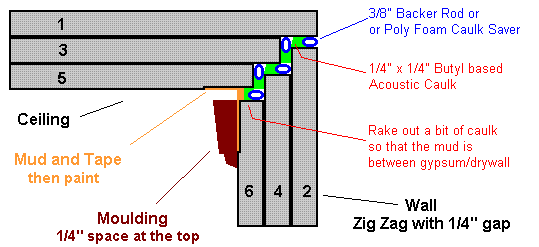
Here's the new one. Any comments, change recommendations, better alternatives?
Recovered from web.archive.org — originally hosted at http://www.bobgolds.com/BuildWall2_zigzag3.GIF
Here's the new one. Any comments, change recommendations, better alternatives?
Recovered from web.archive.org — originally hosted at http://www.bobgolds.com/BuildWall2_zigzag3.GIF
Z,
Looks good - the only thing I might consider would be creating a shadow line with the molding. By that I mean - you tape out the walls/ceiling - paint them - and then drop the molding down 1/4" to 3/8" (more for ceilings higher than 8'.
What this does is create a finished "shadow line" at the ceiling edge without pinning the wall to the ceiling with the molding. The idea of the caulk joints at the edges is 2-fold.......... 1) seal a sound path,,,,,,,,, 2) seperate the ceiling membrane from the wall membrane - which also helps to stop the transfer of flanking sound between the 2. (And - least anyone asks - yes - even if the wall/ceiling framing connects - this does help stop flanking transmission - at least everything that would transfer through the bodies of the membranes themselves.
Rod
I have built a floating room within a room which was built on top of rubber blocks to isolate it from the floor.
I've reviewed all of Les' posts, but I'm unable to determine whether he decided on (a) ceiling suspended resiliently from outer ceiling, or (b) resting on the floated walls. (Les, can you clarify?)
If he chose (a), then I can understand the need to maintain resilency among inner leaves. However, if he chose (b), then is it necessary? Basically, I'm trying to understand if, (and, if so, why) decoupling inner ceiling leaf ceiling from inner wall leaf is so critical, even though there are no flanking paths between inner leaves and outer leaves, which is the ultimate sin as I understand it in terms of isolation.
My revised illustrations for my project does not account for this, but that's because I'm going with option (b).
Hopefully the answers we get to this will help Les and me both. :) Thanks all!