One thing I should point out Rod, that may or may not have an effect on the outcome of this. We did not use just 1/4" of Acoustic sealant. We put in as much as would fit, without it coming back out. So there's probably 1/2" to 1" throughout. We basically treated it like regular caulking. I figured the density would be less than that of the drywall so we wanted to put in enough to somewhat equall the drywall in density.
I get the picture that you did this in one application?
And you don't think that putting some tape on the front would serve as to hold it in place huh?
Actually - as I said earlier - I think stoping the front will only cause it to ooze out the back (which I am sure is already happening - BUT - you can stop it from migrating to the front if you get a good quality reinforced poly (make sure it's reinforced - that poly is more rubber like than plastic - and the reinforcing holds it together) - staples it to the wall - make a clean crisp bend - and then staple it to the floor in line with the face of the wall......... you will probably have to staple on maybe 2" to 4" centers..........
This should hold it in.
You can then finish this the way you should - with your floor finish tucking under the carpet - and the baseboard finishing above that.
Rod
Rod, it's been in there for 5 days now and the off gassing is getting better now. It does not appear to be settling any noticeable amount. I guess the settling is something that would happen over a long period of time. This stuff is pretty dense (thick). Looking at it I get the feeling that having such a large amount of it in there could possibly help it to remain more or less in place. Yes we installed it in one application, although I don't see as it would make any difference.
My friend who is helping me brought in some tape called "Tuck Tape" which he says is really strong long lasting tape. It doesn't turn to goo like gaff etc.
We are considering taping the bottom corner with it prior to bordering and carpet.
Your idea of the strong poly is a good idea too. I'll look into both these options closely before deciding which way would be preferable. Another option would be to shove the acoustic sealant in a bit deeper and then seal the outside drywall with a layer of regular caulking.
Thanks to everyone here for all the different ideas.
Rod and Knightfly:
OK, I've updated the official version (everywhere) with
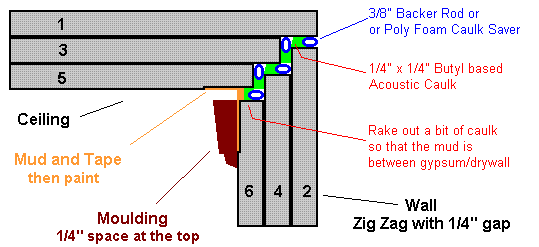
Recovered from web.archive.org — originally hosted at http://www.bobgolds.com/BuildWall2_zigzag.GIFIs it prefered/best to just mud and tape that last layer, or is it better to use the newer "flex" plastic corner moldings (Knightfly recommended in this thread )
I didn't get an answer as to what to do if gypsum/drywall sheets #1, 2, 3, 4 in my diagram have that tape indentation all the way around. Do I just ignore them at the wall/ceiling junction?
z60611
If you don't use plastic or metal (gal) corner strips under your plaster mud in the corners the joint will crack. If you must avoid flanking noise between the wall and ceiling (de-coupled) don't mud - use caulk. If you have already used mud, I would cover the joint completely with a moulding and caulk or gapseal the crack top and bottom. Air leakage due to a crack could provide a much more efficient transmission path for airborne noise than the outer wall and ceiling layers semi-coupled.
I've been building plaster/timber walls for a long time. Make no mistake, this joint WILL crack unless you use some angle under the mud.
Cheers
Jas
I think that what we are probably going to do is heavily caulk the molding to the wall and floor. Using a generous amount of caulking I am hoping this will cover our asses if there is any future problems with the acoustic sealant failing. I hope that this is the answer.
What we've finally ended up doing to fix this mess, (and it truly is a mess) is cut pieces of cardboard just a little wider than the gap between the floor and walls. We have pushed this cardboard into the gap thereby pushing the acoustic sealant goo backward to create a space to fill with sillicone. We will next put on a border trim and finish the room.
This idea came from a carpenter friend and it has worked well and saved the day. To be honest with you even if I had seen the instructions for the backing plate which I'm guessing is somewhere around this site, if I was to do it again there is no way I would ever use this stuff anywhere near a studio.
If some of the experts here have had actual success with this stuff, I respect that. However I think that to recomend that people who are building home studios use this goo to seal walls to floors and / or ceilings is a very big mistake. This stuff was never designed for this application and unless you are an expert and experienced with this, one should use a sealant that's actually designed for the application.
In my opinion silicone does a much better job as long as you don't need to paint over it. It actually dries, doesn't make a huge mess, and will stay put.
In your earlier description you talk about mudding over the acoustic sealant at joints. I don't see any way you can mud over this goo. But that's just me. Your mileage may vary.
This is a great site and I have learned a lot of stuff here. I think for the amature builder though that this stuff should NOT be recomended.
Thanks very much for all your efforts in trying to help me out of this. I really appreciate it.
Point taken, Les - I don't remember anyone else having used the LePage stuff, I vaguely remember commenting when someone asked (possibly you) that although I'd NOT used it, that LePage had been in the glue biz since I was old enough to eat paste (Truman was just leaving office at the time :cry: , so it would probably be OK - IF that was you, I'm really sorry. Sometimes I forget to post ALL the things to watch for, and one of them is this - NEVER, repeat NEVER, use something you aren't SURE of without first TESTING it on something that DOESN'T MATTER - this warning (or similar) is present on most paints/chemicals you buy, but few of us are patient enough to actually DO it that way, including me.
Trust me, I will NEVER allow LePage stuff to be recommended here again, it's officially on our SH**-list... Steve
I ran into a similar issue with OSI -170. Many posts have recommended OSI-175 but I found the 170 line at HD, so figured I'd go for it. Fortunately I only bought 2 tubes. It turned out to be basically black tar that was totally nasty to work with, sounds alot like this LePage stuff. I ended up switching to the USG Acoustical Sealant. Nice normal caulk cleanup, should have similar properties.
"Another option would be to shove the acoustic sealant in a bit deeper and then seal the outside drywall with a layer of regular caulking"
Is this the stuff you have been using:
http://www.lepageproducts.com/products/ ... 9&plid=260
If so it will eventually dry and the smell should stop. The smell is caused by a solvent in the caulk to help it remain very flexible during application. It does dry and become less flexible(but still maintains much flexibility). It does take a long time to FULLY dry - if I had to guess I would say several weeks.
I am not sure about it settling and separating from one surface or another but as you have noticed the stuff is very sticky and basically stays put. Now if a wall experiences shaking .... will it settle over time? Perhaps?
One of this products main uses is with a vapour barrier that is applied over say 2x4's. This is a two surface contact. I do not think this material will seep out or it would not fulfil its purpose. For certainty you can call the company direct. I had called them several months back regarding this product and they seemed very helpful.
I believe that this product should not be left exposed. Therefore your comment above regarding the application of regular caulking would seem appropriate.
For cleaning purposes mineral spirits will clean it up excellently.
I have spoken to one custom installer who recommended applying gobs of this stuff to the face of 2x4 studs just before applying drywall to create less contact (i.e. drywall screws will still provide contact).
Did you only use this stuff at the bottom of your wall? Did you apply any to the upper corners between walls and ceiling or corners where your walls meet? If yes how did that work out for you?
For what its worth I did use this stuff several months ago - not sure that it will get much dryer than this. The area was still exposed as it has not been closed off yet so I touched it and no material stuck to my finger. I pushed it much harder and yes some did stick to my finger. It appears to dry to a gummy like texture. Seams reliable.