for now i'm having trouble finding a drywall guy who will come and rock the ceiling. every drywall guy i talked to so far completely disagrees with hanging one layer vertically along the studs and the second layer horizontally. they won't even take the job...
"what do you do? you play in a band. well, i've been doing drywall for 25 years... i don't tell you how to play your guitar do i?" is the usual response. :roll:
Why is this controversial? What is the risk of doing it this way - why are they saying no? And is this desirable to alternate seams for soundproofing?
That's crazy. Stick to your guns and don't settle for anything less than right.
Maybe it's time to buy a Telpro and do the ceiling yourself -- the right way! 8)
--Keith :mrgreen:
Maybe it's time to buy a Telpro and do the ceiling yourself -- the right way! 8)
--Keith :mrgreen:
Ok, I read thru that thread and understand more now. Rotating and staggering for strength, sound, etc...
But I'd still like to know why drywall contractors are so taken aback by this suggestion?
I've done some Googling in an attempt to find actual building code references regarding proper installation of multiple layers of drywall on a ceiling (or even on walls), and I'm coming up empty handed.
This does not mean that code is silent on the subject -- it just means that I'm giving up my Googling for now. ;-)
I would suggest calling or visiting (visiting is better) your local building department to see if you can get a definitive answer based on the model codes they are using and with which they are holding you responsible for complying.
If there indeed is code that backs this up, then by all means, write down the code section number and the exact language in the relevant paragraph, and insist that whomever you have doing your work follow that code to the letter. That makes code the "bad guy" rather than you. And, of course, call the jerk who smugly made your "you're a musician -- I don't tell you how to play guitar" and edify him on the building code for which he should have more respect!
If code is silent on the subject, then maybe our community can reconsider the recommendation. If we conclude the difference is negligible, then it may make sense to forego being a stickler on that point and allowing the contractor to do what is intuitive/comfortable. (Although the aforementioned "jerk" should not be reconsidered!)
If code expressly prohibits rotation of multiple layers (doubtful), then we'll all know better... And then maybe the "jerk" should be reconsidered. And maybe not. ;-)
In short, not knowing what code says (or doesn't say) makes the argument academic. Having the facts makes the argument meaningful and clears up the controversy.
--Keith :mrgreen:
:P I just made my first successful solder, thanks to you steve and the others on this site! nothing can stop me now!!!
Here is what i am looking at as far as audio wiring is concerned: aaron, please jump in!
Balanced lines: for microphones, Mogami 3080 (AES 110ohm digital cable)
These will be my main lines… i have looked at belden, canare, gepco, etc... but i think i will go with Mogami. max runs are 30'
Signal Path:
Microphone > Mogami 3080 > TR wall panels (black/gold female Neutrik “D” series) > Mogami 3080 > CR wall panel (black/gold male Neutrik “D” series) > Mogami 3080 > Preamp > Mogami 3080 > A/D Converter
I will use the cable for basically every balanced line return from the CR to the TR (but will keep a safe distance from the send lines)
Unbalanced line-level: for guitar, headphone mix, other instruments
I am still divided here and am even weighing having a few specialty guitar cables as separate lines so I can play from the control room and get the desired options from there. Runs will be 20'-30’ max, maybe I can use the extras in the studio for my footpedal board..
- Canare GS-6
- Mogami 2524
- George L. .155 http://www.georgelsstore.com/custom.html
- Belden 8760
Anybody have preferences? i guess i'm looking for foil shielded line level cable?
Speaker Cable:
I have 2 zaolla silverline 50' mic cables w. XLR connectors that i have been using from my DAC to my powered monitors... is there any problem with installing the zaolla as speaker cable?
the signal path is:
DAC > Zaolla silver line mic cable > Powered Monitors
what's your pick for speaker wire along the lines of sanity - not looking for a $1000 solution (transparent audio, etc) if you catch my drift!
max runs will be 30' - should be able to take speakon connectors as well as xlr and 1/4" unbalanced.
MIDI Cable:
any suggestions?? i know mogami makes midi...
did i miss anything?
oh yeah, I am sweating a kvm switch remote on a wireless cat5... and this forum is incredible!!!
thanks!!!! :lol:
Congratulations on popping your soldering cherry! :lol:
Isn't it great to be able to celebrate these little accomplishments milestones in a community that won't think you're a complete freak? Imagine telling the UPS delivery guy or the meter maid or the McDonald's drive-thru person about your soldering accomplishment, and the look of bewilderedness with which they'd respond! ;-)
Geek power. LOL I did my 1st solder at 7 and it was an amazing experience. then I got older. resolder a 48 channel patch bay for a monitor console in my church and realized I dont like to solder that much. Although I had some great quiet time to reflect.
Then....HA HA..
Came this studio. Thankfully it was only 20 Mic Lines and 8 Headphone lines but still, that is 168 solder joints. LOL
More time to think and reflect.
We engineers have so much quiet time. LOL
Have fun dude it is empowering to know you dont need to BUY that cable.
Sure Does...... I lost my crimper and was forced to buy a 75' CAT 6 cable the other day. ARRGH!!! Way to much money for a couple minutes worth of work.
well i must admit, it was only a guitar cord that crapped out on me (plug mold ends) - i bought 1/4" connectors from Radio Shack just for experiment's sake and whaddya know, it worked.
i took a wire stripper that was lying around for years (been wondering what it was) and - pretty crudely - stripped off the wire, which had one lead wire and a copper braided shield that i twisted and used as ground.
the process was not as hard as i thought but there must be a way to make the connections cleaner, smoother, less frayed? i have no idea what crimping is, so maybe i am missing something?
also i will have to replace these old rusty wire cutters when i do this with quality wire. can you guys recommend the exact tools to make this as tight and effortless as possible?
i have a cart open at markertek so if they have the product you recommend, please provide link.
Geek power. LOL I did my 1st solder at 7 and it was an amazing experience. then I got older. resolder a 48 channel patch bay for a monitor console in my church and realized I dont like to solder that much. Although I had some great quiet time to reflect.
geeks unite! i get geekier as i get older (thanks in part to you guys :wink:) but if anything ever made me feel like a genuine toolbox it is buying a soldering iron and "euctectic" solder from radio shack. even the guy at the desk didn't even know what euctectic was until i said 63/37. I might as well have been wearing a collared plaid shirt w. a name engraved pocket protector LOL!
it's cool to accomplish something for the first time... but i can see it now... it is the repetition with consistent results that will be a pain. wire stripping - that is really the bitch. what tools do you use?
I crimp my own CAT-5 and phone cables and punch down my own jacks nowadays... Does that count?
sure counts to me especially since you are talking over my head! LOL i will get there though! please tell me how to crimp!!! :lol:
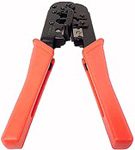
The crimper to which I was referring is specifically for fabricating CAT5 and CAT5e cables... the kind that are used for Ethernet connections.
Recovered from web.archive.org — originally hosted at http://www.cablesnmor.com/ProductImages/rj11-45-crimper.jpgThere's no relationship between this and soldering, other than the satisfaction of not having to purchase premade cables. :-)
Framing in front of the garage door...
this door was completely caulked, then painted over with 2 coats of Quiet Seal polyelastomeric compound, then insulated 2" foamboard. when i rapped on the other side, it felt and sounded like a solid wall.