Drat, this BB posting function has twice wiped out a rather lengthy reply upon submittal.
Thanks for the curteous and rapid reply, Stuart. I appreciate your efforts to help one who is acoustically naive, such as myself. If I may return the favor-
Quote:
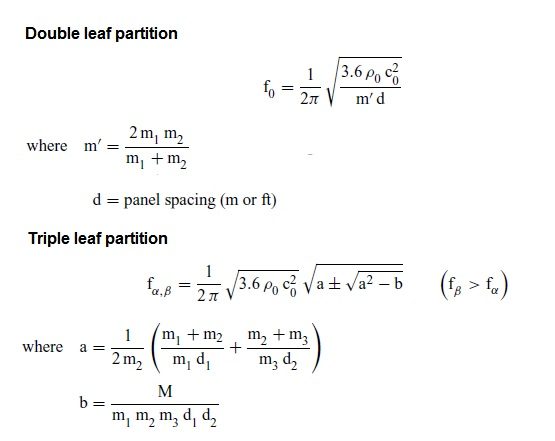
if TL is desired to be higher than possible with a given assembly for higher frequencies (greater than Fr), Multi-Leaf assemblies may be required.
I would really like to see such a case! Can you show us one? I mean, show us a scenario where a multileaf assembly gives better performance across the entire spectrum than a two-leaf MSM structure, all other factors being equal (cost, space, mass, etc).
I can't, because that's not how I qualified my statement- which pertains to higher frequencies only (1K & up).
Though not without caveats, the NRC IR-811 pdf file (pg. 73 od pdf, 61 of text) brings up a case comparison for ceiling joists. As Andre cited, it is an excellent comparison of three different Triple-Leaf systems, and two (proper) Double-Leaf systems. The baseline case is the classic Single Layer Double-Leaf, as a Floor-Joist-GB assembly. Just above this in the chart is the plot for a FL-J-GB-RC-GB config, Triple-Leaf system, which although far worse than the superlative Triple Layer Double-Leaf, does at least a little bit better than predicted by Mass Law (if I understand properly that Doubling Mass = 6dB frequency linear TL), but only in the high frequencies, and gets worse in the lows. Indeed, Double-Leaf systems dominate in general for low frequencies, but other examples on this chart suggest that in some cases, Triple-Leaf configs may equal or do better than Double-Leafs in the highs.
The fact that most of us here at this forum are more interested in low frequency stopping doesn't preclude this as a possible tool that might have to be utilized in the real world.
Quote:
Also, as Mr. Gervais I think stated already, real-world (usually economic) concerns sometimes prevent us from being able to get away from Triple-Leaf designs by removing an existing Leaf in an already finished structure -
But that's an entirely different case! You just switched sides on your own argument! Are you arguing for multi-leaf structures being better and desirable? Or are you arguing that sometimes you just have no choice? That's two entirely different things. Everyone agrees that sometimes there really is no choice, and that a 3-leaf is the only solution, but NOT because it is a BETTER solution acoustically, simply because there is another overriding factor that forces isolation to take a back seat. Examples are: existing structures that cannot be modified, code, time, cost, space, weight, etc.
In other words, make up your mind! If you are arguing the case that multi-leaf can be better than two-leaf, all other factors being equal, then go ahead and make that case. But don't try to then claim that the justification for that argument is that "sometimes you have no choice". That's an entirely different argument, and in fact using that argument automatically implies that multi-leaf is not the best solution, that there was a better solution acoustically (ie, 2-leaf), but that some OTHER factor moved it to second place.
Pardon the confusion, my point was not to waffle on the line of which is better (which is related to many factors, only one of which is to match the Acoustic Ideal), merely to suggest that they are different, and therefore may have unique utility in situ. And it's not an entirely different argument, just not so monolithic as you seem to require.
So Stuart, just so we're clear, I didn't post to champion Triple-Leaf over Double-Leaf for all cases. I'm not deluded that such superiority exists as an absolute, especially given all the overwhelming empirical evidence to the contrary, but I needed to suggest that there might be useful, unique properties with each.
Onve again, you are arguing form the defeatist point of view: Your argument itself recognizes that multi-leaf is NOT the best solution acousticaly, but that there are OTHER FACTORS that leave you with no other choice than to use it EVEN THOUGH it is not the best.
Beg pardon, but this is no Holy Joust, and taking a position which encourages open-mindedness is absolutely NOT "defeatist", sorry.
Quote:
If one were unable to pour concrete into a stable wall, or use masonry products that made solid, flush (mechanically unified) leafs, this might be a case where it could become necessary.
Well, to be honest, I don't see anyone here saying that the best way to build a 2-leaf MSM wall is with masonry products that made solid, flush (mechanically unified) leafs! Rather, I see people using plain old drywall sheets nailed to plain old wooden studs. It's hard to envision a case where such a construction method is not possible. And one more time, your phrase "...might be a case where it could become necessary" admits defeat: you are arguing for compromise, for choosing multi-leaf for other reasons, even though it is not the best solution acoustically.
How about the case above, wherein I suggest that masonry (and other structural extremes, like heavy steel I-Beam construction) might not be possible for some reason- would you prefer to have unsubstantially structurally supported super-thick Double-Leaf walls or a couple of well supported Triple-Leafs? Good Luck if you ever feel that headache rain down on you, which I sincerely hope will be never.
And I recognize that most of the time, the most common way of getting things done in the world will be with plain old vanilla stud and drywall construction. I'm currently a carpenter by trade, by the way.
Alright then, on to more fertile soil vis-a-vis salient facts and understanding of acoustics.
Now your next statement is very informative, thank you!
Also, as I struggle to understand the underlying concepts of the M-S-M concepts
Try not to think of it in terms of acoustics: try to think of it more familiar terms, such as trying to force a clock pendulum to swing at any rate other than its natural rate. Or better still, think of it in terms of electronics: an MSM wall is roughly equivalent to a tuned RC circuit. The spring is the capacitor, and the mass is the resistance. Or you can even think of it like a parametric equalizer. Acoustics is confusing, but real-world analogies are rather helpful. For me, at least.
So without being facetious, likening the MSM to a tuned electronic (RC) circuit (yes I spent ten years as an electronics tech) - won't the day be cool when we can tune a wall as easily as turning a dial? We might even see variable Q walls in our lifetime, if we keep our minds open to possibilities like the ones I'm trying to explore.
Quote:
is it not true that any single material might exhibit properties that are both Mass-like and Spring-like
Yes, but if you are going to use such materials then you need to consider them in the MSM equations, in which case you cannot use the simplified version, and you'd need to fall back on other more complex equations that take these into account, or if you don't have any such equations then you'd have to test your hypothetical materials in an acoustic lab, to extract the equations empirically.
But once again, you are sliding the goalposts: Either mult-leaf is better per se, or it isn't. If you have to resort to exotic and really expensive materials, and more complex mathematics, just to get the same result, then you kind of defeated the purpose of the exercise, didn't you?
Er, um, nope on "sliding the goalposts". I'm still trying to figure out what the white painted lines are for!
:)
I guess my point here is really that we're still in a sort of infancy where the efficient implementation of acoustical science is concerned. Why, just a few decades ago mass alone was the only way we knew of achieving sound isolation, let alone understanding of the importance of coupling, absorption, damping, and their effects on resonance when dealing with common building materials.
Quote:
or is this strictly a case of trying to differentiate situations where a solid and a gas are compared?
The MSM equations do no speak of solids and gasses: they speak of masses and springs. Simple Newtonian mechanics. The masses are assumed to be rigid, or rather sufficiently rigid that their "springiness" is negligible, and the spring is assumed to be massless, or rather sufficiently low density that the mass is negligible. Yeah, if you really wanted to , you could consider the mass of the air as part of the equation, and you could also consider the springiness of the masses, but doing so would not change the results by enough to be of concern, for regular building materials and reasonable costs. Once again, if you have to resort to exotic materials in order to make your point, then you kind of defeated the purpose of the exercise. For example, I postulate that a room made from a single leaf of uranium six inches thick will absolutely beat any conceivable multi-leaf structure you can come up with, but such a structure is rather impractical...
Thanks for the illumination here. I don't know about uranium leafs, but I could swing down to Hanford and probably find some radioactive mud I could send ya
;)
In all seriousness, building materials themselves are evolving. If I recall correctly elastomeric-compound CLD's like Green Glue have only been around a few years, so it's possible things won't need to be too exotic in order to achieve some of these goals. Often just a few simple ideas can change the way we do things, yes? If I recall correctly, you posted earlier in this thread about an impractical case of all steel construction, and I think your point was to explore hypothetical definitions of when an assembly could be considered all mass, and not subject to MSM - was this not your point?
Specifically, are laminates of differing materials considered to be the Mass portion, regardless of differences in their densities
Exactly. From the point of view of the MSM equations, mass is mass. Exotic materials do not change the mass.
Think of it this way: if you take the pendulum off a grandfather clock and replace it with one made from laminates of MLV, carpet and egg crates, but having the same overall mass, will that make the closk run at a different speed? Obviously not: it won't change a thing. It is the mass that counts, not how you made the mass. And the higher then density, the better. Once you start resorting to things with low density, you start blurring the boundaries of the wall, thus invalidating the equations.
Thanks for that assesment, and for further clarity on MSM. Although I think, a pendulum made of chicken feathers might make the clock run a little slow, if for no other reason than increased surface area
:)
If the Inverse Square Law holds true for acoustics, shouldn't it be possible to design multi-leaf "laminates" whereby the differing leaf densities and distances between leaves would increase in such a way that the overall resonances would not coincide, thereby reducing the effect of unimodal low frequency transmission
No, not for any practical MSM wall. You seem to be talking about coincidence dip, which is an entirely different thing.
If you just stack up a whole bunch of differing materials, with differing acoustic impedances, all that you succeed in doing is changing the mass of the composite, from the MSM point of view. You might manage to change the path of some higher frequency sound waves through the wall, but you won't change the overall isolation provided by the wall. Once again, go back to the pendulum in the grandfather clock: Can you make it swing faster or slower by laminating a large number of exotic materials together but keeping the mass the same? Obviously, no you cannot. You can change the speed by changing the mass, period. Nothing else has any effect.
See chicken feather pendulum above.
OK, so I believe I've read that Coincidence Dip is a affected by / related to plate stiffness, whereas the Structural Resonance (usually <200 Hz) is described best by the MSM, which means of course mostly mass driven. If true then, apparently the most convenient variable to modify for MSM other than mass would be the "Spring". How much effect does insulation have on spring-like properties of the air within the cavity? Or am I overstating its importance for this attribute?
When it comes to acoustic isolation, the number one law is this: Mass rules. (The number two law is: distance rules.)
Although proper application of these two laws have yielded the relatively recent ability to isolate more sound energy with substantially less mass, ala proper Double-Leaf construction.
[quote]There simply is no place in the equations that govern how an MSM wall works for the materials that go into it. If you change the materials, you change the mass, period. IT doesn't matter how you made the mass, or how much you paid for it, or how much time you spent carefully laminating together your magical materials, in the end all that matters to the sound waves is the mass.
So back to your original point: Can a multi-leaf wall be built that will isolate sound just as effectively as a two-leaf MSM wall? Absolutely it can! But it will cost a whole lot more, take up more space and be more complex to build. Which comes back to the basic point of the good old 2-leaf MSM wall: It is the best isolation you can get at reasonable cost and in a reasonable amount of space and using reasonable materials. You simply cannot build a multi-leaf wall that is both cheaper and better, or easier to build.
[quote]
I won't argue these points at all, the data so far is too compelling to support other wise,
for a brand-new, unimpinged studio build. It is for cases that involve real-world compromises that I offered an alternate view, as I outlined above, that's all.
Thanks once again for your patience with my naivete, Stuart. I appreciate your help explaining some of the basic principles in easily understood terms and analogies.
Bill