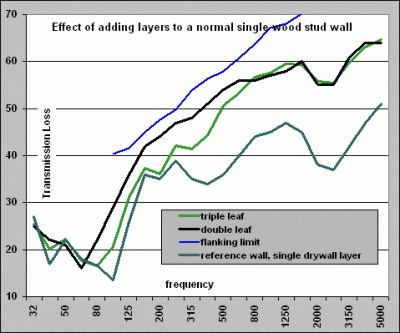
I'm a construction contractor in new york city who specializes in soundproofing. so in this topic you could say that i am discussing some of the "anomalies" of the "room " within a "room" design. I have dozens of recording studio builds under my belt that are this design, and i admit some of my earlier builds have triple leafs and the isolation is still good, well good enough to keep the studios running without any noise complaints. So the obvious reason why double leaf is more money is when you are building a sound isolation "room" within your existing "room" one would have to DEMO the existing walls(the third leaf). So this cost money and in most cases the landlords in nyc will make you take the new room apart before you move out. In new york studios and people move a lot, at least the low budget builds do like most of the discussions in this forum are about. For me this is a typical situation, to avoid the demo process (if and when i have to) (the cheapest thing to do is to just add lots of absorption to existing walls) I fill the cavity with blow in cellulose insulation and add another layer of drywall with greenglue to existing walls. it's expensive but very effective if you don't have the option of demo. BUT (of course) not as effective as demoing the walls to get the double leaf and hand filling both cavities with 3 inch thick thermafiber rockwool insulation. If you are going to demo existing walls it would be only if your design is a room within a room or if you plan on using furring channel with resilient channels. If you don't use those designs then find a local contractor who specializes in BLOW CELLULOSE who wouldn't have to demo the existing walls to fill them up. typically it should only cost around $3 sqft for the blown cellulose and keep in mind that the blown cellulose is adding around 3-4 lbs per sqft to your wall and is the highest rated insulation on the market.
Please feel free to add comments to this.ideas, new technology, ect... thank you for your time.
perhaps your statements might be more credible if you pointed us to the studios you have completed.
Otherwise I'm inclined to consider this spamming for cellulose insulation.
spamming for cellulose was not the intention nor did i display any number or business name that would gain me business. this is a forum and i will respect it so. If you think i crossed the line then do what you got to do. The triple leaf effect is an issue that I thought needed to be discussed further. So to break the question down further creating a room within the existing room works better when you demo existing walls, floors and ceiling. But if you don't have the option to demo you create a triple leaf effect with most standard room designs like resilient channel and room withing room. There isn't much left to do but to build onto the existing wall and treat the inside of the existing wall cavity with blown cellulose. so would you suggest demolishing all the existing walls to start your pro-isolation room as the #1 way to go? what would you could only add more layers to existing walls? sorry if this question has been answered already. and thank you for your time.
so would you suggest demolishing all the existing walls to start your pro-isolation room as the #1 way to go?
If it really is a "pro" room, which is what you postulate in your hypothetical situation, then yes, that's exactly what I'd suggest! And even if it is just an average home studio, I'd still suggest that course of action, if low frequency isolation is important (and when is it NOT important?!).
In any event, you do not need to demolish the entire wall: careful removal of the sheet rock from the side of the wall that will face the cavity, is all that is required. Said "carefully-removed-sheetrock" can then be used to beef up the other side of that wall, from within, between the studs. Then you can proceed to build the inner leaf, on its own studs. And if you ever DO need to demolish your entire studio (a major and rather expensive undertaking in any case) due to moving to a new location, then all you need to do is put new sheetrock back on those original studs right where the original sheetrock was, then tape, mud and paint. Presto! Right back the way it was. Not a huge expense, and not even very complicated, compared with demolishing the rest of the studio first.
So I don't even see what the problem is!
On the other hand, if you blow in cellulose and then have to demolish the studio later, you are now stuck with an even bigger problem: getting all that cellulose out, disposing if it, cleaning up the original sheetrock, and re-painting it anyway. If I have to choose between cleaning up all that cellulose, and hammering up a couple of sheets of sheetrock, I think I'll take the hammer-and-sheetrock solution any day!
what would you could only add more layers to existing walls?
If you absolutely cannot touch the existing walls due to some warped rental contract, then you have no choice but to build a three leaf wall, in which case you would compensate for the reduced low frequency isolation by leaving a much wider air gap, and making the third layer far more massive than you would have otherwise. You'd do the math and see how much wider you'd need to make the gap, and how many extra layers of sheetrock you need to get the necessary mass, in order to drive down the resonant frequency of the MSMSM wall to the same point where it would have been with a simple MSM wall, and attain the same isolation.
That's what I'd do. Others might have a different opinion.
- Stuart -
Stuart,
I think you say a lot of similar things than Andy. You just pick out one sentence.
Andy states that a double leaf is more efficient than a triple leaf.
He states if a double leaf isn't possible, that you just maximize the isolation of the existing double leaf system (additional panels and Green Glue + absorption).
Since you can't add other absorption than blow-in absorption (in existing wall without demounting), he refers rather explicit to cellulose. Andy probably has no experience with other blow-in absorption (insulation). He does however assigns it some superior properties which are not substantiated and likely of less importance compared to whatever other good absorption in the cavity (whether blow-in or not).
From a practical approach it seems that the OP gives a good summary, but probably overestimates the double leaf properties he suggests (and blow-in is only possible when the cavity was still empty, but any absorption versus empty will have a significant impact).
In function of MSM however, a 1-sided improvement (see picture) by tripling a 1/2 inch gypsum board (77.3 Hz) gives him +/- the same MSM as 1/2", 4" cavity, 3/2", 8" cavity, 1/2" (79.4 Hz) and significant lower, if rather than the center leaf, the third leaf is made heavier: as 1/2", 4" cavity, 1/2", 8" cavity, 3/2" (101.6 Hz)
You state that you still need a third wall, when you're not allowed to demount the inner side of the existing wall, with a large cavity and more mass on the inner enclosure (third leaf).
You suggest: Do the math. That's easier written than done isn't it? (The above and picture is theoretical, are rather complex quadratic equations, and triple leaf systems can behave rather strange, often not bothering too much about simple theories)
If you know the math you should know that it's indeed still best to do what the OP suggests by improving (adding mass) that (future inner) wall of the existing double leaf system, rather than adding more mass to that 3rd leaf of the inner enclosure (better is both, but the inner leaf of the existing wall is significant more efficient in function of MSM).
Thanks for the chart and sorry for asking questions when the answers are already there in the math. I just though if there is any more besides the math to be said on this subject you guys would be the ones to ask. which leads me to my last question on this topic.
Instead of demolishing sometimes antique plaster and ornate trim molding, "I drill some holes" in the existing walls to relieve the spring sound pressure created by the triple leaf?
Thanks for the chart and sorry for asking questions when the answers are already there in the math. I just though if there is any more besides the math to be said on this subject you guys would be the ones to ask. which leads me to my last question on this topic.
Instead of demolishing sometimes antique plaster and ornate trim molding, "I drill some holes" in the existing walls to relieve the spring sound pressure created by the triple leaf?
Don't be sorry for whatever, certainly not for asking questions.
You should be more careful however in making explicit statements about specific products, unless you can substantiate them.
It is indeed possible to shortcut the air volume by making one-sided holes in the existing wall. That's a matter of investigating how much (law of inertia), which % free opening, and how large the closed parts should be, maximum. And also not cause¿ing an additional, unintended Helmholtz effect.
I even think that with a bit of fantasy you can make this as such, provided that the structural stability of the existing wall is preserved.
If I just wanted a NON-calculated rough guess (hence don't take this as an axiom!) I guess that between 15% and 25 % could do the job.
If you hope to do this with just a couple of holes on top and bottom, forget it. It will just act as if you increased the cavity of the existing wall a bit, by weakening the air spring.
thanks everyone for your response to my "kinda" "hypothetical" but "common" issue i've run across with soundproofing in NYC. I'm using this forum to clarify the importance of demolishing the hard pre-existing drywall or plaster surface if you plan on doing a professional sound isolation room using "standard designs". I will take everyone's advice as "advanced credible evidence" for confused people who don't understand what needs to be done to achieve their goal. Thank you for you time and have a great day.
3b_leaf_studiotips.GIFAnd if you want the theory behind it, with abundant examples and numerous real laboratory tests, then the best I can recommend is the 1973 Wyle report:
http://www.box.net/shared/jcaoavdc8g
It might be old, but it is still very, very valid. And very interesting reading.
- Stuart -
Thanks a great deal for taking the time to digs those up.
Let me re-phrase. Has anyone seen data where an existing double leaf was made triple and LF was worse than before?
Yep, but I don't remember where. It was either on Gearslutz or Studiotips, where someone who was in the process of building their studio reported accidentally creating a third leaf when they placed a sheet of plywood or drywall close to the outside of a finished two-leaf wall while loud music was playing on the other side, and discovered that reality is exactly as theory predicts. I'll see if I can find that, but I seem to recall a figure of at least a 6 dB drop in isolation being quoted.
- Stuart -
And thanks once again! We all have heard the ills of triple leaves and the advantage of double. No question on the data. I don't believe inserting a third leaf makes LF worse than before
I don't believe inserting a third leaf makes LF worse than before
Fortunately for acoustics and studio builders, what you "believe" is irrelevant: all that matters is the science. Science works despite what you believe, not because of it. I can't understand how you can possibly even make such a statement, when scientific proof to the contrary is staring you in the face, in the above graphs and publications. Inserting a third leaf ALWAYS makes LF isolation worse, all other factors being equal, for the simple reason that it raises the resonant frequency of the entire MSM system due to there now being two thin air gaps, instead of one thick air gap. Raising the resonant frequency of a wall will bring the resonance dip into the low frequency part of the human audible spectrum, thus REDUCING isolation in that area. There simply is no question about that. There are several comments on this forum and elsewhere by people who have experienced exactly that in real life while building studios, despite what they might have "believed" beforehand.
I read it, and I gave you the data (perhaps you didn't notice, since I updated my post to add more). You state quite clearly that you do not believe that adding a third leaf to an existing two-leaf wall will reduce the low frequency isolation of that wall, ie, make it transmit sounds better in the low frequency range. The data that proves your belief wrong is right there, in the graphs and links I posted, most notably the final diagram of several walls. Move from right to left across that, and the second step will get you to exactly that situation: A two-leaf wall on double studs with one layer of drywall on the outside of each stud frame, and STC 57. One step to the left gets you to the exact same double-stud wall, same insulation same two leaves of drywall, but now with a third leaf added on one side of one of the stud frames, hence making it a three-leaf wall with 33% GREATER mass that its predecessor, yet the STC rating DROPS by 7 points. OK, STC means practically nothing in the LF area, but if you check the graphs on the Green Glue web site for the exact same situation, you will note that practically all of this drop is on the low frequency end of the spectrum, and is practically all due to the resonance dip now occurring at a high frequency.
Like I said before: there simply is no question about this, despite your beliefs. Eric's Desart's carefully prepared tables (above in this thread and elsewhere) show the exact same effect, as do many other sources. Adding a third leaf to an existing two-leaf MSM wall will drive up the resonant frequency, and will reduce LF isolation, unless the third leaf is hugely massive enough to compensate.
- Stuart -
Does anyone have data that shows a triple leaf makes the LF worse?
Ted White wrote:
And thanks once again! We all have heard the ills of triple leaves and the advantage of double. No question on the data. I don't believe inserting a third leaf makes LF worse than before
Ted White wrote:
Stuart. Maybe you should read my last question more carefully
Ted,
Maybe you should formulate your remark (was that a question?) more clearly? You ignore data entered bij Stuart (Stuart can you please enter sources of your pictures?)
"I don't believe inserting a third leaf makes LF worse than before". Can you please substantiate that sentence?
Just a question: Are you the former colleague of Brian Ravnaas, of am I mistaken here?
From your images, looking at the STC 36 Double Leaf. Insert a single leaf in front and you have the STC 50 wall, no? I should qualify that I realize STC Does not measure below 125Hz.
From your images, looking at the STC 36 Double Leaf. Insert a single leaf in front and you have the STC 50 wall, no?
What does that have to do with LF?
Further, what does it have to do with this: "double leaf effect cost more than triple in most situations."
As you, or anyone with good eyes can see, the walls you compare are completely different in build. One is coupled the other is not.
From your images, looking at the STC 36 Double Leaf. Insert a single leaf in front and you have the STC 50 wall, no?
You choose an extreme. Inserting means putting in between.
But more important you compare STC which isn't representative for the Low frequencies which you explicit mentioned. STC ignores these Low frequencies. The problem of triple leaf systems manifests itself specific in the lows which are defining for the single number rating of the spectral distribution of studio music. Kick drums and other other low frequent instruments fall outside the STC boundaries.
The difference for double leaf between studio music and STC can be between 12 to 15/18 dB, for a triple leaf system this difference (can) becomes larger. This is all caused by these low frequencies dominant defining for the STC values.
And further: I do have practical AND measured experience. Years ago I was confronted with the traditional triple leaf windows. I started with demounting the stuff and removing the center window (hence at the expense of mass). The result : increase in TL for studio use.
It's all a matter of ratios, but that no argument for : "I don't believe .... " as some slogan without whatever boundary or specification are just words until you substantiate them in a better manner.
In fact we should check the ones Brian published from which we know where and how they were measured (official reports).
xSpace wrote:
As you, or anyone with good eyes can see, the walls you compare are completely different in build. One is coupled the other is not.
Eric,
It is important that you know, someone has purchased the domain name you use in your sig.
It is not being used with the spirit you had begun that statement with so you are in effect advertising for a venture that you most likely would not want to be associated with.
Brien
You are absolutely right, I can see that was misleading on my part. Of course inserting a leaf in between two existing leaves would worsen things. My apologies. My question was more exactly:
Ted White wrote:
Has anyone seen data where an existing double leaf was made triple and LF was worse than before?
I guess I don't consider it extreme since that's a common scenario. Someone has an existing single stud wall (the STC 36 wall shown), and they contemplate leaving the drywall or plaster there and simply build a wall in font of it with a gap between old wall and new framing (STC 50 wall shown).
Again, my question (and it is, in fact, a question) is has anyone seen data where an existing double leaf was made triple and LF was worse than before? Does that STC 30 wall above have better LF performance than that STC 50 wall?
Eric,
It is not being used with the spirit you had begun that statement with so you are in effect advertising for a venture that you most likely would not want to be associated with.
Brien
Brien,
You're right. Thanks for noticing this (at the time it was a dead link).
I adjusted it now.