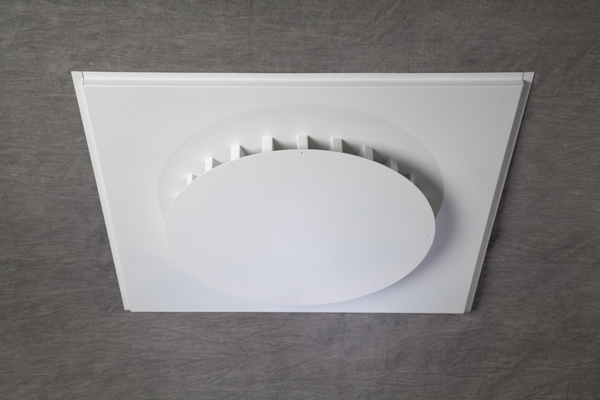
So, I'm looking for band-aids that I can implement with the limited political and financial capital I have available.
You have your work cut out for you!


Trying to treat cardiac arrest with band-aids is a tough job...
That's my "humorous" attempt to point out that it's not really feasible to fix the problem, without actually fixing the problem. There are some things you could do, yes, but the results probably won't be what you are looking for, and might backfire on your "political and financial" position: If you do start replacing stuff, even if you only spend small amounts on it, and it basically doesn't make much difference, that might not be a good thing for you...
Not trying to discourage you... just pointing out reality.
300 fps or 300 fpm? 300 fps is 204 mph

Here I am doing the same thing you did! FPS/CFM FPM/FPS! Man, I gotta stop typing so fast, and double-check my own posts... Yep, you are right: that should be 300 FPM, not FPS. A gentle breeze, not a screaming hurricane...
it would seem that our max airspeed at a particular register is about 764 fpm, or about 2.5x your limit.
Yup. Very true. Which explains the noise problem that you are having, to a certain extent.
This assumes that the dampers for each register are all set wide-open, which isn't the case, so some wind up getting more than this while others probably get less.
Partially closed dampers will add even more noise: they create turbulent air flow, which is noisy, and when that turbulent flow strikes the vanes in the register, it creates even more noise. Dampers should be located a long way upstream from the registers.
In this situation (assuming my understanding of the system is correct), do you think merely adding extra registers could be a potential solution -
To a certain extent, it would help. If you put in three times the number of registers, that would reduce the flow velocity to more reasonable levels while still providing good volume, and good cooling. Bot don't forget that you need three times as many return registers, as well: it's not just the supply side that has a problem. The air coming into the room has to get back out, so the total area of the return registers needs to be at least as much as the total area of the supply registers.
Plus, you'll need to have up-stream dampers to be able to adjust the flow rate to each room individually, and you'll need to do some manual balancing of those, so that each of the registers in a given room is supplying about the same amount, and the total between them is correct for that room (room volume x 6 room changes per hour = total volume of air you need to move though the room in one hour. Divide by 60 is the correct number of CFM. Divide that by the total open area of all the supply registers gives you FPM, and that result should be less than 300, preferably around 100).
perhaps not a perfect solution, but a better-than-nothing-and-not-too-expensive solution?
It would make a difference to the actual air movement noise, yes, since the air would hen be coming in slow enough to not cause audible hiss. But there might still be turbulence that still causes problems when it hits the registers,even at slow speeds, and there might be noise in the air stream itself, coming from further upstream. For example, the air is moving fast in the plenum (hurricane) so it is noisy in there. Even if you slow down the airflow, the noise is still there. That's why you need silencer boxes, or at least long runs of duct that has a couple of 90° curves in it. But you have to be careful doing that with flexduct, since curving it too tight into an actual bend will restrict the airflow, and thus cause an increase in velocity again, and turbulence... and you are back to square one.
The whole system has to be done carefully, thoughtfully, with an understanding of what is happening, in order to have any appreciable overall effect.
And that's without getting to the issue of this being a studio, and the loud sounds in the control room / tracking rooms finding their way through the HVAC ducting, into the vocal booth... and vice versa...
Doing studio HVAC right is not as easy as it looks.... and I guess the guy who did yours found that out along the way!
In my mind, we could splice an extra register and extra section of flexduct onto the main trunk, so that each room would have two registers instead of one.
Not enough. Your own math showed that you are at least 2.5 times over the limit, so only doing 2x is not going to get you there: you'd still be over the limit. You'd need three times as many registers. Both supply and return.
And it would behoove us to add the new ductwork as far upstream as possible, right? - say, by taking an extra feed off the main trunk rather than putting a y-junction at the existing register.
Exactly. Many many feet of duct, and a couple of curves along the way (but not bends) and the final curve should be at least 5x the diameter of the duct away from the register. So for 8" duct, the last curve needs to end at least 40" upstream.
It's worth a try, I suppose, but I'm not convinced that you'll be entirely happy with the result...
- Stuart -