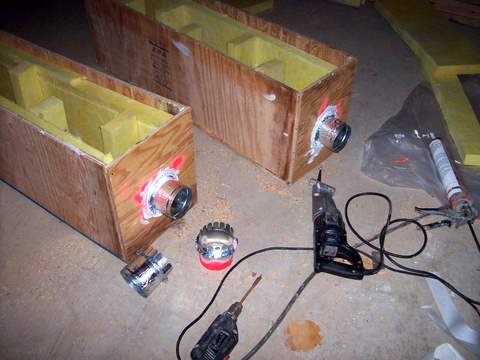
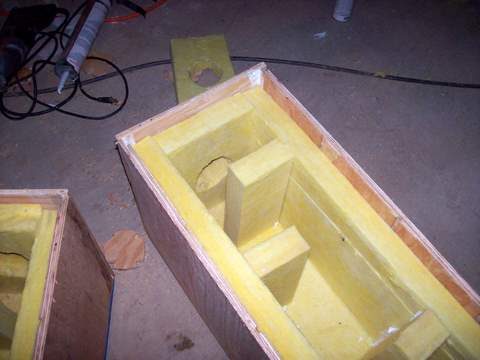
I have seen several pics here of home made airduct silencers made from wood and rigid fiberglass. I have done a search but I can' find them for some reason. I found one in Len Morgans studio diary but there was a couple more that I was interested in.
DOes any body know what I am talking about?
Might you have those pics handy?
I would greatly appreciate it as that is next on my list to build.
Thanks
Try this,
BTW- remember that this is sized specifically for the air-flow I needed in this particular iso-booth - make sure to size the unit to fit your specific needs.....
Try this,
BTW- remember that this is sized specifically for the air-flow I needed in this particular iso-booth - make sure to size the unit to fit your specific needs.....
That is probably what I need.......but I don't know it yet.
:oops:
I would love to think that they are mine but probably not
And they are dead quite
Tom
Yeah!!!!!!!!
That's the ones!! :D
Thanks
Did you cut the round hole with the sawsall?
What kind of glue is that?
I suppose Home Depot has that glue?
DId you ever wrap them in plastic? How did you secure the plastic if you did?
WHat is the red stuff?
What are the ruff dimensions?
My air ducts are 10 inch. I guess I will have to reduce them down as those fitting look smaller. I can't find those in 10 inch
My air ducts are 10 inch. I guess I will have to reduce them down as those fitting look smaller. I can't find those in 10 inch
Russ,
if you do that then it may not work properly - because you'll be increasing the velocity - which creates it's own air noise -
the idea is to pass everything through a box which:
a. has material that absorbs sound -
b. causes enough turns in the air flow as to for the absorbers to do their job
c. creates either a decrease (or at least not an increase) in air velocity.
The slot through the box is best sized at about double the inlet - this will decrease the velocity through the box by 1/2
if you are feeding the box with square duct - then just bring the square duct directly to the box - you don't need to convert to round - if you're bringing round duct to the box - you can use a ceiling outlet - round to round the size of your duct.
Take a loot at page 8 of the attached PDF file - they're on the right available for 5, 6, 8, and 10" round duct - and then transition to 6, 8, 10 or 12" for the outlet.......
you could also use - (up to 12" round duct and the same page and side) a top diffuser or side outlet diffuser (depending on your particular duct run) both of which are flanged for the box connection -
Otherwise, if your duct was upto round 14" - then you could always get a 14 round to to 14" square conversdion - same page - same side - top of page.
If you had round larger than 14" you could always have a custom piece made at a metal fabricator near you.
Rod
eruss,
Take warning in what Rod is saying. You want your box larger than your pipes. You can build it any size you want
Jig saw to cut the opening in the wood and a utility knife to cut the 703
Acoustical caulked all the corners acoustical caulk to glue in the 703
Tom
The cross sectional area of your baffles (which will likely have a rectangular shape) should be equal to the cross-sectional area of the pipes to which they attach...that way there will be no change in velocity (Bernoulli's equation).
Cheers,
Kris
The cross sectional area of your baffles (which will likely have a rectangular shape) should be equal to the cross-sectional area of the pipes to which they attach...that way there will be no change in velocity (Bernoulli's equation).
Cheers,
Kris
Kris,
with all due respect I disagree with that approach,
By decreasing the velocity by 1/2 you decrease the possibility of buffeting taking place within the chamber as the air makes it's way past the baffles - and buffeting air makes noise.
Remember that the entrance and exit are the same size - and thus - with the chamber designed according to my system (which decreases velocity by 1/2 - but also increases volume by a factor of 2) you get a net result of no change once it reaches the other side.
Everything works exactly the same as if it was hard piped (from the point of view of overall velocity and volume) - but with much quieter results.
Especially seeing as I use a design of 100fpm max velocity in the entire system - so I'm down to 50 fpm passing through the chamber.
So if I was feeding a 12x12 in - and returning to a 12x12 leaving - it would be - 100cfm @ 100fpm to 200 cfm @ 50fpm to 100cfm @ 100fpm.
As you can see the net is a smooth transistion with much less chance of noise within the chamber itself.
Designing so that machine noise doesn't pass through the chamber is not a problem - but you have to include creating a chamber that doesn't create any noise itself as well.
Sincerely,
Rod
Sorry Rod...you are correct, my suggestion was more as a minimum size (i.e. don't screw anything up by speeding up the flow). Bigger is better if it won't hurt transmission loss to the partition above (i.e. i.e. at some point your sacrificing the STC and TL of your partition for silencing the HVAC).
CHeers,
Kris
Sorry Rod...you are correct, my suggestion was more as a minimum size (i.e. don't screw anything up by speeding up the flow). Bigger is better if it won't hurt transmission loss to the partition above (i.e. i.e. at some point your sacrificing the STC and TL of your partition for silencing the HVAC).
CHeers,
Kris
Kris,
when I am lucky enough (and in the case of the Gemini Studio design I am that lucky across the board) I always make the outlet side of the baffle a hard connection to my framework - using an airtight seal - so it's a simple hard connection into the room - hopefully with no TL Loss (when I get real REAL lucky - which is pretty much always to date).
Well in my case I wanted to slow the air down. THe AC is massive in this place and would freeze us out if I did not.
THe Duct coming of the main trunk is 12 inch. I reduced it to ten inch with a 25 feet run that cureves around twice.
Then I built the silencer box 2 feet by 4 feet. and reduced the outlet to 8 inch.
Then I will have a 4 foot section of 8 inch air duct that comes out of the silencer and attaches to the frame work which I will attach the grill.
I tested it yesterday and it worked perfect! It was just the right amount of air comming out to cool the small room but not freeze us out.
However, I am wondering if one silencer is enough. DO I have to build another in the live room?
Is the purpose of the silencer to quiet the noise from the AC or to quit transfer of sound between the rooms in the studio?
Well in my case I wanted to slow the air down. THe AC is massive in this place and would freeze us out if I did not.
Except that you didn't slow it down - you sped it up...... and are still getting exactly the same air you would have gotten anyway - just faster and noisier....
The Duct coming of the main trunk is 12 inch. I reduced it to ten inch with a 25 feet run that cureves around twice.
Then I built the silencer box 2 feet by 4 feet. and reduced the outlet to 8 inch.
OK - wake up call - you should read a book about the properties of air handlers......
This is the way it works.......
Any residential fan coil unit can handle one 1" of static pressure water column (WC)easy..........
SO let's suppose for a moment that you have 250 cfm of air moving through your 12" round -
That would be 250 cfm @ 0.15" static pressure (WC) @ 320 fpm
now decrease the pipe to 10" round
that would be 250 cfm @ .038" of static pressure (WC) @ 460 fpm.....
now decrease to 8" round:
That would be 250 cfm @ 1.2" static pressure (WC) @ 700 fpm
Now - when you install your 8" register - that is going to increase your velocity even more - because an 8" register (due to the fact that they have turning vanes on them) actually only have about 83% net opening - which means your 8" just got squeezed down to almost 6" -
AND THE REGISTER ITSELF IS probably GOING TO BE NOISEY AS ALL GET OUT......
do you have the picture yet?
You are not supposed to try to handle flow through the use of pipe size - you do it through the use of a damper installed to be adjusted when the system is balanced. That establishes your air flow - and then 0 if anything - you INCREASE duct size to allow for the same volumes at reduced velocity......
If the existing system is working fine - you shouldn't just steal air without balancing because you then deprive the last register of whatever air you took.
so it the existing system has the capicity to handle what you need - then the entire system must be balanced after you finish installing your work - and balancing requires balancing dampers......
OK so far?
Now - the idea is to move all the air you want - as slowly as you possibly can - it's called a low velocity - high volume installation - which also decreases the static pressure on your system......
Is the purpose of the silencer to quiet the noise from the AC or to quit transfer of sound between the rooms in the studio?
The purpose of the silencer it to quiet down mechanical noise- as well as the noise caused by air movement - and should be installed immediately before entering the room - because it can also act (in that case) as a shield to protect the actual hole you penetrated the membrane with.... systems I design have the silencer aqttached directly to the structure at the point of entry.
Good luck,
Rod
Rod,
I did everything wrong according to what you said, BUT, I tested my system again today and it is perfect!
It is probably because I did it wrong that the air DID slow down. I am the one standing in front of it. I know.
There was no noise to begin with. So maybe I wasted my time.
If the silencer has nothing to do with stopping sound from live room to control room then maybe I'll just take it out. I'll just get colder faster.
Any residential fan coil unit can handle one 1" of static pressure water column (WC)easy
It is not a residential fan coil that we have. It is a commercial roof mounted system.
AND THE REGISTER ITSELF IS probably GOING TO BE NOISEY AS ALL GET OUT......
You are assuming things here. It is actually quiet as all get out.
do you have the picture yet?
Yes. But I'm affraid you will laugh at me. :oops:
If the existing system is working fine - you shouldn't just steal air without balancing because you then deprive the last register of whatever air you took.
so it the existing system has the capicity to handle what you need - then the entire system must be balanced after you finish installing your work - and balancing requires balancing dampers......
That probably DID happen, But I am not sure we are concerned about it. People in the other rooms might appreciate that. :D
I do not have any pics of the inside.
Rod's last post is one of the most informative HVAC-related posts on the forum and includes information that (I think?) doesn't yet exist in the current edition of his book. You would be wise not to be too fixated on your own anecdotal experience and pay very close attention to his decades of hands-on and pens-on experience in studio and HVAC (and studio HVAC) design.
If I may, with all due respect, I'm seeing a pattern of your asking questions and posting reports/pictures of your progress, but then when challenged about your techniques or assumptions, you tend to be rather defensive. I observed this in your "to bolt or not to bolt soleplates to slab" decision point, at which time the unanimous recommendation was to use bolts, especially given your area's seismic risk, yet you used nails anyway. :roll: Then there was your cavalier attitude about fire safety with your "Let it burn!" remark! :shock:
I don't worship Rod's words, but I do take them seriously. He also never seems to take offense at being challenged about the facts, about the whys... It usually leads to more learning and he always appears to welcome that.
I guess I'm just saying that we all want you to be successful, but it's getting hard (for me at least) to watch you getting terrific advice -- the kind many would pay big bucks for were it not for this forum and its generous-with-their-time membership -- which is often/typically ignored or challenged on its merits.
I hope this I coming across the way I intend it to. I really do care about the outcome of your project, but it's truly getting to the point that I may just have to cover my eyes.
Respectfully,
--Keith :mrgreen:
Rod,
I did everything wrong according to what you said, BUT, I tested my system again today and it is perfect!
It is probably because I did it wrong that the air DID slow down. I am the one standing in front of it. I know.
Yes you did do it wrong - and no - not according to what I said - but according to what SMACNA says - along with he entire history of HVAC design.
I do not invent these things I say - so I don't really understand your sarcasm............
"There was no noise to begin with. So maybe I wasted my time."
That is an assumption on your part.......... I'll explain below........
"If the silencer has nothing to do with stopping sound from live room to control room then maybe I'll just take it out. I'll just get colder faster."
I'll try again -
There are 2 totally seperate sources that sound can travel from place to place - IF YOU HAVE COMMON DUCTING FOR HVAC......
The first is through the duct itself........
The second is through the ceiling penetration - through the air - in into another ceiling penetration in a different room.
The silencer you have will deal with the 1st - and would have dealt with the 2nd as well - except that you didn't install it to do so.........
You are assuming things here. It is actually quiet as all get out.
Actually, it's you who are assuming things here..........
1st off - what exactly is the level of your ambient background noise right now? I have a feeling you don't know......... neither do I - but I do know this - it is going to be a whole lot less once you finally install the completed work - and until that point in time - the ambient noise can completely mask the noise of the HVAC........
You'd be amazed what little things you can hear (that will bother you) when you walk into a room that is acoustically isolated from the world to any great degree.
Even the smallest of background noise becomes very annoying because it's so apparent......... remember - we live in world where we are always surrounded by sound - and a lot of it just becomes background noise that we ignore - but when we step into an environment that is outside the norm - then things change.........
Next - you have no way of knowing exactly what your final product will produce for sound because you still have not installed the supply register........
As to your "slowing down the flow" with your method......... I dodn't do any advanced math to come up with those figures above - I simply used a one page item called a Ductulator - tool made by Trane Company.
I took a beginning of 250cfm and your 12" round and then examined the changes that would follow if I maintanined the same airflow (CFM)............ the static wasn't excessive - so the system would provide air (without dampers) exactly as I said...... with an increase in velocity -
You can argue with whatever you want - but the only thing that can defreat air flow calculations os some sort of obstacle stopping the air from moving as it should.
SO this means that you did sometning to defy the laws of physics....... which means that you have created a tremendous back pressure on the system.
I have to ask you - what was the flow and static in your original 12" pipe - and what is the static and air flow at your final outlet.........
If i owned the building you're in - I would be taking a reading on the amperage draw of the fan coil unit you're tied into - excessive static pressure can cause the fan motor to go into thermal overload - and (after a bunnch of resetting) eventually cause it to burn out.
Yes. But I'm affraid you will laugh at me. :oops:
I don't laugh at anyone's work - and actually it looks pretty good.......
Sincerely,
Rod
Yes you did do it wrong - and no - not according to what I said - but according to what SMACNA says - along with he entire history of HVAC design.
I do not invent these things I say - so I don't really understand your sarcasm............
I did not say you invented it. I said you said it. No sarcasm intended.
There are 2 totally seperate sources that sound can travel from place to place - IF YOU HAVE COMMON DUCTING FOR HVAC......
The first is through the duct itself........
Then should I keep what I have? Will it do nothing to stop noise from place to place? That is my main concern. NOT the air noise.
You'd be amazed what little things you can hear (that will bother you) when you walk into a room that is acoustically isolated from the world to any great degree.
No I won't be amazed. THis is not my first time in a recording studio listining. I know how that sort of things goes.
1. The AC will not be on full time. It is on a timer that can be turned off when critical listening is being done. 2. I am more concerned about compter and fan noise than what will come out of that duct. I'll be posting about that soon. I will really need your help on that. Hopefully you are not tiered of me by then. :D
You can argue with whatever you want - but the only thing that can defreat air flow calculations os some sort of obstacle stopping the air from moving as it should.
LOL. My silencer would be that obsticle.
SO this means that you did sometning to defy the laws of physics....... which means that you have created a tremendous back pressure on the system.
Tremendous, no. Back pressure.........yeah.
I have to ask you - what was the flow and static in your original 12" pipe - and what is the static and air flow at your final outlet.........
If i owned the building you're in - I would be taking a reading on the amperage draw of the fan coil unit you're tied into - excessive static pressure can cause the fan motor to go into thermal overload - and (after a bunnch of resetting) eventually cause it to burn out.
The building is some 30,000 to 50,000 sqft. The ducting runs though out. I seriously doubt that this little blockage will cause that, BUT, If you really think it will then I will take my silencer out. Or, if it causes that then I have a way of accessing it after contruction is completed to take it out.
Or I will take other suggestions you have. But I really don't want to build another one. I am very bad at it and I will screw it up again. If I can buy one to fit for less than $200 then I will buy one. We are not over budget yet, but I want to keep it that way if possible.
I don't laugh at anyone's work - and actually it looks pretty good.......
Thank you sir. Your time and coments are extreamly valuable. Even if I don't take your suggestions,I still need them and I really appreciate it very much. Any problems that develope later as a result of me not heeding your advise will not be blamed on you. I accept full responsibility for what I do now that may effect us later.
Eruss,
what I would do if I were you......
Pick up the box and install 2 layers of drywall to place it over.
Take the penetration you have running out the end and plug it up.
Replace that penetration with one going down in the same location as you have now..
Frame out an opening (in your ceiling joist where the drop is) about 16" wide and then enclose all 4 sides of it with drywall. Make sure to caulk the corners and stagger the joints (and use backer rod of course). SO now your drop will pass from the baffle through a sound stop......
Reinstall your drop and outlet......... insulate around that well.
When you install your ceiling make certain to caulk against the drops of the drywall box you installed above.
This way the baffle you built will serve dual purpose - stop air (and mechanical) noise through the duct itself - and stop sound transmission from room to room.
Rod
Eruss,
what I would do if I were you......
Pick up the box and install 2 layers of drywall to place it over.
But not over the whole ceiling right. Just enough to cover the size of the box. right?
Replace that penetration with one going down in the same location as you have now..
I was originaly going to do that.
Frame out an opening (in your ceiling joist where the drop is) about 16" wide and then enclose all 4 sides of it with drywall. Make sure to caulk the corners and stagger the joints (and use backer rod of course). SO now your drop will pass from the baffle through a sound stop......
Reinstall your drop and outlet......... insulate around that well.
So you think there will be noise comming from the box. I don't think that will happen, but, It will be hard to do this after I dry wall in the room.
hmmmm......
I'll think about it. I can always turn off the AC when it is critical listening time.
But since I'm going through all this, I should take your experienced suggestion.
Thank you Rod!
Eruss,
what I would do if I were you......
Pick up the box and install 2 layers of drywall to place it over.But not over the whole ceiling right. Just enough to cover the size of the box. right?
Yup just box size........
Replace that penetration with one going down in the same location as you have now.. I was originaly going to do that.
Good
Frame out an opening (in your ceiling joist where the drop is) about 16" wide and then enclose all 4 sides of it with drywall. Make sure to caulk the corners and stagger the joints (and use backer rod of course). SO now your drop will pass from the baffle through a sound stop......
Reinstall your drop and outlet......... insulate around that well. So you think there will be noise comming from the box. I don't think that will happen, but, It will be hard to do this after I dry wall in the room.
hmmmm......
I'll think about it. I can always turn off the AC when it is critical listening time.
Sure you can - but if you don't have to why bother?
One more question here? How areyou handling trning on and off your surpply air? You mention turning it off if you want - but you also said this was a roof top unit that handles the building (or at least you floor) So how are you doing this?
Rod
One more question here? How areyou handling trning on and off your surpply air? You mention turning it off if you want - but you also said this was a roof top unit that handles the building (or at least you floor) So how are you doing this?
Rod
There is a timer in the hall way. It is one of those dials you turn and it winds down till it shuts off. I can set it for 5 minutes or 30 minutes, or just turn it off.
I sat in that room last night with all the lights off an nobody around with the doors shut and the AC on. I could here the crinkling of the insulation I just put up but no noise at all comming from the air duct.
Remember the AC units are another 30 feet above where my silencer is. Those ducts you see in the pic are NOT the main trunk. The main trunk is big enough to crawl in and it runs maybe 150 feet from the main unit before it gets to where my ducts are wich then runs another 30 feet before it gets to my silencer.
Could that be why I don't hear anything? I have been a recording engeineer for 25 years. I am trained to here stuff for a living. I would think that if the AC made noise I would certainly here it.
If Insulation does not crinkle then my head makes noise, but not the AC.
Maybe something will be different once the Dry wall goes up?