Yup! Very true... you informed us that you are a signature-spaming low-life twerp, so that information got you blocked, banned, and deleted... informatively!
- Stuart -
I have low end studio monitors that are back ported. Will flush mounting work with speakers that are not front ported. :?:
Absolutely yes! The majority of rear-ported speakers can, in fact, be flush mounted, as long as the flush mount system is designed correctly. Here's an example: viewtopic.php?f=2&t=20471 The speakers in that studio are Eve SC-407s, which have rather large ports on the rear. As you can see, they were flush mounted very successfully, and
the performance is outstanding.
So very likely your speakers can also be flush mounted. What speakers do you have? (make and model). Unless they are very unusual in some sense you should be OK.
- Stuart -
Based on the very well explained Genelec flush mounting techniques, and the techniques mentioned on this forum, i was wandering if i can make the outer wall from concrete blocks, and fill the inner space with absorbant material, and also place an opening (like a speaker port) near the bottom of this concrete wall, so that the air can enter and by convection cool a bit the speakers. In this case, do i get any significant advantage on using concrete blocks instead of wood or mda? should i calculate this port based somehow on the speaker size? thanks in advance guys!!!
Cheers from Argentina!!
Any recommendations on the sound absorbing material to deaden the cavity? Would 50mm (2") lets say 46kg/m3 (no idea in imperial sorry) be enough or something more broadband like perf wood is better for low freq abs?
Is there any rule of thumb on the minimum dimensions of the speaker cove? The smaller (with sound absorbing material) the better?
Thanks
As long as the monitors never come in contact with the front baffle, any method of decouplig the monitors from the framing of the baffle should suffice, correct? The goal is to limit vibration transfer between the two? Would suitably matched monitors and sorbothane hemispheres be sufficent since they stop 96% of energy transmission? I know another well respected studio designer uses them to decouple the monitors in his flush mount designs, but your thoughts would be appreciated.
For instance, in the following scenario, placing the monitor on the shelf, but decoupling with sorbothane vs buildig a rigid box to hold the monitors in place
Recovered from web.archive.org — originally hosted at http://i64.tinypic.com/r7m8pc.jpg
Would suitably matched monitors and Sorbothane hemispheres be sufficent since they stop 96% of energy transmission?
Hi Jason,
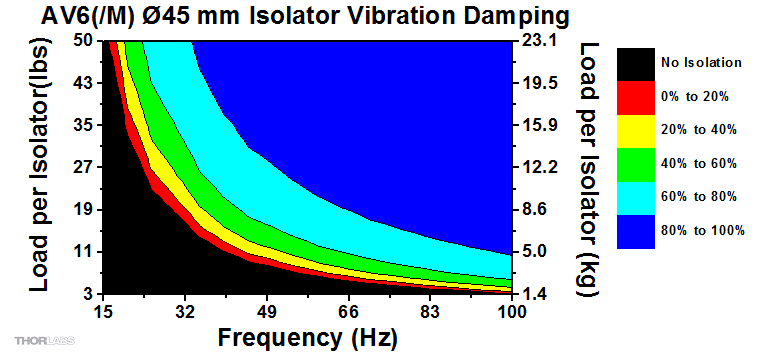
I'm not sure where you got that 96% figure, but it's certainly not true for low frequencies. This graph shows transmission data for a 1.77 inch thick Sorbothane foot. The thickest hemispheres I can find are only 1.25 inches.
Recovered from web.archive.org — originally hosted at https://www.thorlabs.com/images/tabimages/45mm_Isolator_780.gif
Thomas
Thanks for the reply, Thomas! I do not have any frequency specific data. I reviewed the manufactures claims, and they state, "absorbs 94.7% of vibration", not the 96 i previously stated. Thats at 1" hemisphere with a durometer of 50 (they have hemispheres up to 2" on their site). 6 of those would have a rating of 24lbs, the same as my monitors, eve audio sc208's. Considering the cutoff frequency of the baffle step at 447hz, and the fact that i will be using a subwoofer as well, would that be effective isolation? Or should i mount the monitors in a rigid box?
Or is it that the problem is the baffle transfers energy to the monitor instead of the problem being the monitor transfering energy to the baffle? If thats the case then decoupling the monitor as in your method is the superior choice? Correct?
:oops:
Thanks for the reply, Thomas! I do not have any frequency specific data. I reviewed the manufactures claims, and they state, "absorbs 94.7% of vibration", not the 96 i previously stated. Thats at 1" hemisphere with a durometer of 50 (they have hemispheres up to 2" on their site). 6 of those would have a rating of 24lbs, the same as my monitors, eve audio sc208's
As Thomas pointed out (Hi Thomas! Welcome back!!! :thu: ), it's not as easy as that. And manufacturer's claims should be taken with a large grain of salt!
That said, I do use Sorbothane pads (not the hemispheres!) in my speaker mount designs, but it's a real pain to get it right: As the graph posted by Thomas show, you need to get a lot of weight on the pads in order to get the frequency down low enough... but you also have to ensure that you don't over-compress (or more accurately "over deflect") the rubber, as that will trash your isolation too.
Also, do take into account that in acoustics, we don't often talk about isolation in terms of "percent", as that's misleading. It's more common to talk about it in decibels. I always get skeptical when I see isolation claims specified in percentages, as it is easy to mislead like that. Someone who claims their product "stops 75% of sound" is not saying much at all! It sounds like a LOT, but it rally isn't. If your car fuel tank is 75% full, you have plenty of fuel, but if your speaker isolator gives 75% transmission loss, that's pretty poor. This conversion scale might help illustrate:
Image not preserved: dB-to-percentage-conversion.jpg
It's the reciprocal of 94% that you want here, so look at the 6 percent mark on that graph: it's about 24 dB. So if you could tune your mounting system to isolate across the full audio spectrum according to that 94% figure, you'd be getting 24 dB reduction. And that's assuming that you really do get 94%! If it turns out to only be 85%, then the reduction is more like 15 dB.
But what does that even mean? The isolation is different for every frequency on the spectrum, so when they say "94%", do they mean at 100 Hz? Or at the resonant frequency? Or maybe one octave higher? Or 4 octaves higher? They don't say, so you can only guess...
Saying that a product "isolates 94%" is basically meaningless, unless that is qualified with more data.
For example, lets' assume that the 94% figure is true for a tone of 1 kHz. But isolation rolls off ever more steeply at lower frequencies, for reasons that are a bit complex to go iot here (but you can see that on the graph Thomas posted), so even though the product might really provide 94% isolation at 1 kHz, it very surely will not be 94% at 100 Hz! Maybe 80%, with luck... And at 50 Hz, it will be far worse... The isolation gets worse, the lower you go.
You also need to factor in your cross-over (assuming you are using a sub). You might think that because you have a sub, your mains are not sending out any low frequencies, and all of the lows will be coming only from the sub. But that's not correct. For example, if you have your cross-over set to 80 Hz, that does not mean that your main speakers stop dead cold at 79 Hz! They are still emitting abundant sound down to much lower frequencies. Your SC-208's are spec'd to get down to 36 Hz (-3dB), so they are very much capable of putting out a lot of energy at low frequencies, even considering the cross-over. Let's say your cross-over is second-order: it's rolling off 12 dB per octave, so at 40 Hz (one octave below the cross-over point) the level is only 12 dB down: still quite a lot of energy there. Even if you use a fourth-order cross-over, rolling off at 24 dB per octave, that still allows a fair amount of power output at 40 Hz, or 30 Hz, or even 20 Hz. And it's the vey low frequencies where vibration becomes a big issue.
In other words, if you go with a resilient mount, you need to ensure that the isolation system is tuned way lower than the bottom end of the speaker's spectrum, even if you use cross-overs, or else the speaker could still be transmitting substantial vibration into the soffit structure.
Considering the cutoff frequency of the baffle step at 447hz,
The baffle step response is not related to the speaker cut-off frequency. Baffle step is about something else entirely: it's the frequency where the front panel of the speaker stops acting like an infinite baffle, and sound can start "wrapping around" behind the speaker.. And it's not really a "cutoff" either: more like a "roll-off". But either way, the baffle step response does not influence what you are trying to accomplish with the mounting system. In simple terms, your mount must either be tuned so that it provides sufficient isolation at least an octave below the lowest frequency that your speaker will be producing in order to not transmit excessive vibration into the soffit structure, or it must be rigid, solid, and massive enough to be able to handle that energy transfer without vibrating.
- Stuart -
Ok, that clairifies things a bit. Thank you, Stuart. It seems a resilient system would be much more involved than I anticipated. I think my best bet would be decoupling the monitor tray from the baffle framing.
I think my best bet would be decoupling the monitor tray from the baffle framing.
The exact same principles apply... :)
The only thing easier about that, is that you have the additional mass (weight) of the tray and speaker enclosure box, which is useful for compressing (deflecting) the Sorbothane correctly...
But it still has to "float": decoupling ALWAYS implies that it has to be done at the right frequency, no matter where you do it: at the speaker, or at the tray, or even the entire soffit! You still need to get that resonant frequency down low enough.
- Stuart -
I dont see where thomas used a speaker enclosure box in his design. It looks like the monitor just sits on a tray that has zero contact with the baffle or baffle frame. I dont even see how an enclosure box would be possible with the sc208's. The manufacturer states that there should be a minimum of 2mm gap on the sides and top of the monitors to allow for proper function of the bass port. How would i rigidly mount a monitor and leave a gap?
I dont see where thomas used a speaker enclosure box in his design. It looks like the monitor just sits on a tray that has zero contact with the baffle or baffle frame. I dont even see how an enclosure box would be possible with the sc208's. The manufacturer states that there should be a minimum of 2mm gap on the sides and top of the monitors to allow for proper function of the bass port. How would i rigidly mount a monitor and leave a gap?
It's 2cm, not 2mm.
From the manual: "EVE Audio monitors can also be flush-mounted in a wall, in which case there should be enough air flow. This is important to keep the electronic components cool but also to allow for the best performance of the bass reflex port. We recommend to keep at least 2 cm to the sides and top."
Which is why I do not mount speakers tightly in a rigid box! I mount them loosely in a rigid box, with separation on all sides (including underneath). There is air flow all around, on all sides, plus correct compensation for the bass reflex port. I'm not sure if you have seen the Studio Three Productions thread (www.johnlsayers.com/phpBB2/viewtopic.php?f=2&t=20471)? Those are the "big brothers" of your speakers: Eve Audio SC-407's, and they are soffit mounted using my system. You can see the results. When I did that, I spoke to the chief engineer at Eve Audio, I explained what I intended to do and why, including mounting them vertical instead of horizontally. He agreed, and gave it his blessing, with a couple of tips. Great people at Eve, by the way. Very helpful.
Those speakers are mounted inside large, rigid, heavy, massive enclosure boxes, but with an air gap all around, and provisions for both the rather large bass reflex port on the rear, and also for cooling air flow up past the rear. They are resiliently mounted on Sorbothane pads, and the resonant frequency is a little below 13 Hz. They are hooked up with a couple of subs, and there is a cross-over in there, set a little above 90 Hz. So the resonant frequency is roughly three octaves below the cross-over point, and as you can see, they are fully floated and working fine. The cross-over is fourth-order (24 db/octave). There's very little energy coming out of them below about 35 Hz, which is the low end spec for those guys (35 Hz, -3dB), and no discernible vibration in the soffit structure. I doubt that I could have got that performance with any other mounting method.
You don't need to be too daunted by the task: it can be done, with a little patience, careful design, and a few calculations...
- Stuart -
I see. I sent the folks at eve an email earlier today. Hopefully they can point me in the right direction. I know the baffle frame and 1.5" thick baffle will be extremely rigid. So basically, youd advise making a massive speaker enclosure about an inch too big on all sides and then place multiple sorbothane pads evenly inside on all sides of the box to have the monitors "float"? Would i leave a 2cm gap between the baffle and monitor as well or shrink it down to 3mm?
So basically, youd advise making a massive speaker enclosure about an inch too big on all sides and then place multiple sorbothane pads evenly inside on all sides of the box to have the monitors "float"?
That's the basic idea, yes, but the pads are not spaced even around the speaker: they are spaced where needed, and sized accordingly. For example, the pads underneath the speaker will have the full weight of the speaker on them, plus the pressure applied by the ones on top, but the ones on top will only have the pressure applied by the "lid" of the box. So you need to adjust the dimensions of the pads to account for that. And the ones on the sides have no weight at all on them, but they do have the pressure applied by the side walls of the enclosure box. so you need to adjust the dimensions of the box to get that pressure correct, and adjust the sizes and placement of the pads for that pressure. You will probably also need to adjust the locations of the pads under the speaker, to keep it on an even keel, since speakers often have uneven weight distribution inside. That leads to some pads being more compressed than others, so you need to nudge their locations around to compensate, such that the speaker sits level with just the pads under it (no pads on sides or top yet).
Would i leave a 2cm gap between the baffle and monitor as well or shrink it down to 3mm?
Thin gap between the baffle and the speaker. 3mm is fine. Don't go too thin on that gap, or you run the risk of the speaker vibrations when played at very high levels causing the speaker to touch and vibrate against the baffle. Some people like to seal that gap with a bead of very flexible caulk or rubber, but I'm not to keen on that. But don't get confused here: even though you have that thin gap around the speaker to the edges of the baffle, you still have a larger gap (maybe 1cm or so) between the rear face of the baffle, and the front edge of the enclosure box around the speaker. Once again, that's for air circulation. And because of all that, the speaker is sticking out well beyond the enclosure box: you say you plan on having a 1.5" baffle, plus another half or so for the gap I just mentioned (enclosure box to baffle rear face), so the speaker is "cantilevered" about 2" beyond the point where it is supported by the sorbothane pads. In other words, it is slightly over-balanced forwards, with more weight on the front pads than the rear ones. That's another reason why you need to nudge those pads around to get the speaker to sit flat inside the box, before you put the side and top pads in.
Lots of stuff to think of when soffit-mounting! :)
- Stuart -
Ok, that seems doable. I can only imagine how difficult its going to be to slide the speaker in that box full of slightly compressed no skid pads. :shock:
Thanks, Stuart. You've been extremely kind, and i truly appreciate your input.
I can only imagine how difficult its going to be to slide the speaker in that box full of slightly compressed no skid pads.
Hint> Don't do it that way! You'll never get it in. Instead, build the box around it... Start with the base, then glue the pads to the side panels and attach those to the base/back. Then put the top pads on, adjust locations for even pressure, and screw those down too. When it all works properly, take apart, glue, and re-assemble.
- Stuart -
Can you think of a reason why this wouldnt work?
If i used the sorbothane hemispheres under the speaker ( and they were positioned as to support the speaker in a level position independently), and then used the sorbothane bumpers for the sides and top, I would be able to insert and remove the speaker as well as make pressure adjustments after the speaker box was built.
Bumpers below..
https://www.isolateit.com/sorbothane-vi ... -1498.html
Constructed as pictured below. Ive seen tensioners built the same way. The nuts on either side of the speaker box securing the bolt would hold extremely rigid.
Recovered from web.archive.org — originally hosted at http://i65.tinypic.com/2884d2v.jpgId love to hear your thoughts on this approach..
It's an interesting idea! Looks like it should work.
Give it a try, and let us know. Test it OUTSIDE the soffit, with your speaker and enclosure box set up on a stack of bricks in your back yard, or some place like that, where you can get a good clean test, without interference from the room.
- Stuart -
Hi,
Ive asked this here rather than the "Soffit Mounting?" thread (which seemed more apt for this particular question), as there doesnt seem to have been much activity there in recent times. Apologies if its in the wrong place!
Nonetheless:
I have a question with regard to using a stand to mount the speaker on within the soffit, rather than an inner frame.
If one were to do this, as Barefoot states is acceptable at the start of this thread, but also incorporate his design for a speaker mount, would it be necessary to partition the spaces above and below the speaker (as per John's design)? While a partition above is easily doable, one below seems a bit more uncertain due to the speaker column running up through the middle of the soffit cavity.
One could of course partition around the column (leaving enough of a gap that the two dont touch), but would that compromise any acoustic properties of the soffit?
Also, while Barefoot's speaker mounting method does not incorporate a box around the speaker (unless im missing something here?!?!), how would one deal with the insulation surrounding it? Just stuff it in and close the thing up? Use chicken wire? Partition it off? Actually build a surrounding box/frame?
Im nearly at the stage where these questions need to be put into practice and am thinking of going down the speaker stand route (build from 2x4" and bolted to the ground).
Thanks
Chris
It's an interesting idea! Looks like it should work.
Give it a try, and let us know. Test it OUTSIDE the soffit, with your speaker and enclosure box set up on a stack of bricks in your back yard, or some place like that, where you can get a good clean test, without interference from the room.
- Stuart -
How exactly should i do the test? REW sweep with and without the box out in a field?