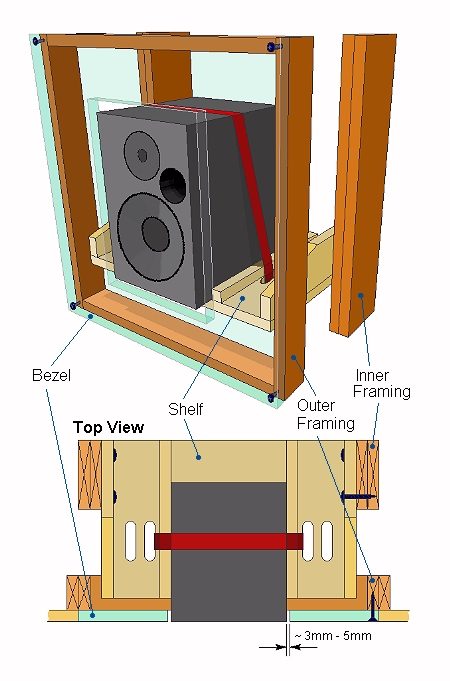
Here is a method for a flush mounting that I developed a couple of years ago. It provides for a simple modification method when upgrading your monitors. It also helps isolate the speaker cabinet vibrations from the control room. The picture below depicts the basic design. The front bezel is clear in the picture to help visualize the whole setup.
Here is an outline of the method:
1. Create an opening that is large enough to accommodate your monitor or any monitors you might potentially use in the future, plus some extra room for sound absorption material. Building a larger space than what you presently need gives you the flexibility to upgrade. Avoid building any structures that directly couple the inner and outer framing.
2. Rigidly mount an adjustable shelf to the inner framing. Mounting to the inner framing isolates the cabinet vibrations from the control room. I've depicted small wooden rails attached to the shelf to maintain the monitor's lateral position. A belt clamp thens hold the monitor firmly to the shelf. The face of the monitor should be flush with the front wall.
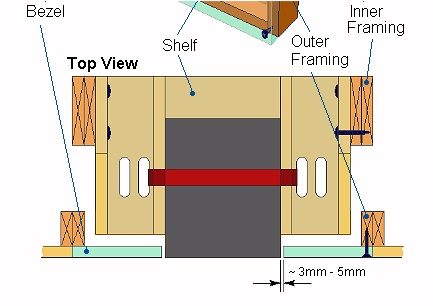
3. Screw mount a rigid bezel to the outer framing. The bezel should be flush with both the front wall and the front of the speaker. The more massive and rigid the bezel the better. The opening should not contact the monitor cabinet, but the gap should be no more than 5mm (3/16 inch). You might have the idea of filling the gap with some sort of gasket, but this is both unnecessary and detrimental. Any gasket will increase the transfer of vibrations to the bezel, therefore, effectively increasing the cabinet radiation surface area. Gaps less than a half wavelength will have little effect on wave propagation. 5mm is less than 1/3 wavelength at 20kHz, so audible diffraction induced by the gap isn't an issue. In any case most tweeters radiate very little energy 90° off axis at 20kHz. When you upgrade your monitors all you need to do is remove the bezel and cut a larger size opening, readjust the shelf, then mount the new speaker and screw the bezel back in.
4. Fill the extra space in the mounting cavity with sound absorbing material like fiberglass. This will help absorb sound radiated from the monitor cabinet.
You might have noticed that a big part of this mounting method centers around isolating the monitor cabinet energy from the control room. Loudspeaker cabinets are almost invariably under-constructed and can radiate a significant amount to energy, resulting in coloration. If you follow these design principles, I think you'll hear a noticeable difference from a simple flush mount.
Hope you find this useful!:D
Thomas
Sorry for my lack of clarity. One of our English as a second language members asked me what "bezel' means. A bezel is a rim or frame that encompasses an object. The light blue front panel in my picture is the bezel.
I updated the picture with more labels and reworded some of my description in the post above to make things clearer.
Thomas
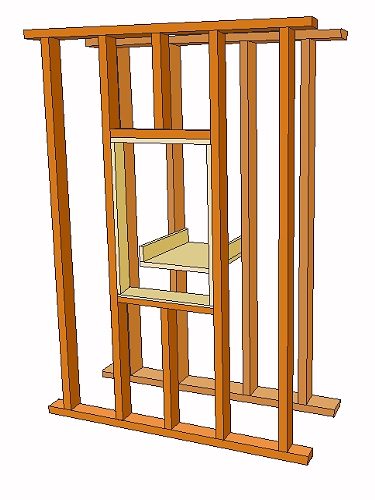
Here is another drawing, in case anyone is having trouble envisioning the "big picture" of this design. The inner and outer framing are completely isolated from floor to ceiling. The speaker shelf is attached to the inner framing.
Thomas
What about using a stand instead of the inner framing construction? That would lessen sound transmission to floor as well as lessen sound coloration by vibrations transmitted to the inner frame...
Or am I missing something?
Xspring,
A stand is perfectly fine. The main points of this design are to decouple the speaker from the front wall and make it easy to upgrade your speakers. Everything else is secondary. The reason I chose a shelf mounted to the rear wall is because it provides a large amount of decoupling with a rigid support. It also integrates easily with John's soffit design. But yes, variations on the speaker mounting are no problem.
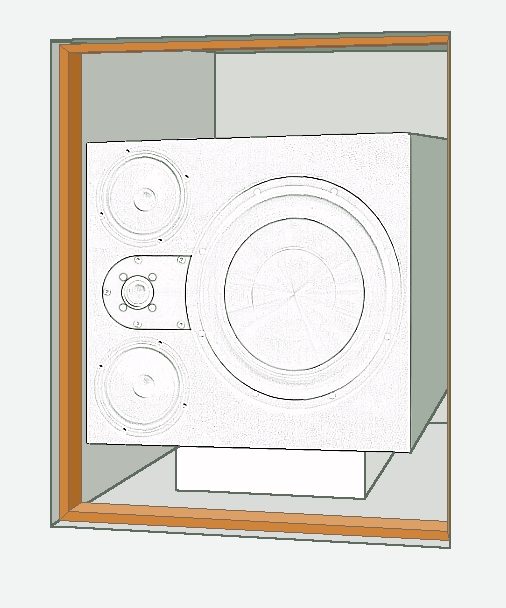
Here is an example of how you might mount a speaker into an exiting soffit opening using my method. You would attach a frame inside near the front on which to mount the bezel. Then you could mount the speaker on a heavy stand.
Recovered from web.archive.org — originally hosted at http://barefootsound.com/homerecording_images/soffit-existing.jpg
Thomas
Bluefield Studios has posted some great construction pics and final pics of their bezel soffit implementation! Recovered from web.archive.org — originally hosted at http://barefootsound.com/homerecording_images/THUMSUP.gifStudios Under Construction - Bluefield Studio
Hello Thomas. My small studio is located on an upper floor, and although it is just my personal studio and listening space, I am trying to treat this room the best I know how. After reading about placing monitors on a decoupler of some kind between the monitor and a massive stand such as concrete, I was concerned about the point load on my upstairs floor. Hence my interest in your soffit framing design.
I am just starting to frame my soffit enclosures, and checked here to update my familiarization with your concept. However, upon further inspection of the drawing above and this statement:
The inner and outer framing are completely isolated from floor to ceiling.
I must be missing a critical piece of puzzle :? Exactly WHAT isolates these frames from the room envelope, if they go from floor to ceiling as I see what looks like floor and ceiling plates in the framing picture, yet i see nothing that would decouple the inner frame. And since the monitor is rigidly mounted on the shelf which in turn is fastened to the inner frame, how does this isolate anything? It seems to me this directly couples the framing to the room envelope AND the front framing. Wouldn't this be a direct flanking path through the structure to other spaces in the building as well? What am I missing here please? Thanks.
fitZ
I must be missing a critical piece of puzzle :? Exactly WHAT isolates these frames from the room envelope, if they go from floor to ceiling as I see what looks like floor and ceiling plates in the framing picture, yet i see nothing that would decouple the inner frame. And since the monitor is rigidly mounted on the shelf which in turn is fastened to the inner frame, how does this isolate anything? It seems to me this directly couples the framing to the room envelope AND the front framing. Wouldn't this be a direct flanking path through the structure to other spaces in the building as well? What am I missing here please? Thanks.
fitZ
Yes, the monitor is strapped to the shelf that attaches to the inner frame. However, neither the monitor nor the shelf touches the outer frame. So there is no direct coupling.
Maybe the top view in my first drawing is misleading? If I remove the horizontal piece of outer framing that's under the monitor, does this make it clearer?
Thomas
Wow, that was fast. :shock::lol: Ok, I understand that the monitor and inner frame are NOT touching, although, it would appear that they are STILL coupled via the floor and cieling, no? If the only thing that matters is the baffle on the front frame is NOT physically touching the monitor case, then let me ask you this.
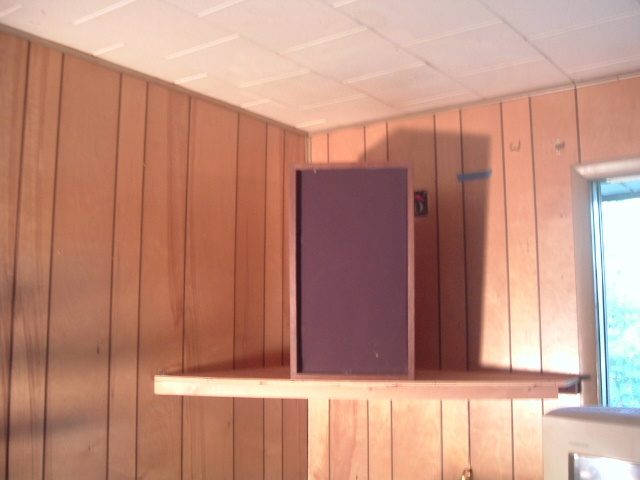
Here is a picture of a TEMPORARY shelf, that I mounted to measure the geometry of the FRONT frame. I was going to remove this and build the inner frame to support the monitor. But from what you've told me, it would appear that as long as the shelf doesn't touch the front frame/baffle, then it would do the same thing, no? Actully, if this will work, I'll further support the shelf with a heavy duty brace back to the wall. Still seems like structural transmission will occur to the wall and then to the soffit face even though the frame/soffit face panel/ and the monitor do not touch. Hmmm. Could you comment on that? I'd sure hate to have these vibrations structurally transmit to the bedroom while my wife is sleeping. :lol:
Also, I see no studs at either frame, at the wall connections for a baffle to fasten to for stiffness. Is this unnecessessary?
In addition to that Thomas, I could have sworn that at one time, there was a previous design that used an EXTERIOR box to slide the monitor box into, with only a thin layer of decoupling material between them. What happened to the exterior box??? The reason I ask, is I was going to beef up my monitor cases by gluing a layer of 1" MDF to the existing monitor case with GREEN GLUE. And then slide this whole massive box into the box I am referring to in a previous design of yours. But now, I'm a little confused, expecially with gluing another layer of mass to the existing box.
Are these steps or concepts unnessessary now?
Anyway, the speaker you see in the picture is an OLD JBL studio monitor design, but sounds just fine for my humble purposes, although I plan on filling in the recessed baffle with a layer of MDF and moving the speaker forward flush with the new baffle(which will be flush with the soffit face(baffle extension?).
:?
Thanks again Thomas, especially considering our dissimilar views on other subjects. I finally realized the rediculous nature of the Cave. Ha! You once again prove you are a gentleman.
fitz
fitZ
Yeah, the shelf you have there is fine. The "inner framing" can be your existing wall or corner or whatever. My drawings weren't intended to be specific construction plans. I just wanted to illustrate the general concepts.
Yes, the soffit face is still coupled to the speaker via the wall. But it's a very indirect coupling. A more roundabout coupling path means less vibration transmission.
John has a more traditional soffit design with a box. Maybe you're talking about my suggestion to beef up the speaker cabinet by gluing or clamping extra wood to the sides?
Thomas
Hello Thomas. Hey, sorry I didn't get back to thank you right away. I had total disconnect/meltdown from the net for over a week from simply moving my modem/router/computer net from one room to another. What a nightmare. I can't believe what happened. Anyway, thats another story.
To continue this decoupling issue, I have a few more questions in that regard, but have a few other issues which are related . All which must be solved before cutting the baffle fronts so at this point I need to start my own new thread, which I will do tonight.
Thanks again Thomas, and if you have time, please look at my thread/issues and comment accordingly. Your input is highly appreciated.
Oh, btw, the issue of another "box" around the monitors will be included in my thread.
fitZ
Hi
I notice on the pictures of Dave Blauvelt's sutios he has soffit mounted Dynaudio BM15a's. Has there been any equalisation of these speakers?
I was interested in doing this a couple of years back but was told on this forum that because of the way the speaker is designed you had to have something to reduce (or increase, i can't remeber which!) the bass frequencies of the speaker when soffit mounting..
So, how do they sound? Brilliant i bet. If so I'm definitelky going to do it myself!
Cheers
Oliver
Just a question regarding the bezel, is the bezel required to retain a hard reflective face, or could it be covered in an absorptive material? Would covering it in say 1inch rigid glass be beneficial or do you want your bezel to act as an extension of the speaker?
Thanks for any help, am about to mount my Mackies,
Matt
Hi Matt,
Yes, the bezel acts as an extension of the speaker. So you do want it to be reflective at the wavelengths where it is active. However, the influence of the bezel drops to lower and lower frequencies the further you move away from the center of the speaker. If you play around with my Wall Bounce Calculator you can see this effect. Set Mf to zero to represent the flush mounting case and increase Ls to something like 2000 to clear up the effect of the side wall refection. Now increase the speaker width W to say 50 and then 100cm. You'll notice the left side of the curve gets flatter at lower frequencies. This basically illustrates how the higher frequencies care less and less about the bezel or the wall it's mounted in the further you get from the center of the speaker. For example, if you made the bezel/wall highly absorptive above say 3kHz greather than 25cm out from the speaker center, it would have almost no effect of the speaker response.
So imagine that you gradually increase the thickness of the absorptive material as you move out radially from the center of the speaker. You follow the guide of the Wall Bounce Calculator and you just make sure the bezel/wall is reflective below the frequencies where the curve begins to rise as governed by that imaginary delineation of a larger and larger speaker cabinet baffle. In this case, you won't effect the speaker response at all.
To put it in it's simplest terms, you can make the soffit face more and more absorptive as you move further out from the speaker.
Am I making sense?
Thomas
Hi Thomas,
Thanks for the reply that was exactly what I was after. Just one more question if you have time, i understand that incorporating some sort of filter is desireable in a soffit mount setup. My Mackies feature a 'half space' (speakers close to wall, -2dB shelving) and 'quarter space' (speakers in corner, -4dB shelving) setting to counter the effects of speaker placement. While the data in the manual is limited it appears from the chart that these filters start rolling off as high as 1kHz. Would i be correct in assuming that the second filter would be most suited in a soffit mount situation? Or am i better just to trial all 3 settings (ie normal, half, quarter space)?
Thanks
Matt
Theoretically, you need 6 dB of roll-off if you soffit mount, if I recall correctly, since your soffit acts as an infinite baffle.
Maybe one of the speaker experts can confirm that. I don't recall what frequency the roll-off should start at, but 1 kHz. does sound pretty high! I would suspect that it would be somewhere around 200 to 400 Hz where you'd need to start rolling off, but I'm sure someone like Andre or Ro can give you the exact numbers. I also seem to recall that it has something to do with the width of the baffle, as well.
So those "-2dB" and "-4dB" numbers on your Mackie don't seem to jibe with theory for soffit mounting. I wonder if they were just meant for having the speaker "close" to the wall, and "close" to the corner, rather than exactly in them?
- Stuart -
Hey,
this thread is like a good movie that stopped before it finnished.
Over a year and no reply to the roll off question.
My monitors only have a 3db roll off
Now I am worried and off to search through the forum for the info I need