Brian,
> an FFT of the file you posted ... WAs this trap mounted on a wall? <
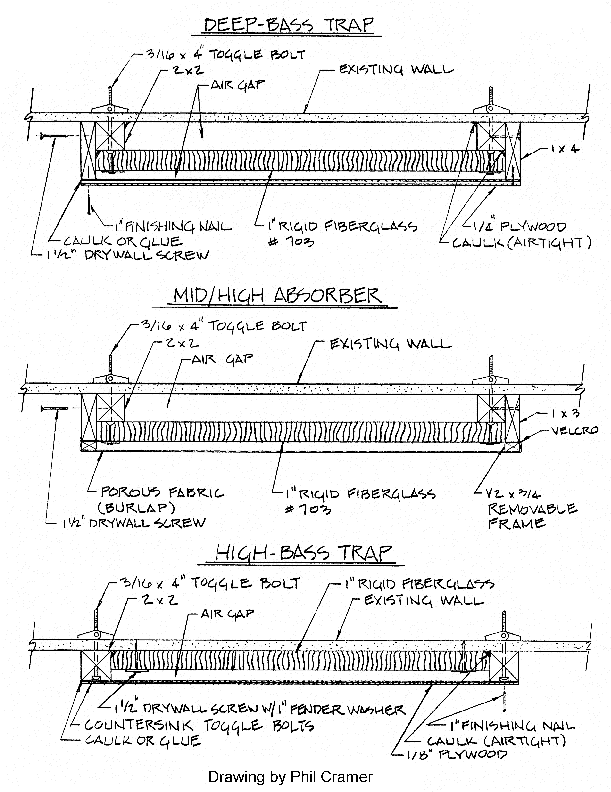
Yes, that is a low-bass type (~100 Hz) and it's built directly onto a standard sheet rock wall. I have 12 traps (6 low-bass and 6 high-bass) built onto the walls, and I also have 5 of the traps I used to sell hanging on the wall firmly using French cleat hooks. If you'd like me to record a fist thump with any of those let me know.
--Ethan
Ethan,
if you have a heavy, plastic or rubber handled screwdriver that is often the best choice for stimulating a trap. Sometimes a knuckle slap is good, but sometimes the soft parts of the hand linger too long on the surface and skew the results a bit.
Or a small rubber mallet that's fairly firm.
But sure, post whatever is convenient for you to generate.
Brian
Hello all,
My 0.016 euros : I understood a panel trap would add stiffness to the gypsium wall, thus lowering the flexibility and increasing in turn the sound transmission. Sorry, no reference.
BTW : Paul's experiment with the thin mdf handed on the door is really fascinating, thanks knightfly for remembering that.
What about a three leaf ceiling/roof that consists of corregated steel as the uppermost leaf? That's something that Moemedi in Botswana has proposed doing, and I'm thinking it's not a good idea... :roll:
--Keith :mrgreen:
Brian,
> sometimes the soft parts of the hand linger too long on the surface and skew the results a bit. <
I occasionally play percussion in the local symphony, so I'm pretty good at hitting things and "getting off" them quickly. :)
> But sure, post whatever is convenient for you to generate. <
My intent was to see the panel's resonant frequencies. I know it absorbs best around 100 Hz, but it vibrates sympathetically at many frequencies. So it was just a learning exercise.
--Ethan
Rick,
> ever built a membrane trap(panel) across a corner, either wall/wall, or wall/cieling <
No, but I've seen others do that. I have no idea how effective it would be though. Wood panel traps are pressure absorbers, so they work best at the room boundaries. Versus fiberglass and foam that work best away from a boundary. In the rooms I've treated with wood panel traps I put one of each type (low, high) on the adjacent walls.
--Ethan
Wood panel traps are pressure absorbers, so they work best at the room boundaries.
Hmmm, I was under the impression that corners were where low frequency/ modes occilated...but maybe I'm confusing that with pressure. I also was under the impression that corners ARE a boundary:lol:
Ethan, I know this is off subject, but a long time ago I asked how size(width/height=area) of a panel absorber translates into overall absorption(coefficient?). Like you said, not being a math guy I'm at a disadvantage understanding these things. What determines how much absorption actually takes place? Have you ever measured the absorption of a panel absorber in a lab? I've never seen any discussion of these things before. What I'm curious about, is the fact that I've seen pictures of studios with panel absorbers(they called them "bass traps"), fully the length of the room and variable depth, as if the face was the wall. It would seem to me, this would actually become a "third leaf", especially considering the airgap is sealed.
This seems relative to the discussion at hand. If big studios use very large panel absorbers, comparable to the length or width of a room, I wonder if the designers were aware of the "third leaf" syndrome prior to designing these. And if so, I wonder what they did to compensate? I also wonder if these were calculated to absorb a target amount of absorption at a certain
frequency measured in Sabins(Sabines?). Afterall, I would assume that large commercial studios are designed by acousticians, or at least the acoustical aspects. But those are just a few thoughts. Ignor them.
You know me...curiosity gets me into trouble all the time. :lol: Anyway, thanks.
fitZ
Rick,
> I also was under the impression that corners ARE a boundary:lol: <
Any wall or ceiling etc is a boundary. As you know, foam and fiberglass work best when spaced off the wall, because that's where the wave velocity is greater. Panel traps work best right at the boundary, where the pressure is higher, and they absorb less when spaced away.
> I asked how size(width/height=area) of a panel absorber translates into overall absorption(coefficient?). <
Absorption coefficients are independant of area. So an absorber that's only 6 inches square could have the same absorption coefficient as a full size bass trap that's much larger. This is a big problem, because often what matters most is how much absorption you get from one device versus another. This is exactly why the comparison graphs on the RealTraps site show Sabins only.
> What determines how much absorption actually takes place? <
For a wood panel trap, what matters is the acoustic impedance of the trap at each frequency of interest. I think of a panel trap as working like a car's shock absorber, except for sound waves.
> Have you ever measured the absorption of a panel absorber in a lab? <
Yes, I tested the portable panel traps that were our first product. The low-bass trap hit (exceeded slightly) 1.0 at 100 Hz, and the high-bass model was around 0.8 at 180 Hz. One of the problems with measuring tuned traps using a standard lab reverb room is the data is usually reported in third octaves. So for all I know our high bass trap also hit 1.0 at some frequency that happened to fall between the standard third octave frequencies.
> It would seem to me, this would actually become a "third leaf", especially considering the airgap is sealed. <
The key difference as I see it is the third leaf does not reduce the available wall thickness. See my first post in this thread. This is not to say that adding a panel trap will not affect isolation. I honestly don't know, and I'd like to know, which is exactly why I posed the question!
--Ethan
Steve,
> Sounds like Brian is getting close to your answer Ethan, according to the thread @ studiotips. <
Well, it sounds like he's getting close to devising a test method anyway. :)
--Ethan
Panel traps work best right at the boundary, where the pressure is higher, and they absorb less when spaced away.
:shock::shock::shock:
Excuse me Ethan? :?:?:? Ahhhh,... I thought a membrane..er, panel absorber had to have a hermetically sealed airgap??? And the depth of this airgap defined some portion of the formula for calculating ...hmmm, was it frequency? But now you are saying they perform BEST right against the wall...which is...just a panel against drywall? Wait a minute...what am I missing here. That implys the panel becomes part of one leaf, unless there is air between them, and not necessariarly sealed, but if right against the wall, with no air, HOW would that become a third leaf???...man, I must have missed an entire chapter on this stuff somewhere... could someone P-U- L- L EEEEEESE tell me whats going on here?? Unless you are talking about a TWO LEAF device that has an airgap, ...that means the front panel(membrane) and a back panel seperated by a framework, that when mounted against a wall, the back panel should be directly against the drywall for best absorption...is that what you mean Ethan?
fitZ[/code]
Panel traps work best right at the boundary, where the pressure is higher, and they absorb less when spaced away.
:shock::shock::shock:
Excuse me Ethan? :?:?:? Ahhhh,... I thought a membrane..er, panel absorber had to have a hermetically sealed airgap??? And the depth of this airgap defined some portion of the formula for calculating ...hmmm, was it frequency? But now you are saying they perform BEST right against the wall...which is...just a panel against drywall? Wait a minute...what am I missing here. That implys the panel becomes part of one leaf of the wall, unless there is air between them, and not necessariarly sealed, but if right against the wall, with no air, HOW would that become a third leaf???...man, I must have missed an entire chapter on this stuff somewhere... could someone P-U- L- L EEEEEESE tell me whats going on here?? Unless you are talking about a TWO LEAF device that has an airgap, ...that means the front panel(membrane) and a back panel seperated by a framework, that when mounted against a wall, the back panel should be directly against the drywall for best absorption...is that what you mean Ethan?
This is the same as a wall,no? Which means if it is against the wall, then there are now TWO airgaps...THREE LEAF system..right? Maybe I confused something from the beginning. I assumed the device was simply a panel fastened to a framework, and then fastened to the wall somehow. Which in essence, is the same thing as a two leaf device placed against the wall..right? Goooooooood grief...maybe I should shut up and forget about this stuff...(sigh) maybe some pictures will help..
fitZ :?
Panel traps work best right at the boundary, where the pressure is higher, and they absorb less when spaced away.
:shock::shock::shock:
Excuse me Ethan? :?:?:? Ahhhh,... I thought a membrane..er, panel absorber had to have a hermetically sealed airgap??? And the depth of this airgap defined some portion of the formula for calculating ...hmmm, was it frequency? But now you are saying they perform BEST right against the wall...which is...just a panel against drywall? Wait a minute...what am I missing here.
You want a membrane trap at a pressure area.
There are modal pressure areas (good spots), and modal pressure nulls (bad spots). (as opposed to a modal velocity area)
The edges do not have to be hermetically sealed -- remember Paul's door experiment where he held plywood in his hand in the air away from the door ? Air has inertia as well as spring. When the edges are open the spring is softer than if the membrane is close to something massive (like a wall). In the middle of the room a membrane would have a very soft spring, and also probably be in a modal pressure null.
The spring gets stronger (higher frequency resonance) right up until the membrane is touching the infinite mass wall, at which point depth is zero and frequency is infinite (or the msm of the less than infinite mass wall system).
If a 4'x8' panel is 2" from a wall, but open on all the edges, then the frequency at the center of the panel can be higher than the frequency at the edges of the panel, because the air spring is stronger in the middle than it is at the edges. Maybe with Chladni patterns.
There are modal pressure areas (good spots), and modal pressure nulls (bad spots). (as opposed to a modal velocity area)
Hello z60611. Thankyou for the reply. Hmmm. I won't pretend to understand this as I was also under the impression that velocity of the air molecules in a traveling wave WAS what caused the pressure when it encounters a boundary :? Hmmm, time to reread this...
http://www.moultonworld.pwp.blueyonder. ... 1_page.htm
Maybe I am confusing force/pressure with velocity.
edited quote...
You want a membrane trap at a pressure area. ....
The edges do not have to be hermetically sealed ....
Alright, now I'm REALLY confused about membrane absorbers. Isn't this what the subject matter is on this thread? How a SEALED membrane trap creates a THIRD leaf by virtue of its SEALED airgap?????
Consider these statements posted by Knightfly here..
http://www.johnlsayers.com/phpBB2/viewt ... t=membrane
Panel resonators work by vibrating the front panel, which moves the air inside the (sealed) trap, which gets then absorbed partially by the insulation inside - bass losses occur first when expending the energy to move the front panel, then again when trying to navigate the interstices of the insulation.
A light rear panel messes up the calculations, making it nearly impossible to predict the results.
Probably the best and easiest FIRST thing to do to most rooms is to forget the "bass trap" paradigm, and just build some NON-backed frames (4' wide if possible) - large perforations in back board, cloth fronts, heavy/light insulation as before, and just stand them catty corner in the corners. Floor to ceiling if possible, two halves work as well as one tall one if it's easier to build/move. If tippy, a couple of screen door hooks and eyes or something to hold them against the wall; pieces of foam between frame and wall to kill rattles.
If you need absorption at lower than maybe 200 hZ, and still want portable, build the panel traps to specific room mode frequencies but use a heavy (at least 3/4") MDF back so your calculations aren't totally out of whack... Steve
Good grief, can anyone tell me what the heck the real deal is here? I'm starting to think that its impossible to tell what "fact" really is with this stuff anymore. :?
fitZ
Hmmm, I just looked at this two hours ago. :lol: But frankly, those pictures don't jive with what you said in the quote. Your statement says
As you know, foam and fiberglass work best when spaced off the wall, because that's where the wave velocity is greater. Panel traps work best right at the boundary, where the pressure is higher, and they absorb less when spaced away.
Well, in reference to the fiberglass in a resistive absorber, and an airgap behind them, whats the difference from your membrane trap? The membrane,panel or what ever you want to call it, STILL has an ENCLOSED airgap between it and the wall leaf, no? So what do you mean by " best right at the boundary"? This is what confused me? there is NOTHING-ZILCH-.no panel, membrane, sheet, or other type "leaf" against the wall excluding the frame. the SAME as a framed resistance absorber. And since this thread was aimed at the implied "panel" becoming a third leaf, which I BELIEVED it cannot become unless there is a "hermetically sealed airgap between, I became confused. Now z60611 says the panel does NOT need to have an hermetically sealed airgap between it and a boundary...the fact that it is adacent to, parallel to, and spaced a certain
distance from, in fact now becomes a "panel absorber", no? Good grief.
Now, if placing a panel close to a boundary such as a wall, can in fact cause the TL in a two leaf system, to lower at a certain frequency, then this implies that indeed, a panel ....or picture....or cabinet, or anything with a surface of suffiecient size, can cause this effect...in essence, becomeing a third leaf....is that correct? :?
fitZ
I think this line of questioning is only fair to members like myself, who are less educated than other members here. Especially since Brian is doing tests, and from my understanding at Studiotits :lol: is using your design, I think its only fair to describe the whole function of this device. If what you guys have said is true, then a frame such as in your plans is of NO consequence or physics related function, other than fastening it to the wall at a SET distance of the airgap, sealed or not., correct? Unless the stiffening of the panels edge is part of the picture If not, why use a frame at all. Why not standoffs with adustable airgap depth? :?
fitZ
Futhermore, if this phenomena is correct(third leaf syndrome), then John Sayers solution of a vented outer leaf in a three leaf system, actually preventing the vented leaf from becomeing a third leaf by virtue of venting, same as your membrane "third leaf senario, is actually rubbish..
Futhermore, if this phenomena is correct(third leaf syndrome), then John Sayers solution of a vented outer leaf in a three leaf system, actually preventing the vented leaf from becomeing a third leaf by virtue of venting, same as your membrane "third leaf senario, is actually rubbish..
I think if you ask your indirect questions less agressive, you have more chance people will respond (including your previous posts).
The edges do not have to be hermetically sealed -- remember Paul's door experiment where he held plywood in his hand in the air away from the door ?
Z,
buddy - you're mixing apples and oranges here.
In order for Ethan's traps to work as designed - they have to be sealed. It's a critical part of the design - and he points this out often on his web page.
Even small air leaks will begin to decrease the amount of attenuation with these units.
You can't equate a sealed trap to a floating membrane.
As Brian pointed out - a floating piece of plywood would have a reasonance that carried on for a while- as opposed to the fairly rapid "thunp" you hear in Ethan's recording of the sealed trap.
Sincerely,
Rod
Hmmm, I was under the impression that corners were where low frequency/ modes occilated...but maybe I'm confusing that with pressure. I also was under the impression that corners ARE a boundary:lol:
FitZ,
Corners are not a boundary - but are (rather) the intersection of multiple boundaries.
A standard "box" room has 6 boundaries.
So wall to wall you have 2 boundaries meeting - introduce the ceiling (tri-corner) and you have 3 boundaries meeting.
cadesignr wrote:
Hmmm, I just looked at this two hours ago. :lol: But frankly, those pictures don't jive with what you said in the quote. Your statement says
As you know, foam and fiberglass work best when spaced off the wall, because that's where the wave velocity is greater. Panel traps work best right at the boundary, where the pressure is higher, and they absorb less when spaced away.
Well, in reference to the fiberglass in a resistive absorber, and an airgap behind them, whats the difference from your membrane trap? The membrane,panel or what ever you want to call it, STILL has an ENCLOSED airgap between it and the wall leaf, no? So what do you mean by " best right at the boundary"? This is what confused me? there is NOTHING-ZILCH-.no panel, membrane, sheet, or other type "leaf" against the wall excluding the frame. the SAME as a framed resistance absorber. And since this thread was aimed at the implied "panel" becoming a third leaf, which I BELIEVED it cannot become unless there is a "hermetically sealed airgap between, I became confused. Now z60611 says the panel does NOT need to have an hermetically sealed airgap between it and a boundary...the fact that it is adacent to, parallel to, and spaced a certain
distance from, in fact now becomes a "panel absorber", no? Good grief.
Now, if placing a panel close to a boundary such as a wall, can in fact cause the TL in a two leaf system, to lower at a certain frequency, then this implies that indeed, a panel ....or picture....or cabinet, or anything with a surface of suffiecient size, can cause this effect...in essence, becomeing a third leaf....is that correct? :?
fitZ
Fitz,
1st…….. Z60611 is mistaken in his statement – so take that out of the equation.
2nd……… Ethan’s statement is accurate – and you are just reading too deeply into this – when it’s really quite simple.
The “Panel Trap” is created through it’s many elements. It is not just the face. It’s the Basic sub-frame- the finished face-frame- the panel and the rigid fiberglass behind the panel. All of that that creates the “Panel trap” (note that it has no “back).
Now, the “trap” is then placed against a room boundary (a wall) and the trap frames are sealed at the wall to trap intersection points to assure it works properly.
This creates the 3rd leaf of the wall system – and it is this that Brian will be testing to see if it has any appreciable effect on the TL value of a wall.
I hope this helped,
Sincerely,
Rod
The edges do not have to be hermetically sealed -- remember Paul's door experiment where he held plywood in his hand in the air away from the door ?
Z,
buddy - you're mixing apples and oranges here.
In order for Ethan's traps to work as designed - they have to be sealed. It's a critical part of the design - and he points this out often on his web page.
Even small air leaks will begin to decrease the amount of attenuation with these units.
Rod,
We not often disagree, but here I clearly do.
I'm very sure that small leaks in Ethans design will not influence attenuation that much. I even believe it's not even worth it to seal them so accuratly with caulck or silicone as often described, assuming they are made relative good. And the shift in frequency caused by such minor leaks is probably smaller than the uncertainties involved in the whole construction of the trap versus his background, stiffness, wool filling etc.
I've build traps, wittingly spaced from the walls (without backing) to get my frequency low enough. I DO use this shortcut of the air enclosed by the trap and its frame with the environment to tune them.
What Ethan wrote on his page and in his related articles is based on his related knowledge at the time he wrote it. And that became an axiom, but a wrong one.
I even remember clear at RO that somebody explained Ethan how they could be calculated. Ethan at the time had no idea about these physical principles on which they worked. He just knew they did from empirical experience.
Ethan learned about that formula in Everest's book long after he wrote his articles about it.
If I should make a paneltrap to solve specific problems as per those drawings on Ethan's page, I should tune them theoretically somewhat too high, don't provide them with a backing and use whatever solution (screws, conic pieces of wood, whatever) to tune them after placement, which probably means I should wittingly create a gap all around while tuning them.
This is not an assumption, When using them (only to solve specific problems) I standard provide the option to tune them afterwards, because I know how difficult it is to get them theoretically right. And a shortcut with the surrounding environment is one of the logical options to obtain that.
In a later stage, after related discussions about it, and before MiniTraps substituted the PanelTraps completely Ethan even played with the thought to provide vents in his paneltrap designs.
While Z goes to the other extreme here, in principle he's right. And that's not comparing apples with oranges. You can not take Z comments out of the equation.
I'm rather convinced that the mistuning of paneltraps by the assumption of an infinite mass in these stylized formulas, and the mineral wool filling is much more significant than all these discussions I saw before about perfect sealing with caulck at those edges and connections.
This whole thing is a mass spring system. What you do with shortcuttig the air behind the trap with the surrounding environment is altering the properties of the spring, which is very much related with the law of inertia.
I recently saw Steve also somewhere telling here that the difference of sealing panel traps or not, is that they become easier to calculate. And Steve is right. It's not easy to bring this inertia into the equation.
But while Steve brought it as an uncertainty making that approach risky, he forgot that the same principle also provides some additional flexibility to tune them after real life placement.
This is exactly comparable with the vent of a speaker. A closed cabinet will show a resonance where the woofer cone act as the panel. By introducing a vent you can alter the resonance of that speaker cabinet. But the wool has a very large impact on that as well. And altering the vent design allows altering the resonance frequency.
It's all a matter of the dynamic stiffness and damping of the airlayer.
If we could that easily get rid of this defining mass-spring resonance caused by this dynamic stiffness of this airlayer by applying a shortcut, which could be damped then we could build superior walls, with double leaf systems.
But we hardly can, as little as we can't get rid of a speaker cabinet resonance with a vent. We can use it to alter things.
Warm regards