Hey there...wel I've been on this site searching the forums and i've found out alot about building my own corner bass traps but i haven't been able to find out too much info on how to construct absorber panels for the wall...I understand that I'd biuld a frame and put in some 703/705 rigid fibreglass or rock wool....but do i need a gap between it and the wall? actualy any plans or comments would be great since i am fairly new at this...thanks
These
http://www.johnlsayers.com/phpBB2/viewtopic.php?t=4581
Will also work fine for wall - leaving an air gap behind the absorbent makes them work to lower frequencies, so smoother frequency response in general... Steve
leaving an air gap behind the absorbent makes them work to lower frequencies, so smoother frequency response in general
You have me completely confused here. An air gap lowers the cutoff frequency of effective absorption AND creates a dip above the lowered frequency causing a rougher absorption frequncy response. The reason people seem to ask about leaving gaps is the perceived geting something for free, not realizing the dip in absorption, without being aware of the both cheaper and acoustically more effective method of using lighter (cheaper) thicker material to fill the entire space, ignoring the cost savings of lighter absorbent materials being much cheaper than just the reduced density would indicate because materials from another market (construction fire/acoustic material) can be used providing the double goal of reduced cost and greater absorption. (Is the last sentence a record for RSD run on sentences? :D )
This is not even remarking upon people creating a gap in wall absorbers where the cost of material to support the inside of the absorbent material is greater than the cost of filling the space! Clear case in point, ROXUL Safe N Sound is 0.37$/ft^2 in my neck of the woods and chicken fencing (for supportig the back surface) is 0.50$. Using half the absorber with an air gap is more expensive than fillng a 7" absorber completely!
Your clarification is eagerly awaited.
Andre
An air gap lowers the cutoff frequency of effective absorption AND creates a dip above the lowered frequency causing a rougher absorption frequncy response.
Congratulations Andre, (not that it's that difficult, but) you threw something at me I'd not seen/heard/read before - where did you read that, and why wouldn't two inches of absorbent space 2" off the wall do AT LEAST as good at absorbing higher frequencies as 2" AGAINST the wall? You still have the same thickness of material, only with a space it's allowed to influence lower frequency.
Has this been tested, or what? Any links, sources, graphs or pix would be MOST welcome (even if you quote a book I already have but haven't had time to read :oops: )
I agree that using other materials to space out the absorbent could very easily be false economy, and personally wouldn't use less than 4" stuff ANYWAY -
Awaiting YOUR clariification... :?
Thanks for the reply Steve. I am trying to find any of the few professional references (which how I found the BBC RD on loation BTW) and am great luck at being able to continue my search!
why wouldn't two inches of absorbent space 2" off the wall do AT LEAST as good at absorbing higher frequencies as 2" AGAINST the wall?
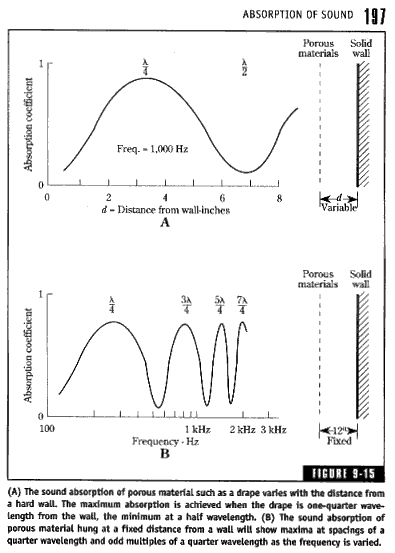
I think I worded it a bit too tersely. Building the theory behind it, imagine that the 2" material against a wall has a LF cutoff of 2o0 Hz. With a 2" gap behind it the LF would be 100 Hz. The dip in absorption would be around 140 Hz. The cause of it being that at wavelengths between the material thickness and the surface distance to the wall, the peak velocity point of the sound wave is not being absorbed at all, so the peak absorption is reduced.
It took me quite a while to realize WHY I have so few professional reports on using this technique. The reasons being that 1) because the dip is in effect a tuning of the room system and must be taken into account in other design sompnents of the room, and 2) the construction of such absorbers with support mechanisms to maintain the gap permanently becomes more expensive in material and labor. My previous post has the example of where making a 3.5" gap with SAfe N Sound is more expensive than filling the entire space with absorber. That is of assuming no labor costs!
I'll continue to look for the professional references about the subject.
Andre
imagine that the 2" material against a wall has a LF cutoff of 200 Hz. With a 2" gap behind it the LF would be 100 Hz. The dip in absorption would be around 140 Hz ... It took me quite a while to realize WHY I have so few professional reports ...
Maybe it's not a professional report, but I showed that very effect in my Acoustics FAQ three years ago and, well, you know the flack I got for it. The image below from Everest's book also shows what you're describing.
--Ethan
Recovered from web.archive.org — originally hosted at http://www.ethanwiner.com/airgap.gif
Damn, and I have both the print and electronic versions of that; guess "brain farts" are very real...
OK, so choosing absorbents = same as buying gas for the car; it's better if you just say, "Fill er up..." :lol:
So if I understand this right. I could use cheaper materials (such as regular wall insulation) and fill a fixed frame 4 to 6 inches deep (where it actually touches the wall) and it would have a smoother frequency absorption response, but absorb as much (or more) low frequency as the equivelant thickness in compressed fiberglass or rockwool?
If that is so. I am rethinking my wall and ceiling treatments.
Tom
NO......
You still need the density unless you want about 3 FEET of depth or more for every absorber - otherwise, you won't get anywhere near the AMOUNT of absorption at any frequency. Standard "fluffy stuff" insulation runs typically 0.8 PCF, which doesn't do much for absorption within the room. No one here is saying that you don't still need the DENSITY, only that you'll get more even results with 4" 3 PCF rockwool than you will with 2" 3 PCF spaced 2" from the wall...
Andre, be my guest; if I wanna keep secrets, I just won't post 'em in public :wink:
Andre, be my guest; if I wanna keep secrets, I just won't post 'em in public :wink:
What secrets? This has been one of my key points for years, that seems to get continually ignored. That being despite the readily available data explaining it. I'll ignore the fact that I forget about the sources, in order to protect my new clothes. :D
You gave an excellent reminder of th (to us) obvious. One has to select the proper material for any application, including this one. There may be a wide range of suitable materials, but you still have to choose the right one.
Always sharing (except when I don't):
Andre
One point I should bring up - the drastic looking graphs Ethan posted from Everest are based on CURTAINS, not thicker batts of insulation; so I would expect quite a bit less DRASTIC peaks/dips from spacing 2" or thicker insulation batts away from a boundary than those seen in the graph; the effect would still be there, just likely not as obvious... Steve
Steve,
> I would expect quite a bit less DRASTIC peaks/dips from spacing 2" or thicker insulation batts away from a boundary than those seen in the graph <
Indeed. The thicker the material, the less of this effect you'll get. The graph above shows an extreme example just to make the point. But I had to post it somewhere else recently when someone asked if 703 one inch thick with a 36 inch air gap would absorb down to really low frequencies. :)
--Ethan
if 703 one inch thick with a 36 inch air gap would absorb down to really low frequencies
Sure it would; probably at least 0.05 dB at 100 hZ or so :wink:
Or, maybe just a layer of burlap at 9 feet; that would absorb about .001 dB, but it'd do it clear down to 30 hZ... :mrgreen:
if I make my corner absorbers this large ( sidelength around 4 feet * 4 feet, depth around 3 feet) and the fiberglass directly behind the cloth cover as in the picture would not be the optimum ? Because of the large room I could afford the space so I thought "the bigger = the better". I see many people doing those "hangers" in the back of the room so I wonder If they would have a much better performance than my design. Would you recommend to fill all the airspace with rigid fiberglass insulation or doing the hangers ?
Getting confused everyday more.. :-)
whole room visible at :
http://www.johnlsayers.com/phpBB2/viewtopic.php?t=5850
Cheers,
Heiko
How low are you trying to absorb? From tests that I have seen, 280 mm of rockwool will provide above 1.0 absorption coefficient down to 50 Hz (the lowest frequency tested) in random field absorption.
Now you are confusing me!
Andre
Just when I think I have a handle on these things, and the day I recieved my very own 703 from Fed-EX I read this!!!
Leaving an air gap always sounded too good to be true to me.
While we are mythbusting is regular fluffy insulation really just good for nothing? I made some absorbers out of it and I think my room sounds a lot better. Then again my room sounded like total crap before.
I glued strips of the 4" fluffy onto the back of a 4'x2' ceiling pannle and covered them realy tight with burlap and hung them behind my monitors. I read somewhere you couldnt get enough front wall absorbtion and rockwool is unavailible here so I improvised.
4" of fiberglass and 1 inch of compressed paper covered in burlap has to be doing something?
On the first question - if you have ANY kind of off-cuts from ANY type of insulation (other than polystyrene) your corner traps will absorb better at lower freq's than they will without it.... Steve