Mixing position, home/project studio

Started by G-Sun on 8 April 2013. 11 replies.

Originally posted at johnlsayers.com, topic 18278.

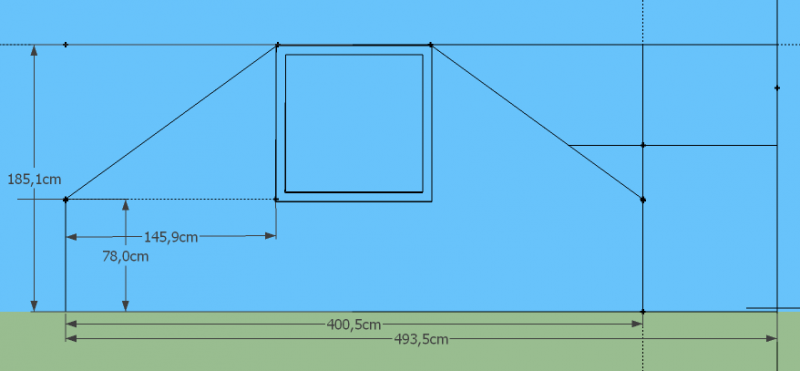
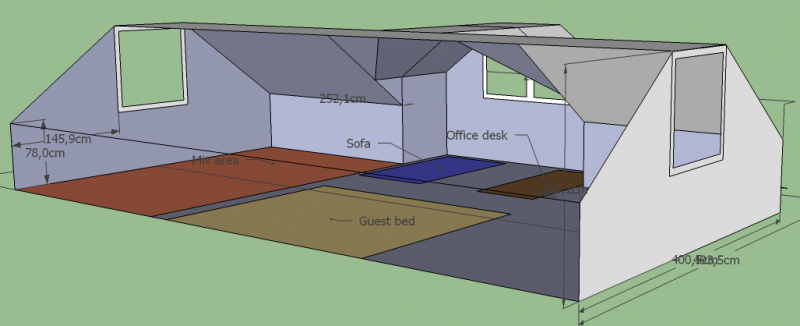
Hi all! I'm designing (and hopefully soon start to build) a place for me to mix and work with midi and non-acoustic instruments. Later I'll design and build a small room for tracking. The room available is first floor above a double garage, and this is my initial thoughts for allocation of space:
Mixp-1.png
Mixp-1.png
A vertical view:
Mixp-2.png
Mixp-2.png
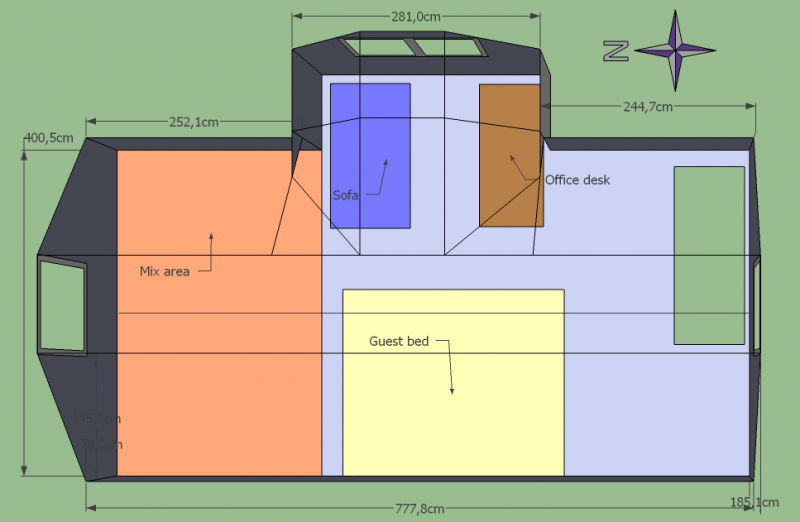
Here's another view:
Mixp-3.png
Mixp-3.png
I'm thinking of: - Mixposition facing West - Build a half-wall that hides and separates the mixarea from the guestbed. This will also create symmetry for the mixing. - Build some basstraps down west and east. - Add absorbtion on part of north wall (symetry and reflexion points - Build a desk, with monitor-stands - Add absorption on reflection-points
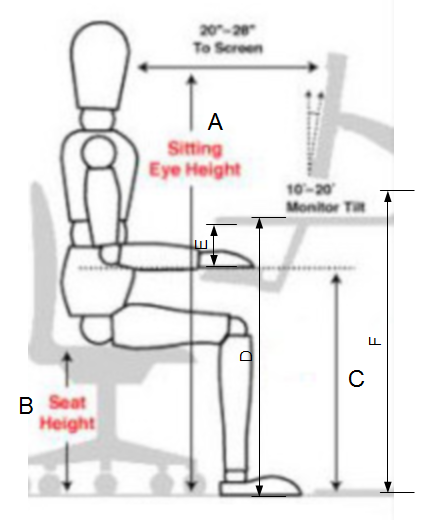
Sitteplass.png
Sitteplass.png
A (Ear height) = 129cm B (seat height) = 48cm C (midi keyboard drawer, under) = 63cm (min 62cm) D (desktop, pc keyboard) = 72cm +-6cm E (midi keyboard height) = 9,7cm (min 8,2cm) F (pc monitor stand) = 73-85cm My height is 192cm Midi Keyboard lenght (61keys) = 99,0cm (if/when upgrading)
Reserved
:?: :shock: "Reserved"? For what? :)
- Mixposition facing West
Actually, the only real option you have is to have it fast north. That's the only orientation where the ceiling makes sense. Facing east or west would give you a steeply descending "wall" behind you, and another one, steeply rising, in front of you. Not good.
- Build some basstraps down west and east.
You'll need bass traps in several places: as many as possible.
- Build a desk, with monitor-stands
The stands should not be part of the desk. Build the stands separately, make them massive (very heavy), and set them up behind the desk. Place a rubber pad on top of the stand, under the speaker, to help prevent it transmitting vibrations into the stand. - Stuart -
Thanks a lot for chiming in so quick Stuart! Direction: Yes, North was my first thought. It has two downsides: 1) Window behind screen is not so good. 2) It will be very visually exposed for guestroom/livingroom-area. I'll make a better sketch of my ideas first, but.. yes, it won't change the fact of the angle of the west and east walls.. Monitors-stands: I was thinking something along these lines: http://www.youtube.com/watch?v=X2ZKfJshmbc I'll see if I can come up with a design for separate stands. Of course, this build will not live up to pro standards for mixing-room. But I hope achieving as good results as I can get, while preserving the usability for the rest of the room.
Of course the visual aspect for the rest of the room can be dealt with. Some heavy curtains could serve well as a back-drop for the mix-position. It would eat some light though.
Maybe somethin like this for stands: http://www.gearslutz.com/board/studio-b ... -pipe.html ? But, how much difference is it really with separate stands vs. integrated in desk? If deciding to build myself, the design with monitors on desk seems much more practical. I'll then make some 19"rack units under each monitor. Googling I see a lot of pro-looking desk with this type of design.
Added sitting position heights
how much difference is it really with separate stands vs. integrated in desk?
There can be a very big difference, for several reasons. First, speakers directly attached to the desk can transmit sound into the desk itself, and even cause you to hear some sounds BEFORE the direct sound arrives at your ears. Second, putting the speakers on the desk causes reflections off the surface of the desk/console, right into your ears: That creates comb-filtering, phase cancellation, and just plain early reflections, all of which distort the stereo image, spatial cues, and frequency response. Finally, putting the speakers on the desk can bring them too close to your ears, which in turn creates several sub-problems, such as incomplete integration of the sound fields form the woofer and tweeter, large differences in level from small head movements, sweet spot issues, and others. There's a reason why the ITU, EBU, AES, and others, including all major reputable speaker manufacturers, all recommend that the optimum listening distance should be around 2m.
Googling I see a lot of pro-looking desk with this type of design.
Yup. And Googling, I see a lot of studios with egg-crates on the ceiling, carpet on the walls, and thin floors "floated" on rubber pucks.... :) :shock: 8) Just because you see it on a Google search does not mean it is correct, or even useful. It's better to read the text books on the actual acoustic principles behind how sound works, and base your studio designs on the science of acoustics, rather than the garbage that floats around on top of the Google ocean... :)
Some heavy curtains could serve well as a back-drop for the mix-position.
Probably not useful. Might work for some of the problems with the room, but will do nothing at all for the most serious problems, which will allow be under 200 Hz. Heavy curtains have no effect at all at such low frequencies. - Stuart -
Desk design added in post#3
I've not been satisfied with the solutions discussed here in this thread. And as my health and my life has made me downscale and relax my ambitions a little, I'll go for another idea. I'll start a new thread for a small one-room-solution when I have my sketch-up ready. Thanks!