Hi all!!
This is my first post on this forum so go easy on me :).
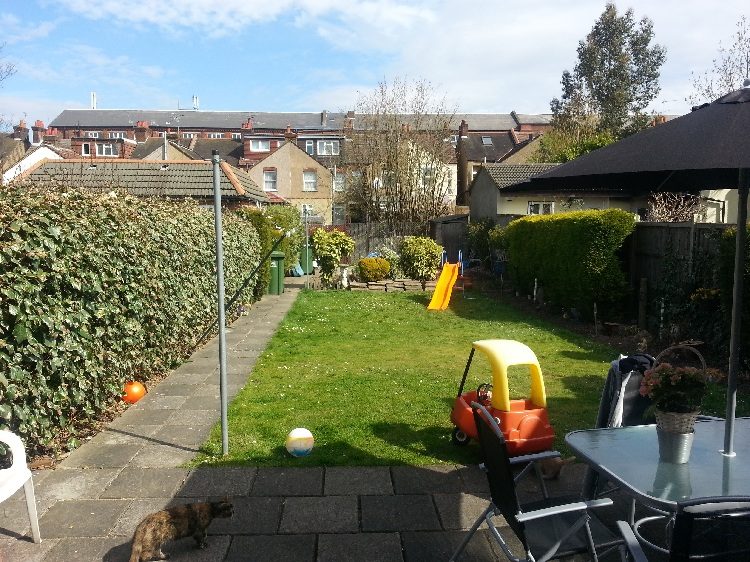
I am looking to build a studio in my back garden and need all the help i can get!
In this studio i want a control room and vocal booth (yep that's it), the size of the area where this will be built is as follows:
Length:7m Width:7m Height:3.5m
At the moment I'm reading 'Build it like the pros' by Rod Gervais, but am finding it hard to design the studio.
I want it to be as best as possible, my budget is £5000 and i work at a builders merchant so can get materials relatively cheap.
Thanks for all your help!
Kirk
Hi Kirk, and welcome!
You are certainly in the right place, then! That's what the forum is all about: helping people build design and build their studios.
So when you are ready, post your initial design and all the other information listed in the stickies, and I'm sure folks here will comment on that, and start suggesting how to improve it.
For example, the dimensions you gave are not a good idea: the length and width are identical, and both of them are twice the height! That's actually about as bad as you can make it: There should be no direct mathematical relationships between your room dimensions. So do some research on room ratios, and then figure out a ratio that would work for the space you have available.
- Stuart -
Hi Stuart!!
Thanks for the reply.
Level wise i wont be going over 95db.
It's a new build so i was thinking of using dense concrete blocks for the exterior walls, and 2x4 stud timber with 2 layers of 15mm soundbloc plasterboard hung with resilient channels and auralex sheetblok in between the layers. The dimensions have now changed as the floor area can only be upto a maxmium of 30 square metres, anything over that requires planning permission :( also the floor will be concrete slab and ceiling same as walls.
I have taken your suggestions on board and have been playing around with room ratios, the best i've come up with is 6x4x3 which is a ratio of 1:1.33:2.00
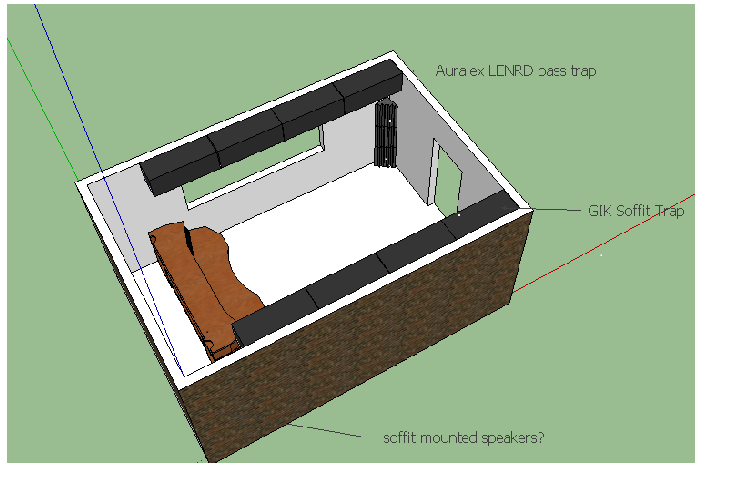
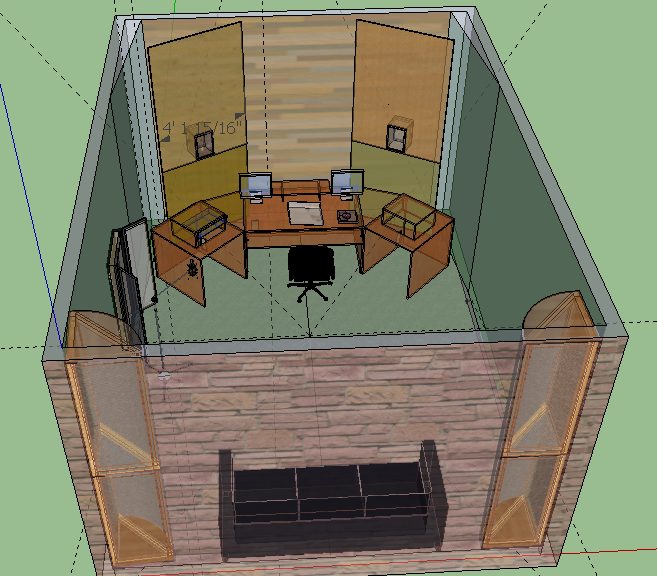
Also been learning sketch up so attached is a simple design i have come up with, would also like to go with a rfz design. i originally wanted a vocal booth but don't think this is possible with the space?
Please can you advise on soffit mounting my speakers (Adam a7x) and angling the walls?
Thank you for your time and help!
It's a new build so i was thinking of using dense concrete blocks for the exterior walls, and 2x4 stud timber with 2 layers of 15mm soundbloc plasterboard hung with resilient channels and auralex sheetblok in between the layers.
If you build your inner-leaf like that, with a separate stud frame isolated from the concrete blocks, then you do not need the resilient channel. The separate frame already decouples the inner-leaf, so there is no need to decouple it again.
You also do not need expensive, proprietary drywall: Plain old ordinary 15mm fire-rated drywall will do the job just fine, and is much cheaper. Sound waves can't read price tags, and do not care how much you paid for your mass: All they see is mass, and the react to the amount of mass in front of them, regardless of how much it cost.
The same applies to MLV (Mass Loaded Vinyl) and similar products: there's no demonstrable advantage to that: It is simply mass, and very, very expensive mass at that! And when you see claims like "6dB more effective than solid lead at stopping the transmission of sound", you really have to wonder! :shock::!: You might want to ask them for proof of that claim, as shown by a full set of tests in a recognized, independent acoustic laboratory. In other words, two identical walls, one with 1/8" of their product, and the other with 1/8" of lead sheeting. You can imagine which of the two tests I'd put my money on... :)
also the floor will be concrete slab and ceiling same as walls.
Excellent! You should be able to get pretty good isolation with that.
I have taken your suggestions on board and have been playing around with room ratios, the best i've come up with is 6x4x3 which is a ratio of 1:1.33:2.00
Did you test that in a ratio calculator, such as this one?
http://www.bobgolds.com/Mode/RoomModes.htm
Take a close look at those numbers: Not very good. The length is exactly twice the height, which means that the odd harmonics of the modes for one line up exactly with the even harmonics of the modes for the other. Perfect overlap. Bad. Not only that, but four times the height is three times the width and also twice the length. Very bad. There should be no simple integer mathematical relationship between dimensions.
i originally wanted a vocal booth but don't think this is possible with the space?
I agree: it is probably a bit too small for that. You could fit one in, but then both rooms would be very small.
Please can you advise on soffit mounting my speakers (Adam a7x) and angling the walls?
You only need to angle part of the side walls, at the front of the room. Normally about one third of the wall is enough. The exact angle is different for every room, based on the dimensions, geometry, speakers, and things inside the room, and the only way to figure it correctly, is by "ray-tracing".
Do it like this:
http://www.johnlsayers.com/Studio/Pages/Somewhere.htm
(Those are P22's, not A7X's, but the concept is identical)
- Stuart -
Thanks for the all the advise Stuart!
I have spent some time with room dimensions and came up with 5.7m x 4.23m x 3m which is a ratio of 1:1.4:1.9 Loudens best ratio. What do you think?
At the moment i'm trying to work out how to splay the walls and soffit mount speakers. So far i have worked out the speaker and listening positions.
Please can you advise on working out how to splay the walls? i have searched the forum and found alot of threads on soffit mounting but cant get my head around it. i need a 'idiots guide to...''
Thanks Kirk
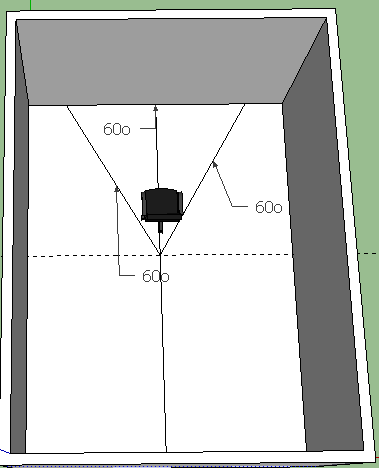
Just a quick update, i have the listening position 60 degrees triangle and the soffits angled at 30 degrees. i phoned adam audio yesterday and they will email me the polar plots when i receive them i will start ray tracing (god help me)!
To be honest, that's kind of what I expected from Adam. I love their speakers, and highly recommend them, and I even own some myself, but the documentation is poor, at best, and very disappointing overall. There's very little actually useful technical data in the "specifications" pages (unless you want to know the size of the box and how heavy it is! :shock: ), and there's no polar plots, frequency response graphs, or anything else. In fact, the only graphs I have seen published for Adam speakers were done by reviewers, in magazine articles, not by Adam themselves.
It's frustrating that a company that has created such amazing technological breakthroughs as the ART drivers, and builds such highly acclaimed, quality studio monitors, does such a lousy job of documenting their products. When you compare their documentation to that of other high-end manufacturers, like Genelec or K&H for example, it's actually shocking how poorly Adam stacks up. When you pay lots of money for studio monitors, you do expect to at least get a good manual filled with technical data about what you bought!
So I'd suggest that carry on hitting them, incessantly, badgering them every day until they do give you something, but I wouldn't count on actually getting much from them.
And if they do give you something, I'd really love it if you could send me a copy of whatever you get! :)
- Stuart -
Hey Stuart!
They don't have the information to hand but will get someone to do it which should take a couple of weeks.
On another matter as im only permitted to go 2.5 metres high i will go down 1 metre, i have hired a structual engineer to design the retaining walls and roof which he says will need a rsj. I have broke up the old concrete which my shed was on, now its time to hire a skip.
They don't have the information to hand but will get someone to do it which should take a couple of weeks.
Don't hold your breath! :)
On another matter as im only permitted to go 2.5 metres high i will go down 1 metre, i have hired a structual engineer to design the retaining walls and roof
Great! That's good news. I'm liking this build more and more! 3.5m of ceiling height can get a you really nice sounding room.
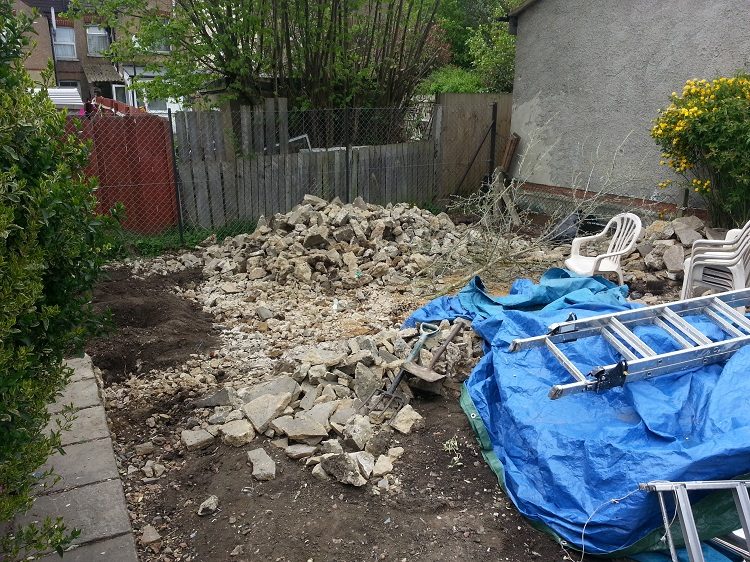
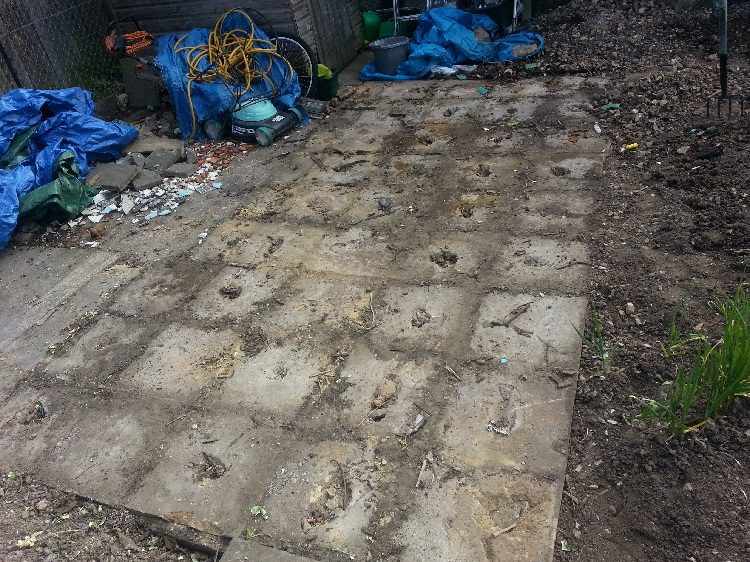
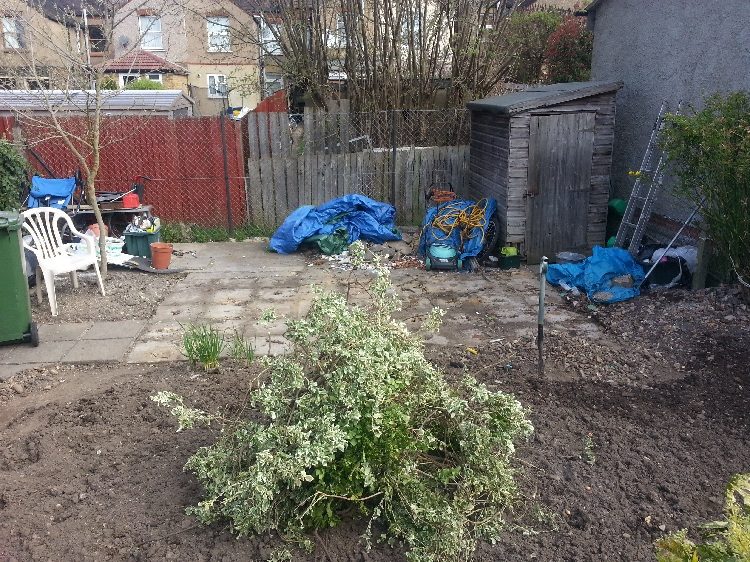
I have broke up the old concrete which my shed was on, now its time to hire a skip.
There's a wise and sacred saying that you'll see repeated frequently here on the forum: "Photos, or it didn't happen!". :)
- Stuart -
If they do not provide the info, can i still go with a rfz design?
I'm off to dig a big hole in my garden to check the water level :), then i will pay the structual engineer so he can start the design and last but no least hire a skip!
Soundman2020 wrote:
There's a wise and sacred saying that you'll see repeated frequently here on the forum: "Photos, or it didn't happen!"
Concrete broken up.jpgPatio before break.jpgBack garden shed.jpgGarden.jpg
The only thing is i don't know what i'm looking at
Me either! That's not what I expect from a diagram for dispersion angle.... Doesn't even say if that is vertical or horizontal! :shock: What I was hoping for is a set of polar plots for different frequencies. That single graph is not much use at all...
And I certainly find it hard to believe that the total dispersion pattern at 20 kHz is practically the same on-axis as 15° off axis... :!::shock::shock::roll:
Still, being aware of the lousy documentation provided by Adam in general, this is not unexpected. In fact, it's rather surprising that they sent you anything at all!
I wonder why they are so darn closed to providing any useful technical details of their speakers. It almost makes you wonder what they are hiding....
- Stuart -
Hey Stuart!
They don't have the information to hand but will get someone to do it which should take a couple of weeks.
On another matter as im only permitted to go 2.5 metres high i will go down 1 metre, i have hired a structual engineer to design the retaining walls and roof which he says will need a rsj. I have broke up the old concrete which my shed was on, now its time to hire a skip.
Good plan ,thats what I did more or less so I'v ended up with finished ceiling height of around 2.8m :D
Hey guys!
Been away for awhile work and family commitments!
I finished the digging last year August (see photos attached), have ordered dense blocks, buildings sand, cement etc to get the external walls up.
Stuart, how have you been?
Adam audio never did get back to me with the polar plots :(
The only thing is i don't know what i'm looking at
Me either! That's not what I expect from a diagram for dispersion angle.... Doesn't even say if that is vertical or horizontal! :shock: What I was hoping for is a set of polar plots for different frequencies. That single graph is not much use at all...
And I certainly find it hard to believe that the total dispersion pattern at 20 kHz is practically the same on-axis as 15° off axis... :!::shock::shock::roll:
Still, being aware of the lousy documentation provided by Adam in general, this is not unexpected. In fact, it's rather surprising that they sent you anything at all!
I wonder why they are so darn closed to providing any useful technical details of their speakers. It almost makes you wonder what they are hiding....
- Stuart -
I would guess that they are hiding the transition from piston driver to AMT which has a drastically limited vertical dispersion compared to the cone driver. The "ART" is just their version of a traditional air motion transformer. Could be useful in a studio environment, but rest assured there is no graceful transition between the two. In order to smooth the vertical dispersion transition between the two they would need to have a fairly shallow slope in the crossover which has the potential of creating harmonic distortions, unless they move the crossover point down to the middle of the vocal range, which is not desirable, especially since a shallow slope also creates phase distortions. There is no way to match the phase over a band of overlapping frequencies between a piston driver and AMT. They require a fairly steep crossover - third or fourth order - to avoid such problems, which brings us back to the problem with dispersion.
The AMT acts almost like a mini line array, which means it would need to be a bit shorter to widen the vertical response.
On another note, I'm actually not surprised by the consistency of the frequency response. A good AMT is quite consistent on the horizontal plane, and Adam make a pretty good AMT (or modify, more likely).
I must say that Adam speakers sound pretty fantastic - I owned a pair for awhile - and they likely don't want to scare off the potential customers who would raise a brow at the graphs. We are engineers, after all.
Hey post78,
Thanks for sharing your knowledge!
Do you think it is worth soffit mounting these speakers? If so how would i raytrace without having the polar plots?
Thanks
Do you think it is worth soffit mounting these speakers? If so how would i raytrace without having the polar plots?
Absolutely! They sound (and test) spectacular when properly soffit mounted.
You don't need the polar pattern to ray-trace... It would be useful to have, but isn't essential.
- Stuart -
You don't need the polar pattern to ray-trace... It would be useful to have, but isn't essential.
- Stuart -
[/quote]
Thanks Stuart appreciate that, I've been reading the forum on soffit mounting and ray tracing for quite some time now :)
I've got a few questions for you guys. I know your busy and I appreciate all the help you give!
How would i ray-trace without the plots?
Do I go with 1 super door? As I want to save as much room as possible but if I go for a double door they would both have to open inwards meaning I would have to lose around a meter to stop the first door from hitting the second.
Just assume that each successive angled ray represents a lower frequency than the one next to it. So the rays close to the axis are high frequencies mostly, and those that are way off-axis are lower frequencies, and therefore longer wavelengths.
Do I go with 1 super door? As I want to save as much room as possible but if I go for a double door they would both have to open inwards meaning I would have to lose around a meter to stop the first door from hitting the second.
Could you make one of them a slider? If not, then maybe a "superdoor" would be a good solution.
- Stuart -