Hello
First as this is my first post here, a small greeting from Greece, where I'm setting up a small recording studio, for personal purpose only ;)
So I'm planning to build some corner absorbers to treat both my live room and control room. But I don't really like the idea to have so much potentially bad for the health particles floating around me.
So I was trying to find an alternative to the rockwool commonly used. But it seems very hard to find something suitable, and the rare OK in acoustical domains, are not so good for health.
So I thought about another way to do. I know that primacoustic use some kind of resin to harden the edge of their rockwool panels. So I was thinking to cover the WHOLE panel with the same kind of resin.
I assume that I will loose some attenuation at higher frequencies, and create some reflexion for the sames frequencies, but these will be easily attenuated by some auralex foam.
So do you think it's a good idea ? Acousticaly speaking ? And for the principal goal, the fibers loss ?
Do you think I'll need additional absorption like auralex foam ?
Best regards from Greece :)
-fx
there are a number of recycled cotton products, hemp fiber, etc which don't have the same irritants as mineral wool or fiberglass, but they have different absorption characteristics so some research (such as Bob Golds site) will be necessary.
covering the mineral wool in resin probably is not a good idea (most resin products have VOCs). another option is "micro mesh" which is used to wrap the mineral wool before covering it with cloth.
Hello
I posted a recent thread on gearslutz, about the alternatives, but it seems that none is suitable for acoustic absorption.
I looked for hemp, cork, woodwool, cotton, cellulose, ... but with no succes :(
I'll have a look at what are the potential inconvenients of resin, maybe there are some safe products ?
Thanks for the help :)
-fx
Add: I just saw that epoxy resin is chemicaly stable after polymerization, and should not release any volatile component when completely dry, nor causing any problem when touching it.
Maybe it's a good way to do?
-fx
Hello Stuart
I already watched it, but I cannot totaly agree with what they says.
You know that in France (im french), that subject is controversial, because some research institutes (public, no industrial fund there), goes against these statements.
Anyway, if I can find a way to avoid it, I would sleep more easily ;)
Do you know that the producer of different kind of wools are doing lobbying all around, especially in the studio forums ?
Take a look there, we catched it some times ago : http://fr.audiofanzine.com/membres/a.play,u.557236.html
It's in french, but basically, he is only spamming thread about rockwool, talking about the safety of the rockwool, the advantages, always the same copy/paste post. And I'm sure you can find some in gearslutz too ;)
And somewhere in geatslutz, you'll find that the past director of a safety gov agency in the US, was officialy a member of rockwool producer alliance lobby ? So I would not thrust all these report so easily !
Anyway, if I can, I'll find a solution to avoir fiber, because you'll agree with me, any kind of fiber is worst than no fiber at all ;)
Thanks for the help !
-fx
but you would trust the chemical industry and the lobbyist sponsored government officials? :|
in my experience with epoxy, i can say you can still smell it long after the hardening process is completed. maybe there are some sort of latex low-non VOC binders that make sense?
Hello
Yes, maybe I can find another product, that's why I ask here ;)
But for the epoxy, I'm used to this product, and as far as I know with my limited knowledge of chemistry, and from the nautical industry around, Epoxy is dangerous when applying, but stable and neutral once dry.
Anyway I would be happy with a greener product if someone knows :)
-fx
If you forget the loose particles, yes :mrgreen:
I just read a post from John, saying that mineral wool should be avoided in top of mixing console, because a lot of fibers escape from the absorbers, and fall into the console electronic.
So as I'm not sure that its really safe, or I can seal the fiber pannel, to avoir fiber to escape, or I find another product.
I've got a answer from Thomas Jouanjean, recommanding the FLEX CL homatherm product.
He uses it very often, with good, results, and says to me that there is no risk for health.
So any of these 2 solution is good for me, execpt that homatherm will be very hard to find here in greece ! Even the standard glasswool is hard to find, because there is no or very little insulation here !!! (my brand new house doesn't have any insulation !!!)
Best regards :)
-fx
the Homatherm FlexCL is another recycled product (using newspaper instead of cotton) and should be suitable for absorbers and clouds but its probably too dense for the inside of walls or slats. this would seem to be a good fit along with the cotton, hemp, and shredded wood options.
for glasswool and rockwool, Knauf makes a good product.
http://www.knaufinsulation.gr/en/products/kr-l-0
Nice :)
Maybe hard to find here (except the wool ;)), but I'll have a look !
What do you think about sealing a mineral wool pannel with resin ? would it be a good solution ?
Thanks !
-fx
Hi
I just had an idea, I think I'll use rockwool, or glasswool, depending on what i'll find here, and I'll use something to spray all over the pannel, to avoid loosing fibers.
For that purpose, I'll use the special glue that is intended to fix that thin layer of glasswool, the kind of layer that you put on the wall to renovate them (kind of glasswool wallpaper). Am i clear ? ;)
I checked, and the glue is based on methyl cellulose ( http://en.wikipedia.org/wiki/Methyl_cellulose ), that is non toxic, non allergenic. AS it's white you clearly see where you spray it, it's cheap and widely available.
Impac on the sound should be negligible, isn't it ? may I absorb later the higher frequencies that will be reflected, maybe with some kind of foam ? why not a layer of foam facing the room, a small airgap, one layer of rockwool, another airgap, and a last layer of rockwool, what do you guys think about it ?
I think I got my solution :)
thanks for the help !
-fx
depends. if it's only a thin layer on the surface it should be ok, if it penetrates the fibers deeply, the flow resistivity will be impacted and you'll lose effectiveness. otherwise this looks like an option.
Methyl cellulose can be employed as a mild glue which can be washed away with water. This may be used in the fixation of delicate pieces of art as well as in book conservation to loosen and clean off old glue from spines and bookboards. Methyl cellulose is the main ingredient in many wallpaper pastes.
Hello
as the glue comes as a powder that you must mix with water, I'll try not to make it too liquid, so it's should stay on the surface.
I think I'll give it a try, maybe it will be a little bit less effective, but hey, we are talking about HOME STUDIO here, it will be better than nothing anyway ;)
the only problem is that my Control Room + live Room will need aroud ... 100 2'x4' pannel !!! a lot of job at the horizon ;)
I'll report the results here, as well as some pictures and details :)
Best regards
-fx
...Greece, where I'm setting up a small recording studio, for personal purpose only
fxdfxd wrote:
the only problem is that my Control Room + live Room will need aroud ... 100 2'x4' pannel !!!
100 panels seems a bit extreme for a small personal studio - assuming you leave about 2' between them that's a surface area of over 6000ft2... not including floor space...
That's because most of them will be layered ;)
8 corner traps (32 panels)
18 ceiling trap (18 panels)
24 wall basorber (24 pannels)
3 big gobos (24 pannels)
I'll not do everything in one rush ;)
My studio is approx 50m2, in two rooms, a third will come soon :)
-fx
so now between here and the other forums you posted to, you should have several answers WRT protecting yourself:
1) micromesh - polyester mesh, or thin plastic backing to trap the fibers
2) purchase natural products like cotton, hemp, ECOSE, etc
3) spray or brush a cellulose or latex product on the surface (accepting the possible loss of performance)
4) wear a mask and protective gear when handling insulation products
avoid:
1) epoxy (due to flow resistivity impact)
2) compounds with VOC emssions
3) breathing in dust and other airborne contaminants
Hi
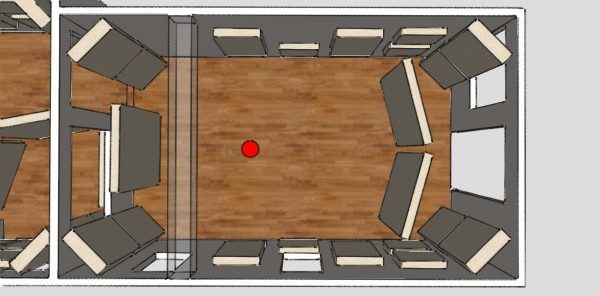
here are the sketch of the studio :
Recovered from web.archive.org — originally hosted at http://f.defaut.free.fr/photos/Studio/Amenagement/Control%20Room.jpg