Hi, I edited this post, If I need to put more info please tell me.
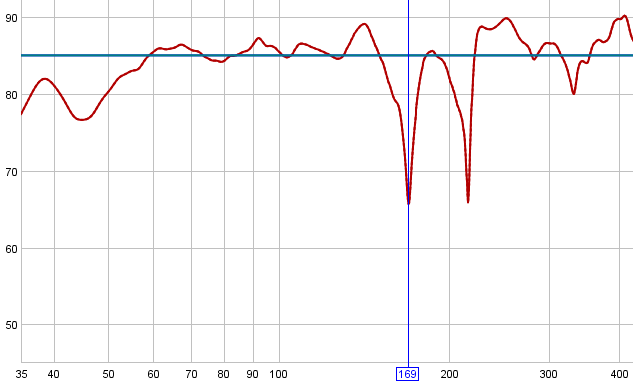
I have 2 big dips like in attached pics, but I dont found any problems at this frequency when I made my math in room modes calculation.
Maybe something related to plasterboard ?
Any help will be appreciated
Cheers !
Please read the forum RULES that can be found at this link:
viewforum.php?f=17
Please correct your initial post to conform with these rules and guidelines. Many here will not only NOT help while waiting in respect for owners and other better qualified persons to proceed, but will simply ignore these type of posts completely.
You may want to immediately ask "what is it that I have missed". Most often it is as simple as including your geographical location in your profile.
Trust me in that the more you know the better others can help you and that the answer to that question is in the forum rules linked page.
Until then, good luck,
Brien
It might be a room mode, but hard to say for sure. You do have your 0,4,0 mode at 171.4 Hz, so that might well be what you are seeing. Also, your 0,5,0 is at 214.2 Hz which looks to be roughly where your other big dip is, so you might well have a mode issue related to that dimension, although it seems strange to get an odd and an even mode in the same place from the same frequency.
How to treat it is an entirely different story. That would depend largely on how the room is treated already.
- Stuart -
Gracias Stuart! I will try to use sketchup for this. There are some room issues I cant explain very well.
Anyway, can I post in spanish in this forum ?
Thanks.
¡De nada!
Es mejor usar inglés siempre aquí, porque somos muy pocos los miembros que hablan español. Es más, los verdaderos expertos aqui (¡no me incluye!) no hablan español. Por lo tanto, si usamos solamente español, ellos no van a entender las preguntas, y no podemos disfrutar de su gran experiencia y conocimiento.
Anyway, a SketchUp model would be great, but photos would also help a lot, to see what you have and how it is treated at present.
- Stuart -
Anyway, can I post in spanish in this forum ?
Thanks.
>Es mejor usar inglés siempre aquí,
I think, by and large, this is an English speaking forum. You do you and others who >try< to read the thread a disservice by posting in a different language.
While this is only my opinion on this issue and seems to be supported by Stuart, I would think the use of English would find a larger audience by the thousands that speak English and may have trouble Googling a translation to every thing typed in another language:).
While this is only my opinion on this issue and seems to be supported by Stuart,
Exactly! I pointed out that, apart from anything else, the real experts here (such as John, Rod, Ro, Eric, André, Ethan, etc.) don't speak Spanish (or at least, as far as I know they don't), so anyone who posts only in Spanish is not going to get the benefit of their expertise and insight, since the experts won't even be able to read the question.
Maybe I should translate what I said in Spanish?
- Stuart -
While this is only my opinion on this issue and seems to be supported by Stuart,
Exactly! I pointed out that, apart from anything else, the real experts here (such as John, Rod, Ro, Eric, André, Ethan, etc.) don't speak Spanish
I don't speak Portuguese either. However my Estonian is good, so any any Fino-Ugraic writers can communicate. In pms of course, as English is the lingua franca here.
Andre
Hello
Try speaker position, you wouldn't believe how much response changes when moving your speakers a couple of centimeters. So, play with that and you'll hopesully see that your response will improve
Also, your speakers are currently firing towards the shorter walls. try flipping 180 degrees
Cheers
Hello
Try speaker position, you wouldn't believe how much response changes when moving your speakers a couple of centimeters. So, play with that and you'll hopesully see that your response will improve
Also, your speakers are currently firing towards the shorter walls. try flipping 180 degrees
Cheers
Yes, the first position was 90 degrees, but in this way I cant find a good subwoofer-listener position. And I tried and measured all ways.
Then , when I flipped right now, I measured a lot better sub response and more tight.
I tested to move speakers in x and y axes, and even in z , with changes, but now in the freq I need !
I found today if I put a big fiberglass roll just back me (like in attached pic) the first dip was great improved, around 5-6 dB.
What are the steps I can do to identify the real problem(s) of my room in this configuration ?
Im using room eq wizard with a high quality omni reference mic.
Cheers
Well first of all you dont have any acoustic treatment, do you?
Read the stickies and you'll know what to do, you know.. bass traps, first reflection points and stuff like that
Ummm... you have no acoustic treatment AT ALL in your room, and you are wondering why you have huge undamped artifacts and can't find a good subwoofer position?
Like Javier said: Rotate the room 90°, set up the speakers and mix position in the CORRECT locations with the correct starting-point angles, install large bass traps in all the corners, place thick absorption at ALL of your first reflection points, THEN measure. In any case, this isn't a listening room, its a studio, so the position for the subwoofer is already set: on the floor, between your feet, up towards the front wall, and at roughly the same distance from your head as the main speakers. Put it anywhere else much further away than that, and there will be delays between the lows/mids/highs and the subwoofer reaching your ears, so the bass will be smeared slightly. Yeah, bass is not directional and sounds cool, so in a home theater you can put the sub anywhere that gets you the most possible chest-shaking "oomph" to impress your friends. But in a studio the bass has to be correctly timed and at the correct level, or else it won't be tight and easy to mix, and your mixes won't translate well. From your response graph, you clearly already have a problem in your lows, which would be the next thing you should have been aiming to fix after fixing those low-mid issues, but they will probably disappear anyway as soon as you orient your room correctly, get the mix position out of the mid-room nulls, and get the correct basic treatment in there. My bet is that one you do that and measure again, your new graph will show a rather different picture, which will reveal the REAL issues with the room itself, not the issues that you have created for yourself.
Also, from your new diagram it's clear that you used only a single layer of 12mm drywall over a 5cm air gap, so it's very likely that the resonant frequency of your MSM system is way up there in the lows or mid-lows, so on your graph you are probably seeing some wall resonance issues that are getting back into your room, as well as the other issues, such as resonance of the 12mm drywall itself in the mids. Your graph doesn't go high enough to show it, but my guess is that you probably also have artifacts up around the range of the coincidence dip for that wall.
The air gap should have been at least 10cm, and the inner-leaf should have been at least two layers of 15mm drywall in order to keep the MSM resonance down low enough. There isn't much you can do about that now, except to take the inner-leaf walls down, move them in 5cm, but them back up (with an extra 5cm of rockwool in the cavity). and use two layers of 15mm instead of one layer of 12mm. I guess you could also just do it by taking off the sheetrock and running hat channel across the studs, then putting the new 15mm sheetrock on again. I say "hat channel" not RC, because I'm assuming that your inner-leaf studs are already decoupled from the outer-leaf wall? Correct? If not, then you could use RC and gain much better isolation, as well as improving your acoustics.
- Stuart -