Another few questions about this technique (adding mass below sub-floor between joists)...
1- The sub-floor has a LOT of flooring nail spikes coming through from above. (anywhere from just poking through to 3/4") Is the contact with the sub-floor the important contact?
I've been trying to think of ways to secure it without having to deal with several hundred little nails (possible pushing up to flooring above).
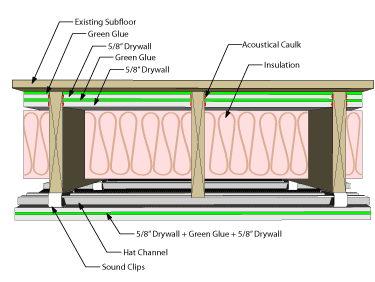
2- On the Green Glue website, there is a diagram of using their material between the layers. Would you suggest this for greater effect of isolation?
3- If the nails are protruding, should I bother with the first layer of green glue (between sub-floor & first layer of drywall) as there will be nails being forced into that layer of drywall? (Would it negate or diminish the effect of the Green Glue on that layer?)
Here's the plan I'm referring to from Green Glue's website:
Recovered from web.archive.org — originally hosted at http://www.greengluecompany.com/images/upgradingExistingFloors/upgradingCeiling2.gifI'm comparing this to Rod's version of this on page 71 of his book (fig 4.22).
Looking for the best isolation between basement/main floor with retaining the most ceiling height below. The bottom of the joists are about 7'6" from the floor. The floor above is 3/4" maple. Joists, HVAC, etc are all exposed right now.
Thinking of the technique above with/without Green Glue and either hat channel/sound clips/Green Glue combo, or open to other suggestions that would retain more ceiling height.
I'm in the Chicago suburbs and am using the basement area for recording space (everything from jazz to hardcore). The control room is already isolated from this space as its on the first floor and about 15' off to the side of the basement above a crawl area (so up and over). Snakes connect the areas.
hey i think we had a similar debate before. i suggested cuting the nails level with the flooring to give you a clean start and not have to damage the upper finish. as nails should fix into a joist.
however Rod surgested bending them over for the same reason as above plus if the nails were holdin anything down they will not pull through.
hope this helps
joey
hey i think we had a similar debate before. i suggested cuting the nails level with the flooring to give you a clean start and not have to damage the upper finish. as nails should fix into a joist.
however Rod surgested bending them over for the same reason as above plus if the nails were holdin anything down they will not pull through.
hope this helps
joey
Although I said this could be considered as an option - my best solution was to use rigid foam (blue board from DOW) insulation to place between the plywood and the new drywall - this can easily be pushed up with the nails passing through.
And yes - if you do this then do not use green glue between any of those original layers.
Rod
Be too much like work man...use the rigid foam.
All that metal flying in your eyes, cutting the sub-floor while trying to cut that one last nail...and oh my god if you try this after a few drinks;)
I think that a sawzall with a metal cutting blade would make short work of them.
Stunt - the extension of the nail is critical to assuring that it won't back out - if you just cut them off what ever is above could loosen up in short time........
Rod
Yeah, the DOW Blue Board seems like a fantastic suggestion.
It's only $7.24 per 4'x8' sheet around here (1/2" thick), and if there are a few spikes longer, I can bend them a little.
I assume you'd use the same construction technique with this?
Blue Board 'pushed up' against sub-floor. A layer a drywall 'tacked' at the joists to hold it in place. Acoustic caulk the sides. Another layer of drywall (tacked & caulked). Then 1x3 ledger board along the joist/drywall to permanently secure.
Is a Green Glue layer between the two drywall layers even worth it?
If so, doesn't it need to be 'squeezed' to together for it to work properly?
(And thanks Rod for your excellent book and responses.)
Blue Board 'pushed up' against sub-floor. A layer a drywall 'tacked' at the joists to hold it in place. Acoustic caulk the sides. Another layer of drywall (tacked & caulked). Then 1x3 ledger board along the joist/drywall to permanently secure. [/quote
Yup.
Is a Green Glue layer between the two drywall layers even worth it?
Yup
If so, doesn't it need to be 'squeezed' to together for it to work properly?
Yup......... that is what the 1x3's are for - you can sock them up real tight to squeeze everything into place.
(And thanks Rod for your excellent book and responses.)
Any 'must have' tools I need to consider for this portion of my project?
Cordless finishing nail gun to 'tack up' the drywall?
Any fancy drywall cutting tools or guides to help cut the 'between the joists' strips?
Regular caulk gun vs. fancy/powered ones for Green Glue or acoustic caulk?
What would be nice to have around for this?
(Already have a second set of hands)
I never had the need for fancy bull***t........ a finish nailer would be useless - 14 1/2" wide strips don't weight squat......... I've always used a standard caulk gun = loading a powered gun is a pain larger than the gain in MHO.
I always ripped strips by just using a standard 1" wide tape measure as a guide - set it for width (backwards so that the outside tip @ 0" is your cutting guide)- hold the tape and lock it in at that dimension at the sheet edge - and then just run down the edge creating a score with the knife to create a prefect edge.
Like I said - nothing could be easier.......
Rod
I think that a sawzall with a metal cutting blade would make short work of them.
Stunt - the extension of the nail is critical to assuring that it won't back out - if you just cut them off what ever is above could loosen up in short time........
Rod
Interesting. Is it because of the wood expanding and contracting?
John Katsafanas
Interesting. Is it because of the wood expanding and contracting?
John,
Sure - there is constant movement in buildings - everything from wind loads to expansion/contraction (based on relative humidity and (or)temperatures) - with each material having different expansion coefficiencies - and thus working one against the other.
Rod