hello! this is also the first time i've found my way to this forum, but i'm glad i did! lots of useful information here and knowledgable focused people as well. (:
the situation i'm in is this: my band is now in a new practice space. it's not a place we can modify in a permanent way, so my treatment options are limited to portable and only minorly installed options.
the room size is odd.. it's about 15.5' long, 11.5' wide and 6.5' tall. i've got some mineral wool boards up covering maybe 10% of the wall space.. and i have a panel absorber (ala ethan's plans) in there i built for another application.. also.. this is only one leg of an L shaped area. it is open on the 11.5 end and it is about evenly proportioned to the rest of the space...
everything else sounds wonderful as it is except for the bass and guitar note D (73.4, 146.8 hz) is VERY loud. doing a little figuring i find out that the length 15.5' has problems with this freq. and doing a little reading about the boundry effect on waves, i realize that i need to do something about that particular freq. and it's octaves...
so my thought was to build a narrow band slat resonator with 6"x1" slats spaced 5mm from one another with a cavity depth of 4" and a peice of 1" mineral wool board inside. (these numbers come from an excel calculator i found at sae... )
this should target 292hz (d is at 293.7hz) and use readily available components and not take up too much space. i guess what i want to know is this: will a resonator that is targeted at 292 also effect the other octaves? (ie. 36.7, 73.4, 146.8, 587.3hz)
i assume that if it DOES effect those, it will have a diminished effect...
i also assume it needs to be an enclosed cabinent that is airtight sealed except for the slat gaps to be effective..
is placement of this resontator significant? the sound is not coming from a singal source, but from bass, guitar, and keyboard amps as well as a clarinet... so standard techniques for 'control room' treatment wouldn't apply...
i was also thinking of just placing some mineral wool boards at a fixed distance from the wall equal to the 1/4 wave of 293 and 146.8 (roughly 11.5" and 23")...
also, how much percentage of wall space is necessary for a resonator of this type to be effective at returning those freq. to average levels?
i know this is a lot of questions, but hopefully the asnwers will be simple things i should have figured out on my own. (:
thanks,
_illium
thinking of building a slat resonator (first time)...
-
illium
- Posts: 11
- Joined: Wed Sep 10, 2003 1:57 pm
- Location: st. louis, missouri, usa
-
giles117
- Senior Member
- Posts: 1476
- Joined: Sat Jun 21, 2003 2:42 am
- Location: Henderson County
- Contact:
A Simpler solution, Lift the mineral wool batts off the walls maybe by a foot or so. I guess I should ask, what is the thickness of this material. I'd recommend some 4" if possible.
The Freq's you speak of are obviously bass freq's and require BASS trapping. The intended design of a slat resonator is to control mids. It can be adapted, but is not as cost effective as just placing mineral wool about a foot off of the walls from floor to ceiling.
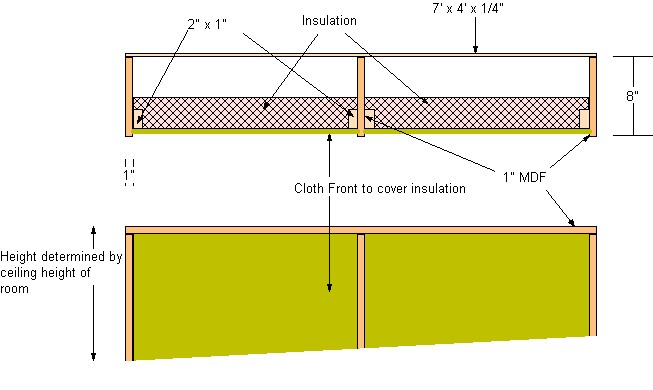
Something like Johns Bass traps in the DIY section could be built and made portable. His design places the wool about 8" off the wall. It could be adapted using 1x12's in place of the MDF to take the wool further off the wall.
<img src = "http://www.johnlsayers.com/HR/images/Unit_2_imp.jpg" / img>
Bryan Giles
Remember sound is sound, who cares what is creating it, sound is sound so normal methods (tried and proven) will always work to control sound. Never get caught up in the hype.
The Freq's you speak of are obviously bass freq's and require BASS trapping. The intended design of a slat resonator is to control mids. It can be adapted, but is not as cost effective as just placing mineral wool about a foot off of the walls from floor to ceiling.
Something like Johns Bass traps in the DIY section could be built and made portable. His design places the wool about 8" off the wall. It could be adapted using 1x12's in place of the MDF to take the wool further off the wall.
<img src = "http://www.johnlsayers.com/HR/images/Unit_2_imp.jpg" / img>
Bryan Giles
Remember sound is sound, who cares what is creating it, sound is sound so normal methods (tried and proven) will always work to control sound. Never get caught up in the hype.
-
illium
- Posts: 11
- Joined: Wed Sep 10, 2003 1:57 pm
- Location: st. louis, missouri, usa
i have a decent supply of 2" unfaced rigid mineral (basalt) wool boards... so i guess i could double them up to make a 4" board..
so you think just a simple sealed box with the front face panel being mineral wool would be more effective than say, another membrane 'panel' absorber like the ones i've built?
i assume i should make the cavity depth a even division of the wave length of the frequencies i'm most concerned about, rather than just 'about a foot'.. so closer to like.. 11.5 inches which is the 1/4 wavelength of 293.7 aka, the 1/8th wavelength of 146.8 or 1/16th of 73.4 (73.4 is the frequency i'm most concerned about since the bass, piano and cello often play this note and it's VERY loud compared to the others... )...
will making detailed measurments to target that wave form be significant, or should i just grab some 12"x1" lumber and build the frame from that and let it go? (i guess with 4" of insulation it'll catch a pretty wide Q..)
also -- that cloth is really an ugly colour. (:
thanks,
_illium
so you think just a simple sealed box with the front face panel being mineral wool would be more effective than say, another membrane 'panel' absorber like the ones i've built?
i assume i should make the cavity depth a even division of the wave length of the frequencies i'm most concerned about, rather than just 'about a foot'.. so closer to like.. 11.5 inches which is the 1/4 wavelength of 293.7 aka, the 1/8th wavelength of 146.8 or 1/16th of 73.4 (73.4 is the frequency i'm most concerned about since the bass, piano and cello often play this note and it's VERY loud compared to the others... )...
will making detailed measurments to target that wave form be significant, or should i just grab some 12"x1" lumber and build the frame from that and let it go? (i guess with 4" of insulation it'll catch a pretty wide Q..)
also -- that cloth is really an ugly colour. (:
thanks,
_illium
-
John Sayers
- Site Admin
- Posts: 5462
- Joined: Mon Jan 27, 2003 12:46 pm
- Location: Australia
- Contact:
-
illium
- Posts: 11
- Joined: Wed Sep 10, 2003 1:57 pm
- Location: st. louis, missouri, usa
-
barefoot
- Moderator
- Posts: 554
- Joined: Thu Feb 27, 2003 4:49 am
- Location: Portland Oregon
- Contact:
illium,
A slot resonator targeted for 293 Hz will also absorb somewhat at higher harmonic frequencies (293x2, 293x3, 293x4,....), but not a lower frequencies. If you want to absorb 73.4 Hz, then you need to design the absorber to reach down that far. However, remember that a slot resonator can only absorb the fraction of energy corresponding to the slot area. So, if you build a resonator with 1/4" slots and 3/4" slats, its maximum absorption efficiency can be no higher than 25% - corresponding to the fact that 75% of the resonator area is reflective slat.
Panel absorber efficiency depends on the mass of the panel. The heavier the panel, the less efficient it will be. So, you can build a shallow (not much air volume) panel absorber that reaches very low frequencies by making the panel heavy, but most of the energy will be reflected from the heavy panel rather than absorbed.
In any case, it's not fruitful to try and target a very specific frequency. Once you install an absorber the physical size of the absorber, plus the absorption itself, alter the resonant characteristics of the room. It's a bit of a moving target, so you're better off building somewhat broadband absorbers.
You should also place the absorbers at the ends of the dimensions that correspond the specific resonances. The 73.4 Hz resonance is almost certainly due to the 15.5' room dimension. So, you would place your absorbers at the one or both ends of that dimension - i.e. the absorbers for this resonance would be mounted on the short walls.
Thomas
A slot resonator targeted for 293 Hz will also absorb somewhat at higher harmonic frequencies (293x2, 293x3, 293x4,....), but not a lower frequencies. If you want to absorb 73.4 Hz, then you need to design the absorber to reach down that far. However, remember that a slot resonator can only absorb the fraction of energy corresponding to the slot area. So, if you build a resonator with 1/4" slots and 3/4" slats, its maximum absorption efficiency can be no higher than 25% - corresponding to the fact that 75% of the resonator area is reflective slat.
Panel absorber efficiency depends on the mass of the panel. The heavier the panel, the less efficient it will be. So, you can build a shallow (not much air volume) panel absorber that reaches very low frequencies by making the panel heavy, but most of the energy will be reflected from the heavy panel rather than absorbed.
In any case, it's not fruitful to try and target a very specific frequency. Once you install an absorber the physical size of the absorber, plus the absorption itself, alter the resonant characteristics of the room. It's a bit of a moving target, so you're better off building somewhat broadband absorbers.
You should also place the absorbers at the ends of the dimensions that correspond the specific resonances. The 73.4 Hz resonance is almost certainly due to the 15.5' room dimension. So, you would place your absorbers at the one or both ends of that dimension - i.e. the absorbers for this resonance would be mounted on the short walls.
Thomas
Thomas Barefoot
Barefoot Sound
Barefoot Sound
-
illium
- Posts: 11
- Joined: Wed Sep 10, 2003 1:57 pm
- Location: st. louis, missouri, usa
thomas --
thanks for the reply! i think you answered my questions precisely.. in fact, what you've suggested is exeactly what my first thought on the matter was, which is why i brought in the panel absorber i already have in place there, however, it didn't remove the problem completely. i think i will need to perhaps build another one for this purpose. maybe a bigger one, since the one that is there now is only a 4'x3' unit with a fairly thin front panel... so maybe building a larger absorber with a stiffer front panel will do the trick..
i guess try and see... the worse case scenario is that i'll have another panel absorber than i can always use somewhere else!. (:
thanks,
_illium
thanks for the reply! i think you answered my questions precisely.. in fact, what you've suggested is exeactly what my first thought on the matter was, which is why i brought in the panel absorber i already have in place there, however, it didn't remove the problem completely. i think i will need to perhaps build another one for this purpose. maybe a bigger one, since the one that is there now is only a 4'x3' unit with a fairly thin front panel... so maybe building a larger absorber with a stiffer front panel will do the trick..
i guess try and see... the worse case scenario is that i'll have another panel absorber than i can always use somewhere else!. (:
thanks,
_illium