According to Bob Gold's absorbtion co-efficients site, 4" 703 absorbs better than 4" 705 at most frequencies even though it is half as dense, but from what I've read around here most people seem to agree that 705 absorbs better. Does 705 just perform better in real world applications?
Product thickness mounting density 125hz 250hz 500hz 1000hz 2000hz 4000hz NRC
703, plain 4" (102mm) on wall 3.0 pcf (48 kg/m3) 0.84 1.24 1.24 1.08 1.00 0.97 1.15
705, plain 4" (102mm) on wall 6.0 pcf (96 kg/m3) 0.75 1.19 1.17 1.05 0.97 0.98 1.10
703, FRK 4" (102mm) on wall 3.0 pcf (48 kg/m3) 0.88 0.90 0.84 0.71 0.49 0.23
705, FRK 4" (102mm) on wall 6.0 pcf (96 kg/m3) 0.65 0.52 0.42 0.36 0.49 0.31
703, plain 4" (102mm) 16" air 3.0 pcf (48 kg/m3) 0.65 1.01 1.20 1.14 1.10 1.16 1.10
705, plain 4" (102mm) 16" air 6.0 pcf (96 kg/m3) 0.59 0.91 1.15 1.11 1.11 1.19 1.10
http://www.bobgolds.com/AbsorptionCoefficients.htm
703 absorbs better than 705 according to Bob Golds site?
-
UC
- Posts: 5
- Joined: Wed Feb 15, 2006 3:04 pm
- Location: Atlanta, GA
-
Ethan Winer
- Senior Member
- Posts: 1063
- Joined: Fri Feb 21, 2003 3:50 am
- Location: New Milford, CT, USA
- Contact:
Re: 703 absorbs better than 705 according to Bob Golds site?
UC,
> Does 705 just perform better in real world applications? <
The problem with standard lab tests is they can vary quite a bit - up to 50 percent at 125 Hz and even more at lower frequencies - and they don't take into account what happens when a panel is mounted straddling a corner or spaced off a wall. For a much better assessment of this see my Density Report:
www.ethanwiner.com/density/density.html
--Ethan
> Does 705 just perform better in real world applications? <
The problem with standard lab tests is they can vary quite a bit - up to 50 percent at 125 Hz and even more at lower frequencies - and they don't take into account what happens when a panel is mounted straddling a corner or spaced off a wall. For a much better assessment of this see my Density Report:
www.ethanwiner.com/density/density.html
--Ethan
-
knightfly
- Senior Member
- Posts: 6976
- Joined: Sun Mar 16, 2003 11:11 am
- Location: West Coast, USA
Ethan, during those tests did you by any chance do any full-range comparisons of 701-3-5 UNfaced at sidewall first reflection points?
I keep hearing from people like Newell, Jeff Szymanski, and even older Everest (R.I.P) that the higher density tends to absorb less effectively as we get away from 90 degree incidence, so am curious whether you had occasion to check this question as well? Thanks... Steve
I keep hearing from people like Newell, Jeff Szymanski, and even older Everest (R.I.P) that the higher density tends to absorb less effectively as we get away from 90 degree incidence, so am curious whether you had occasion to check this question as well? Thanks... Steve
Soooo, when a Musician dies, do they hear the white noise at the end of the tunnel??!? Hmmmm...
-
Ethan Winer
- Senior Member
- Posts: 1063
- Joined: Fri Feb 21, 2003 3:50 am
- Location: New Milford, CT, USA
- Contact:
Steve,
> I keep hearing from people like Newell, Jeff Szymanski, and even older Everest (R.I.P) that the higher density tends to absorb less effectively as we get away from 90 degree incidence, so am curious whether you had occasion to check this question as well? <
Those tests were for bass absorption only. But I can offer a little more:
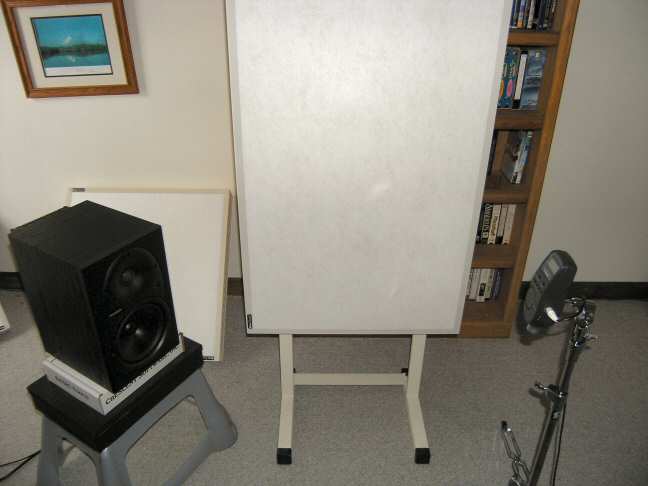
1) I have some of my company's panels that are based on 705 at the first reflection points on the side walls and ceiling in my living room home theater, and they work flawlessly. One day I measured my room using ETF looking specifically for reflections, and found none. In the top 20 dB anyway.
2) I plan to test this again later today using the same panels as a favor for Doug Plumb, author of ETF, for an application note he's working on. I'll try to remember to post the results here too tomorrow.
3) I asked Wes Lachot about this once and he said that while 705 RFZ panels may reflect highs more in theory, he's never had a problem using 705 as a ceiling cloud at the first reflection points.
None of this is to say that Jeff Szymanski and the others are wrong, because if 705 reduces angled reflections to, say, -20 dB, 703 may well reduce them to even less.
The "3 to 1" rule for microphone placement says you need a 10 dB difference between a source and a delayed version to keep comb filtering acceptably low. I assume the same theory applies here too - if you can get the reflections down by 10 dB or more, anything beyond that is less important.
--Ethan
> I keep hearing from people like Newell, Jeff Szymanski, and even older Everest (R.I.P) that the higher density tends to absorb less effectively as we get away from 90 degree incidence, so am curious whether you had occasion to check this question as well? <
Those tests were for bass absorption only. But I can offer a little more:
1) I have some of my company's panels that are based on 705 at the first reflection points on the side walls and ceiling in my living room home theater, and they work flawlessly. One day I measured my room using ETF looking specifically for reflections, and found none. In the top 20 dB anyway.
2) I plan to test this again later today using the same panels as a favor for Doug Plumb, author of ETF, for an application note he's working on. I'll try to remember to post the results here too tomorrow.
3) I asked Wes Lachot about this once and he said that while 705 RFZ panels may reflect highs more in theory, he's never had a problem using 705 as a ceiling cloud at the first reflection points.
None of this is to say that Jeff Szymanski and the others are wrong, because if 705 reduces angled reflections to, say, -20 dB, 703 may well reduce them to even less.
The "3 to 1" rule for microphone placement says you need a 10 dB difference between a source and a delayed version to keep comb filtering acceptably low. I assume the same theory applies here too - if you can get the reflections down by 10 dB or more, anything beyond that is less important.
--Ethan
-
Ethan Winer
- Senior Member
- Posts: 1063
- Joined: Fri Feb 21, 2003 3:50 am
- Location: New Milford, CT, USA
- Contact:

-
Ethan Winer
- Senior Member
- Posts: 1063
- Joined: Fri Feb 21, 2003 3:50 am
- Location: New Milford, CT, USA
- Contact:
-
dReAmfReAk
- Posts: 24
- Joined: Sun Jul 24, 2005 4:01 am
- Location: Singapore
- Contact:
-
Ethan Winer
- Senior Member
- Posts: 1063
- Joined: Fri Feb 21, 2003 3:50 am
- Location: New Milford, CT, USA
- Contact:
-
knightfly
- Senior Member
- Posts: 6976
- Joined: Sun Mar 16, 2003 11:11 am
- Location: West Coast, USA
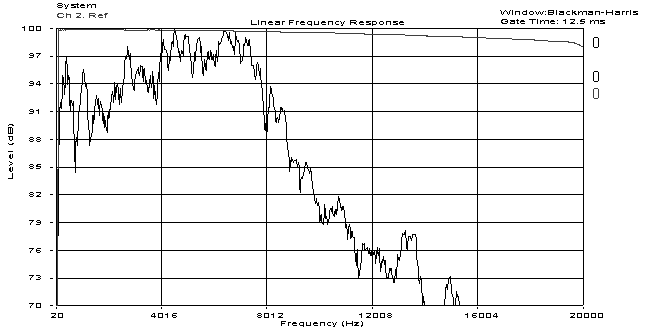
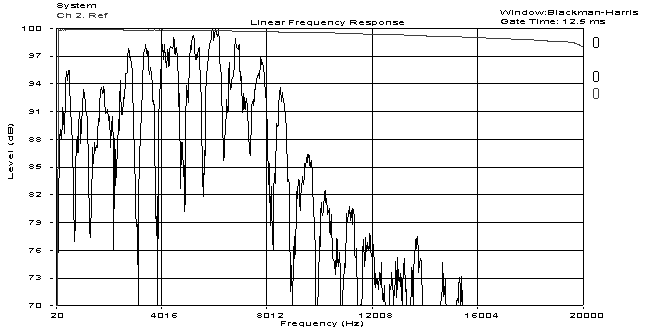
Also, the fall-off above 8 kHz is the limitation of the Radio Shack SPL meter, not the speakers or the test.
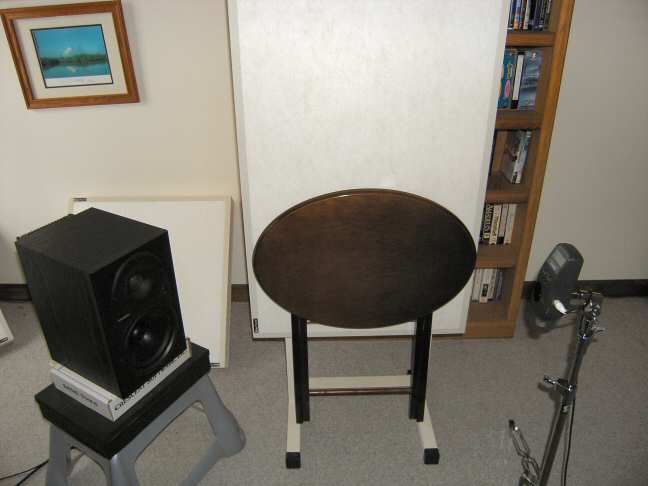
You have a fixed reflection path length, so all those peaks and dips are mostly the result of phase cancellations and reinforcements caused by each frequency having a different wavelength, therefore some reflections being ADDED while others are SUBTRACTED, still others not affected in level.
Note that the peaks/dips are much smaller when the hard surface isn't in the way of absorption.
Ethan, you didn't happen to also compare a 703 panel in the same location to see if it's better or worse than the 705, did you?
(I know, I could get off my ass and do it myself but my entire place is in such a state of flux these days that If I tried that my wife would probably go to jail for spousal abuse
  Steve
Steve
You have a fixed reflection path length, so all those peaks and dips are mostly the result of phase cancellations and reinforcements caused by each frequency having a different wavelength, therefore some reflections being ADDED while others are SUBTRACTED, still others not affected in level.
Note that the peaks/dips are much smaller when the hard surface isn't in the way of absorption.
Ethan, you didn't happen to also compare a 703 panel in the same location to see if it's better or worse than the 705, did you?
(I know, I could get off my ass and do it myself
but my entire place is in such a state of flux these days that If I tried that my wife would probably go to jail for spousal abuse SteveSoooo, when a Musician dies, do they hear the white noise at the end of the tunnel??!? Hmmmm...
-
Ethan Winer
- Senior Member
- Posts: 1063
- Joined: Fri Feb 21, 2003 3:50 am
- Location: New Milford, CT, USA
- Contact:
Steve,
> the fall-off above 8 kHz is the limitation of the Radio Shack SPL meter, not the speakers or the test. <
Exactly. I do have a pro quality omni mike, but it's on "permanent loan" to my partner who uses it in his home studio. He lives an hour away from me so it's a nuisance to get it back when I need to test stuff.
> you didn't happen to also compare a 703 panel in the same location to see if it's better or worse than the 705, did you? <
No, but I wish I did. Then again, my point was just to see if a panel made from 705 does the job. Which clearly it does.
--Ethan
> the fall-off above 8 kHz is the limitation of the Radio Shack SPL meter, not the speakers or the test. <
Exactly. I do have a pro quality omni mike, but it's on "permanent loan" to my partner who uses it in his home studio. He lives an hour away from me so it's a nuisance to get it back when I need to test stuff.
> you didn't happen to also compare a 703 panel in the same location to see if it's better or worse than the 705, did you? <
No, but I wish I did. Then again, my point was just to see if a panel made from 705 does the job. Which clearly it does.
--Ethan
-
Don T
- Posts: 40
- Joined: Sat Feb 11, 2006 4:54 am
- Location: Portland OR
Hello:
I think you will find the increased density of 705 inproves low frequency absorption but you get a definite bump in the mid range. 703 does not exhibit the mid range bump. Naturally all things are trade offs/compromises. We just occupied new spaces that were treated with 705 "A" mount and the mid mud bump is out of control. If you have samples of both, do the ear test. Stand facing a flat reflective wall and speak your usual frequency words (test, test, hello, hello etc). Slide a panel of 705 up so you are speaking into it and note the difference. Then do the same with 703. Have someone listening in the room behind you to get a second opinion. I think even in this simple test you will hear the difference.
I think you will find the increased density of 705 inproves low frequency absorption but you get a definite bump in the mid range. 703 does not exhibit the mid range bump. Naturally all things are trade offs/compromises. We just occupied new spaces that were treated with 705 "A" mount and the mid mud bump is out of control. If you have samples of both, do the ear test. Stand facing a flat reflective wall and speak your usual frequency words (test, test, hello, hello etc). Slide a panel of 705 up so you are speaking into it and note the difference. Then do the same with 703. Have someone listening in the room behind you to get a second opinion. I think even in this simple test you will hear the difference.
Don T
Music & students - what a gas!
Music & students - what a gas!
-
Ethan Winer
- Senior Member
- Posts: 1063
- Joined: Fri Feb 21, 2003 3:50 am
- Location: New Milford, CT, USA
- Contact:
Don,
> We just occupied new spaces that were treated with 705 "A" mount and the mid mud bump is out of control. <
If you have a room with a peak in the low-mids, then that means you need more absorption in that range. Or is that what you meant?
> Slide a panel of 705 up so you are speaking into it and note the difference. Then do the same with 703. <
Agreed - I use the "talk into it" test all the time. This works for diffusors too! (Though there what you're listening for is different than with absorption.)
--Ethan
> We just occupied new spaces that were treated with 705 "A" mount and the mid mud bump is out of control. <
If you have a room with a peak in the low-mids, then that means you need more absorption in that range. Or is that what you meant?
> Slide a panel of 705 up so you are speaking into it and note the difference. Then do the same with 703. <
Agreed - I use the "talk into it" test all the time. This works for diffusors too! (Though there what you're listening for is different than with absorption.)
--Ethan
-
seb
- Posts: 4
- Joined: Thu Apr 13, 2006 11:52 pm
- Location: Syyydenni
An acoustic consultant I used to work for "fixed" quite audible acoustic problems at the Sydney Imax by "terminating" the insulation batts that were spaced off the walls using heavy-duty roofing foil on the back and then filling the gap behind with low density stuff.
This excel spreadsheet is based on the theory of porous absorbers:
http://www.whealy.com/acoustics/Porous.html
It quite clearly shows the (theoretical) effect of spacing batts off the wall. Also, I have seen 1/3rd octave band test data for Ecophon ceiling tiles suspended over large airspaces which clearly show these dips. (I haven't checked if the test freq match the theory). I haven't seen any test data to validate my old boss's idea but later this (southern) winter I plan to set up a laptop to do acoustic tests like Ethan's plots and investigate for myself.
This excel spreadsheet is based on the theory of porous absorbers:
http://www.whealy.com/acoustics/Porous.html
It quite clearly shows the (theoretical) effect of spacing batts off the wall. Also, I have seen 1/3rd octave band test data for Ecophon ceiling tiles suspended over large airspaces which clearly show these dips. (I haven't checked if the test freq match the theory). I haven't seen any test data to validate my old boss's idea but later this (southern) winter I plan to set up a laptop to do acoustic tests like Ethan's plots and investigate for myself.
-
edenorchestra
- Posts: 122
- Joined: Wed Nov 10, 2004 1:07 am
- Location: Latrobe - PA - USA
- Contact:
-
Don T
- Posts: 40
- Joined: Sat Feb 11, 2006 4:54 am
- Location: Portland OR
Ethan:
The mid bump is exactly that, it extends up above 1k hz. I have to qualify that earlier statement though. After some more testing I discovered the contractors left the insulation out of the ceiling cavity. 21" of air space between the iso ceiling and the suspended sheetrock. One BIG echo chamber. So, some of that mid bump is the ceiling. I will have to re-test the room after they fix it. That doesn't change the simple listening test but it sure is going to affect the total result in our rooms.
Also, I have been thinking about a whole new approach to the use of resonant systems in control rooms / studios. It has also kindled some new thoughts about 703, captive air, diaphragms and phase.
For example:
Slatted Helmholtz resonators that are not properly compartmentalized. By its nature a slat resonator needs to have a uniform wave gradient or it essentially becomes a leaky box that does not perform as tuned. This lends itself to performing well with 90* room modes but not as a general absorber.
Bass absorbers with excessive mass. Current accepted designs tend to make up for stiff suspension by adding more mass to lower the resonant Fz. This raises the Q and causes the panel to reflect too much energy.
I have bass aborbers and more diffusion to design for our new spaces and I intend to do some research / testing of accepted axioms before I begin. There are some holes in the data of accepted norms. I'm thinking some inroads can be made in the direction of particle diffusion & phase response.
The mid bump is exactly that, it extends up above 1k hz. I have to qualify that earlier statement though. After some more testing I discovered the contractors left the insulation out of the ceiling cavity. 21" of air space between the iso ceiling and the suspended sheetrock. One BIG echo chamber. So, some of that mid bump is the ceiling. I will have to re-test the room after they fix it. That doesn't change the simple listening test but it sure is going to affect the total result in our rooms.
Also, I have been thinking about a whole new approach to the use of resonant systems in control rooms / studios. It has also kindled some new thoughts about 703, captive air, diaphragms and phase.
For example:
Slatted Helmholtz resonators that are not properly compartmentalized. By its nature a slat resonator needs to have a uniform wave gradient or it essentially becomes a leaky box that does not perform as tuned. This lends itself to performing well with 90* room modes but not as a general absorber.
Bass absorbers with excessive mass. Current accepted designs tend to make up for stiff suspension by adding more mass to lower the resonant Fz. This raises the Q and causes the panel to reflect too much energy.
I have bass aborbers and more diffusion to design for our new spaces and I intend to do some research / testing of accepted axioms before I begin. There are some holes in the data of accepted norms. I'm thinking some inroads can be made in the direction of particle diffusion & phase response.
Don T
Music & students - what a gas!
Music & students - what a gas!