Hey guys,
Just wondering if anyone who has dealt with these flooring options (hardwood, engineered hardwood and laminate) has any opinions to their differences acoustically. To be clear, when i say acoustically, i'm not talking about isolation or anything; i want to know how these coverings may color sound comparatively.
From experience i like hardwood. I'm sure that it would be sonically the best, but is the difference in cost and installation requirements (for basements, especially) worth not going with engineered hardwood or laminate? I have heard that laminate has a very distinct sonic coloration ('plastic-y') but i personally haven't been in a studio with it installed. I'm not afraid to spend the money on hardwood, but if i can spend a bit less and not regret it, i will.
Has anyone examined other non-carpet coverings alternatives? I was going to consider osb (chipboard) but while searching for flooring topics on the forum i found a post about osb outgassing formaldehyde. I'd also like to consider bamboo, but i don't know what sort of accoustic qualities it would have.
hardwood vs engineered hardwood vs laminate
-
bryanarchy
- Posts: 24
- Joined: Wed Mar 23, 2005 2:49 pm
- Location: Edmonton, Alberta
- Contact:
-
bryanarchy
- Posts: 24
- Joined: Wed Mar 23, 2005 2:49 pm
- Location: Edmonton, Alberta
- Contact:
-
Ethan Winer
- Senior Member
- Posts: 1063
- Joined: Fri Feb 21, 2003 3:50 am
- Location: New Milford, CT, USA
- Contact:
Re: hardwood vs engineered hardwood vs laminate
Bryan,
> (hardwood, engineered hardwood and laminate) <
I can't imagine they'll sound different since what matters most is reflectivity versus frequency.
--Ethan
> (hardwood, engineered hardwood and laminate) <
I can't imagine they'll sound different since what matters most is reflectivity versus frequency.
--Ethan
-
John Sayers
- Site Admin
- Posts: 5462
- Joined: Mon Jan 27, 2003 12:46 pm
- Location: Australia
- Contact:
Bryan - I 'd suggest that the thickness is what counts. some of those laminates are only 1/2" whereas true hardwood floor is more like 5-7/8". mind you, mounted on battens with insulation in the cavity you've got a pretty functional bass panel absorber.
tha bamboo does look nice - very expensive though.
cheers
john
tha bamboo does look nice - very expensive though.
cheers
john
-
Ethan Winer
- Senior Member
- Posts: 1063
- Joined: Fri Feb 21, 2003 3:50 am
- Location: New Milford, CT, USA
- Contact:
-
bryanarchy
- Posts: 24
- Joined: Wed Mar 23, 2005 2:49 pm
- Location: Edmonton, Alberta
- Contact:
I can't help but think the reflectivity of laminate, which is basically a melamine, would be different than that of a real wood surface. I totally understand Ethan's feelings of debating something good vs something just as good but but you don't see people making violins out of plastic, if you catch my drift.
John- Can you elaborate a bit on thickness and how it would affect the acoustics? Is the density of the surface something to consider too?
John- Can you elaborate a bit on thickness and how it would affect the acoustics? Is the density of the surface something to consider too?
-
Ethan Winer
- Senior Member
- Posts: 1063
- Joined: Fri Feb 21, 2003 3:50 am
- Location: New Milford, CT, USA
- Contact:
Bryan,
> you don't see people making violins out of plastic <
Actually, a few luthiers are now using carbon fiber for both instruments and bows, and some of them sound very good indeed. Much better than cheap instruments made of wood. But this misses the point. In a violin the wood is free to vibrate, and the many resonances are an important part of the sound. With a floor you want it secured securely to avoid resonances. So it's not really a valid comparison.
--Ethan
> you don't see people making violins out of plastic <
Actually, a few luthiers are now using carbon fiber for both instruments and bows, and some of them sound very good indeed. Much better than cheap instruments made of wood. But this misses the point. In a violin the wood is free to vibrate, and the many resonances are an important part of the sound. With a floor you want it secured securely to avoid resonances. So it's not really a valid comparison.
--Ethan
-
bryanarchy
- Posts: 24
- Joined: Wed Mar 23, 2005 2:49 pm
- Location: Edmonton, Alberta
- Contact:
i agree. I apologize, i was just carrying on your analogy and trying to make the point that plastic vs wood would make a difference. In the case of the floor, i meant reflections, not resonances.Ethan Winer wrote:Bryan,
> you don't see people making violins out of plastic <
Actually, a few luthiers are now using carbon fiber for both instruments and bows, and some of them sound very good indeed. Much better than cheap instruments made of wood. But this misses the point. In a violin the wood is free to vibrate, and the many resonances are an important part of the sound. With a floor you want it secured securely to avoid resonances. So it's not really a valid comparison.
--Ethan
To get back to my question, do you really think that there will be no appreciable differences in reflectivity between a laminate or a hardwood?
-
Ethan Winer
- Senior Member
- Posts: 1063
- Joined: Fri Feb 21, 2003 3:50 am
- Location: New Milford, CT, USA
- Contact:
Bryan,
> do you really think that there will be no appreciable differences in reflectivity between a laminate or a hardwood? <
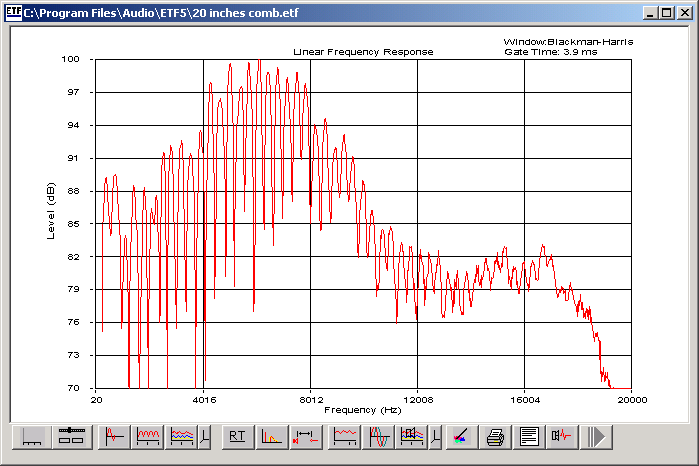
Yes. But it's really easy to test this for yourself. The simplest test is to go to the store and hold samples of each right in front of your face. Talk into them and compare the sound reflected back at you. A more scientific way is to do the same but with the ETF software, or equivalent, to analyze the reflections. The deeper the nulls, and the higher in frequency they extend to, the more reflective the surface.
The graph below shows the reflectivity (by way of the comb filter response) of a standard sheet rock wall from 20 inches away. It's from THIS article I wrote a few years ago for EQ magazine.
--Ethan
> do you really think that there will be no appreciable differences in reflectivity between a laminate or a hardwood? <
Yes. But it's really easy to test this for yourself. The simplest test is to go to the store and hold samples of each right in front of your face. Talk into them and compare the sound reflected back at you. A more scientific way is to do the same but with the ETF software, or equivalent, to analyze the reflections. The deeper the nulls, and the higher in frequency they extend to, the more reflective the surface.
The graph below shows the reflectivity (by way of the comb filter response) of a standard sheet rock wall from 20 inches away. It's from THIS article I wrote a few years ago for EQ magazine.
--Ethan
-
bryanarchy
- Posts: 24
- Joined: Wed Mar 23, 2005 2:49 pm
- Location: Edmonton, Alberta
- Contact:
ok, that article was very helpful. The only thing i don't quite understand is why a hard floor would be different than a hard, vertical wall. ie: how would a floor produce the desired ambience where a wall wouldn't? I would think it would be subject to the same comb filtering, etc.
Having the floor being hard and having the ceiling absorbent makes a lot of sense to me though. A big problem i have had with drums is outlined, to the letter in your article; and that is the overheads being close to the ceiling and the reflections/comb filtering mucking up the sound. While i agree absorption is likely the best and most logical way to do this, has anyone ever tried a treatment such as quadratic residue diffusors on the ceiling over the drum position? The motivating factor for diffusion (in magazines, web boards, product documents) always seems to be that 'it makes the room sound bigger than it is'. First off, i am not sure how it would do this, but admittedly i'm still trying to wrap my head around how qrd's, etc work. Secondly, if it does achieve this in some way, wouldn't putting it over the drum position be a good application?
The only reason i couldn't see it being good is that the wells would have to be pretty deep to deal with the bigger waves. Maybe a combination of diffusion and absorption?
A lot of this stuff is, at this point, only theoretical. The space i'm building is the first i have been able to put up walls, change flooring, etc so there's a lot of questions.
thanks,
bryan
Having the floor being hard and having the ceiling absorbent makes a lot of sense to me though. A big problem i have had with drums is outlined, to the letter in your article; and that is the overheads being close to the ceiling and the reflections/comb filtering mucking up the sound. While i agree absorption is likely the best and most logical way to do this, has anyone ever tried a treatment such as quadratic residue diffusors on the ceiling over the drum position? The motivating factor for diffusion (in magazines, web boards, product documents) always seems to be that 'it makes the room sound bigger than it is'. First off, i am not sure how it would do this, but admittedly i'm still trying to wrap my head around how qrd's, etc work. Secondly, if it does achieve this in some way, wouldn't putting it over the drum position be a good application?
The only reason i couldn't see it being good is that the wells would have to be pretty deep to deal with the bigger waves. Maybe a combination of diffusion and absorption?
A lot of this stuff is, at this point, only theoretical. The space i'm building is the first i have been able to put up walls, change flooring, etc so there's a lot of questions.
thanks,
bryan
-
Ethan Winer
- Senior Member
- Posts: 1063
- Joined: Fri Feb 21, 2003 3:50 am
- Location: New Milford, CT, USA
- Contact:
Bryan,
> how would a floor produce the desired ambience where a wall wouldn't? I would think it would be subject to the same comb filtering, etc. <
Yes, they're exactly the same - but with a difference.
The difference is that with a reflective floor in a good room, there's only one source of reflections. As opposed to people recording in a bedroom with reflections from four nearby walls, a nearby ceiling, and maybe the floor too. In that case there's not only multiple comb filters, but also a million competing reflections that all combine to reduce clarity.
> has anyone ever tried a treatment such as quadratic residue diffusors on the ceiling over the drum position? <
You could do that, but if the ceiling is low I suspect it would not be as effective as absorption. And it would be much more expensive assuming "good" diffusors.
> 'makes the room sound bigger than it is' <
Sure, but if you think about it, a ceiling that is totally absorbent is equivalent to a ceiling that's infinitely far away. Either way, all of the sound that goes up never comes back. Assuming absorption that's effective to a low enough frequency.
--Ethan
> how would a floor produce the desired ambience where a wall wouldn't? I would think it would be subject to the same comb filtering, etc. <
Yes, they're exactly the same - but with a difference.
The difference is that with a reflective floor in a good room, there's only one source of reflections. As opposed to people recording in a bedroom with reflections from four nearby walls, a nearby ceiling, and maybe the floor too. In that case there's not only multiple comb filters, but also a million competing reflections that all combine to reduce clarity.
> has anyone ever tried a treatment such as quadratic residue diffusors on the ceiling over the drum position? <
You could do that, but if the ceiling is low I suspect it would not be as effective as absorption. And it would be much more expensive assuming "good" diffusors.
> 'makes the room sound bigger than it is' <
Sure, but if you think about it, a ceiling that is totally absorbent is equivalent to a ceiling that's infinitely far away. Either way, all of the sound that goes up never comes back. Assuming absorption that's effective to a low enough frequency.
--Ethan
-
bryanarchy
- Posts: 24
- Joined: Wed Mar 23, 2005 2:49 pm
- Location: Edmonton, Alberta
- Contact:
>The difference is that with a reflective floor in a good room, there's only one source of reflections. As opposed to people recording in a bedroom with reflections from four nearby walls, a nearby ceiling, and maybe the floor too. In that case there's not only multiple comb filters, but also a million competing reflections that all combine to reduce clarity.
So would the floor would likely yeild the same comb filtering results if you repeated the experiment from your article, right?
>Sure, but if you think about it, a ceiling that is totally absorbent is equivalent to a ceiling that's infinitely far away. Either way, all of the sound that goes up never comes back. Assuming absorption that's effective to a low enough frequency.
Yeah, i'm clearly dealing with a low ceiling. Now when putting up absorption on the ceiling, should i do full coverage over the drum position, or does your idea of 30-40% of covering walls with absorption carry over to ceilings? If we're talking 30-40%, what about covering the rest of the ceiling over the drum position with diffusion?
Bryan
So would the floor would likely yeild the same comb filtering results if you repeated the experiment from your article, right?
>Sure, but if you think about it, a ceiling that is totally absorbent is equivalent to a ceiling that's infinitely far away. Either way, all of the sound that goes up never comes back. Assuming absorption that's effective to a low enough frequency.
Yeah, i'm clearly dealing with a low ceiling. Now when putting up absorption on the ceiling, should i do full coverage over the drum position, or does your idea of 30-40% of covering walls with absorption carry over to ceilings? If we're talking 30-40%, what about covering the rest of the ceiling over the drum position with diffusion?
Bryan
-
Ethan Winer
- Senior Member
- Posts: 1063
- Joined: Fri Feb 21, 2003 3:50 am
- Location: New Milford, CT, USA
- Contact:
Bryan,
> So would the floor would likely yeild the same comb filtering results if you repeated the experiment from your article, right? <
Right.
> should i do full coverage over the drum position <
Yes, because you want to reduce comb filtering and early reflections as much as possible. Especially if the ceiling is only a foot or so above the overhead mikes.
The idea of covering a room's surface to 30 or 40 percent is to tame the overall ambience without making the room totally dead. That's a very different goal than avoiding direct reflections.
--Ethan
> So would the floor would likely yeild the same comb filtering results if you repeated the experiment from your article, right? <
Right.
> should i do full coverage over the drum position <
Yes, because you want to reduce comb filtering and early reflections as much as possible. Especially if the ceiling is only a foot or so above the overhead mikes.
The idea of covering a room's surface to 30 or 40 percent is to tame the overall ambience without making the room totally dead. That's a very different goal than avoiding direct reflections.
--Ethan