Hi everyone,
I'm new to building studios. I've read a few posts here in the forum, read the Rod Gervais book, but each time I'm more confused! So I need help...
I’m a semi-professional musician (drummer) for almost 30 years. I have recorded albums in professional studios and rehearsal studios, I have played in tiny pubs and in the biggest arenas in Portugal.
Now I finally have my own space to build my studio/rehearsal room.
I do not have any experience in building studios but I know what I want. And I know my space and budget limitations.
The goal is to have a studio as professional as possible to record bands, mix records and rehearsals in live room.
I think in the text below I fulfilled all the requirements so that you can give me indications of how to reach my final goal!
DESCRIPTION:
Recording/Rehearsal Studio in Azeitão – PORTUGAL
The Studio will be built in two separate rooms in my basement.
Control Room - L 5,55m x W 3,54m x H 2,60m
Live Room - L 9,29m x W 3,38m x H 2,60m
The floor is made of cement (or concrete) over the sand.
My biggest concern is having the family upstairs. Although the rooms are on the 1st floor, I'm afraid the sound will go through the floor and walls to the rooms. I have a baby, noise is a problem!
Some walls are 100% under the ground, others are only 11cm brick and face the interior corridor of the house.
For now both rooms are completely empty and without isolation.
My idea will be to build "a room within a room" perhaps with Mason UK LTD's Lightweight Floor Spring system on the floor. But here is my first doubt because in the book by Rod Gervais says that this type of floor is not effective in recording studios!
CONTROL ROOM:
The first phase (June/July) will be the construction of the Control Room because it is a smaller room and will serve to test the effectiveness of the insulation.
If it works, I reply to the live room, if it does not work as expected, a new study will be done with other alternatives.
Mixing room with L 5.55m x W 3.54m x H 2.60m
After the works I intend to stay with L 5.00m x 3.40m W x 2.40m H.
Aspect ratio: 2.08 : 1.42 : 1.00
In the control room the insulation will not be such a big concern because it will serve for mixing/production. In principle the main monitors will be the Yamaha HS8, maybe with subwoofer. As it is for mixing the volume will be around 80/85 dB. I believe that sometimes it can be superior during recordings or simply to listen loud music.
I know it’s a small room but want to build a good mixing room!
The East wall is 100% below the ground and is an outside wall; the North wall is below the ground about 80cm, is an outer wall and has a window; the South wall is the most worrying because it is to the side of the hallway of the house and is only in brick of 11cm; the west wall on the opposite side has the garage, so it also needs a lot of insulation.
I'm thinking of building a floating floor using Mason UK systems to prevent vibrations from flowing into the walls.
http://www.mason-uk.co.uk/mfs-lightweight-floor-spring/
On the walls I will use a spring system to create "structural shutdown" (I don’t know the correct designation) and I am thinking of building STC63 walls.
What kind of springs are indicated?
I have doubts if there are already brick walls, should I build the new wall (STC63) leaving air box between the brick and the new wall or this insulation is too much?
I will have a custom made studiodesk equal to the Argosy Dual15 or Dual15K facing to the West wall. Is it the best way to the desk in the room?
On the right side of the West wall, a connection will be open for the passage of the cables to the live room.
The air circulation system will not be an issue since there is a window that can be opened for air renovation.
But this window, apparently, will be my biggest problem in this room. Being in a corner makes it difficult to build new walls. It was lack of planning when this wall was built ... Any suggestions how to solve this situation?
Other less important issues:
I will install a video system for visual communication between the two rooms.
I would like the control room to be in wood finish, is there any special care I should have?
Budget for insulation/acoustic treatment of the entire studio: 5000€.
I will be flexible in budget.
LIVE ROOM:
Room with L 9,29m x W 3,38m x H 2,60m
Room for recordings/rehearsals.
Daily I will play drums (with a lot of volume!!!).
Rehearsals with drums and guitar amps are expected. Expected volume 100/110db.
Two independent rooms will be built for vocal booth and guitar booth about 2 meters from the west wall.
The East and South walls are 100% below ground and are exterior walls; the South wall is the most worrying because it is to the side of the hallway of the house and is only in brick of 11cm; the West wall is the outer wall with window. But here's the vocals booth/guitar booth so these rooms will serve as isolation for the outside.
There are two stuts in the middle of the ceiling.
It is also necessary to design the air renewal system since after the construction of the booth rooms there will be no access to the window for air renovation.
Doubts:
1. Floating floor results in studios?
2. What to do with the control room window?
3. Position of the desk in control room, is the ideal?
4. Wood finish of control room, tips?
5. Is STC63 too much for the control room?
6. The dimensions of the live room aren’t in the Bolt-Area, what consequences can it have?
For now I’m only focused on Control Room.
Studio in Azeitão - Portugal
Moderators: Aaronw, kendale, John Sayers
-
Duarte_Vader
- Posts: 43
- Joined: Fri Feb 23, 2018 11:30 pm
- Location: Azeitão - PORTUGAL
-
Soundman2020
- Site Admin
- Posts: 11938
- Joined: Thu Aug 21, 2008 10:17 am
- Location: Santiago, Chile
- Contact:
Re: Studio in Azeitão - Portugal
Hi there "Duarte_Vader", and Welcome! 
 That's the best floor you can have for a studio.
Definitely! That's the best way to get good isolation at the lowest cost, and using up the least amount of space.
Here's the explanation for why trying to float your floor is a bad idea: http://www.johnlsayers.com/phpBB2/viewt ... f=2&t=8173
On that very same website page, Mason makes the following statement: ""The best performing floating floor systems are typically heavy and thick, using a concrete layer, such as our jack up floating floors". Yes. Correct. But as explained in that post above, you do not even need that! Your existing concrete slab-on-grade is all that you need.
I'm sure you are thinking; "But this is simple! I look at Rod's book, and it seems so easy!". Yes, it does look easy, but no, in reality, it isn't easy. Once you get started on the design, you'll start realizing that there are so many things that you never even considered before, and now you have to get them all working together. It takes time. Realistically, it will probably take you three of four months to learn the basics of acoustics up to the point where you know enough to design your room, then another three or four months to actually do the design. That's reality. That's how long it takes most people on the forum who want to do it themselves.
So the first thing you should do, is to reset your schedule. If you start now, then you might be ready to build by October or November. That's realistic
The key to having a studio perform as expected, is to take the time to design it properly. It's that simple. Experimenting would be a waste of time and money.
Also, it would be a mistake to build the live room the same as the control room: they have very different purposes, very different sound levels, very different spectra, and therefore very different acoustic needs. BOTH of the rooms must be designed properly, EACH for it's own purpose. So if you build the control room a certain way, and it works, then you build the live room the SAME way, I can guarantee you that it won't work. Mistake.
A more basic question: How much isolation do you need for your live room, and for your control room, in decibels? That's the key most basic questions here. If you don't know that number, then you cannot determine the size of the control room.
Sorry to disagree, but you will often find yourself needing to turn up the volume briefly to check the bass. If you don't, then you cannot know if the low end of your mix sill sound good. Yes, it is normal to mix at around 85 dB, and that is in fact the calibration level for studios and cinema: the room is tuned and tested at a level of 85 dBC. For example, in this room: http://www.johnlsayers.com/phpBB2/viewt ... =2&t=20471 all of the final tuning was done at 85 dBC. But the owner often "turns it up" to check the bass, easily pushing 100 dBC (and more) for brief periods, before going back down to 85 or so to carry on. It is not realistic to believe that you will always mix at exactly 85 dB, and never need to go over that.
You can't guess here...
Here's a diagram that shows how the isolation varies across the spectrum (low frequencies on the left, high on the right), and what aspect of each part of the isolation system governs the isolation for each region of the spectrum:
You can see that, for the very lowest frequencies, it is the stiffness of the walls that controls the isolation. Above that, it is the resonance of the wall parts. Beyond that, it is the mass of the walls that controls how well they isolate. Next up: damping is the main factor (in the region commonly referred to as the "coincidence dip"). And at the highest frequencies, it is the shear characteristics of the wall that control isolation.
Notice something: The LOWEST isolation (the place where the wall isolates the WORST), is in the region controlled by resonance. If you can improve that part, then you improve everything else too! So a lot of your design work should be concentrated on getting the resonance-controlled region as good as it possible can be.
In other words, you have to tune your walls, just like you tune a guitar or a piano. You tune your walls such that the resonant characteristics are what you need for YOUR situation. I can walk you through the procedure for doing that: it involves a bit of math, but not too complicated.
So it is not correct to think that you will be mounting your walls on springs, or to be worrying about the air cavity on the side that has the brick wall. Rather, you should be looking at the entire room as a system, and tuning the system to get the isolation that you need.
STC is a lousy system for measuring the isolation for a studio. Here's why:
It is no use at all for telling you how well your studio will be isolated. STC was never meant to measure such things. Here's an excerpt from the actual ASTM test procedure (E413) that explains the use of STC.
“These single-number ratings correlate in a general way with subjective impressions of sound transmission for speech, radio, television and similar sources of noise in offices and buildings. This classification method is not appropriate for sound sources with spectra significantly different from those sources listed above. Such sources include machinery, industrial processes, bowling alleys, power transformers, musical instruments, many music systems and transportation noises such as motor vehicles, aircraft and trains. For these sources, accurate assessment of sound transmission requires a detailed analysis in frequency bands.”
It's a common misconception that you can use STC ratings to decide if a particular wall, window, door, or building material will be of any use in a studio. As you can see above, in the statement from the people who designed the STC rating system and the method for calculating it, STC is simply not applicable.
Here's how it works:
To determine the STC rating for a wall, door, window, or whatever, you start by measuring the actual transmission loss at 16 specific frequencies between 125 Hz and 4kHz. You do not measure anything above or below that range, and you do not measure anything in between those 16 points. Just those 16, and nothing else. Then you plot those 16 points on a graph, and do some fudging and nudging with the numbers and the curve, until it fits in below one of the standard STC curves. Then you read off the number of that specific curve, and that number is your STC rating. There is no relationship to real-world decibels: it is just the index number of the reference curve that is closest to your curve.
When you measure the isolation of a studio wall, you want to be sure that it is isolating ALL frequencies, across the entire spectrum from 20 Hz up to 20,000 Hz, not just 16 specific points that somebody chose 50 years ago, because he thought they were a good representation of human speech. STC does not take into account the bottom two and a half octaves of the musical spectrum (nothing below 125Hz), nor does it take into account the top two and a quarter octaves (nothing above 4k). Of the ten octaves that our hearing range covers, STC ignores five of them (or nearly five). So STC tells you nothing useful about how well a wall, door or window will work in a studio. The ONLY way to determine that, is by look at the Transmission Loss curve for it, or by estimating with a sound level meter set to "C" weighting (or even "Z"), and slow response, then measuring the levels on each side. That will give you a true indication of the number of decibels that the wall/door/window is blocking, across the full audible range.
Consider this: It is quite possible to have a door rated at STC-30 that does not provide even 20 decibels of actual isolation, and I can build you a wall rated at STC-20 that provides much better than 30 dB of isolation. There simply is no relationship between STC rating and the ability of a barrier to stop full-spectrum sound, such as music. STC was never designed for that, and cannot be used for that.
Then there's the issue of installation. You can buy a door that really does provide 40 dB of isolation, but unless you install it correctly, it will not provide that level! If you install it in a wall that provides only 20 dB, then the total isolation of that wall+door is 20 dB: isolation is only as good as the worst part. Even if you put a door rated at 90 dB in that wall, it would STILL only give you 20 dB. The total is only as good as the weakest part of the system.
So forget STC as a useful indicator, and just use the actual TL graphs to judge if a wall, door, window, floor, roof, or whatever will meet your needs.
. lots of technical terms in there, but I'll explain that at some other point): Therefore, the only usable layout for your room is to have the desk facing the north wall (upwards, towards the top of the diagram). You still won't be able to get the ITDG long enough, but it wil be MUCH better than if you have the desk facing sideways, with the speakers firing along the short axis.
I often have this conversation with first time studio builders, because they want to save money. And that's fine! But HVAC is one place where you CANNOT save money. Opening a window and hoping that you can ventilate your room like that is not only impracticality it is impossible: It won't work! It's that simple.
Let me give you a simple experiment that you can try, so you get this: Go sit in your car in a very noise place, such as rush-hour traffic outside a disco, music festival, street-market with loud music, or something similar. Sit in your car with the windows closed, the radio off, and the engine off. Listen to how much of the outside sound you can hear inside. Now open the window...

That should be the first thing that will convince you that it is not realistic, feasible, or even possible to have a well isolated room and expect that opening the window can be your HVAC system. As soon as you open the window, you totally destroy all of the isolation that you achieved. Period. End of story. In order to isolate your room, you will take great care to build the "room inside the room", with massive walls, insulation in the cavity, carefully sealing everything to make it totally airtight.... and then you want to make an enormous hole in that by opening the window????
 No, no, and no.
OK, let's jsut for a second imagine that you could magically cast a spell on your window so that it does not let the sound out along with the air. Maybe sprinkle some pixie dust on the window frame or something.... Guess what? It STILL would not work to ventilate your room!!! Air will not move unless you give it a reason to move: you have to create a pressure difference between the interior of the room and the exterior, and opening the window does not do that. Your studio will be sealed air-tight, and therefore it will not have all those hundreds of tiny gaps, cracks, and miniature holes that ordinary rooms have, where air can leak in or out. There will be NO pressure difference, and therefore opening the window will accomplish nothing: no pressure change, no air movement. The air will just sit there, not moving.
You would need ANOTHER window in the room, that faces somewhere that has a different pressure (maybe into the garage, for example), and then you could get air moving.
So not only would opening the window trash your isolation, it would not even work to ventilate your room.
You absolute and necessarily MUST build a proper ventilation system, with two air paths: one to exhaust the stale air out of the room, and the other to bring in the same amount of fresh air to replace it. This system will need to have a fan in it, to drive the air through the room, and the fan will need to move the correct amount of air such that the entire volume of air inside the room is replaced six times per hour at least, and preferably more. The ducts will need silencer boxes on them, to allow the air to pass through will preventing the sound from getting through, and the entire system must have the correct dimensions to ensure that that the speed of the air is not high enough that it will create any audible noise.
So, that's the ventilation part: but that's only one aspect of HVAC: Your rooms don't only need ventilation: they also need cooling and dehumidifying. That can be done with a small mini-split system.
You might think that this is not necessary at all for a home studio, but in reality it is totally and absolutely necessary. You need high isolation for your room, therefore it must be sealed and have high mass. Since you need to breath inside there to stay alive, you need ventilation. Since your body and your equipment put our heat, and the studio is extremely well isolated thermally, you need cooling. And since you and the musicians will be exhaling inside the sealed rooms, and exhaled air has very high humidity, you also need to dehumidify the air. You also need to control humidity for another reason: man instruments, some mics, and some equipment is sensitive to humidity, and the tuning, timber, and sound of the instruments and mics will change as the humidity and temperature change. So the tenth take you do in the studio after having everyone sealed inside for an hour or so will sound different form the first take, when the instruments and voices had a different tone due to the different temperature and humidity.
So, forget all about the non-viable "open the window" method: it would trash your isolation, and would not work anyway. The ONLY option you have is to add a suitable HVAC system.
Take a look around the forum at the threads of members who have already built their studios, or are in the process of building them: You will notice that ALL of them have HVAC systems in them. Every single one.
Since your two rooms are not adjacent, this is the only possible solution. So you will need at least two cameras and at lest two screens. Don't forget to allow for the wiring between those two systems, when you plan the conduit path between the rooms.
Your control room has to have a certain acoustic response, in order to be usable for mixing. Basically, it has to be "flat" in both frequency response and time.domain response, just like the graphs in the link I gave you above, to "Studio Three". That's the goal. In typical home studios it is not possible to meet that (due to the size of the room, and the budget), but the goal is still to get as close as possible. This means that your control room acoustic will have to be "tuned", to try to achieve that ideal, or get as close as possible. Here is an example of how a room gets tuned. http://www.johnlsayers.com/phpBB2/viewt ... 68&start=0 We are in the process of tuning that room right now, and getting close to finishing. You can see that some parts do, indeed, end up as wood, and you usually use pretty much any type of wood that you like, with any finish that you like (natural, stained, varnished, painted, etc.) But there are large parts of the room surface that CANNOT be solid, since they must absorb sound in one way or another: those parts cannot be wood. In both of the cases I linked to above, the absorptive parts of the room are covered with fabric. In that room it is mostly either dark green fabric or black fabric, and in Studio Three it is mostly maroon fabric or beige fabric, with some black as well.
So yes, there will be some parts that can be wood, but less than half of the entire surface area of the room will be wood.
I hope I haven't put you off too much with all my negative answers! You have a LOT in your favor here: You have a good sized space, you have high ceilings, you have concrete floors, you have a reasonable (but low) budget, and you have the potential for your studio to be a really great place! I would encourage you to concentrate on the design, until you get it as good as it can be in every aspect, and only then start building. I have a feeling that your thread is going to be one of the best on the forum, if you do it right ...
- Stuart -
That's a nice size for a control room. It is very close to 20 m2, which is the recommended size for a critical listening room. And 2.6m is a nice height as well: a bit higher than the typical 2.4 m. You will lose some of that space for the isolation, yes, but its still a good size.Control Room - L 5,55m x W 3,54m x H 2,60m
The floor is made of cement (or concrete) over the sand.
That's the best floor you can have for a studio.OK, so high isolation is important!My biggest concern is having the family upstairs. Although the rooms are on the 1st floor, I'm afraid the sound will go through the floor and walls to the rooms. I have a baby, noise is a problem!
My idea will be to build "a room within a room
Definitely! That's the best way to get good isolation at the lowest cost, and using up the least amount of space.Bad idea, not necessary, and you don't need it...perhaps with Mason UK LTD's Lightweight Floor Spring system on the floor.
I certainly agree. A floated floor certainly can be "effective", in the sense that it will work to provide additional isolation, but you CANNOT achieve that for studio purposes with a light-weight floor deck! It is physically impossible. The Mason floor system you are taking about is effective for what it is designed for: isolating impact noise and rumble from things like exercise equipment, treadmills, gym floors, bowling alleys, and such like ( http://www.mason-uk.co.uk/wp-content/up ... flier1.pdf ). That is VERY different from having a maniac drummer bashing out 115 dBC, while the killer bass player is also roaring right next to him with a 4x18 cab on the floor also at 115 dBC, and growling screaming electric guitars, and screeching keyboards, and... well, you know what I'm talking about. Building an isolation floor for such an extreme situation is rather different from building an isolation platform for a gym treadmill.But here is my first doubt because in the book by Rod Gervais says that this type of floor is not effective in recording studios!
Here's the explanation for why trying to float your floor is a bad idea: http://www.johnlsayers.com/phpBB2/viewt ... f=2&t=8173
On that very same website page, Mason makes the following statement: ""The best performing floating floor systems are typically heavy and thick, using a concrete layer, such as our jack up floating floors". Yes. Correct. But as explained in that post above, you do not even need that! Your existing concrete slab-on-grade is all that you need.
This is a conversation that we often have with first-time studio builders, and it's hard to understand at first sight, but very true: You will NOT be ready to build in June. Nor in July. The design of a control room will take you a LOT longer than that. I design studios for a living, I'm used to it, and even so it usually takes me at least a month to completely design a control room. If I'm working on other things at the same time, it can take two or three or more months. So it will take you a lot longer than that to get to the stage where you can actually start building.The first phase (June/July) will be the construction of the Control Room because it is a smaller room and will serve to test the effectiveness of the insulation.
I'm sure you are thinking; "But this is simple! I look at Rod's book, and it seems so easy!". Yes, it does look easy, but no, in reality, it isn't easy. Once you get started on the design, you'll start realizing that there are so many things that you never even considered before, and now you have to get them all working together. It takes time. Realistically, it will probably take you three of four months to learn the basics of acoustics up to the point where you know enough to design your room, then another three or four months to actually do the design. That's reality. That's how long it takes most people on the forum who want to do it themselves.
So the first thing you should do, is to reset your schedule. If you start now, then you might be ready to build by October or November. That's realistic
There is no need to experiment: If you design it correctly and build it correctly then it WILL isolate correctly. Period. End of story. The only reason that a room turns out to not isolate as expected, is if it is not designed right: If you just sort of guess, and hope, and imagine the design, and start playing around with s bit of this and some of that, wishing and dreaming that it might work, but without checking the math and the materials and the techniques, then I can guarantee you that it will NOT isolate as designed.If it works, I reply to the live room, if it does not work as expected, a new study will be done with other alternatives.
The key to having a studio perform as expected, is to take the time to design it properly. It's that simple. Experimenting would be a waste of time and money.
Also, it would be a mistake to build the live room the same as the control room: they have very different purposes, very different sound levels, very different spectra, and therefore very different acoustic needs. BOTH of the rooms must be designed properly, EACH for it's own purpose. So if you build the control room a certain way, and it works, then you build the live room the SAME way, I can guarantee you that it won't work. Mistake.
How did you arrive at those final dimensions? Did you do the calculations to ensure that with walls 27.5cm thick and a ceiling 20cm thick, you will get the correct level of isolation for your room, and cover the correct part of the audio spectrum?After the works I intend to stay with L 5.00m x 3.40m W x 2.40m H.
A more basic question: How much isolation do you need for your live room, and for your control room, in decibels? That's the key most basic questions here. If you don't know that number, then you cannot determine the size of the control room.
Not really...In the control room the insulation will not be such a big concern because it will serve for mixing/production. In principle the main monitors will be the Yamaha HS8, maybe with subwoofer. As it is for mixing the volume will be around 80/85 dB.
Sorry to disagree, but you will often find yourself needing to turn up the volume briefly to check the bass. If you don't, then you cannot know if the low end of your mix sill sound good. Yes, it is normal to mix at around 85 dB, and that is in fact the calibration level for studios and cinema: the room is tuned and tested at a level of 85 dBC. For example, in this room: http://www.johnlsayers.com/phpBB2/viewt ... =2&t=20471 all of the final tuning was done at 85 dBC. But the owner often "turns it up" to check the bass, easily pushing 100 dBC (and more) for brief periods, before going back down to 85 or so to carry on. It is not realistic to believe that you will always mix at exactly 85 dB, and never need to go over that.Definitely! But not just "sometimes". In most mixing sessions, it happens all the time, regularly.I believe that sometimes it can be superior during recordings or simply to listen loud music.
Then build it as large as possible while still providing high isolation!I know it’s a small room but want to build a good mixing room!
No problem. It might be possible to keep that window, if you want to. For example, if you like working with natural light in the room, or if you have a great view out of that window, then you can probably keep it. If not, then its not hard to plug a window.is an outer wall and has a window;
That might need "beefing up" a bit. But you'll only know if you do the math!the South wall is the most worrying because it is to the side of the hallway of the house and is only in brick of 11cm
You can't guess here...Bad idea: see above. If you build the control room correctly, then there is no need at all to float the floor. Doing it right is complicated, expensive, and slow. There's thousands of ways to do it wrong, and only a couple of ways to do it right. Making a small mistake during the installation can actually make things WORSE not better. Meaning that you would LOSE isolation, not gain it. You do NOT need a floating floor. Especially conspiring that it will take out a large chunk of the best part of your room: the higher-than-normal ceiling. That is a very desirable feature, and wasting it on a floating floor that you don't need, is silly.I'm thinking of building a floating floor using Mason UK systems to prevent vibrations from flowing into the walls.
You are not going about this the right way: Isolating a studio is not just putting together some parts that act on their own: not at all. The entire studio is a SYSTEM. All parts of that system interact with each other to provide the overall isolation level, and they all do different things in different frequency ranges.On the walls I will use a spring system to create "structural shutdown" (I don’t know the correct designation) and I am thinking of building STC63 walls.
What kind of springs are indicated?
I have doubts if there are already brick walls, should I build the new wall (STC63) leaving air box between the brick and the new wall or this insulation is too much?
Here's a diagram that shows how the isolation varies across the spectrum (low frequencies on the left, high on the right), and what aspect of each part of the isolation system governs the isolation for each region of the spectrum:
You can see that, for the very lowest frequencies, it is the stiffness of the walls that controls the isolation. Above that, it is the resonance of the wall parts. Beyond that, it is the mass of the walls that controls how well they isolate. Next up: damping is the main factor (in the region commonly referred to as the "coincidence dip"). And at the highest frequencies, it is the shear characteristics of the wall that control isolation.
Notice something: The LOWEST isolation (the place where the wall isolates the WORST), is in the region controlled by resonance. If you can improve that part, then you improve everything else too! So a lot of your design work should be concentrated on getting the resonance-controlled region as good as it possible can be.
In other words, you have to tune your walls, just like you tune a guitar or a piano. You tune your walls such that the resonant characteristics are what you need for YOUR situation. I can walk you through the procedure for doing that: it involves a bit of math, but not too complicated.
So it is not correct to think that you will be mounting your walls on springs, or to be worrying about the air cavity on the side that has the brick wall. Rather, you should be looking at the entire room as a system, and tuning the system to get the isolation that you need.
Why?I am thinking of building STC63 walls.
STC is a lousy system for measuring the isolation for a studio. Here's why:It is no use at all for telling you how well your studio will be isolated. STC was never meant to measure such things. Here's an excerpt from the actual ASTM test procedure (E413) that explains the use of STC.
“These single-number ratings correlate in a general way with subjective impressions of sound transmission for speech, radio, television and similar sources of noise in offices and buildings. This classification method is not appropriate for sound sources with spectra significantly different from those sources listed above. Such sources include machinery, industrial processes, bowling alleys, power transformers, musical instruments, many music systems and transportation noises such as motor vehicles, aircraft and trains. For these sources, accurate assessment of sound transmission requires a detailed analysis in frequency bands.”
It's a common misconception that you can use STC ratings to decide if a particular wall, window, door, or building material will be of any use in a studio. As you can see above, in the statement from the people who designed the STC rating system and the method for calculating it, STC is simply not applicable.
Here's how it works:
To determine the STC rating for a wall, door, window, or whatever, you start by measuring the actual transmission loss at 16 specific frequencies between 125 Hz and 4kHz. You do not measure anything above or below that range, and you do not measure anything in between those 16 points. Just those 16, and nothing else. Then you plot those 16 points on a graph, and do some fudging and nudging with the numbers and the curve, until it fits in below one of the standard STC curves. Then you read off the number of that specific curve, and that number is your STC rating. There is no relationship to real-world decibels: it is just the index number of the reference curve that is closest to your curve.
When you measure the isolation of a studio wall, you want to be sure that it is isolating ALL frequencies, across the entire spectrum from 20 Hz up to 20,000 Hz, not just 16 specific points that somebody chose 50 years ago, because he thought they were a good representation of human speech. STC does not take into account the bottom two and a half octaves of the musical spectrum (nothing below 125Hz), nor does it take into account the top two and a quarter octaves (nothing above 4k). Of the ten octaves that our hearing range covers, STC ignores five of them (or nearly five). So STC tells you nothing useful about how well a wall, door or window will work in a studio. The ONLY way to determine that, is by look at the Transmission Loss curve for it, or by estimating with a sound level meter set to "C" weighting (or even "Z"), and slow response, then measuring the levels on each side. That will give you a true indication of the number of decibels that the wall/door/window is blocking, across the full audible range.
Consider this: It is quite possible to have a door rated at STC-30 that does not provide even 20 decibels of actual isolation, and I can build you a wall rated at STC-20 that provides much better than 30 dB of isolation. There simply is no relationship between STC rating and the ability of a barrier to stop full-spectrum sound, such as music. STC was never designed for that, and cannot be used for that.
Then there's the issue of installation. You can buy a door that really does provide 40 dB of isolation, but unless you install it correctly, it will not provide that level! If you install it in a wall that provides only 20 dB, then the total isolation of that wall+door is 20 dB: isolation is only as good as the worst part. Even if you put a door rated at 90 dB in that wall, it would STILL only give you 20 dB. The total is only as good as the weakest part of the system.
So forget STC as a useful indicator, and just use the actual TL graphs to judge if a wall, door, window, floor, roof, or whatever will meet your needs.
Assuming that "north" is at the top of your diagram, west is to the left, south is the bottom, and east is to the right, then no, that is not the correct layout. Your control room is small, and therefore you must have the speakers firing down the longest axis of the room, so that you can extend the ITDG to be as close as possible to exceeding the Haas time (I will have a custom made studiodesk equal to the Argosy Dual15 or Dual15K facing to the West wall. Is it the best way to the desk in the room?
. lots of technical terms in there, but I'll explain that at some other point): Therefore, the only usable layout for your room is to have the desk facing the north wall (upwards, towards the top of the diagram). You still won't be able to get the ITDG long enough, but it wil be MUCH better than if you have the desk facing sideways, with the speakers firing along the short axis.No. There will not be an open passage, if you want isolation! There will be a sealed conduit, that is carefully isolated and decoupled.On the right side of the West wall, a connection will be open for the passage of the cables to the live room.
Wrong. Very, very wrong.The air circulation system will not be an issue since there is a window that can be opened for air renovation.
I often have this conversation with first time studio builders, because they want to save money. And that's fine! But HVAC is one place where you CANNOT save money. Opening a window and hoping that you can ventilate your room like that is not only impracticality it is impossible: It won't work! It's that simple.
Let me give you a simple experiment that you can try, so you get this: Go sit in your car in a very noise place, such as rush-hour traffic outside a disco, music festival, street-market with loud music, or something similar. Sit in your car with the windows closed, the radio off, and the engine off. Listen to how much of the outside sound you can hear inside. Now open the window...
That should be the first thing that will convince you that it is not realistic, feasible, or even possible to have a well isolated room and expect that opening the window can be your HVAC system. As soon as you open the window, you totally destroy all of the isolation that you achieved. Period. End of story. In order to isolate your room, you will take great care to build the "room inside the room", with massive walls, insulation in the cavity, carefully sealing everything to make it totally airtight.... and then you want to make an enormous hole in that by opening the window????
No, no, and no.OK, let's jsut for a second imagine that you could magically cast a spell on your window so that it does not let the sound out along with the air. Maybe sprinkle some pixie dust on the window frame or something.... Guess what? It STILL would not work to ventilate your room!!! Air will not move unless you give it a reason to move: you have to create a pressure difference between the interior of the room and the exterior, and opening the window does not do that. Your studio will be sealed air-tight, and therefore it will not have all those hundreds of tiny gaps, cracks, and miniature holes that ordinary rooms have, where air can leak in or out. There will be NO pressure difference, and therefore opening the window will accomplish nothing: no pressure change, no air movement. The air will just sit there, not moving.
You would need ANOTHER window in the room, that faces somewhere that has a different pressure (maybe into the garage, for example), and then you could get air moving.
So not only would opening the window trash your isolation, it would not even work to ventilate your room.
You absolute and necessarily MUST build a proper ventilation system, with two air paths: one to exhaust the stale air out of the room, and the other to bring in the same amount of fresh air to replace it. This system will need to have a fan in it, to drive the air through the room, and the fan will need to move the correct amount of air such that the entire volume of air inside the room is replaced six times per hour at least, and preferably more. The ducts will need silencer boxes on them, to allow the air to pass through will preventing the sound from getting through, and the entire system must have the correct dimensions to ensure that that the speed of the air is not high enough that it will create any audible noise.
So, that's the ventilation part: but that's only one aspect of HVAC: Your rooms don't only need ventilation: they also need cooling and dehumidifying. That can be done with a small mini-split system.
You might think that this is not necessary at all for a home studio, but in reality it is totally and absolutely necessary. You need high isolation for your room, therefore it must be sealed and have high mass. Since you need to breath inside there to stay alive, you need ventilation. Since your body and your equipment put our heat, and the studio is extremely well isolated thermally, you need cooling. And since you and the musicians will be exhaling inside the sealed rooms, and exhaled air has very high humidity, you also need to dehumidify the air. You also need to control humidity for another reason: man instruments, some mics, and some equipment is sensitive to humidity, and the tuning, timber, and sound of the instruments and mics will change as the humidity and temperature change. So the tenth take you do in the studio after having everyone sealed inside for an hour or so will sound different form the first take, when the instruments and voices had a different tone due to the different temperature and humidity.
So, forget all about the non-viable "open the window" method: it would trash your isolation, and would not work anyway. The ONLY option you have is to add a suitable HVAC system.
Take a look around the forum at the threads of members who have already built their studios, or are in the process of building them: You will notice that ALL of them have HVAC systems in them. Every single one.
Personally, if that were my room, I would just plug it and forget about it. The location is no use at all, as it would be covered with the rear-corner bass traps anyway.But this window, apparently, will be my biggest problem in this room. Being in a corner makes it difficult to build new walls. It was lack of planning when this wall was built ... Any suggestions how to solve this situation?
I will install a video system for visual communication between the two rooms.
Since your two rooms are not adjacent, this is the only possible solution. So you will need at least two cameras and at lest two screens. Don't forget to allow for the wiring between those two systems, when you plan the conduit path between the rooms.Well, the parts that need to be solid can certainly be wood, yes, but the parts that need to be acoustic absorption obviously cannot be wood!I would like the control room to be in wood finish, is there any special care I should have?
Your control room has to have a certain acoustic response, in order to be usable for mixing. Basically, it has to be "flat" in both frequency response and time.domain response, just like the graphs in the link I gave you above, to "Studio Three". That's the goal. In typical home studios it is not possible to meet that (due to the size of the room, and the budget), but the goal is still to get as close as possible. This means that your control room acoustic will have to be "tuned", to try to achieve that ideal, or get as close as possible. Here is an example of how a room gets tuned. http://www.johnlsayers.com/phpBB2/viewt ... 68&start=0 We are in the process of tuning that room right now, and getting close to finishing. You can see that some parts do, indeed, end up as wood, and you usually use pretty much any type of wood that you like, with any finish that you like (natural, stained, varnished, painted, etc.) But there are large parts of the room surface that CANNOT be solid, since they must absorb sound in one way or another: those parts cannot be wood. In both of the cases I linked to above, the absorptive parts of the room are covered with fabric. In that room it is mostly either dark green fabric or black fabric, and in Studio Three it is mostly maroon fabric or beige fabric, with some black as well.
So yes, there will be some parts that can be wood, but less than half of the entire surface area of the room will be wood.
That will probably be sufficient for the control room and perhaps part of the live room, but not enough for both. You will probably need to increase that.Budget for insulation/acoustic treatment of the entire studio: 5000€.
I hope I haven't put you off too much with all my negative answers! You have a LOT in your favor here: You have a good sized space, you have high ceilings, you have concrete floors, you have a reasonable (but low) budget, and you have the potential for your studio to be a really great place! I would encourage you to concentrate on the design, until you get it as good as it can be in every aspect, and only then start building. I have a feeling that your thread is going to be one of the best on the forum, if you do it right ...
- Stuart -
-
Duarte_Vader
- Posts: 43
- Joined: Fri Feb 23, 2018 11:30 pm
- Location: Azeitão - PORTUGAL
Re: Studio in Azeitão - Portugal
Hi Stuart!I hope I haven't put you off too much with all my negative answers! You have a LOT in your favor here: You have a good sized space, you have high ceilings, you have concrete floors, you have a reasonable (but low) budget, and you have the potential for your studio to be a really great place! I would encourage you to concentrate on the design, until you get it as good as it can be in every aspect, and only then start building. I have a feeling that your thread is going to be one of the best on the forum, if you do it right ...

Many thanks for your quick answer! And it's not a negative answer! I know nothing about studio construction so I want to learn how much as I can to do a great studio!
For now I only ask you one more question: what should be my first step?
Only two updates. I forgot to put the coordinates on the studio plan
so your suggestion of the layout of the desk is the same that I imagined! The top of my diagram is the East!And the window... I live in countryside, the only external noise I hear was the birds, 3 or 4 cars a day and sometimes a donkey! And in Portugal we have sunny days allover the year, so work without daylight it's awkward. Even if I can not open it (because I do not have a great view), I prefer to keep it to enter daylight.
Once again, thank you Stuart.
Keep in touch

-
Duarte_Vader
- Posts: 43
- Joined: Fri Feb 23, 2018 11:30 pm
- Location: Azeitão - PORTUGAL
Re: Studio in Azeitão - Portugal
HiHow did you arrive at those final dimensions? Did you do the calculations to ensure that with walls 27.5cm thick and a ceiling 20cm thick, you will get the correct level of isolation for your room, and cover the correct part of the audio spectrum?
A more basic question: How much isolation do you need for your live room, and for your control room, in decibels? That's the key most basic questions here. If you don't know that number, then you cannot determine the size of the control room.
I think I've to start with the measures of the room(s).
So, as you said the decibels in control room should be around 100 dB or sometimes maybe more. I'd rather project to make sure no sound goes to top floor.
How did I arrive at those final dimensions? Simple... I opened the site, I filled with the dimensions of the room and ajusted until the X enter in BOLT-AREA...
I know, it's very wrong...
One more basic question: it's good ideia start only with control room or should I project all the studio at once?
Sorry to insist, I'm a bit excited to start building!


-
Soundman2020
- Site Admin
- Posts: 11938
- Joined: Thu Aug 21, 2008 10:17 am
- Location: Santiago, Chile
- Contact:
Re: Studio in Azeitão - Portugal
It's better to design the entire studio all together, even if you don't build all of it at the same time. You need to make sure that your access paths, sight lines, door-opening senses and things like that are good, and also that no room is interfering with any other room. Also take into account the large amount of space you'll need for HVAC for all the rooms, etc.One more basic question: it's good ideia start only with control room or should I project all the studio at once?
I'd suggest two books: "Master Handbook of Acoustics" by F. Alton Everest (that's sort of the Bible for acoustics), and "Home Recording Studio: Build it Like the Pros", by Rod Gervais. The first one will give you the background in acoustics that you need to be able to design a studio, and the second one will give you the basics for actually designing it and building it.For now I only ask you one more question: what should be my first step?
- Stuart -
-
Duarte_Vader
- Posts: 43
- Joined: Fri Feb 23, 2018 11:30 pm
- Location: Azeitão - PORTUGAL
Re: Studio in Azeitão - Portugal
Hi!
Thank you once again for the tips.
After reading both books and a few more posts here in the forum (especially this http://www.johnlsayers.com/phpBB2/viewt ... =2&t=17363), I think I’m already have more concrete ideas on how to design/build, but first wanted to realize if I'm on the right way.
By the way, great work from you and great lesson! I learned more with this post than from the books!
Control Room:
A Reflection-Free Zone (RFZ) room. I have already understood how these rooms work and it seems to me to be the most suitable for my control room.
I still have a lot of doubts about the insulation, especially of the wall with 11cm brick.
As this wall has space for a new wall, it has a kind of frame (8 cm) (photo 1), what do you think of building a new concrete brick wall filled with sand to create mass? A friend told me about this and I wanted to hear your opinion. Or is a new wall of plasterboard with two or three layers glued with green glue is more effective?
(existent wall 11cm, rockwool 5cm, air gap 10cm, rockwool 5cm, 2 or 3 layers of gypsum board 3cm or 4,5cm = 34cm or existent wall 11cm, rockwool 5cm, air gap 10cm, new wall full of sand 15cm = 41cm)
This kind of bricks:http://www.leroymerlin.pt/Site/Produtos ... 32810.aspx
Also the back wall would take an identical treatment since it has connection to the garage. I only have 36cm between the wall and the door. Not much left over for bass traps in the corners...
The other two walls (under the ground) would have insulation with rockwool 5cm, air gap 10cm, rockwool 5cm, 2 layers of gypsum board 3cm = 23cm. Or maybe don’t need insulation… I don’t know…
The floor, since it is concrete, I want laminate floor. With cork of 3mm or 4mm of thickness underneath (in Portugal the cork is very cheap) or it is better a more professional solution with greater thickness? Is it enough to prevent vibrations for the rest of the house?
From what I learned from the "drum room construction" in Greece it turned out very well.
I still have to study the doors and the HVAC that I'm thinking of taking advantage of the existing window to do the ducts.
The ceiling will be identical to the walls. But I do not know if it should be parallel to the floor.
Live Room:
The same treatment used in the control room for the walls with 11cm brick. Is it enough to isolate a band playing loud?
On the wall in the background, with the window, I will build a booth vocal with about 2mx1,8m separated from the live room with 2 glass doors (like these http://www.johnlsayers.com/Pages/Images ... kone_1.jpg) and a small guitar booth in the corner, just to put a 4x12 cabinet. And maybe, on top of that, another guitar booth for guitar combos. A guitar booth with 2 floors!
Something like that: https://lakesidestudio.ch/gallery_gen// ... 00x820.jpg
In this corner (over the guitar booth) will be the most suitable place for the main room HVAC and vocal booth.
Should the floor carry a stronger treatment or building "drum riser" for the drums and bass and guitar cabinets will be enough?
The doors can be double since it has already been thought for this purpose.
(next time I upload photos from this room)
Doubts:
1. Are studs better in wood or metal? (I think in Portugal it is easier to buy in metal, along with the plasterboard) and how they will be attached to the current walls and ceiling? For example with this? http://www.someacustica.com/suites-para-parede/
2. Golden room ratios still important? I read here that it's not that important anymore https://www.soundonsound.com/techniques ... oom-design
3. Are the monitors I chose indicated for flush-mount? (Yamaha HS8 + HS8S). Since I have not bought them yet, I can think in other options. After writing this I found this studio built by John so I'm already cleared up!http://www.johnlsayers.com/Pages/NuFaith.html
Another idea (I don't know if is possible or advisable): my father had lots of experience building hifi speakers back in the 80's/90's with very good sound, using blueprints of the known models.
What you think if he build my studio monitors?
If you think it's okay, I'll start with math, study HVAC, doors, electrics, etc, and draw my 3D model
Thank you once again for the tips.
After reading both books and a few more posts here in the forum (especially this http://www.johnlsayers.com/phpBB2/viewt ... =2&t=17363), I think I’m already have more concrete ideas on how to design/build, but first wanted to realize if I'm on the right way.
By the way, great work from you and great lesson! I learned more with this post than from the books!
Control Room:
A Reflection-Free Zone (RFZ) room. I have already understood how these rooms work and it seems to me to be the most suitable for my control room.
I still have a lot of doubts about the insulation, especially of the wall with 11cm brick.
As this wall has space for a new wall, it has a kind of frame (8 cm) (photo 1), what do you think of building a new concrete brick wall filled with sand to create mass? A friend told me about this and I wanted to hear your opinion. Or is a new wall of plasterboard with two or three layers glued with green glue is more effective?
(existent wall 11cm, rockwool 5cm, air gap 10cm, rockwool 5cm, 2 or 3 layers of gypsum board 3cm or 4,5cm = 34cm or existent wall 11cm, rockwool 5cm, air gap 10cm, new wall full of sand 15cm = 41cm)
This kind of bricks:http://www.leroymerlin.pt/Site/Produtos ... 32810.aspx
Also the back wall would take an identical treatment since it has connection to the garage. I only have 36cm between the wall and the door. Not much left over for bass traps in the corners...
The other two walls (under the ground) would have insulation with rockwool 5cm, air gap 10cm, rockwool 5cm, 2 layers of gypsum board 3cm = 23cm. Or maybe don’t need insulation… I don’t know…
The floor, since it is concrete, I want laminate floor. With cork of 3mm or 4mm of thickness underneath (in Portugal the cork is very cheap) or it is better a more professional solution with greater thickness? Is it enough to prevent vibrations for the rest of the house?
From what I learned from the "drum room construction" in Greece it turned out very well.
I still have to study the doors and the HVAC that I'm thinking of taking advantage of the existing window to do the ducts.
The ceiling will be identical to the walls. But I do not know if it should be parallel to the floor.
Live Room:
The same treatment used in the control room for the walls with 11cm brick. Is it enough to isolate a band playing loud?
On the wall in the background, with the window, I will build a booth vocal with about 2mx1,8m separated from the live room with 2 glass doors (like these http://www.johnlsayers.com/Pages/Images ... kone_1.jpg) and a small guitar booth in the corner, just to put a 4x12 cabinet. And maybe, on top of that, another guitar booth for guitar combos. A guitar booth with 2 floors!

Something like that: https://lakesidestudio.ch/gallery_gen// ... 00x820.jpg
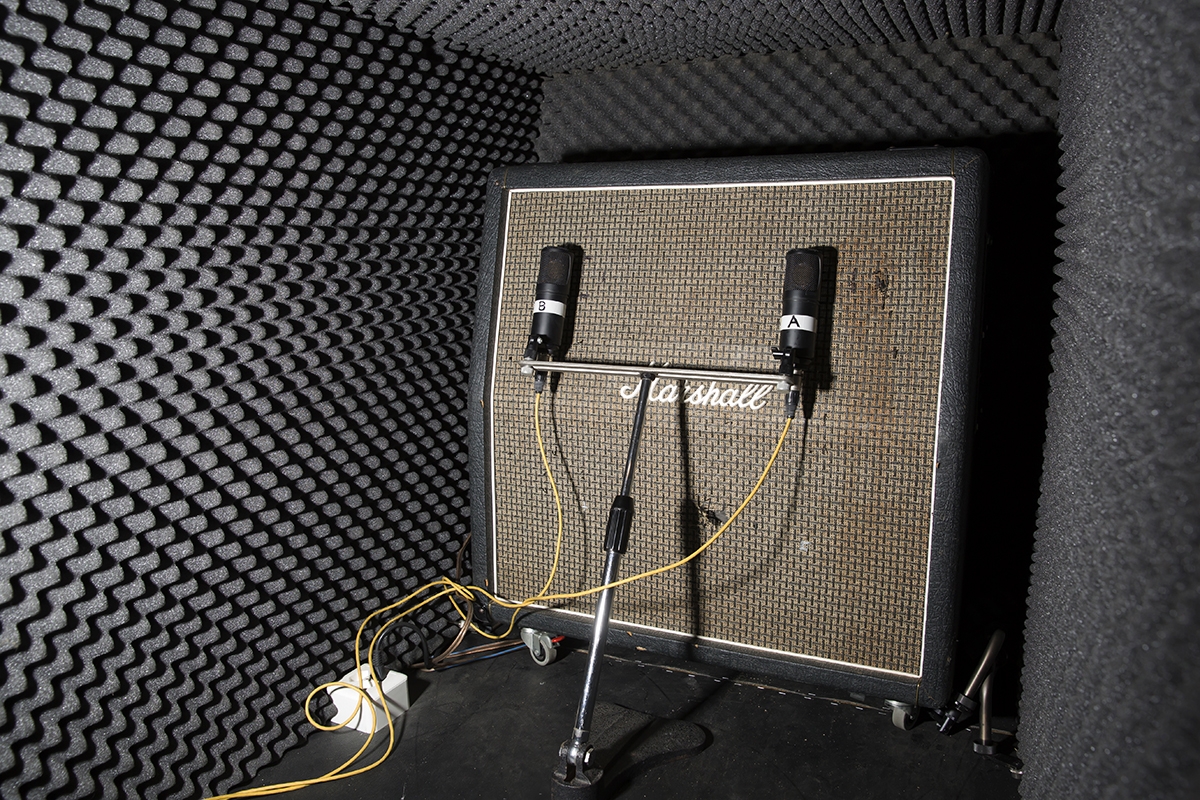
In this corner (over the guitar booth) will be the most suitable place for the main room HVAC and vocal booth.
Should the floor carry a stronger treatment or building "drum riser" for the drums and bass and guitar cabinets will be enough?
The doors can be double since it has already been thought for this purpose.
(next time I upload photos from this room)
Doubts:
1. Are studs better in wood or metal? (I think in Portugal it is easier to buy in metal, along with the plasterboard) and how they will be attached to the current walls and ceiling? For example with this? http://www.someacustica.com/suites-para-parede/
2. Golden room ratios still important? I read here that it's not that important anymore https://www.soundonsound.com/techniques ... oom-design
3. Are the monitors I chose indicated for flush-mount? (Yamaha HS8 + HS8S). Since I have not bought them yet, I can think in other options. After writing this I found this studio built by John so I'm already cleared up!http://www.johnlsayers.com/Pages/NuFaith.html
Another idea (I don't know if is possible or advisable): my father had lots of experience building hifi speakers back in the 80's/90's with very good sound, using blueprints of the known models.
What you think if he build my studio monitors?
If you think it's okay, I'll start with math, study HVAC, doors, electrics, etc, and draw my 3D model
-
Soundman2020
- Site Admin
- Posts: 11938
- Joined: Thu Aug 21, 2008 10:17 am
- Location: Santiago, Chile
- Contact:
Re: Studio in Azeitão - Portugal
I'm glad you found that one! It's very informative, and very much worth reading!After reading both books and a few more posts here in the forum (especially this...
. . . :but first wanted to realize if I'm on the right way.
A Reflection-Free Zone (RFZ) room. I have already understood how these rooms work and it seems to me to be the most suitable for my control room.
definitely!You already have a lot of mass in your existing brick walls, so it should be possible to get good isolation by just adding a stud-framed wall next to that, with a framed ceiling resting on it. You'll need to do the math to check that it will give you the isolation you need at the frequencies where you need it, but it should be possible.As this wall has space for a new wall, it has a kind of frame (8 cm) (photo 1), what do you think of building a new concrete brick wall filled with sand to create mass? A friend told me about this and I wanted to hear your opinion. Or is a new wall of plasterboard with two or three layers glued with green glue is more effective?
That would be another option, if you want very high isolation. The problem then becomes your inner-leaf ceiling: How would you get the same level of mass on your ceiling?This kind of bricks:
The floor, since it is concrete, I want laminate floor.
Once you choose the exact laminate flooring that you want, check with the manufacturer to see what his recommendations are. 5mm cork would be great.With cork of 3mm or 4mm of thickness underneath (in Portugal the cork is very cheap) or it is better a more professional solution with greater thickness? Is it enough to prevent vibrations for the rest of the house?
I still have to study the doors and the HVAC that I'm thinking of taking advantage of the existing window to do the ducts.
As long as you can figure out how to put in the same amount of mass as the walls, to fill in that hole where the window was!Yes it can be parallel. You don't have much spare height to play with, so maximize the room volume (sloping the ceiling wastes space), then put in a "cloud" or other treatment on the ceiling.The ceiling will be identical to the walls. But I do not know if it should be parallel to the floor.
How much isolation do you need?The same treatment used in the control room for the walls with 11cm brick. Is it enough to isolate a band playing loud?
In decibels...That's very small for a vocal booth! Not much bigger than a closet. Small rooms like that always sound bad: "boxy" is the word that people often used to describe it. There's not much you can do to fix that, because the dimensions of the room define how it will sound, and no amount of treatment can change that very much, because there's not enough physical space inside the room to treat it enough! Try to make your iso booth bigger. If you can't, then maybe consider recording vocals in the control room.I will build a booth vocal with about 2mx1,8m
That's fine, but it will need a lot of treatment to make it suitable.a small guitar booth in the corner, just to put a 4x12 cabinet.
Your laminate flooring on 5mm cork underlay would be pretty good, but that still might not be enough to fully damp impact noise from the drum kit and vibration from the bass cab if it is pumping hard. A good solution in that case would be to build a "drum riser", such as the design that Glenn has posted here a few times. You can build a smaller version for the bass cab.Should the floor carry a stronger treatment or building "drum riser" for the drums and bass and guitar cabinets will be enough?
There is a slight advantage to metal for isolation, but it's a lot harder to do complex framing at compound angles with metal, so in general I prefer wood.1. Are studs better in wood or metal?
The inner-lear framing MUST NOT be attached to the existing walls and ceiling! The inner-room is a totally independent structure that stands all on its own, and is not connected to anything else.and how they will be attached to the current walls and ceiling?
The link is broken: there's nothing there...For example with this?
Room ratios are important, to a certain extent, but there's no need to go crazy trying to find a "perfect" ratio, because there is no such thing". There is no single "golden ratio" that is suitable for studios either. That's a myth. It is still important, and the SOS article doesn't really say that room ratios are not important! That article on talks about different design concepts, but it also assumes that the room already has a good ratio, and is quite large. If the room has a terrible ratio (for example, ceiling 2.5m, width 5m, length 7.5m) then the modal response would be really bad, and it would need a LOT of treatment to make it usable. But of the ratio is good, then it is possible to use less treatment and still get a good result.2. Golden room ratios still important? I read here that it's not that important anymore
Yes, those are fine. They are rear-ported, so there's a couple of things you need to take extra care with in designing the soffit, but there's no problem with flush-mounting those.3. Are the monitors I chose indicated for flush-mount? (Yamaha HS8 + HS8S).
- Stuart -
-
Duarte_Vader
- Posts: 43
- Joined: Fri Feb 23, 2018 11:30 pm
- Location: Azeitão - PORTUGAL
Re: Studio in Azeitão - Portugal
Hi
Here I am again. Stuart you were right, only for the project I'm going to take 4 or 5 months!
For now, I’m only focused on control room. I designed a 2D project.
But it’s been a good journey, I’m learning a lot. I hope it's worth the effort...
I finally managed to measure the room and I need to isolate about 60 dBA to be almost inaudible inside my house. The existing wall isolates about 29 dBA. The ceiling isolates 44 dBA to the 1st floor. Ambient sound in the hall between the two rooms is 36.6 dBA. The outer wall, near the window, isolates about 40 dBA.
Doubts:
1. I drew the room but I have serious doubts that it is perfectly drawn.
Can you suggest me documentation about RFZ control rooms?
2. Is the distance between the mix position and the wall sufficient to have an 24 or 32 channels analog mixer of in the future? How I can get the mix position back?
3. Where I should put the subwoofer?
4. Rockwool - what is the correct density?
Walls and Insulation:
South → Interior walls with 11cm, rockwool 5cm, air 2,5; rockwool 5cm; 2 drywall layers with green glue 3,2cm.
West - same as south
North → double exterior wall with 20cm, rockwool 5cm, 1 drywall layers
East → same as north
Here I am again. Stuart you were right, only for the project I'm going to take 4 or 5 months!
For now, I’m only focused on control room. I designed a 2D project.
But it’s been a good journey, I’m learning a lot. I hope it's worth the effort...
I finally managed to measure the room and I need to isolate about 60 dBA to be almost inaudible inside my house. The existing wall isolates about 29 dBA. The ceiling isolates 44 dBA to the 1st floor. Ambient sound in the hall between the two rooms is 36.6 dBA. The outer wall, near the window, isolates about 40 dBA.
Doubts:
1. I drew the room but I have serious doubts that it is perfectly drawn.
Can you suggest me documentation about RFZ control rooms?
2. Is the distance between the mix position and the wall sufficient to have an 24 or 32 channels analog mixer of in the future? How I can get the mix position back?
3. Where I should put the subwoofer?
4. Rockwool - what is the correct density?
Walls and Insulation:
South → Interior walls with 11cm, rockwool 5cm, air 2,5; rockwool 5cm; 2 drywall layers with green glue 3,2cm.
West - same as south
North → double exterior wall with 20cm, rockwool 5cm, 1 drywall layers
East → same as north
-
Gregwor
- Moderator
- Posts: 1501
- Joined: Wed Feb 01, 2017 6:03 pm
- Location: St. Albert, Alberta, Canada
Re: Studio in Azeitão - Portugal
You have to do slow C weighted measurements, not A weighted.I finally managed to measure the room and I need to isolate about 60 dBA to be almost inaudible inside my house. The existing wall isolates about 29 dBA. The ceiling isolates 44 dBA to the 1st floor. Ambient sound in the hall between the two rooms is 36.6 dBA. The outer wall, near the window, isolates about 40 dBA.
ITU-R BS.1116-3 -- the final few pagesCan you suggest me documentation about RFZ control rooms?
Depends on the mixer. This is basic measurements. Make sure your head is around 38% depth of the room. There is wiggle room here, but aim for that. Add in your mixer measurements and see if it fits!Is the distance between the mix position and the wall sufficient to have an 24 or 32 channels analog mixer of in the future?
Not sure what you mean here. Draw it at the location it needs to be and adjust your soffit and soffit wing to get you an RFZ sphere of around 2ft diameter around your head.How I can get the mix position back?
Once your room is pretty much complete, mount your woofer where your head would normally be and crawl around to find the best spot for it. From there, you could then do acoustic measurements and fine tweak it.Where I should put the subwoofer?
For what purpose? In your walls? For hangers? For what frequency band?Rockwool - what is the correct density?
This should answer your question:
Fibreglass in kg/m^3
High Freq = around 40 (others say 60-80)
Mid Freq = around 35
Low Freq = 20-25
Mineral Wool in kg/m^3
High Freq = around 65 (others say 90-120)
Mid Freq = around 55
Low Freq = around 30 (others say 40-45)
As an example
OC705 is 90 and OC703 is 45
OC EcoTouch R24 is between 20 and 23 (this is the heaviest pink fluffy they make)
In general
Lighter is better for bass (light fluffy fiberglass insulation)
Heavier is better for higher frequencies (heavy mineral wool)
You're implying that you're going to have an air gap between your rockwool. You shouldn't. Fill the entire cavity with insulation. No voids.South → Interior walls with 11cm, rockwool 5cm, air 2,5; rockwool 5cm; 2 drywall layers with green glue 3,2cm.
What is a "double exterior wall with 20 cm"?North → double exterior wall with 20cm, rockwool 5cm, 1 drywall layers
Also you haven't mentioned any wall structure details? Is it concrete, wood?
Your 2D drawing is missing too much detail. You need to draw in drywall, framing, insulation, drywall, etc. Right now you're drawing it as if the treatment walls are your inner leaf when I assume they are not.
Have you done any ray tracing to check your soffit and soffit wing angles yet?
You're on the right track, I think. Draw this in more detail and we'll get you on your way!
Greg
It appears that you've made the mistake most people do. You started building without consulting this forum.
-
Duarte_Vader
- Posts: 43
- Joined: Fri Feb 23, 2018 11:30 pm
- Location: Azeitão - PORTUGAL
Re: Studio in Azeitão - Portugal
Hi Greg, thank you for your answer.
Sorry for the delay in my answer but unfortunately I had to stop my project the last couple months...
So, now I did some raytracing and here are 2 versions of RFZ control room.
The mixing point is around 29% of the room. You said 38% but if I do it, I got reflections on mixposition and "damage" the equilateral triangle... how can I resolve this? I saw a mixer with 1m depth. It don't fit here, if I don't resolve this!
The centre of the speakers are 2/5 of the soffits. Is correct?
Until I measure my room I'm only focused in understand if the room design is correct. I know that many details are missing here... But let me measure the room and I will add all the missing details!
Finally I ordered a decent sound level meter (the other one was borrowed by a friend and it sucks!) and an acoustic measurement mic (Sonarworks XREF 20).
The diffuser at the end of the room? It's correct use a diffuser or a absorber could be better?
Sorry for the delay in my answer but unfortunately I had to stop my project the last couple months...
So, now I did some raytracing and here are 2 versions of RFZ control room.
The mixing point is around 29% of the room. You said 38% but if I do it, I got reflections on mixposition and "damage" the equilateral triangle... how can I resolve this? I saw a mixer with 1m depth. It don't fit here, if I don't resolve this!
The centre of the speakers are 2/5 of the soffits. Is correct?
Until I measure my room I'm only focused in understand if the room design is correct. I know that many details are missing here... But let me measure the room and I will add all the missing details!
Finally I ordered a decent sound level meter (the other one was borrowed by a friend and it sucks!) and an acoustic measurement mic (Sonarworks XREF 20).
The diffuser at the end of the room? It's correct use a diffuser or a absorber could be better?
-
Soundman2020
- Site Admin
- Posts: 11938
- Joined: Thu Aug 21, 2008 10:17 am
- Location: Santiago, Chile
- Contact:
Re: Studio in Azeitão - Portugal
Simple to fix: Forget the famous "equilateral triangle"!!!! It's a myth. Or rather, it DOES work (sort of), but it is not the ONLY way of setting up your speakers and mix position. You see it all over the place, in magazines, speaker manuals, web sites, etc, and it is so common because it will work for pretty much any room... but there are better ways too, for most rooms.The mixing point is around 29% of the room. You said 38% but if I do it, I got reflections on mixposition and "damage" the equilateral triangle... how can I resolve this?
Think of this: I'm sure you already know that, for best sound, your ears should always be on-axis to the speakers. Because the further off-axis you get, the worst the sound is. Now take a close look at those infamous "equilateral triangle" diagrams. What do the show? They always put the apex of the triangle in the middle of where your head will be. Right? Have you noticed that? Well, look even closer: if you do that, then the axis from each speaker is pointing at your EYES, not your EARS!!! That's the first issue with the "equilateral triangle". It works great for everyone who has had their ears surgically transplanted onto their eyeballs, but for the rest of us, it's clearly not the best. To fix that, you have to rotate the speakers a little bit outwards, by maybe a degree or so, to make them point at your ears, not your eyes.
In fact, psycho-acoustic research shows that it is better to rotate the speakers even more than that, so that they are pointing at a spot about 16" behind your head (anywhere from about 12" to 30", depending on room dimensions). With that setup, the axis of each speaker is pointing just a little past your ear hole: roughly grazing the tip of your pinna (the flesh thing that sticks out the side of your head: your "ear"). That's the best possible place to have your speakers pointing. And certainly not your eyes...
In reality, you can rotate your speakers so they are angled anywhere between about 20° and 45°, but the best range is between 25° and 35°, instead of the "standard" 30° angle that you see in those silly diagrams.
That's too far forward. It's very close the rather bad 25% location, which is where all the first-order modal peaks occur, and also all the second order modal nulls. Not a good place to put your head. Theoretical best is, as Greg said, 38%, but that is not carved in stone either! You can move a bit: 43% to 32% is fine.The mixing point is around 29% of the room.
That's great, but you don't need to be quite so extreme! On ray every 5° is plenty, to get a good idea of where your mids and highs are going. If you do rays more often than that, it just clutters up the image and you can't see anything clearly.So, now I did some raytracing
You will need both. Or rather, you will always need deep absorption across the entire rear wall, and even deeper bass traps in the corners, plus for your room in particular, which is long and skinny, you can also use a diffuser on the rear wall, in front of the absorption. Rooms that are too short cannot have diffusers on the rear wall, but yours can, it seems.The diffuser at the end of the room? It's correct use a diffuser or a absorber could be better?
I would suggest that you spread your speakers further apart, move your mix position back, and re-arrange the soffit panels so that you still get a good RFZ.
- Stuart -
-
Duarte_Vader
- Posts: 43
- Joined: Fri Feb 23, 2018 11:30 pm
- Location: Azeitão - PORTUGAL
Re: Studio in Azeitão - Portugal
...It works great for everyone who has had their ears surgically transplanted onto their eyeballs, but for the rest of us, it's clearly not the best.
I'm very attached to the equilateral triangle. I never thought in another way to do this.
I think I understood all the points you talked about and there it is a new version of RFZ room.
I angled the speakers to 25º, so now I have the mix position at 36% of the room, 60cm ahead of spot point of the triangle.
If I go more closer to the point I start having reflections.
Tomorrow I will measure the room! .
-
Duarte_Vader
- Posts: 43
- Joined: Fri Feb 23, 2018 11:30 pm
- Location: Azeitão - PORTUGAL
Re: Studio in Azeitão - Portugal
Hi!
I’ve doubts about the measure with REW. Maybe stupid questions….
But I don’t have the final walls, I don't have laminate floor and, off course, mixing point!!! I don’t even have a door!
My actual speakers are Yamaha HS50m, I think they don’t have enough bass to do the test correctly. Should I use another speakers?
I’ve doubts about the measure with REW. Maybe stupid questions….
But I don’t have the final walls, I don't have laminate floor and, off course, mixing point!!! I don’t even have a door!
My actual speakers are Yamaha HS50m, I think they don’t have enough bass to do the test correctly. Should I use another speakers?
-
Soundman2020
- Site Admin
- Posts: 11938
- Joined: Thu Aug 21, 2008 10:17 am
- Location: Santiago, Chile
- Contact:
Re: Studio in Azeitão - Portugal
If you don't have your inner-leaf walls in place, then any REW test you do won't be telling you much about how that final inner-leaf room will respond! You could test without the door and still get usable initial results, and even without the floor, but not without the walls. The first test you do, which I call the "baseline" just shows you the overall modal response, and is basically a check that you are doing the tests correctly, and that the room is responding mostly as predicted. Having the floor, or not having it, isn't going to change that much, since the floor is only a few mm thick. Having no door could potentially couple the acoustics to whatever is outside the door, which would probably just have the effect of extending the overall decay times a little, but it would be noticeable and easily identifiable on the graphs, especially after you do another test with the door in, so that's also not a problem: Test with no doors and no floor if you want, but if the walls and ceiling are not there, then you don't even have a room!But I don’t have the final walls, I don't have laminate floor and, off course, mixing point!!! I don’t even have a door!
That said, it might still be an interesting exercise to test the current outer-leaf room, so you can compare later and see how things change with the inner-leaf room in place. Basically just for fun, and to make sure your test procedure is correct. But it won't help much with treating the final inner-leaf room.
- Stuart -
-
Duarte_Vader
- Posts: 43
- Joined: Fri Feb 23, 2018 11:30 pm
- Location: Azeitão - PORTUGAL
Re: Studio in Azeitão - Portugal
Ok, that's what I thought!
But now I have a decent sound level meter to measure how much I really need to attenuate!
Should I make the noise tests inside the room using pink noise?
I will also measure a full band rehearsal.
So now I need your help to see if my last room design is correct.
Sorry I'm very slow with my project ...
But now I have a decent sound level meter to measure how much I really need to attenuate!
Should I make the noise tests inside the room using pink noise?
I will also measure a full band rehearsal.
So now I need your help to see if my last room design is correct.
Sorry I'm very slow with my project ...