Over the past year I’ve lurked, read and read some more about achieving isolation but I don’t want to start without getting advice from the forum. I hope there's enough info here, if not, I'll happily add it!
I have a detached garage in the UK which is ‘post and panel’ concrete construction and is nearly completed. The panels are well sealed with flexible mastic/sealant and all gaps will be filled with cement mortar before any work is done. The base of the garage is 12” concrete with steel mesh. Under that is 12” hardcore, 2” blinding/quarry dust, 4” EPS Insulation (Kingspan). The internal dimensions are 6m x 5m (19.5’ x 16.6’) and the wall heights at the sides are 2.2m (7’). The garage has a raised tie truss system for additional ceiling height in the middle portion, raising the ceiling height to 2.6m (8.5’) for 75% of the span. At the front there is an insulated roller door measuring 4.2m x 2.1m (14’x7’). Not perfect by any means, but it’s what I have.
The side door in the images below was omitted.


I have a little stream which runs behind my house and lots of trees which add to the background noise level. Typical noise levels for my neighbourhood are 45-50db. I want to use the garage as a man cave for working on cars, tinkering with engines and also as a place where my kids can make noise, hit things with hammers and learn how to skin their knuckles like I did with my Dad. In terms of how much isolation, ideally I’d love to use an angle grinder at 10pm and hear next to nothing outside. Data I’ve come across suggests an angle grinder produces around 110db when cutting. I’m possibly hoping for too much then! I’d be very happy to eliminate general talking and music being played at 80db.
My current plan is to build a freestanding 2x4” stud wall on neoprene rubber (2” away from the outside wall) around the 3 side walls of the garage, fill with 6” of fibreglass insulation, then cover with 3/4" OSB, bitumen roofing felt and then 1/2" drywall. For the roller door wall, I need occasional access for cars so a permanent structure won't work. I'm planning on making a freestanding, removable wall of 12 off 2.5x4.5’ ‘stackable gobo’ type boxes made from 8x1” boards covered in OSB and 2 layers of drywall each side. Each box will be keyed to fit together, sealed with neoprene rubber seals and clamped with latches/toggle clamps. The remaining 3 feet will be a door with similar construction. Something along the lines of this (but solid both sides):

With the roller door, that may result in a 3 leaf construction so my plan is to build them with fabric on the side nearest the roller door and see how it performs first.
Windows will have removable window plugs made from 8x1" timber frames, OSB and Drywall.
Like any newbie with a little knowledge, I’m fairly confident in the wall construction and I’ll have to work on maximising the non-ideal situation with the removable wall. The ceiling however is a serious concern as the garage has a ‘box profile’ steel roof. At the minute, this roof is completely vented so that moist air won’t condense on the inside and drip onto the garage floor below. My intention is to use Genie Clips and Hat channel on the underside of the trusses and hang a layer of OSB, bitumen roof Felt and drywall from that. Above the ceiling between the trusses will go 6” of fibreglass insulation.
From my research, I need Mass-Air-Mass to reduce the sound transmission, with the mass as isolated as possible. In my case, I think the OSB, Felt and drywall will give me reasonably good mass and the genie clips and hat channel provide isolation. The air gap is filled with insulation, but my outer leaf (trusses and steel roof sheet) is neither massy or sealed.
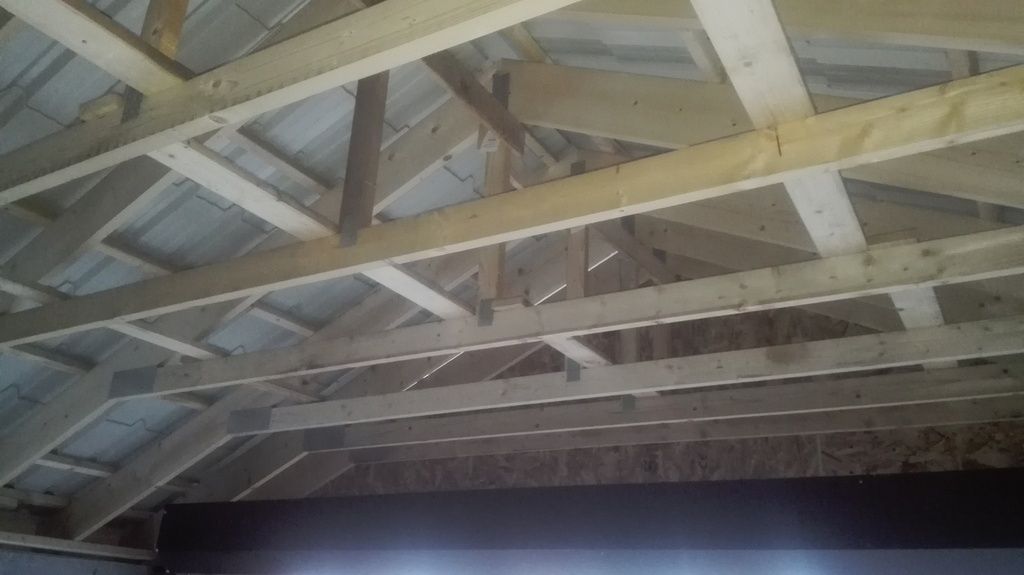

The roof sheets are screwed onto 2x2" battens which are then nailed onto the trusses.
To stop rot and condensation, I’ve considered adding a 'closer' board under the battens and at the eaves. My hope is that I can seal the attic, but leave the roof sheet vented to the outside.
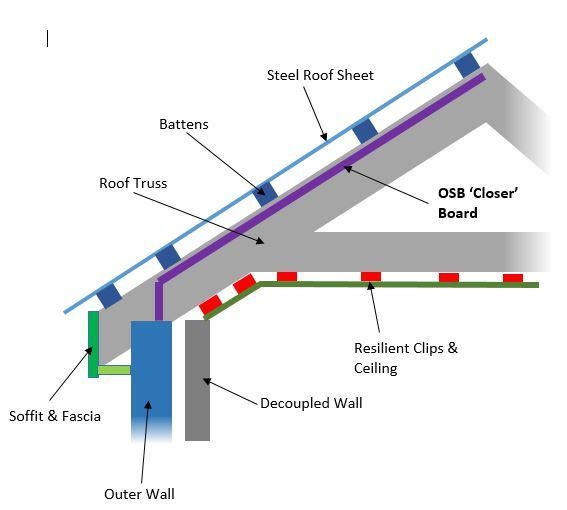
Seems common to do with rigid insulation, but I'd propose to do it with OSB, or OSB and drywall if it helped.
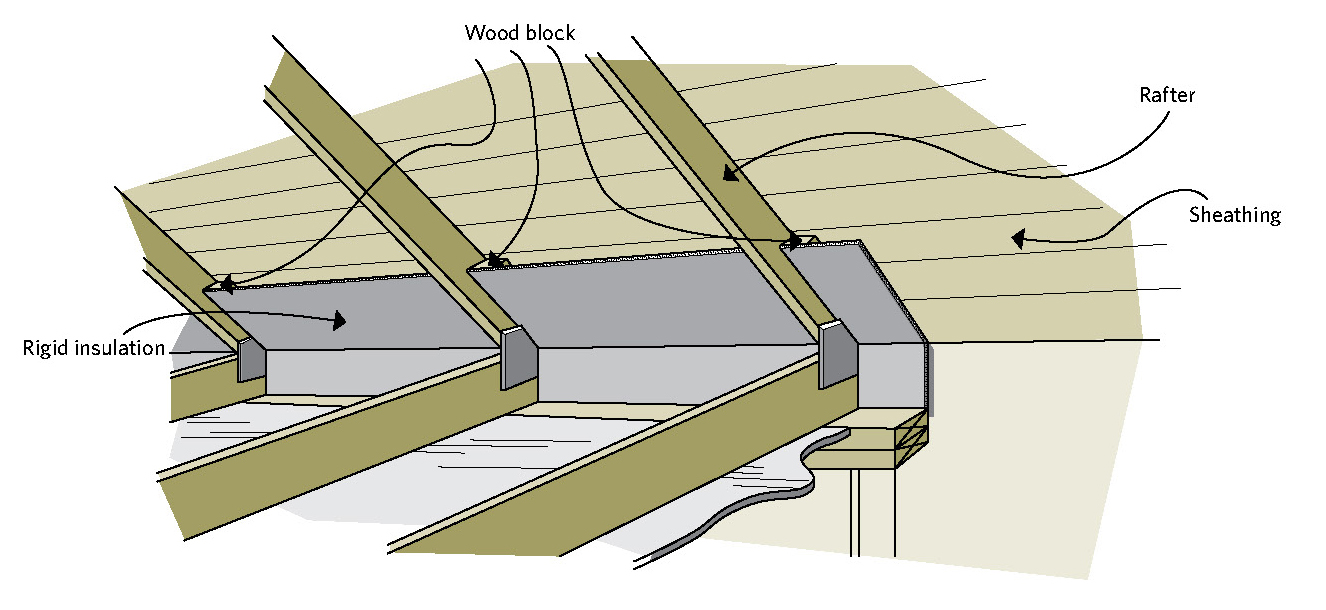

What do you think? Do I gain anything by sealing the attic? Once the inner ceiling is up, there's not much I can do to seal it.
If you’ve read this far, I appreciate it. There's a beer waiting for you at the bar in heaven.

Sorry if the images are a little too big - still working on how to reduce the image sizes for posting here.
All advice gratefully accepted!
Thanks!
Mikky


