nickdhal
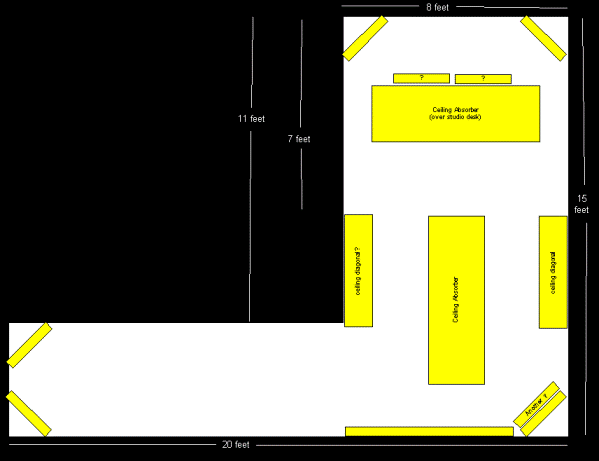
First, if you spin the two absorbers drawn next to the ceiling absorber above the desk 90 degrees, and move them against the left and right wall, you'd have it right!
Second, my rear wall is 16' long.
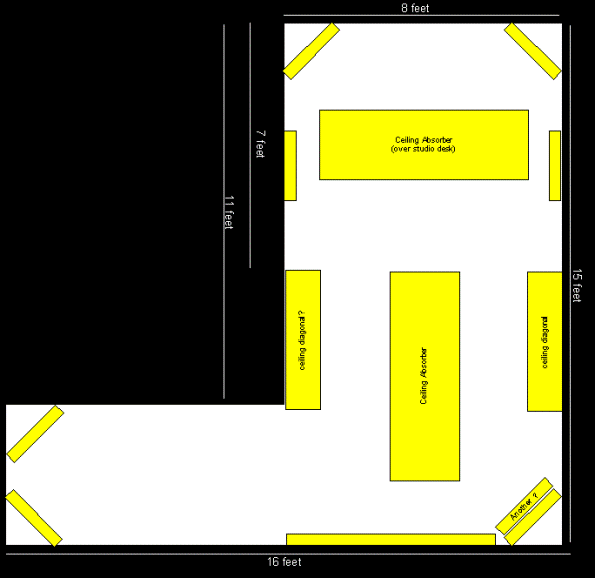
I think it's time you drew your own diagrams.
You can upload your pictures to websites that you can upload pictures to for free. e.g.
http://www.imagevenue.com/
http://www.imageshack.us/
And then you can use the [ img ] tag around the URL to that image when posting a message here, and it will show.
Or post them as attachments here.
Please try to keep them about 600pixels wide.
Anyway, how about if you add 210 ft^2 of 4" 703 flushmount or air-spaced, and 20 ft^2 of
absorber low pass. Placement to be determined based on: room dimensions giving axial mode lengths the same as your problem frequencies, SBIR and early reflections issues.
http://www.bobgolds.com/nickdahl/RT60_nickdhal.xls
The spreadsheet was done at the 1130 ft^3 room volume estimate -- which seems to be wrong now. But I haven't a clue how big your room is.
Extending the spreadsheet down to 63 hz might help.
I used the Absorber Low Pass because I think it'll do nice things between 63hz and 100hz particularly if it's placed on the surfaces that are giving axial mode problems, whereas leaving it out and just using 220 ft^2 4" 703 air mount would do a reasonably nice job from 125hz to 4khz without any absorber low pass. However, I gave you the spreadsheet so you could fiddle with the surface area, and include the AC/Frequency results from other things you might have in your room (carpet, slat absorbers, membrane absorbers, diffusers that also absorb, whatever), or be willing to try.
BTW, the absorption coefficients (AC/frequency) that I used for the walls/floor/ceiling assume that you're on the 2nd floor with gypsum walls and a wood floor over joists. If you're in a basement with a concrete slab for a floor and bare concrete walls then those absorption coefficients that I used are WAY TOO HIGH.