Tonio:
The day Eric posted it, at my home woman (no relation to Paul's woman) came in. Smiled at me curious about what I had found.
Woman said, "What's so interesting." She looked closer, frowned, "Oh, acoustics." and left.
She came back 15 minutes later and asked "How can you stare at that chart for half an hour?"
I replied, "Different chart" and scrolled up to the first one, and then back down to the second one.
She handed me a bowl of watermellon and strawberries, each cut up into 3 cubic centimeter pieces and said "Eat." and she sat down beside me and opened her book with her own bowl of the same on her lap.
Some people learn by formulas.
I learn by examples -- and then use the formulas grudgingly later to fine tune to specific situations I'm interested in.
The charts are a bunch of different examples of wall systems. Where it gets interesting is when you start comparing them, and discovering trends.
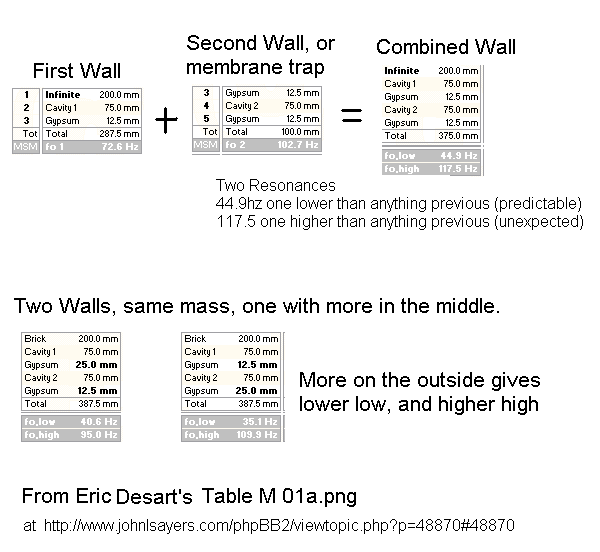
This is relevant to Ethan's question because the traditional formula (1DOF - assumes infinite mass behind other leaf)
d = 28900 / (f ^2 * m)
where
d = depth in inches
f = resonance frequency in hz
m = surface density in pounds per square foot
75mm = 2.952 inches
surface density of 1/2" drywall is 1.8 pounds per square foot.
for the top left wall would be
f = sqrt( 28900 / (m * d) )
f = sqrt( 28900 / (1.8 * 2.952inches) )
f = 73hz.
same as Eric calculated for 'First Wall'.
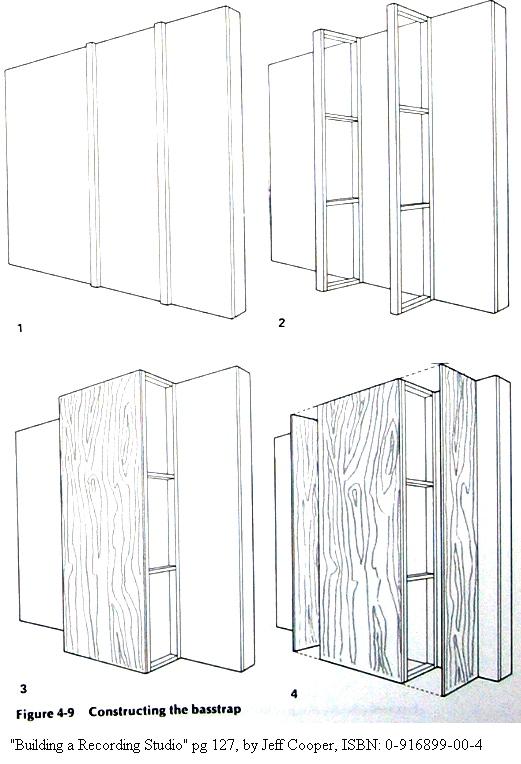
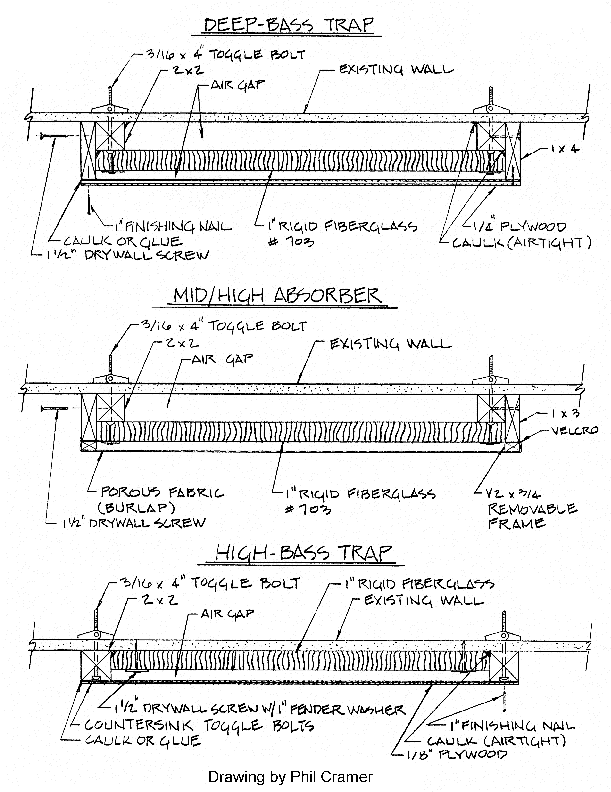
If that second 'wall' is a membrane absorber you've just built, but you stick it on a similarly constructed current wall, then the resonances you end up with are not the target one you wanted. i.e. not 72hz, but rather something that's pretty good at 44hz and 117hz.
Within the limitations of Eric's disclaimers. namely
This are strict theoretical calculations based on the mass-spring system, ignoring other parameters as mounting method, flanking, or whatever other phenomenon.
 Everytime I edit the above message the picture description in the titlebar of the uploads is lost (dissapears).
 could you - or anyone splain(explain) please?
 Now I feel dumber
  Just kidding