Already have home made traps should i buy some pre-made now?

How to use REW, What is a Bass Trap, a diffuser, the speed of sound, etc.

Moderators: Aaronw, sharward

John Sayers
Site Admin
Posts: 5462
Joined: Mon Jan 27, 2003 12:46 pm
Location: Australia
Contact:

Post by John Sayers »

And me ?? Was I good ??
I'm also a good boy .... NO? Please ... NO?

No sounds wrong:
I'm still learning, don't know this language yet, I'm still used that words mean something .... sorry ..... let's try again ...
Eric - you were good - we all love and respect you and understand your problems with language, I have trouble sometimes understanding you, but I don't disrespect you for it :D:D

I also understand and respect your attention to precision, accuracy and detail, your countrymen are famous and admired for it.

I hope that answers you last sequence of posts as once again, I'm still a bit confused ;)

cheers
john
nukmusic
Posts: 149
Joined: Wed Apr 09, 2003 11:44 am
Location: Dallas,Tx / New Orleans, LA
Contact:

Post by nukmusic »

I've been following you folks..... :D

since we are on the subject of traps and trapping.. What have you concluded to be the best or should I say most effective materials... for bass hangers? I deal with a lot of music with deep bass...40hz and up in just about every song I have seen pictures of folks using all kindds of stuff wrapped up and hanging for the ceilings and corners...... from 703(or similar) wrapped in different coverings, MDF, plywood, etc etc with different materials attached.....I have even seen rolled vinyl carpet with duck tape being used. Does one have an advantage over the other?

maybe I overlooked a "Sticky" section with this info.

thanks
Ethan Winer
Senior Member
Posts: 1063
Joined: Fri Feb 21, 2003 3:50 am
Location: New Milford, CT, USA
Contact:

Post by Ethan Winer »

Scott,

> As I demonstrated quite clearly - the HF absorption curves of the RT424 [a fabric wrapped 703 panel an analog of which can readily by be made by a DIY user] and the MiniTrap are stunningly similar - in fact in large part, they are precisely the same! <

I find this statement amazing because in the past you ridiculed the absorption curve of MiniTraps, and Eric called their absorption "sick" many times. For at least three years both of you derided MiniTraps as a lousy way to make a panel. Here are a couple of quotes I dug out from when you and a half dozen of your friends tried to gang up on me at the SOS forum in Xmas 2004:
MiniTrap's poor performance above 125Hz ... why would anyone want that in a device?
So now you agree that MiniTraps defined the standard for how a broadband bass trap should work? I'll take that as a compliment. As they say, Imitation is the highest form of flattery. And just so nobody can accuse me of quoting out of context - a popular strategy lately - here are links to those threads at SOS:

"Auralex Roominator Kits??? Any good??"

"Right, A potentially contentious Post, in defence of Real traps "mini" traps."

> Don't be misled by attempts to divert the discussion to uncertainties of low frequency measurement... the original false proposition, and your question are about high frequency - and I assure the % uncertain measurements are miniscule from both labs in these frequency bands [less than 3% on average from 500 to 5,000 Hz for the RAL data - you can see these numbers yourself once I get the final reports posted]. <

For someone who claims to be an acoustics professional you should know that acoustic labs vary a lot even at certified frequencies for standard A mounting. The ASTM C423 document I referred you to earlier explains lab variances and shows the very wide spread for A mount testing. For you to compare products in different labs for non-standard mounting in corners down to 63 Hz, especially when the corner locations are not even known, is either incompetence of fraud. Take your pick. You and Eric both know this, so clearly both of you are willfully trying to distort science to your advantage. Which is ironic because that's exactly what you always accuse me of! In fact, in that Xmas 2004 thread you wrote this:
I detest deceit, particularly when science is involved.
Apparently you don't detest deceit as much as you say.

Here's another pair of quotes by you from the same threads, put together to show the contradiction:
As to comparing the IBM data to the RAL data... different things were tested, it aint valid to try and mix those apples with them oranges
I reject the idea that the RAL/Studiotips corner absorber data is misleading.
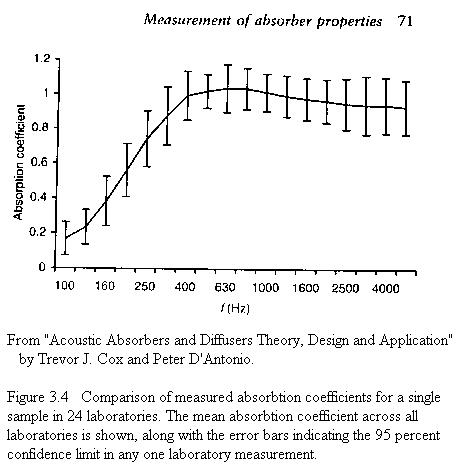
Even more clear is this figure Bob Golds recently posted in another thread here:

Image

It's obvious that at 100 Hz the variance among labs is quite large and gets even larger as the frequency goes down. Extrapolating down to 63 Hz it seems the numbers will vary by 5 to 1 or even more for the very same material measured in different labs. And the data above is for standard A mounting in the "certified" range of 100 Hz to 5 KHz. As soon as you put the traps in randomly chosen corners the variance is even larger.

Scott, you either know this and are bending the truth on purpose anyway, or you don't know this because you haven't yet learned enough about lab testing. Which is it?

I know for a fact that your "18 versus 12" comparison is totally bogus because I have measured MiniTraps at IBM's lab side by side with plain 703. At 100 Hz and below, measured in a corner, MiniTraps absorb twice as much as the same thickness of plain 703. So your comparison is obviously flawed.

--Ethan
Eric_Desart
Senior Member
Posts: 760
Joined: Wed Jun 18, 2003 6:09 pm
Location: Antwerp/Belgium
Contact:

Post by Eric_Desart »

Can you please link to the correct messages.

Those sentences are hidden in threads between > 300 posts. (including posts which are novels in itself).

You don't give a reference to the national library, but to a book an author and a page.

In a forum you link to individual messages quoting from an author.
And you leave sentences within the context they are used, as such that a quoted text can not mean anything else than originally intended by its author.

As a writer you should know that. And Copyright law applies as well on messages in public forums.
Best regards - Eric Desart
My posts are never meant to sell whatever incl. myself, neither direct, nor indirect.
z60611
Posts: 251
Joined: Fri Jun 18, 2004 9:08 am
Location: Ontario, Canada

Post by z60611 »

John Sayers:

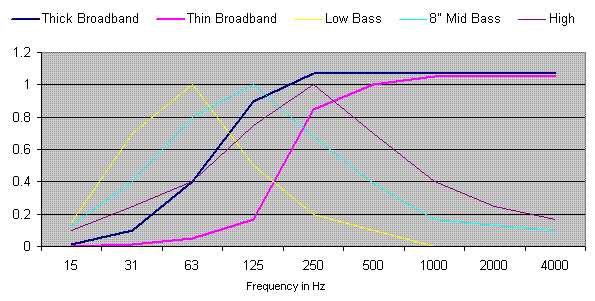
I've been fond of the words 'broadband' (thick/thin) and 'bass trap' (low/med/high) defined like this for quite a while:
Image
Scott R. Foster
Posts: 14
Joined: Fri Jul 07, 2006 2:47 am
Location: Jacksonville, FL - USA
Contact:

Post by Scott R. Foster »

Mr. Winer:

Your attempt to divert this discussion will not work - this discussion is about the HF absorption properties of your MiniTrap - and false assertaions made as to same.

It will remain so.

As you well know the accuracy of absorption measurements from an acoustics lab are extremely high above 100 Hz [see direct quote below - linked to the original] - and though accuracey does diminish sub 100 Hz - as you explain in the linked post - this factor is well understood and quantified by the lab.

In that regard, please post FULL lab reports on ALL of the measurements you have carried out with your products - including the ones you once published but have since removed from your website.

Publitcation [and to some extent, re-publication] of this information will not only detail exactly how accurate your measurements are, but will provide everyone an opportunity to understand more about all which you have said in the past, what you are saying now, and all that you might say in the future, about your products and their actual performance.

Of course, it will also clear up the confusion you seek to create with regard to the accuraccey of your measurements in this thread.

Thanks,

Ethan explains absorption measurement accuracy above/below 100 Hz:

http://forum.studiotips.com/viewtopic.p ... t=winer#70
Subject: [acoustics] Re: On LF testing, verification, etc.
From: ethan@xxxxxxxxxx
Date: January 2, 2004 2:30:09 PM MST


Gary,

>>I am told that one lab has a very large room
that may be qualified down to 50 Hz. <<

I'm not so concerned about further testing below
100 Hz because IBM's lab already reports below
100 Hz. I understand that as you get farther
below 100 Hz the results become less accurate.
But it's not like 100 Hz is within 1% and all of
a sudden at 80 Hz it could be off by 50%. Dr.
Matthew Nobile, who heads IBM's lab, told me I
could count on reasonable accuracy to either 80
Hz or 63 Hz. (Sorry, I forget which - it was a
year ago.)

snip
John Sayers
Site Admin
Posts: 5462
Joined: Mon Jan 27, 2003 12:46 pm
Location: Australia
Contact:

Post by John Sayers »

Hey - come on guys - All you are arguing about is the difference between 3" of 703/5 in Ethan's traps and 4" of 703 in the RT424. In volume terms of 703, the chart posted says that 12 x RT424 equals 18 minitraps. well 18 Ethan traps only have 12% more 703 volume BUT 1" less absorption depth.

I'm not surprised they appear as similar. Who fucking cares?? - we aren't talking about traps - we are talking about 703/5!!
scottdru
Posts: 10
Joined: Sat Jan 14, 2006 1:20 am
Location: NYC - a small island off the coast of Europe

Post by scottdru »

Scott R. Foster wrote:
SoulFood wrote:I'm looking for some acoustic treatment for a home studio, but it has to be very portable, so any kind of acoustic pannels make sense...
Buy or make something light weight that is easy to hang or place to maximize portability. There are significant differences between products as to these attributes. For example the RT424 weighs less than 10 lbs.
With my very limited knowladge in acoustics, as far as I understand, The main difference is that ReadyTraps don't have a membrane. So they absorb higher freqs and could make a room more dead sounding.

Am I correct?
No!

The whole point of my original post here was to explode the myth purported by Glenn that magical qualities arise in "membraned" panels such as the MiniTrap with the result that HF is not absorbed.

As I demonstrated quite clearly - the HF absorption curves of the RT424 [a fabric wrapped 703 panel an analog of which can readily by be made by a DIY user] and the MiniTrap are stunningly similar - in fact in large part, they are precisely the same!
Scott, I think calling it a "myth" that needs to be exploded is a bit harsh and perhaps misses the point of how these materials work with regard to various broadband absorbers *in real world use*. For starters, the effects of kraft paper facing on the fiberglass absorbers is known, and is indeed discussed in some detail on pages 213-215 in Everest's "Master Handbook of Acoustics". To quote Mr. Everest:

" Figure 9-29 compares the absorption efficiency of R-19 (6 inch) and R-11 (3.5 inch) with the kraft paper backing exposed and with the glass fiber exposed to the incident sound. When the paper is exposed it shields the glass fiber from sound above 500 Hz but has little effect below 500 Hz. The net effect is an absorption peak at 250 Hz (R-19 and 500 Hz (R-11), which may be important in room treatment. With insulation exposed there is essentially perfect absorption above 250 Hz (R-19) or 500 Hz (R-11)."

So . . . unless you wish to also accuse F. Alton Everest of perpetuating a myth, or call him a fraud (both of which you have accused Ethan of repeatedly over the years), I'd say you'll need to be a little more fair in your accusations.

Further, your assertions that there is no substantive difference between the test results from different ASTM certified labs are not based in reality either . . . unless of course you would also like to call ASTM themselves a fraud. In addition to the graph Ethan posted above, which was originally supplied to us all in the above form by Bob Golds, there is very clear discussion of such differences in section 13 of ASTM's C-423 standards paper (available here), which also states that you can get the supporting data for the ASTM E.33-05 Committee's round robin tests/research by requesting it from ASTM Headquarters. This is not an unknown fact amongst acoustics professionals -- not by a long stretch. I'd post the document up here, but I don't think it would be kosher to do so, given that these are coprighted documents which ASTM charges a fee to supply -- so it isn't in their or any of our best interests for anyone to do so.

ASTM standards do not cover every single issue that might come into play for certain things. This is particularly true with regard to corner absorption.

So, once again, unless you want to call ASTM, Trevor Cox and Peter D'Antonio (among others) all frauds who are perpetuating myths for commercial or other reasons . . .

Sorry . . . I don't really want to contribute to flame wars either (as you guys know I hate flame wars on forums as a rule, and feel they are highly counterproductive on every level), but I really felt these points needed to be made. Maybe now we can get back to discussing the science of things and perhaps even come up with some answers to the real questions at hand?
Don't be misled by attempts to divert the discussion to uncertainties of low frequency measurement... the original false proposition, and your question are about high frequency - and I assure the % uncertain measurements are miniscule from both labs in these frequency bands [less than 3% on average from 500 to 5,000 Hz for the RAL data - you can see these numbers yourself once I get the final reports posted].
Aside from what I feel is unnecessary aggression and accusations of fraud, etc. in the above statements (highly unproductive, perhaps quite hypocritical, and questionable as to the accuracy of the accusation in this case), it isn't clear to me exactly what you mean by this (i.e., less than 3% variation). Do you mean to say that these labs are both within 3% (at all frequencies in that freq. range) above or below the mean absorption coefficient of the 14 different labs that ASTM tested, as reported in the ASTM round robin tests? If memory serves, the data I've seen did not support this assertion. And, according to that data, RAL is known to report on the high side of the mean, and IBM is known to report on the low side of the mean. That said, I do not have the data to hand at this time. If you have this data, I would love to see it. If I'm factually wrong on this point, I'd be happy to be corrected. (Perhaps it would solve some long-standing arguments!)

Ignoring the lack of any ASTM standards for corners for a moment, without at the very least taking into account this data, it is not really legitimate to use test results from two different ASTM certified labs as a comparison of two different products. Far more accurate to test both actual products in the same lab under the exact same conditions. (I should also point out here, with all due respect, that Eric's quoting of Ethan to point out an apparent conflict in Ethan's statement misses its mark, because the quote was indeed taken out of context, and Eric's interpretation mischaracterizes the meaning of Ethan's statements in that particular article on his website. I can see why Eric might have read it that way, but his characterization in that case is objectively wrong, which is clear when the quoted statement is read in context. I'll be happy to explain further in another post if needs be.)

As to the corner testing issue -- once again, given that there is NO established ASTM standard for corner testing, and the fact that there could very easily be variables in the different rooms (even under ASTM standards) that could make for inconsistencies in corner testing, corner tests are the least accurate with regard to comparing the test results of two different products in two different labs. As one example, ASTM 423 standards do not dictate precise volumes and dimensions for these rooms. ASTM 423 prescriptions for size and shape consist only of what is stated in section 7.3, which reads thusly:

"7.3 Size and Shape -- The volume of the room shall be no less than 125 m3. It is recommended that the volume be 200 m3 or greater. No two room dimensions shall be equal nor shall the ratio of the lartest to smallest dimension be greater than 2:1. (See 11.12 on calculating room volume.)"

Section 11.12 basically says that room volume must be calculated carefully, taking into account recesses and other irregularities that can make up for more than 1% of the room volume, and also states that, when testing specimens that take up greater than 1% of the room volume, the voume of the test specimen must be excluded fom the room volume.

That's pretty much it. So it seems to me that it ain't "rocket surgery" to figure out the many reasons why this lack specificity could allow for variations that could significantly affect low frequency test results, particularly in corners, even under ASTM standards as they currently exist -- and why it might not be such an easy thing to set up a standard for this across existing ASTM certified labs.


Even ignoring all of this, the only data you are supplying here is the data from corner testing. This clearly shows the peak around 100 Hz that we know is inherent to all corner absorbers (except, apparently, the FBM products, which are clearly utter crap compared to RealTraps and Auralex products from the comparative testing of these products Ethan did at IBM labs). That's all fine and dandy, but what interests me at least as much as (or perhaps even more than) the corner testing data is the data for tests for each of the products using A mounting and comparable E-## mounting I suspect these would be more accurate and usable indicators of the difference between the relative HF absorption and as to whether or not the "myth" of a difference between faced or unfaced rigid fiberglass absorbers is "fraudulent", or at least with regard to any differences in such behaviour in real world use of the products. This is the case especially because neither the MiniTraps nor the Ready Acoustics panels are intended to be used ONLY in corners, and we also know that the absorption peaks in at a different frequency range with these panels (at least the with regard to the MiniTraps, as well as other faced fiberglass absorbers).

This is also one issue I've had with the old arguments put up by you and Eric and a few others (if memory serves) from the Studiotips contingent that the MiniTraps are "peaky", because they can be (and are intended to be) used both ways, which means that using them in combination minimises or eliminates any significant problem of "peaky" absorption curves for these purposes. Unless I've missed something? I mean . . . if you've got problems ~250 Hz and below, put more MiniTraps in the room corners. If you've got problems in the 250-500-700 Hz range, put more MiniTraps on the walls. If you need more HF absorption, use HF MiniTraps (which do not have the facing/membrane, and therefore, according to lab tests done in the same labs under that same conditions, absorb more HF than the standard MiniTrap). Once again . . . it ain't rocket surgery.

Moving on further into the discussion with regard to real world use . . . I think one of the important points with regard to using rigid fiberglass panels with kraft paper or other similar facing material as a scrim, limp mass membrane, or whatever you want to call it (incidentally, F. Alton Everest does indeed refer to these as "membrane absorbers"), is that the facing/scrim/membrane does indeed reflect HF sound. If stand up close and sing into the front of a standard MiniTrap, you will hear the high frequencies reflected back at you, to a very similar degree as you would if you were to sing into a wall made of a plaster, cement or other hard surface . . . though if you listen carefully you'll notice that you do get a slightly different quality of the reflected sound (which I'll discuss further in a moment).

Now, if you turn the that same standard MiniTrap around and sing into the back of the panel (which does NOT have the membrane), you will notice a major difference with regard to the amount of HF sound that is reflected back at you -- this lack of HF reflection is the same on both the front and back surfaces of the HF MiniTrap, which does not have a membrane on either surface. Likewise with a typical DIY 703 or 705 panel (sans facing) wrapped in an acoustically transparent or absorptive fabric.

As I said, I will be interested to see the *full* lab test results (assuming you have also done the testing with E-## mounting standards) for your Ready Acoustics panels. If indeed your panels do show a similar absorption curve to the standard MiniTraps under this test standard, I might wonder if the fabric you are using on your panels is also acting to some degree as a scrim or limp mass membrane? I put that forward as a wild ass speculation only based on Eric's description of the fabric as having a "leathery sheen".

Just to be clear, by the way, I'm not saying any of this stuff to be in any way disparaging with regard to the validity, performance, usefulness, quality, value, etc. of the Ready Acoustics panels. Indeed I think they are quite nifty. To tell you the truth, I remember a number of years ago (before the Ready Acoustics products hit the market) thinking that it would be good to have a product that would allow people who didn't want to go whole hog with the DIY thing a cheaper, easier way to assemble their own rigid fiberglass absorbers that also wouldn't cost an arm and a leg to ship. I came up with a number of ideas, but nothing quite as nifty as the Ready Acoustics product.

Anyhoo . . . to take the conceptual discussion further, my instinct, along with my personal experience in real world use (in my own studio and in others) with the MiniTraps (both with and without the membrane), and experiments using the standard MiniTraps both face in and face out, tells me that there is definitely a difference in the subjective sound of the room (or at the very least at the listening position) between rigid fiberglass absorber panels with the membrane and such panels without the membrane. I've also had direct real world experience comparing the difference between a studio treated with DIY 703 panels (wrapped in fabric, no membrane and no frame) and the same studio treated with roughly the same number of standard MiniTraps (though in the end we used more MiniTraps, which did indeed offer additional improvement that was much needed, particularly in the low frequencies). The difference was not at all insignificant between the LF absorption of the DIY 703 panels and the increased LF absorption of the same number MiniTraps

In fairness, I will also point out that there were other factors that contributed to the difference, such as proper mounting (spaced from the wall) of the MiniTraps versus the various ways the DIY 703 panels were mounted in that room. However, there was still a difference in the amount of LF absorption between just tossing the MiniTraps in the room, unmounted, and having the 703 panels in that room, unmounted and similarly placed. FWIW.

Further, I experimented with treating the small vocal booth in this studio with MicroTraps, Standard MiniTraps, HF MiniTraps and the DIY 703 panels (and for good measure, I'll add that the guy had some FBM or other cheap knockoffs of the LNRDs, which, although they were of a *similar* type of open cell foam, offered noticeably piss poor absorption -- proving yet again that all studio foam is not alike!). This particular room was having the majority of its problems with ringing somewhere in the 200 to 400 Hz range (or possibly a bit lower -- I didn't actually run ETF or R.EQ.W tests on the room), and very little problem with HF ringing (due in part, I suspect, to some angled walls). I found that the MicroTraps (obviously) didn't touch the problem, either mounted in on the walls (with air gap) or across a corner. The DIY 703 panels did a pretty decent job, but the HF MiniTraps did a better job, and the standard MiniTraps did the best job for the low frequency ringing. Overall, I actually preferred the Standard MiniTraps over all in that room, because it left a nice, clear, but controlled presence (without excessive or problematic ringing) in the room for singing. The HF MiniTraps (and the DIY 703 panels) gave an overall deader sound in the room that was subjectively not as nice, either in the room or on recording. We ended up using the HF MiniTraps in the vocal booth anyway, because the standard MiniTraps were more needed in the control room.

What I'm getting at with all this (at long last :wink:) is basically that, even if Scott's assertion that there is no difference (between the standard MiniTraps and the Ready Acoustics panels) in the overall level of absorption for X amount of absorption surface, this doesn't necessarily mean that there isn't a difference in the behaviour of these two devices that can result in a subjective difference at the listening position. (I keep using the term subjective, which may not be exactly the best/most precise term to use here, but I hope my meaning is clear?) I have a couple of explanations and theories (read semi-educated wild-ass guess for the latter term).

The MiniTraps absorb most, if not all, of the high and mid frequencies via the back and side surfaces of the panels, but at the same time allow a certain amount of reflection of the highs and mids off the front of the panel. So, to make a generalised/sweeping statement (subject to the obvious necessary conditions such as having enough of the things and having them properly placed) his allows for control of problematic/repeating/build-up of reflections of those frequencies, but still allows a certain amount of early reflections to reach the listening position. Further, it allows you put more MiniTraps in the room, as needed to control whatever troubles a particular room without preventing some needed reflection/reverb in the high and mid frequencies. I certainly would be less hesitant to substantially cover the walls (e.g., to the degree Ethan has in his home theater room) with panels that allow for the reflection of some highs and mids) than I would be to cover them in the same manner with HF MiniTraps or other unfaced rigid fiberglass absorbers that have an increased absorption in the highs and mids (or, in the words of F.A. Everest, "essentially perfect absorption above 250 Hz (R-19) or 500 Hz (R-11)").

Some theories I have (based on my experience with both the MiniTraps and the 703 panels and on my instinct) are as follows:

I think it's entirely plausible that attaching a membrane to the 705 (as is used the MiniTrap) allows for the whole panel (possibly also affected by the rigidity of the frame) to act in certan ways as a larger/thicker, heavily damped membrane. Given the increased density of the 705 over the 703, this might be more likely to occur (or to a greater degree) with the 705 than with the 703. One of the things that makes me think this is that, if you put your hand on the face of a standard MiniTraps and you sing (or shout) into into it, you can feel the trap itself vibrate (which vibration is very quickly stopped). So perhaps, among other things, this accounts for the difference in LF absorption between the HF MiniTrap (without membrane) and the standard MiniTrap. And, if memory serves, I seem to remember the HF MiniTraps not exibiting the same kind of vibration when I sang or shouted into them.

Another theory I have as that another difference in the reflected sound from the panel WITH the membrane (which I find to be ever so slightly sweeter/clearer, at least in my vocal experiments, than, e.g., the sound that is reflected back from a cement, brick or plaster wall) is that sound waves reflected off a hard surface are reflected 180 degrees out of phase with the direct sound waves, and sound waves that are reflected off a soft surface are reflected exactly in phase with the direct sound, as shown here: http://www.kettering.edu/~drussell/Demo ... flect.html

In my own studio, I have MiniTraps completely surrounding my drums. I've also noticed that I prefer the sound of my cymbals (in particular) having the membrane side of the MiniTraps facing the direct sound. One of the things I notice is that the top end sounds ever so slightly sweeter to me than with the membrane side facing away from the direct sound.

FWIW.

As I said, the above theories are basically my own wild-ass guesses, and if there is a better scientific explanation regarding what is happening in any of those scenarios, I'm wide open to fair and productive discussion/education on any relavent scientifically based theories/concepts, etc. I put these things out there to (hopefully) add to and/or stimulate meaningful discussion that could be relavent to the questions posed by the original poster and some others in this thread (including SoulFood).

Erm . . . sorry for the preposterously long, windy post. I just had a few things on my mind that I thought might be relevant. ;)

Hehe . . . holy smokes! After a second look I have to say that one was incredibly long . . . even by MY standards! :shock: DOH! :oops: :lol:
Eric_Desart
Senior Member
Posts: 760
Joined: Wed Jun 18, 2003 6:09 pm
Location: Antwerp/Belgium
Contact:

Post by Eric_Desart »

Hi Scott,

I'll go in depth in a later stage, on your extensive very valuable post as 'objective' outsider/new member.
Nice to see that you 'accidentally' dropped by.

In-between:
My messages in the beginning showing those contradictions are NOT out of context, and are representative for a systematic behavior of RealTraps and Ethan Winer over the years.
It's exactly like readers read, and interpret it. And how they are guided to do it.
Since you refer, seemingly with related insight, to ASTM you certainly know that the use of "Sabins" and "Absorption Coefficients", to which my, as per you, "out of context" quoted RealTraps' text refers, is NOT allowed as per this same Standard? Or is this also "Out of Context"?

Tipically the newly added LENRD measurement, couldn't find a place in that "absorption coefficient" table. Put in in there and it becomes obvious why.

The first question marks related to uncertainties and differences between labs (based on a complete out of context incorrect misleading example to substantiate it) on the RealTraps site, on another page are DIRECTLY related to the appearance and publication of the GIK materials, being annoyingly high.

There is no way, that you can explain this difference from 12 to 18 by this page filling and uncertainties in lab measurements.
I know about those uncertainties very well. I discussed them from years ago.
And there is a physical logic behind it, which is more complicated than the simplified approach of John, who made it seemingly a hobby now to degenerate corner absorption.
And as I said in this thread I don't understand the current MiniTraps measurements completely, but I come back to that as well.

Can you show the data showing that RAL systematically measures higher, and IBM systematically lower, since that's noted on RealTraps's site as common knowledge, and you confirm that here.
If you show data I count on the fact that you leave them in context can I?
If clear and significant in order to justify this noted: "common knowledge", I'll certainly will check with them, referring to your data and RealTraps site.

The questions of DNorth, the original poster, SHOWS how people interpret things they hear and read.
Where do you think this originate from, or did they read also everything out of context?
Reading these posts we aren't only speaking about in how far this ratio 12/18 is more or less correct, but that those special designs should be superior. Hence the OP assumes (without numbers), based on what he heard and was told, somehow a reverse ratio. This assumed reverse ratio is the direct cause of his related questions.

But I will come back in detail to this later.
Best regards - Eric Desart
My posts are never meant to sell whatever incl. myself, neither direct, nor indirect.
Ethan Winer
Senior Member
Posts: 1063
Joined: Fri Feb 21, 2003 3:50 am
Location: New Milford, CT, USA
Contact:

Post by Ethan Winer »

Folks,

In order:

Eric:

> You don't give a reference to the national library, but to a book an author and a page. <

After all the great points I made, the only thing you can comment on is that I didn't link to specific posts? That's on purpose. I think it's useful for anyone interested to see how much venom you and your followers have spewed at me over the years.

> My messages in the beginning showing those contradictions are NOT out of context, and are representative for a systematic behavior of RealTraps over the years. <

The only "systematic behavior" I see is yours, and it's not a pretty story.

Scott Foster:

> Your attempt to divert this discussion will not work ... the confusion you seek to create <

The same goes for you as for Eric. You failed to address even one of my points, continuing to accuse me of diverting and confusing when in fact it is you who is diverting and confusing. I can see your problem and I do sympathize. After denigrating MiniTraps as a crappy product for three years, now you find yourself in the unenviable position of trying to compete with this same product that is widely recognized as the best way to make a broadband bass trap. But you can't have it both ways pal. You can't defend three years of denigrating MiniTraps, then suddenly turn around and claim your product is "stunningly similar." At least, you can't do it with a straight face while continuing to claim scientific honesty. I will concede this though:
I'm not so concerned about further testing below 100 Hz because IBM's lab already reports below 100 Hz. I understand that as you get farther below 100 Hz the results become less accurate. But it's not like 100 Hz is within 1% and all of a sudden at 80 Hz it could be off by 50%. Dr. Matthew Nobile, who heads IBM's lab, told me I could count on reasonable accuracy to either 80 Hz or 63 Hz. (Sorry, I forget which - it was a year ago.)
That was 2-1/2 years ago, talking about something from a year before that, and I was wrong. At that time I did not understand by how much lab tests really can vary. However, you didn't know that then either. But this is beside the point because what really matters is what we all know now, not what Ethan thought was true 3-1/2 years ago. Hopefully, you've learned some things in the past 3-1/2 years too. I'll have more to say about what we all know now below.

ScottDru:

Thanks for chiming in. Your knowledge and experience with both the technical and "historical" facts are most welcome.

> if you've got problems ~250 Hz and below, put more MiniTraps in the room corners. If you've got problems in the 250-500-700 Hz range, put more MiniTraps on the walls. If you need more HF absorption, use HF MiniTraps <

Exactly, and this points up a big problem for the Ready Bags guys. They have only one style of absorber, so of course they're going to either 1) pretend theirs is the single best choice and both standard and HF versions are not needed, or 2) try to make it sound like theirs is as good as a MiniTrap, or 3) continue to insult me as they've done for four years now to convince people I'm incompetent to sell acoustic products. It's a lose-lose all around for them because they can't have it all three ways at the same time! Either Ethan is an idiot and MiniTraps suck but Ready Bags are great, or Ready Bags are just as good (stunningly similar) as MiniTraps. But that makes Ethan a visionary instead of an idiot. Oops!

I think John Sayers summed it up best:
Who fucking cares??
Indeed.

In the end, what matters even more than which product has how many Sabins at 2 KHz is how experienced and competent the company's tech staff is when advising customers on what to buy and where to put it. I don't know what kind of phone calls and emails the Ready Bags guys get, but every day I advise people on all aspects of their rooms and electronic equipment. My advice extends way beyond the specifics of my company's products. And in that regard RealTraps has it all over these wannabes.

In the larger picture, this whole thing is silly because after four years of harassing me, it turns out I've been right all along on every one of the technical issues, and those guys have been wrong. We all now know that peaks and nulls occur at non-modal frequencies. We all now know that modal ringing is as least as damaging as the peaks and nulls. We all now know that room mode predictions can be off by 20 percent from what is actually measured. We all now know that a standard is sorely needed for corner testing. And most important, we all now know that Eric is more interested in bashing me than being honest about science, now that he's admitted he doesn't even know how much of the increase is due to edge absorption and how much is from diffraction. (By the way, I have the solution for that, and I'll post it when that comes up again. And Yes, I was right about that too.)

These are all points I have made over the years, for which those guys shouted me down repeatedly in at least a dozen threads that ended up having to be locked because of all their insults. Yet now, four years later, we all know I was right and they were wrong. Ironic isn't it? So who really is incompetent?

--Ethan
Eric_Desart
Senior Member
Posts: 760
Joined: Wed Jun 18, 2003 6:09 pm
Location: Antwerp/Belgium
Contact:

Post by Eric_Desart »

Ethan Winer wrote: Eric:

> You don't give a reference to the national library, but to a book an author and a page. <

After all the great points I made, the only thing you can comment on is that I didn't link to specific posts? That's on purpose. I think it's useful for anyone interested to see how much venom you and your followers have spewed at me over the years.
That's VERY cheap.

Answer them TO THE POINT and you should get replies, rather then going in your VICTIM ROLL again.
And I HAVE NO FOLLOWERS, I DON't WANT FOLLOWERS, for me acoustics is NO CULT (unlike for others).

Those measurements you refer to are in NO way related to the comments you link them to.
And I will reenter them, and put them in exact context. And don't tell then that they aren't representative BECAUSE YOU REFER TO THAT THREAD and link them here.

And those measurements are executed on exactly the same spot on exactly the same lab, in exactly the same session, and are here discussed already years back, for which you spent HUNDREDS of messages anywhere to declare those invalid too (as you try here again), while having seen OFFICIAL reports from Riverbank Acoustical Laboratories.

You're wittingly aiming once more at chaos and diversion.

Edited:
I wanted to take more time for your last post and answer later. But I read it diagonally now.
But it's again from the same, as I predicted that should happen in this thread. Chaos, none related stuff, playing the haunted victim, and the guru simultaniously, spiced with untrue and suggestive facts.
Last edited by Eric_Desart on Tue Jul 11, 2006 2:54 am, edited 4 times in total.
Best regards - Eric Desart
My posts are never meant to sell whatever incl. myself, neither direct, nor indirect.
Scott R. Foster
Posts: 14
Joined: Fri Jul 07, 2006 2:47 am
Location: Jacksonville, FL - USA
Contact:

Post by Scott R. Foster »

Scott:

I do not know what "myth" you are discussing, but when I said % uncertainty, I meant % uncertainty. And when I stated that Glenn's assertion that MiniTraps have a superior HF absorption curve to upoholstered 703 panels was false. I meant just that - the assertion is false - demonstrably false per scientifically valid measurements.

I hope that clears things up.

As to the accuracey of the IBM measurements of the MiniTrap, if you and Mr. Winer feel these measurements are wildly inaccurate from 500 to 5,000 Hz and that therefore his products suffer in comparison to upholstered mineral fiber panels like the Ready Acoustics RT424 and its DIY analogs, then there is an exceedingly simple solution and I offer to provide it to you and Ethan at no cost.

Send 8 MiniTraps to RAL and I will pay for an absorption test conducted by the staff there precisely the same as the RT424 test we recently conducted.

If you would like, we can make a wager as to the shape of the curve across the frequency bands 500 to 5,000 Hz which will result.

It will not vary significantly from the one that IBM measured.

If you lose, then Ethan and Glenn have to publish all their test data for the benefit of the DIY community seeking to understand how mineral fiber can best be used to make LF absorptive panels. I'll be out the cost of the test regardless.

Fair enough?
Mario Petrinovich
Posts: 64
Joined: Tue May 16, 2006 12:10 am
Location: Zagreb, Croatia

Post by Mario Petrinovich »

z60611 wrote:John Sayers:
I've been fond of the words 'broadband' (thick/thin) and 'bass trap' (low/med/high) defined like this for quite a while:
Image
Hi!
Can you explain to me, please, what '8"' in '8" Mid Bass' means.
Thanks. -- Mario
Ethan Winer
Senior Member
Posts: 1063
Joined: Fri Feb 21, 2003 3:50 am
Location: New Milford, CT, USA
Contact:

Post by Ethan Winer »

Scott,

> If you lose <

I already won long ago. BTW, how are sales lately? Are you earning a living from this yet? 8)

Even if you had the best bass trap in the world, which you don't, the hard reality will soon be clear. At $30 per bag you guys are going to have to sell THOUSANDS of them to make any money. I wish you the best of luck with this. I really do.

> I'll be out the cost of the test regardless. <

As if I'd ship eight MiniTraps to a lab of YOUR choosing, for YOU to supervise, and trust YOU to be neutral and honest. Now, if you'd agree to pay the cost for my air fare and hotel to be there, plus a day's pay for an assistant to cover the phone while I'm away, then maybe - maybe - we'd have something worth discussing.

--Ethan
myfipie
Posts: 112
Joined: Tue Jun 21, 2005 11:46 pm
Location: Atlanta

Post by myfipie »

"f you lose, then Ethan and Glenn have to publish all their test data for the benefit of the DIY community seeking to understand how mineral fiber can best be used to make LF absorptive panels. I'll be out the cost of the test regardless. "

I am not part of this. I never said anything bad about your product. But as far as the PDF's I have a phone call into my web guy now to get them linked back.
If you would Scott (I am not being a smart ass here) please go to my HTML lab page and print it out. When the PDF's are back up then you can compare the 2 and make sure nothing has chanced.. BTW the Tri Trap PDF is up there so you can download that if you need.

Glenn
Glenn Kuras
GIK Acoustics
http://www.gikacoustics.com - USA
http://www.gikacoustics.co.uk - Europe
(770) 986 2789 (US)
+44 (0) 20 7558 8976 (UK)
Post Reply