Well, I can't speak to your room exactly (I'm sure others will jump in if I say something wrong here), but I can tell you about my room which is similar. In my thread [url="http://www.johnlsayers.com/phpBB2/viewtopic.php?t=4488"] you can see my whole studio layout. At the back of the control room, you'll see a little alcove (which is like your hallway. If you put on some music, it sounds very well balanced until you walk into that little alcove (I haven't finished the room yet so you still CAN walk in there. Lo and behold, the bass level "rises" dramaticaly when you stand there. That's where all the bass is going.
What does this have to do with you and your room? I suspect that you are going to get a lot of sound escaping down the hallway but it's going to be very frequency dependent. In other words, your bass may head down the hall, but never come back. You would try and compensate for that by turning up the bass on your mixer and if you burned a CD and played it in say your car, you would have way too much bass in the music. Been there, done that.
It's actually pretty cool (but then, I'm pretty easily fascinated). The effect is not subtle either - it's like you turn the treble to full cut and the bass to full boost and then some. Walk just out of the alcove and everything is back to normal.
I guess that depends on who's outside in the hallway. I've noticed a change in the sound (frequency response) when I open and close my door. It may all be in my head but I'm sure there is some physical effect.
It's NOT all in your head; that open door leads to a LARGE bass trap. Usually this isn't a BAD thing - but use your EARS; if it SOUNDS good, it IS good... Steve
Soooo, when a Musician dies, do they hear the white noise at the end of the tunnel??!? Hmmmm...
David French wrote:...I also recommend adding 2-4 more of these where the walls meets the ceiling. Once you have about 10 of these thick panels across the corners, the returns start to diminish quick...
I'm back at working on the room, and I just wondered about this recommendation. David, did you mean I should take a 2x4 absorber and angle it across the corner created where the wall meets the ceiling?
I'm moving the side absorbers out 4" from the wall. Any guesses on what this might do for the absorber's "absorbing" capabilities?
Great! Thanks a lot, David. I'm going to place a 2'x4' absorber on an angle, almost exactly across the room from each other, spanning the wall-ceiling intersection. I'll also place a 2'x6' absorber across the back wall's wall-ceiling intersection as well. I'm moving all of my wall-mounted absorbers out 4" with spacers to help absorb more low end.
Well, the semester is over, and I have more time to work on my room. It's sounding pretty good--much better than before--but I've got one issue to deal with: a hump around 70Hz. The room seems to resonate at that frequency.
I can't conjure up more OC 703 for my corner traps very easy. Instead, would something like this work? I could buy several rolls of the pink insulation and place them behind the corner traps. Would that help, or should I buck up and drive the 75 miles to pick up more OC 703?
Your room undoubtedly IS resonating at that frequency; 71 hZ is the first harmonic of both your height and width's axial modes. One way to verify this is to put your head exactly halfway between ceiling and floor, and exactly 4 feet from the front wall; this should be the minimum effect of the 71 hZ peak.
Although more absorption in corners and on walls may help, there's not a lot of room in that size room; perhaps another way would be (if you're up for it) to build two panel resonators 4 feet wide and nearly ceiling high, tuned to 70 hZ - this will pull out much of the room's axial problems without affecting much else.
If floor space is REALLY tight, building four such panel traps TWO feet wide by 8 feet long and placing two of them on the ceiling with their long dimension running front to back, and two more on the upper section of wall, also running front to back, can work as well or better. This would affect BOTH of the 8 foot dimensions which are causing the problem.
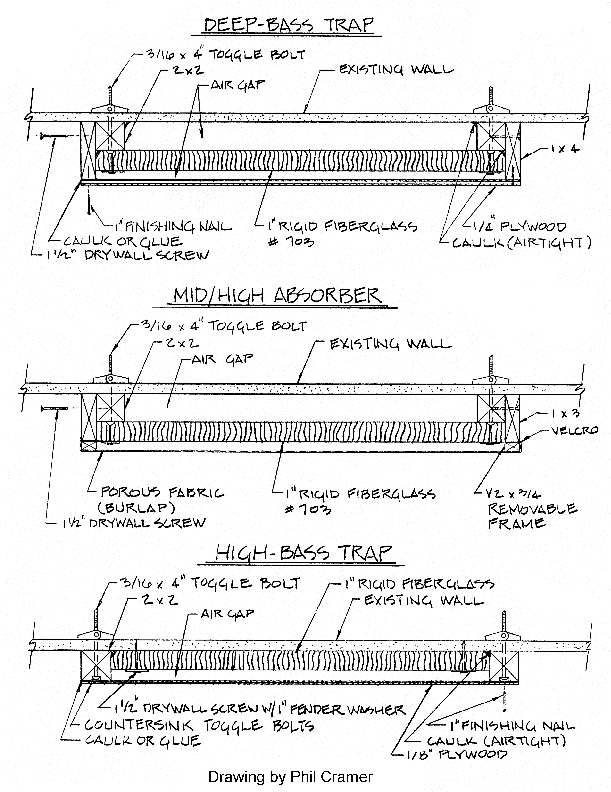
To build these, you can use Ethan's plan for a LOW bass trap with one change - instead of 1/4" plywood for the face, use 1/2" ply instead. This will lower the trap's center frequency to your modal problem range.
If you've followed this thread, you'd know that I've been working with a small room, and have achieved some success using acoustic treatments. Now, a situation has developed where I could use some advice. Here's the issue:
My wife wants to reclaim the space I've been using. She would like me to move to the other side of our finished basement. So, instead of working with an 8' x 11' room, I'd be in a 11' x 22' room with 8' ceilings. This room has a 4' hallway that intersects the room at 8' to 12' from one short wall. I'm not on a computer where I can sketch a diagram, but the room's layout would look like a "T" turned 90 degrees clockwise, with the 4' wide hallway making up the stem of the T.
Here are my questions:
1. Should I move or should I stand my ground?
2. If I move, should I position my DAW on one of the 11' walls?
3. Would it be disadvantageous to turn my DAW sideways, and use one of the side walls, preferably one of the shorter walls split up by the hallway?
I have several absorbers available: four 2' x 8' four-inch absorbers, four 2' x 6' four-inch absorbers, and several 2' x 4' one-inch absorbers.

 I've noticed a change in the sound (frequency response) when I open and close my door. It may all be in my head but I'm sure there is some physical effect.