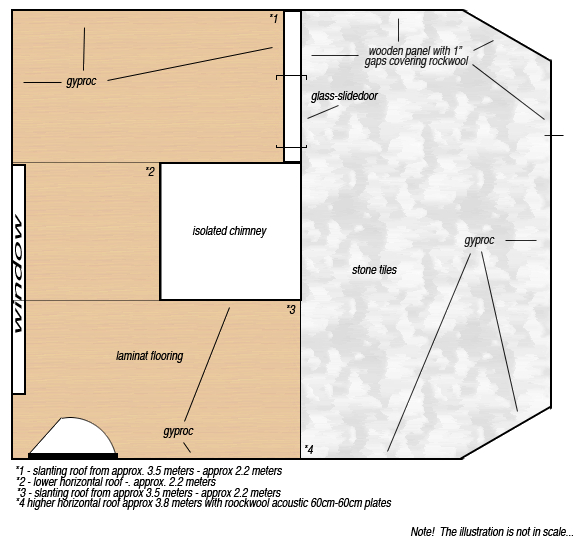
basicly the lowered celing tiles are mounted with gaps on two sides facing the wall for the LF to enter. Above the tiled celing there´s boards of rigid fiberglass attached to the celing above. The idea is for the LF to enter and be compledely absorbed by the insulation above the tiles.
The celing tiles shoud be about 2" thick and 23"x47" (5cm x 60cm x 120cm)
I have not seen this type of bass trap mentioned on this forum, so I´m checking with you guys
> The idea is for the LF to enter and be compledely absorbed by the insulation above the tiles. <
You can do this with standard tiles too. Just lay fluffy fiberglass (or fluffy rock wool or mineral wool) above the tiles. The thicker the better, and one foot thick is ideal. Since it's above the ceiling you don't have to spend time and money making it look good.
Note that all rooms benefit from as much bass trapping as possible, and not just above the ceiling. Most important is having traps in all the corners. So plan for some bass traps across the wall-wall corners too.
I would most definitely like to have as much bass absorbdion as possible. My planned "tiled celing-bass trap" is about 70 square feet big, but for my studio walls there are´nt really much room for bass traps...
Ethan Winer wrote:
Just lay fluffy fiberglass (or fluffy rock wool or mineral wool) above the tiles.
--Ethan
Do you mean I should lay the insulation right on top of the celing tiles, or attached to the celing with an air-gap between the lowered tiles and the drywall celing?
The insulation can (and should) lay right on top of the ceiling tiles; this will keep them from rattling. The insulation can and should be extended to meet the walls even though there is a gap in the ceiling tiles at the edge of the ceiling -
Where the ceiling and walls meet is going to be a high pressure point for ALL room modes, so is an ideal spot for absorption - if you make the gap fairly wide the trap will also give you some broadband trapping as well. The more insulation you place above the ceilng, up to a complete fill, the better performance from any given depth between the hard ceiling and the suspended one... Steve
Soooo, when a Musician dies, do they hear the white noise at the end of the tunnel??!? Hmmmm...
Acoustically, yes; but if you have any moisture problems it might be a good idea to leave a few inches of air space at the top for a bit of air circulation. I'd need to know more about the rest of your construction, heating system, drainage conditions around the building, etc, before I could venture a better guess... Steve
Soooo, when a Musician dies, do they hear the white noise at the end of the tunnel??!? Hmmmm...
The basic construction is a room within a room. There´s a two layerd plasterboard fire-block celing in the original room construction. My construction is "free-standing" below, also with two layers of plasterboard with insulation inside. There is no water pipes above or signifficant moisture in the basement in general.
The ventilation system provides good air-circulation in this room + heating, so moist should not be a problem at all.
The celing tiles will be lowered 6" from the inner studio shell.
Would this ceiling basstrap concept work if the "cloud" material were not acoustic tile, but rather were solid plywood or gypsum board (sheetrock)?
I.e., a floating suspended ceiling with gaps where it meets the walls, the resulting cavity above it entirely stuffed with high-density absorbant (such as Owens-Corning 704)...would this work, or does the bulk of that lower ceiling boundary need to be acoustically transparent at all frequencies in order to function?