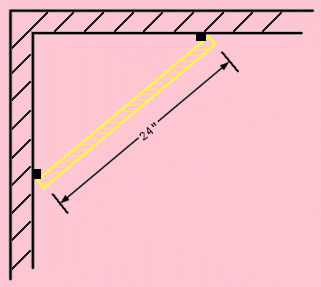
Use the 40 kG in front, the 70 kG behind - both layers touching each other, diagonally across the corner. Cloth over the face of the 40 kG. You can either leave the actual corner open behind the two layers, or complete the fill for a solid rockwool corner... Steve
Soooo, when a Musician dies, do they hear the white noise at the end of the tunnel??!? Hmmmm...
Is this the best way to construct a corner trap? I have heard so many diffirent "best ways to construct" corner traps that I get confused.
Some say you should shape rockwool into a triangular collumn, and others say its best to cover the 90degree corners with rockwool in a "V" skape and then cover the corner with cloth...
I´ve also heard that a bass trap should be constructed with plywood as a front, with "gaps" for the low frequences to enter, and be absorbed in the rockwool covered room on the inside...
Some say you should hang pieces of rigid fibarglass or rockwool vertically inside the 90degree angel, side by side, and then cover woth cloth.
There are two entirely different principles used in traps, depending on the depth available and the frequencies that need absorption.
Principle #1 is the "absorbent trap" principle; often referred to as the "broadband trap", although this can be misleading. The way this type trap works is that it is made from porous material (typically mineral wool, rockwool or fiberglass insulation if built, and more often acoustic foam if bought readymade, although there are more of the insulation type traps being offered as readymade units these days.
The way an absorbent trap works is that it needs to be placed in a position where the VELOCITY of a sound wave is maximum, so that the "interstices", or little fissures cracks and threads of the material partially block the sound wave; the effort required for the sound to pass through the absorbent converts part of the sound energy into HEAT energy, so that portion of the sound wave no longer makes noise.
Maximum velocity of a sound wave occurs at 1/4 and 3/4 of the sound's wavelength away from a solid boundary (a wall, for example) so, depending on the frequency of the sound, the absorbent needs to be a specific distance from a wall in order to best absorb that particular frequency. Frequencies HIGHER than the one whose 1/4 wavelength occurs at the same distance from the wall will also be absorbed, but those frequencies BELOW the 1/4 wave point won't be absorbed nearly as much.
This is why you get more "bang for buck" by spacing absorbent traps away from the wall by at least their thickness; even more than that in some cases. It's also why best results in a corner absorptive trap result from placing the absorbent DIAGONALLY across the corner; this gives greater depth between absorbent and the wall surfaces, so deeper absorption with the same material. Entirely filling the corner with absorbent will give better results, but it's a diminishing effect the closer to the wall you get.
The downside of absorbent traps is in trying to get sufficient LOW frequency trapping; the 1/4 wavelength of, say, 60 hZ, is about 56 inches - not too practical in your average bedroom, or even a large living room for that matter.
Enter the "panel resonator", "panel trap", "membrane resonator", etc, all different names for the same principle.
A panel trap's center frequency is affected by the weight of the front panel per square foot, the depth from the front panel to the rear of the trap, and to a certain extent the thickness and density of the absorbent used inside; a panel trap has to have no contact between the front panel and the absorbent placed inside; otherwise, the panel will be damped and the trap won't do its job. The way this trap works is that the sound vibrates the front panel at its resonant frequency, this moves the air INSIDE the trap, the absorbent (1/2 to 1" away from the front panel) converts this air movement to heat (same as an absorbent trap), also the energy required to flex the front panel back and forth is ALSO converted to heat.
Panel traps have a narrower bandwidth than absorptive traps, which is why EThan shows different frequency designs in his plans; you need NOT to make them all the same, or you'll CAUSE more problems than you solve.
This is also part of why we recommend corner absorbers so much; wider range, fixes a BUNCH of problems with minimum head trauma.
The term, "bass trap", is bandied about 'way too much without defining it; so when someone says you need "bass traps", generally they've not done enough homework or they're just being too "generic" for any practical use.
There are other types of treatments, some broadband and some specific; each has its place, but the corner absorbers will get you the best results with the least chance of making things WORSE... Steve
Soooo, when a Musician dies, do they hear the white noise at the end of the tunnel??!? Hmmmm...
...I still want to know which trap design is the best. If anyone has any links or guides to other threads where this is mentioned, please let me know, ´cause this forum has grown so big and there are so many threads about the same topics. All together, it can be quite confusing.
But again, thanks to Knightfly for the quick reply and the great advice.
> I still want to know which trap design is the best. <
There's no such thing as best. It's like asking which is the best microphone. Or car. Each design has its strengths and weaknesses. If your room is small, then rigid fiberglass across all the corners is probably best. But since you didn't give your room dimensions it's not possible to be more specific.
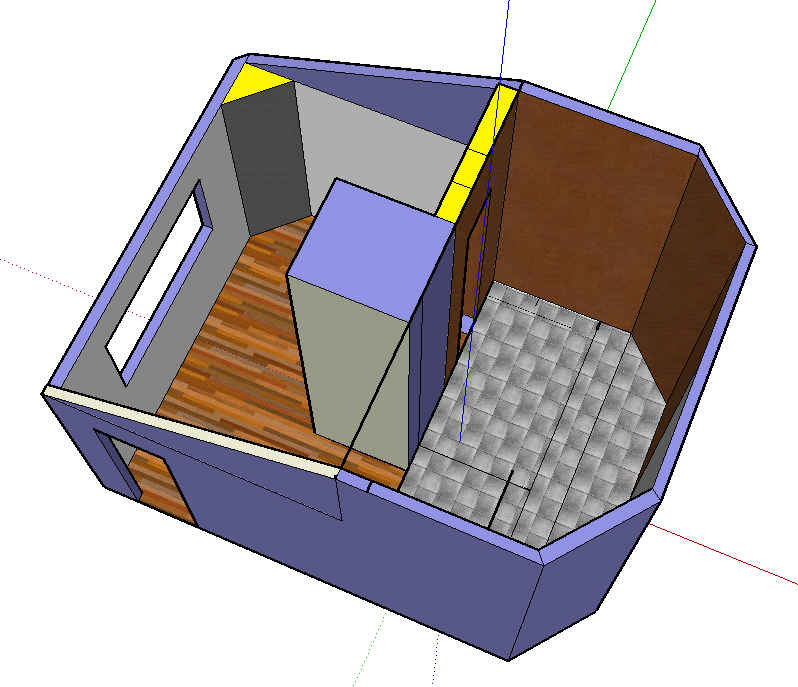
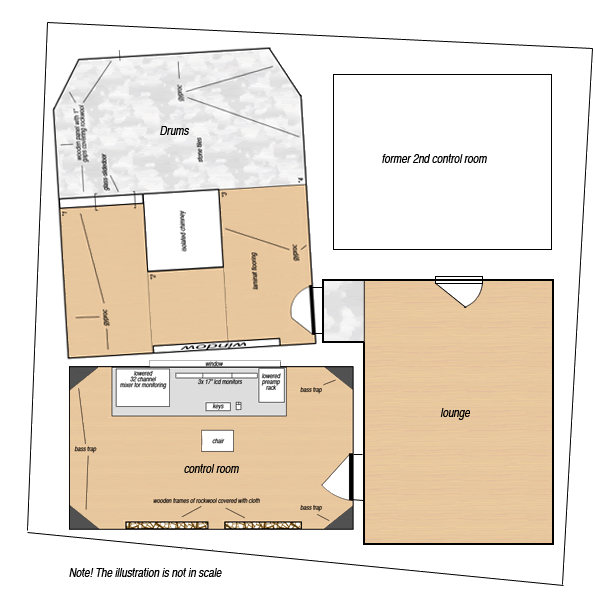
my control room is 3 x 6 meters and about 2.4 meters high.
the tracking room is about 35 square meters, almost in a "G" shape, with few 90degree angles.
> my control room is 3 x 6 meters and about 2.4 meters high. <
In that case I'd just use rigid fiberglass in as many corners as you can, and forget tuned traps. I also suggest you rotate your setup if possible, so the speakers fire the longer way down the room. The way it is now you're very close to the wall behind you. And that's where the bass response is always the worst.
Oh, my drawings are not up to date!
I got a tip on rotating the set-up of my controlroom earlier, and kind of settled to the thought.
Rigid fiberglass you say... how? as described on the John Sayers site?, or massive triangular columns of fiberglass?
The illustration on the John Sayers site describes two layers of insulation with gaps separating them, placed in a 90 degree corner... How do I keep the two layers separated? I don´t want the two layers to tip over one another and become ineffectfull.
All input, construction pics before, during and after is appreaciated
"Tuned traps" you say... What does that mean exactly?
Sorry if my questions sound stupid, but with a resource like this forum available, I just want to get everything right...
The drawing below is from my Acoustics FAQ, and it shows rigid fiberglass panels straddling a room's corner. Tuned versus broadband traps are also described in my FAQ.