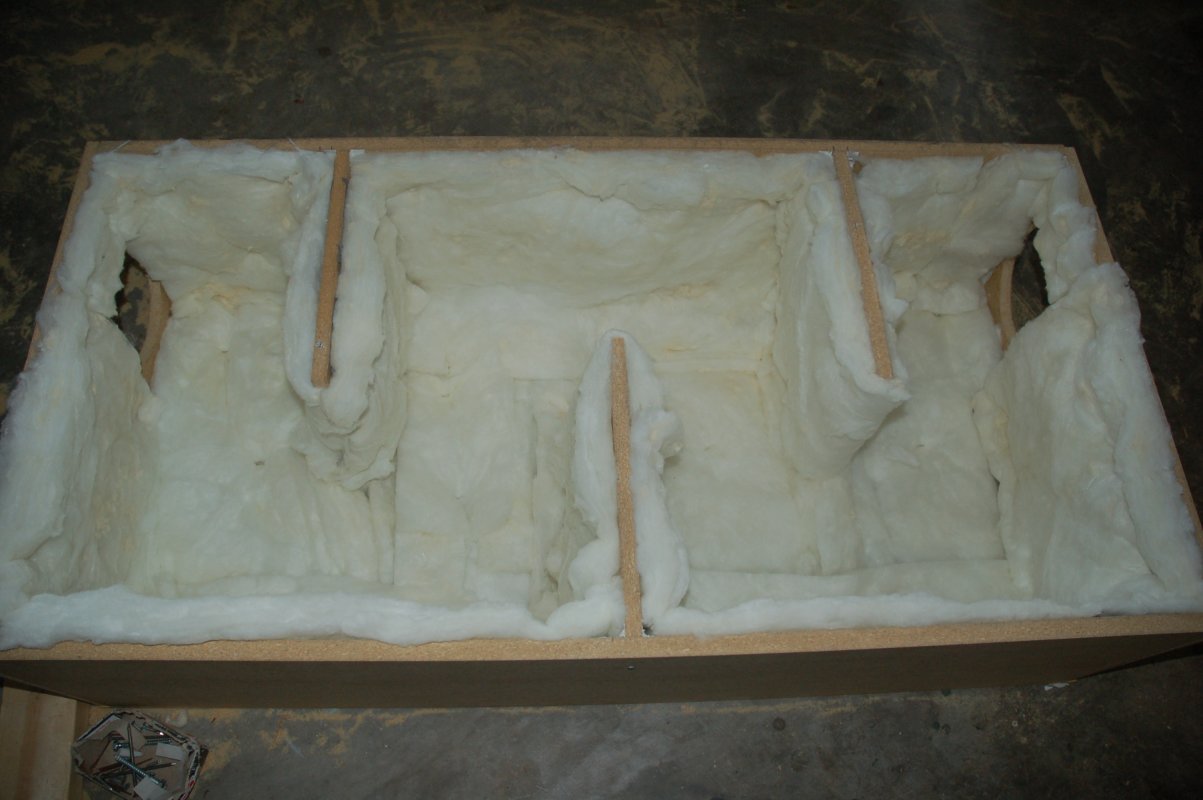
What about the drainage tube (the one expelling humidity outside in the form of water)? That seems to be a large source of noise. Are you suggesting it (along with the copper pipes) should just go through the leaves untouched, simply caulking the holes?
There won't be much flanking through that tube. It is usually soft and flexible, sometimes even corrugated. It won't flank much.
My other question is, should the "extended silencer" go through the leaf with a duct-sized, 86.5 sq inch cross section (and then inside the room attach the ø25mm of the provide pipe to go into the AC unit), should it have the 346 sq inch cross section of the silencer, or should it be the size of the pipe?
Just to clarify: The
duct does not go through the leaf: the
silencer goes through the leaf. As I already mentioned, here's an wood "sleeve" on the end of the box that penetrates the leaf. That "sleeve" can have a smaller cross section than the box itself if you want, but the transition from duct to sleeve is where the impedance magic happens, so it needs to be a fairly large change in cross section.
The idea of drilling a 18.6x18.6" hole in the external leaf makes me feel a little dizzy...

That's a
huge hole! Why do you need it to be so big? Your studio is only 1800 ft3, so why do you need nearly 350 in2 cross section? Assuming 1800 ft3 and six changes per hour, you need to move 180 CFM. Moving 180 CFM through 350 in2 (2.4 ft2) implies a velocity if just 75 fpm at the register. Why do you want your air to move so very slowly? I mean, there's nothing wrong with that, but there's no need for it. As I mentioned before, 300 fpm is a more reasonable speed, which you could do with a cross section of about 90in2. I don't understand the need for such a huge section. The ducts themselves could be 6" with no problem, or 8" if you really wanted to, and even then you'd have a good cross-section change at the interface.
my cross section needs to be 86.5 sq inch, making it about 9.3x9.3", and making the silencer 18.6x18.6 (346 sq inch) (plus the thickness of the duct liner and the two drywall layers.
Huh? How did you get there from here? Assuming you start with a 6" supply duct (as I said before), the area of that is roughly 30 in2 (28.3 in2, to be more exact). You only need to double the cross sectional area where the duct connects to the sleeve, but you are increasing it more than twelve times! Why do you need an area of 346 in2, when 60 would be fine, and 90 would be fantastic? I do not understand why you want such an enormous cross section for such a small room.
and then inside the room attach the ø25mm of the provide pipe to go into the AC unit
Why are you insisting on still using that tiny little pipe? I already showed you why it is no use, and why you should totally forget about using that, and you said you "got it", but here you re still talking about trying to use it... What I actually said was "
The small amount of air that thing brings in is not enough for a typical studio. ... Forget that your unit even has that capability, and build proper supply and exhaust ducts."
Here's a model of a 86.5 sq inch duct penetrating the two leaves and terminating with a hole for the HVAC's internal unit ø25mm pipe.
Sorry, but I do not understand what you are trying to accomplish there at all. It just makes no sense. Why do you want to connect a 1" pipe to a silencer designed for an 11" duct? And how did the 346 in2 cross section suddenly became 86.5 in2? I'm not getting the plan at all.
I'm aware that it's better for the silencer to be attached to the most sensitive leaf,
Sorry, but there's no such thing! In an MSM wall, BOTH leaves are EQUALLY "sensitive". Together they make up a tuned system, and it is the system that provides the isolation, not the individual leaves. You seem to be misunderstanding how MSM isolation works. Neither of the leaves is more sensitive than the the other, and neither provides more isolation that the other: They work together as a system. Saying that one is more important than the other is the same as saying that the gearbox of a car is more important than the engine in making it move: they are both equally important and a failure in either one will prevent the car from moving. So to with your wall: both leaves are equally important, which is why each leaf needs its own silencer box.
so I'm only going to do that for the exhaust.
You are missing the point: There's no point in silencing only one duct where it passes through only one leaf. You need to silence BOTH ducts and each one of them needs to be silenced where it passes through EACH leaf. In other words, a total of four silencers.
I read your comment in another topic about an alternative when using one silencer on the least-sensitive leaf and it gave me hope
You quoted what I said, but there is nothing at all in there about me saying that one leaf is more important than the other. Nothing. I don't know how you could read that and understand that I was saying that one leaf is more sensitive than the other, or one duct is more sensitive than another. I just don't see how you got to that conclusion from reading what I wrote.
I'm using 2 layers of 5/8" drywall w/ Green Glue.
???
WHAT!!???? You CANNOT make a silencer box out of drywall! It has no structural strength. It will be way too heavy for the screws to hold together. Did you not notice what I said about how to make it? :
The thickness of the wood that you use to make your silencer boxes
. Wood. Not drywall: Wood.
Since caulking a box from the inside is not the easiest thing,
To be honest, I don't see why! I've never ha a problem doing that. You caulk the wood edges as you put the box together, then caulk them again before you put the duct liner on, then you caulk around the edge of the front panel before you put that on, and caulk that from the outside once the screws are in place. I've never had a problem doing that.
do you suggest cutting the drywall leaving the space for the caulk at the risk of it not being perfect, or not leaving any space, avoid caulking and letting the liner fill the gaps?
I'd suggest that you don't do it with drywall at all! That thing will fall apart. I would suggest that you build it properly, out of wood.
suggestions on how to put together the box made of drywall?
Yes: DON'T!
it's not the easiest material to work with as it crumbles, and I definitely wouldn't want that in the air system.
That's why I definitely would not ever make a silencer box of drywall.
Could I get away with going straight from the external unit through the supplied ø25mm pipe into the silencer and avoid using a duct since the distance is so short or would you rather build that 10" duct?
Neither, because I just don't understand either of those measurements. A 10" duct makes no sense for such a small room, and a 1" pipe makes no sense either. Typical duct size would be 6" for that room. You'd have to have a hurricane going through a 1" pipe to get 180 CFM out of it.
Are there any precautions I should take for the other three pipes (water outlet, gas, liquid) or should they just run outside, parallel the silencer, untouched and with no insulation?
Do not remove the insulation from those pipes! They come from the factory fully insulated, and you should not ever remove that.
The exhaust silencer's duct/pipe will penetrate the internal audio room's leaf, then after a 5" air gap it'll go straight into the outer leaf which is also the external wall of the building.
Ummm... Nope! You need a silencer on EACH leaf! Every point where a duct would go through a leaf, needs to have a silencer.
Should it end in the outside wall as a small ø25mm pipe
NO!!!! BOTH paths must end in reasonably sized registers. The intake path will have some type of register or grill or hood over the end, perhaps with a filter in it, and the area of that will probably be at least the equivalent of a 6" round duct, and likely more. The area of the exhaust grill will be something similar. I have no idea why you want to use a 1" pipe. The static pressure from that would be way beyond what any reasonable duct fan could handle for 180 CFM.
the duct liner I managed to find here in Italy was the K-Flex St Duct. They don't have a 25mm version, so I went with the 30mm. The alternative was 20mm.
Either 20mm or 30mm would be good, but those are both rather unusual for duct liner. Are you SURE you got stuff for lining the INTERIOR of HVAC duct? That normally comes in either 1" or 2" (25mm or 50mm). Sometimes you can get 1/2" (12mm) or 1-1/2" inch (38mm), but 20mm and 30mm are unusual sizes. That's more like what I would expect for EXTERNAL duct liner, that goes on the OUTSIDE of a duct. Better check carefully that the stuff you got is designed and certified for use INSIDE HVAC ducts. If not, send it back and get the right stuff.
Do you think the best way to install them would be to:
1) build my two boxes with only 5 sides and a missing 2x1 bottom panel and applying it directly onto the wall (for the inner leaf) and under the ceiling (for the outer leaf) essentially using the wall/ceiling itself as my 2x1 panel
2) cut a 2x1 hole into the drywall and screw the (whole, 6-sided) silencer box onto the joists for the inner leaf and hang the box from the ceiling with toggle bolts for the outer leaf?
3) other ideas?
The best idea would be to take off an entire sheet of drywall, install your silencer boxes correctly, carefully cutting the holes in the leaf a little larger than the MDF sleeve, pushing the sleeve through the hole, sealing the gap with backer rod and caulk, then doing the same for the drywall sheet that you took of, replacing it carefully over that sleeve, with the gap around it, more backer rod, more caulk.
I've read your post a few times to make sure I got it right.
It seems like you misunderstood several things in there!
I have proceeded to cut all the necessary drywall for the silencer. Boy that was a lot, this thing is going to weigh a ton. I'll be getting some help from my drywall installer in order to assemble the box as I don't want to screw it up. Hopefully I'll be able to put it all together next week.
Throw all of that away, and go buy some wood, preferably MDF, but you could also use OSB or plywood if you prefer. You will
NOT be able to make silencer boxes out of drywall, and in any case the design you are showing is seriously flawed. Even if you did make those things properly out of MDF, they still would not work. You
cannot have air coming into one end of that box at twenty six thousand feet per minute through a tiny little 1" pipe, then exiting out the other at 75 feet per minute through a 350 square inch hole. I don't even know where you would find a fan capable of producing 26,000 fpm into a one inch diameter pipe... That's 295 miles per hours! Very literally, hurricane speed. You'd need a miniature engine to move air like that.
It seems like you are completely misunderstanding the concept here.
All that you need to do is to have a typical sized duct (for example, six inch diameter, which is roughly 30 in2 cross section) on the supply end, going into the first silencer box through a wooden sleeve that passes through the outer-leaf, where the internal cross section will increase to around 60in2 (or maybe 90in2 if you really wanted to), and stay at roughly that cross section passing several baffles, before exiting at the other end back into a 6" duct, from where it will go to the
second silencer box, on the inner-leaf. Here it will go to a larger cross section again, probably 90 in2, and it will stay that at that section all the way through. The sleeve that takes it through the inner leave and into the room itself will also be the same section, or perhaps even larger if you really wanted to slow the air down, and the register on the end of that sleeve will have an open area of about 90 in2. The same happens in reverse on the exhaust side. And at some point you need a fan to drive the air through the system. The fan needs to have the ability to move 180 CFM of air into a 6" duct and it must be able to handle whatever static pressure you are projecting for the system, which hopefully will be below 0.5 in.wg. The fan can go on either the intake duct, or the exhaust duct.
That's it. Nothing more, nothing less.
- Stuart -

 If you are bout to FINISH your room, and you still don't have a design for your HVAC, then you might be more than just a little late!
 Those things are highly pressurized with refrigerant. Don't ever try to remove those...
 What about the drainage tube (the one expelling humidity outside in the form of water)? That seems to be a large source of noise. Are you suggesting it (along with the copper pipes) should just go through the leaves untouched, simply caulking the holes?
 ) That being said, I did the math again and I still come up with a cross section 86.4 in2. I have no idea how you come up with 28.3 in2, but I'll be more than glad to simply execute what you are suggesting without questioning!