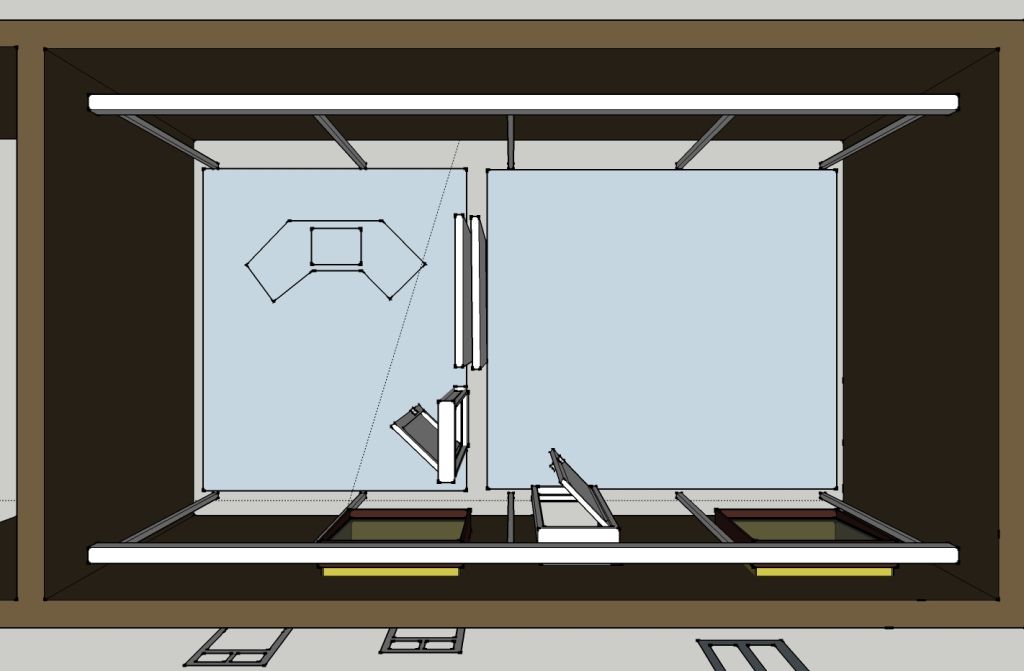
The brick walls are 3,50m so it's easily obtainable to keep 3m untreated space.
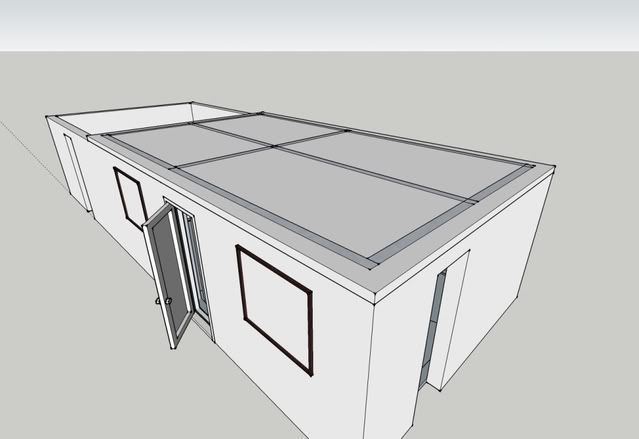
The steel beam in the middle should be moved a bit to go in between the control and live room:
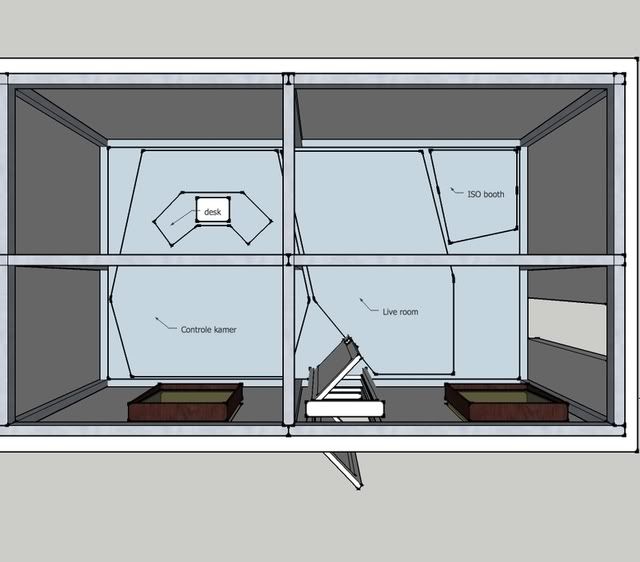
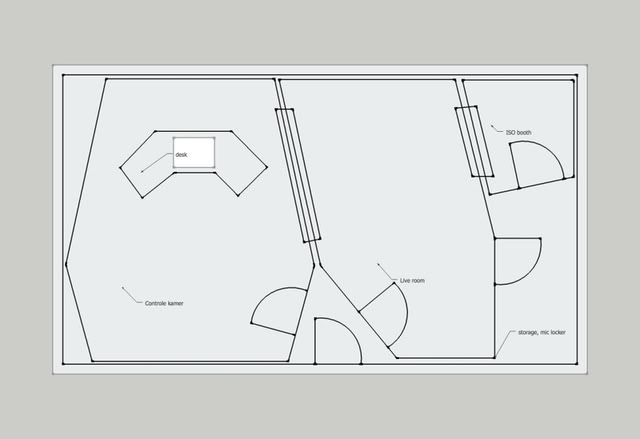
Any comments about the floorplan design ?
Moderators: Aaronw, kendale, John Sayers
Beats me ??gullfo wrote:the floor plan looks good. why does the architect think the walls are only 2.7m high?

You don't show any dimensions on your diagrams, so it's hard to say, but it does look like you have enough space to do a small control room and a small live room.I'm not confident in what I wanna do with the space, one-room recording space or live/control room.
Your opinions ?
Use one of these Room Ratio calculators to figure out the best dimensions for your room:One of the first thing that is mentioned in acoustic books is the room ratio, but in my original plan all inside walls are in an angle non 90 degrees. Is it possible to calculate room ratios? Is it a bad idea ? Should I go with rectangular rooms?

When I poured the concrete floor I made a 2cm gap between the mixing room and the live room.Soundman2020 wrote:There's no need to angle the walls like that. You can if you want (for example, if you are trying to do an RFZ or CID design concept), but in that case they only need to be angled as far back as the mix position. And the rear of the room should not get narrower: it should get wider, or stay the same width.
From "Small Studio in Finland" thread: You are wasting space by splaying the complete side walls like that. You only need to splay (angle) a small part at the front of the room, roughly as far back as the mix position. From there to the back, the walls can be parallel, to increase the total volume of the room. If you end up with flutter echo problems like that, then it's easy to treat those with absorption panels on the walls (and you will probably need those in any event).
The same problem happens with the way you are cutting off the rear corners of the room. That wastes space, and those corners are where your bass traps need to go.
Hmmmm... that's a problem! It means that you are locked into those shapes and dimensions now.When I poured the concrete floor I made a 2cm gap between the mixing room and the live room.
Flutter echo is fairly simple to deal with, using basic absorption panels at strategic locations, or diffusion in some cases. And since you will need that anyway, there's no need to splay the walls as well. The only real reason for splaying walls is if you want to build an RFZ-style studio, or one of the similar types, where the room shape itself is used to direct sound away from the mix position. Or you might just want to do it because it looks good!I was also trying to minimize flutter reflections, possibly out of a lack of real knowledge?

yes.Soundman2020 wrote: Hmmmm... that's a problem! It means that you are locked into those shapes and dimensions now.
I'll have to check for option 2 if I can find someone to cut it.Soundman2020 wrote: You have three options:
1) Use them as they are, with the CR shape not being optimal.
2) Modify them by cutting the slab in some places, and filling it in in other places.
3) Ignore them, and build any place you need to, but losing the advantage of the decoupling.
The walls are more or less separate from the floor.Soundman2020 wrote: But first, there's a question: Did you leave a gap ONLY between the LR and CR? Or did you also leave gaps all around the edges of both slabs, such that they do not touch the walls? In other words, are your walls resting on a separate foundation from the slabs?
I believe someone told me that for a good RFZ design my ceiling height is way too small.Soundman2020 wrote: Flutter echo is fairly simple to deal with, using basic absorption panels at strategic locations, or diffusion in some cases. And since you will need that anyway, there's no need to splay the walls as well. The only real reason for splaying walls is if you want to build an RFZ-style studio, or one of the similar types, where the room shape itself is used to direct sound away from the mix position. Or you might just want to do it because it looks good!
That depends on how much isolation you need. If it is typical levels for project studios, then it is not an issue. If you need very high levels of isolation, then it would be worthwhile to have decoupled slabs.Or just go for option 3, I don't know how much of a disadvantage this is.
Then your slab is not decoupled!!!! So there's no difference in isolation.So the floor and walls connect at ten 80x80cm points where these concrete blocks have been poured.
Not true! Whoever said that does not have a good understanding of RFZ. You have 3.5m!!!!! That's PLENTY. I have designed RFZ-style rooms where the available height was a bit less than 2.2m... It's not easy at all, but it can be done.I believe someone told me that for a good RFZ design my ceiling height is way too small.
Yes. Correct.Going for what I planned, the diamond shape, wastes space in the corners as I have read here.
That's still plenty. Not a problem.There's only about 2.9m height left under the concrete ceiling.