Sunny Ledge Recording Studio - Construction Diary

How thick should my walls be, should I float my floors (and if so, how), why is two leaf mass-air-mass design important, etc.

Moderators: Aaronw, sharward

mileskb
Posts: 17
Joined: Mon Jan 23, 2012 10:08 am
Location: Skagit Valley Washington
Contact:

Sunny Ledge Recording Studio - Construction Diary

Post by mileskb »

Hello Everyone.
I have been reading these forums and as this is my first post I hope properly took care of the few modest requests of our hosts and don't get spanked on day one. The subject studio will be my second recording studio build. The first http://www.baronaudio.com was a successful experiment I think in spite of my efforts. In 2006 we moved across country to the great Pacific Northwest and I'm ready to start a few studio, hopefully having learned form any mistakes of the previous.
I have just started downloading the design software and will get an outline of the existing building up as soon as I can, but it's simple enough to explain. What I am looking for are suggestions of layout. I have a blank canvas, but the canvas isn't that big, so I want to make the most of it.
The mission is pretty standard a control/mixing room, a tracking room, a drum kit area or room, and a vocal booth. I also have two keyboard trees that I assemble in an L shape in the tracking room somewhere. The tricky part is the building is 31'L x 13'W x 12'H. Just a big open box that is drywall finished walls, cement floor, and the ceiling is unfinished at this point. It's previous life was a garage for a 26' boat. On one end of the building is a platform currently that is 2 feet up from the floor that spans the width of the building about 4 feet wide. The significance of this is that the building is built against a hill so that one end and one side is backed by earth to a line about 2' from the floor. So without the platform... you'd step in and fall two feet.
I know a picture is worth a 1000 words so I will go take a few before it gets too dark.

The sample on your website titled THE GARAGE STUDIO 1, the idea of the central control room is very intriguing to me.
Image

Well I hope I have met all the requirements to be part of this community and get some assistance. I don't think this site was around for my previous build in 2001, but I want to say thanks in advance for all the information I have gathered so far.
Miles-Kevin Baron
Sunny Ledge Recording Studio
Mount Vernon, Washington
mileskb
Posts: 17
Joined: Mon Jan 23, 2012 10:08 am
Location: Skagit Valley Washington
Contact:

Re: Sunny Ledge Recording Studio - Construction Diary

Post by mileskb »

Well I couldn't figure out how to use SketchUp, but I did figure out how to use this other tool called FloorPlanner. http://www.floorplanner.com/

While maybe not as detailed as SketchUp, it was great for a quick drawing. I put this together in less time than it took to figure out how to get Sketchup running, but frankly I think I just missed something on SketchUP and I'm going to give it go tomorrow. I just wanted to at least get my basic idea out there for the hive mind to look at.

Image
floorplan-1-23-2012- by mileskb, on Flickr

Here are some 3-D views as well.
Image
floorplan3Da-1-23-2012- by mileskb, on Flickr

Image
floorplan3D-1-23-2012- by mileskb, on Flickr

This is based on 12' ceilings as I haven't figured out to compensate for the outside door by the restroom being 2 feet up from the inside floor.
Overall dimensions are 31' x 13' (yeah, I'm not sure how they came up with those odd figures either, but I measured it at least twice)
Washroom/Toilet is 4' x 6'
Drum Booth is 9' wide @ the widest and 7' @ the deepest
Vocal Booth about 3.5 x 5
Control room is approximately a 10' wide x 13' deep
The main area is about 9 x 14 not regarding nooks and crannies.
The cabinetry along the walls is an idea that grew from invention in my last studio. Storage was at a premium there as well and it seemed we were always looking for a place to lay something down for a minute. A soft drink, a guitar pick, a book... so these cabinets are going to be about 3' high and 14" deep. That's deep enough to put an guitar combo amp on, and/or inside as well.

There will be a lot of slot wall for guitars and whatever else needs hanging.

I also only need worry about acoustics inside. No close neighbors.

Thoughts and comments ?
Miles-Kevin Baron
Sunny Ledge Recording Studio
Mount Vernon, Washington
mileskb
Posts: 17
Joined: Mon Jan 23, 2012 10:08 am
Location: Skagit Valley Washington
Contact:

Re: Sunny Ledge Recording Studio - Construction Diary

Post by mileskb »

Hurrumph.. I see a flaw in the plan already.. That sliding glass door needs to go and I need an airspace between the control room and tracking and between control room and vocal booth.
Miles-Kevin Baron
Sunny Ledge Recording Studio
Mount Vernon, Washington
mileskb
Posts: 17
Joined: Mon Jan 23, 2012 10:08 am
Location: Skagit Valley Washington
Contact:

Re: Sunny Ledge Recording Studio - Construction Diary

Post by mileskb »

So here's REV-1 with some air-space between the main rooms and also I added the elevation to the control-room/restroom/vocal booth area from the main and drum rooms.

Image
floorplan-1-23-2012 -REV1- by mileskb, on Flickr

Image
floorplan3D-1-23-2012 -REV1- by mileskb, on Flickr
Miles-Kevin Baron
Sunny Ledge Recording Studio
Mount Vernon, Washington
Soundman2020
Site Admin
Posts: 11938
Joined: Thu Aug 21, 2008 10:17 am
Location: Santiago, Chile
Contact:

Re: Sunny Ledge Recording Studio - Construction Diary

Post by Soundman2020 »

Miles, you are wasting a lot of space by cutting off the corners of your control room like that! Those rear corners are where your bass trapping should go, and the front corners are where your speaker soffits should go (if you plan to soffit mount) or more bass trapping (if your speakers will be on stands), or both, if you use John's soffit design.

Also, the front and rear inner-leaf walls of your control room are still fully coupled to the outer leaf walls: if you need isolation (you didn't say, but I'm guessing that you will!) then you need to fix that too, and decouple those walls for a full 2-leaf MSM design.

- Stuart -
mileskb
Posts: 17
Joined: Mon Jan 23, 2012 10:08 am
Location: Skagit Valley Washington
Contact:

Re: Sunny Ledge Recording Studio - Construction Diary

Post by mileskb »

Thanks,
I really should decouple the control room thanks. Also the lost space is just my drawing skills... I was just reflecting (pun) the idea of not using a square box.

About speakers.... I know this is covered in another section, but I am wondering if some clarification should be made, or is there an assumption that everyone knows the difference between near-field monitors (which aren't mounted into walls) and reference monitors. I've actually seen very little reference to near-fields on here, and maybe I'm a bit old school, but not as old as using reference monitors in soffit design. :)

I realize this goes against-the-grain but if I used reference monitors, I'd set them up so the sweet spot was on the listening couch in the back of the control room. (pulling the couch a little off the wall too). They are really cool for impressing customers. Of course I guess I could get some JBL 4310's for nostalgia purposes (did I just date mice elf)
Miles-Kevin Baron
Sunny Ledge Recording Studio
Mount Vernon, Washington
mileskb
Posts: 17
Joined: Mon Jan 23, 2012 10:08 am
Location: Skagit Valley Washington
Contact:

Re: Sunny Ledge Recording Studio - Construction Diary

Post by mileskb »

Was looking for some input on this...

I'm seriously considering dumping the drum booth, and here's why.

My recording technique for drums is taken from the open style where we mic up the kit, but most of what is used in the mix are the room and overhead mics. The individual drum mics are just to accent the overall sound. This needs room. I'd be better off putting the guitarist in the the little box if I need to isolate things and put the kit in the bigger room. I might actually be better off and more space efficient with two smaller booths and leave the drums in the open. A lot of studio's do it that way. I did it previously because I had no choice, but now I'm thinking I should design that way.

By the way this is a stand alone building. I don't have to worry about sound leaking outside...

Thoughts?
Miles-Kevin Baron
Sunny Ledge Recording Studio
Mount Vernon, Washington
BriHar
Senior Member
Posts: 356
Joined: Tue Feb 15, 2011 7:35 am
Location: Turbenthal, Switzerland

Re: Sunny Ledge Recording Studio - Construction Diary

Post by BriHar »

I think your ideas regarding the drum booth are valid. More and more musicians and vocalists are laying down their tracks right in the control room and the recording either DI or over an amp in an Isolation booth or other room.

Your idea for the "reference monitors" pointing at the couch is the same as what I am doing. The terminology however, reference monitors, nearfield are rather ambiguous and undefined. I have nearfield monitors but they are described as reference monitors, my soffit mounted monitors (Cerwin Vegas directed to the couch) are not technically reference monitors. Many people mean different things by these labels - just so there's no confusion :wink:
Brian
As you slide down the bannister of life, may the splinters never point the wrong way...
Soundman2020
Site Admin
Posts: 11938
Joined: Thu Aug 21, 2008 10:17 am
Location: Santiago, Chile
Contact:

Re: Sunny Ledge Recording Studio - Construction Diary

Post by Soundman2020 »

The terminology however, reference monitors, nearfield are rather ambiguous and undefined....
Exactly! The terminology is more marketing hype than actual defined technical terms. In reality, you could label a monitor whatever you want, and there's no real standard that someone could point to and say "Well, that isn't near field, because it does't have a Q of so-and-so" or "That's not a reference monitor because the response doesn't meet such-and-such criteria". Any manufacturer is free to call his monitors anything he wants!

What makes a monitor "reference" or not? What makes it a "monitor" and not just a "speaker"? Who defines that? In reality nobody knows.

And as I pointed out several times recently, the "near field" or "far field" name on the monitor means very little once you put it inside the average small studio, since the inherent characterstics of the studio itself tend to override those of the monitor: there's no such things as a true "far field" (reverberant field, or diffuse field) in a small room! And "mid-field" really is pure marketing hype: there's no such thing as that either: not technically and not practically. "Mid field" implies the transition zone between the near field and the far field of a large room: Who on earth would want to sit and mix in an area of transition between two different acoustic spaces???!!! :shock:

To me, get the best speakers you can afford that give flat response across the spectrum and have good directivity and off-axis characteristics, flush mount them, calibrate, and call them "Superfield ultra reference pressure transducers" if you rally want to! :)


- Stuart -
mileskb
Posts: 17
Joined: Mon Jan 23, 2012 10:08 am
Location: Skagit Valley Washington
Contact:

Re: Sunny Ledge Recording Studio - Construction Diary

Post by mileskb »

Maybe things have changed, or maybe I bought the hype... but "near-field" monitors essentially mean their pattern is designed to be used about 3-5 feet apart with the listener in the middle. In my experience with the two sets I have been using for 10+ years... you can NOT angle them toward the sweet spot or you loose separation. I've tried it... they work best when parrallel with the desk, 3 feet apart and the sweet spot is 3 feet from each. I have tried to use them in other scenarios... they just don't work. In my first studio as example I built these really cool stands.. But because of the desk I was using they were about 6 feet apart. If I angled them toward me it was like I was in a dead zone. Phase cancellation maybe... didn't invest a lot of time in research because the only place they sounded decent was about 4 feet back from where I was sitting. Once I moved them onto the back of the desk, about 3 feet apart... not angled... they were fine..

This has been my experience with NS8M, NS10M and Event 20/20's Your mileage may vary... but my experience with the performance of these speakers is that they are indeed designed to be listened to at close range.... period. Oh sure you can hear them in the rest of the room... but the sweet spot it obvious to the point where I need someone else to listen, I need to get out of the chair and they need to sit in the control chair. That is the only downside, but I kinda like it like that. :)

Now I will add one thing. I am open minded, and a typical male (that's what she sais). When I got those first speakers I didn't read the directions, and I didn't know they were "near-field" monitors. After building the stands I mentioned above, and having them sound like crap... I finally looked at the paperwork for the manufacturers suggested placement. When I followed the directions, they sounded great. Yeah, I hate it when that happens to, but I'm just say'n..

FWIW, never heard of mid-field.

Miles
Miles-Kevin Baron
Sunny Ledge Recording Studio
Mount Vernon, Washington
mileskb
Posts: 17
Joined: Mon Jan 23, 2012 10:08 am
Location: Skagit Valley Washington
Contact:

Re: Sunny Ledge Recording Studio - Construction Diary

Post by mileskb »

Ok, I just did a little research and according to Event's NEW manual online... they ARE supposed to be angled toward the listener, but still only 3-5 feet away, so I'm going to get my old manual out when the time comes as my speakers are 10 years old.. (may be time for new speakers... hmmmm) anyway... I found the term "near field" by reverse engineering. That is I couldn't get a decent sound where I needed it until I followed the instructions, then found out there was a reason.

Now... don't feel bad if you have to say "Miles, your nuts"... You won't be the first and I can take it. I love audio. I'm the guy that gets asked to mix a band in the worst of conditions and I say "bring it on"... I love the challenge of getting it to sound good. So as on the American TV Frasier.... "I'm listening..."

-Miles
Miles-Kevin Baron
Sunny Ledge Recording Studio
Mount Vernon, Washington
Soundman2020
Site Admin
Posts: 11938
Joined: Thu Aug 21, 2008 10:17 am
Location: Santiago, Chile
Contact:

Re: Sunny Ledge Recording Studio - Construction Diary

Post by Soundman2020 »

don't feel bad if you have to say "Miles, your nuts"...
OK! "Mile, you're nuts!" :) (Sorry! Couldn't resist! :) )

Naah, you are not nuts. If that's the way you hear it, then that's the way you hear it! But if you have speakers where, as a pair, they sound terrible on-axis and good off-axis, with a null at the sweet spot when angled correctly, then I'd venture that you have a phase issue, with one of them inverted. That's about the only logical explanation. Maybe you have a wiring issue that you didn't know about, with one of your speaker cables being wired inverted?

If you have speakers 5 feet apart, aimed straight back (not at you), and you are seated between them, 5 feet away, then your ears are way off axis from both speakers (at least 30° off axis!), so you are most definitely not hearing the true sound of the speaker. Especially with NS-10s and Event 20/20s: Their on-axis response is, shall we say, debatable (to be polite) but a lot of engineers like them, because they sound, well, like typical consumer home stereo speakers, on-axis, or maybe even 5 or 10 degrees off-axis. They often were used that way in studios: a few degrees off axis. But I don't know of any engineer who thinks that NS-10s sound good 30° off-axis! :shock: In fact, I'm thinking real hard to come up with ANY studio monitor that sounds good 30° off axis... :?: :?

Seriously, if that's the way you have to set up yours to get them sounding good, then there's something badly wrong somewhere. Maybe cables, maybe cross-over, maybe even the room. But something is off if you have to get 30° off-axis, and they null when mounted correctly.


- Stuart -
mileskb
Posts: 17
Joined: Mon Jan 23, 2012 10:08 am
Location: Skagit Valley Washington
Contact:

Re: Sunny Ledge Recording Studio - Construction Diary

Post by mileskb »

Soundman2020 wrote:
don't feel bad if you have to say "Miles, your nuts"...
OK! "Mile, you're nuts!" :) (Sorry! Couldn't resist! :) )

Naah, you are not nuts. If that's the way you hear it, then that's the way you hear it! But if you have speakers where, as a pair, they sound terrible on-axis and good off-axis, with a null at the sweet spot when angled correctly, then I'd venture that you have a phase issue, with one of them inverted. That's about the only logical explanation. Maybe you have a wiring issue that you didn't know about, with one of your speaker cables being wired inverted?

If you have speakers 5 feet apart, aimed straight back (not at you), and you are seated between them, 5 feet away, then your ears are way off axis from both speakers (at least 30° off axis!), so you are most definitely not hearing the true sound of the speaker. Especially with NS-10s and Event 20/20s: Their on-axis response is, shall we say, debatable (to be polite) but a lot of engineers like them, because they sound, well, like typical consumer home stereo speakers, on-axis, or maybe even 5 or 10 degrees off-axis. They often were used that way in studios: a few degrees off axis. But I don't know of any engineer who thinks that NS-10s sound good 30° off-axis! :shock: In fact, I'm thinking real hard to come up with ANY studio monitor that sounds good 30° off axis... :?: :?

Seriously, if that's the way you have to set up yours to get them sounding good, then there's something badly wrong somewhere. Maybe cables, maybe cross-over, maybe even the room. But something is off if you have to get 30° off-axis, and they null when mounted correctly.

- Stuart -
Well first... they were only separated about 3 feet and yes, actually they were pointed a little inward, maybe 30 degrees, but likely closer to 15.

I agree at the wider spread, there was probably a phase issue in play. It was a long time ago and I likely didn't think of that at the time.

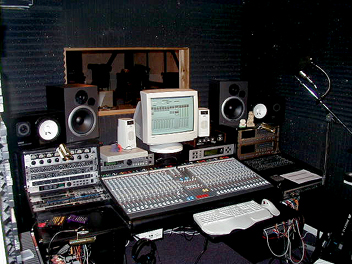
This is a photo of my last control room from about 2003-ish. As you can see the Events are tipped in a little. :( guess I never noticed...

Funny how I ended up with 20/20's. I went to a store that had all of the monitors lined up in pairs. I used a Miami Sound Machine CD not particularly because I like the music, but the mixes are very intricate. They had all the names... Tannoy, Genelic, JBL, etc etc.. when I got the Event's I heard some castinets and other subtle instruments that I hadn't noticed while listening to the same track over and over on the other speakers. I double checked it... and even the guy in the store was a little surprised.

Now overall... the Events do NOT make things sound very good. I don't find them at all like home stereo speakers. I find them VERY flat sounding, but at the same time I hear EVERYTHING.

Great for mixing levels, not so much for Final Mastering, however, If I got a mix to sound as good as possible on the Events'... they sounded fantastic everywhere else..

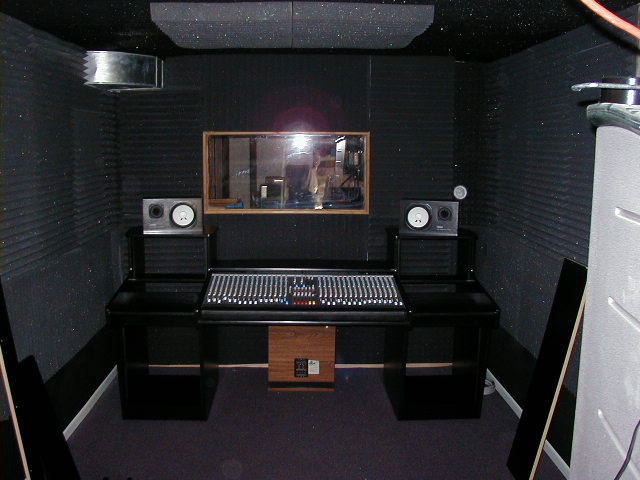
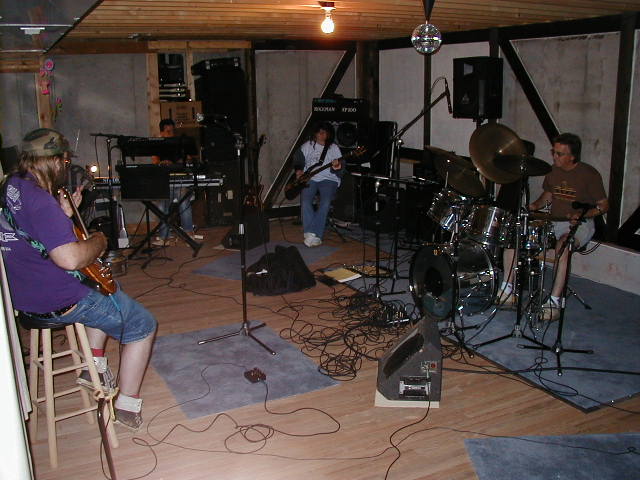
Here are some shots of my previous studio. I made lots of mistakes in the build, but I managed to get some decent work out of it.

Image

Image

This was the first sound check. Didn't have the walls complete, didn't have the Bose 800's in.. just got a group in to see where we stood..
Image
Miles-Kevin Baron
Sunny Ledge Recording Studio
Mount Vernon, Washington
BriHar
Senior Member
Posts: 356
Joined: Tue Feb 15, 2011 7:35 am
Location: Turbenthal, Switzerland

Re: Sunny Ledge Recording Studio - Construction Diary

Post by BriHar »

Seems we're getting into details here.
Suffice it to say, the general consensus views "Nearfield" as any configuration of speakers which minimizes the effects of the room at the listening position. Distances and angles when given are only guidlines and always relative to the size and geometry of the room.

Reference monitors are generally understood to mean a loudspeaker (typically a combination of drivers in a box enclosure) designed to reproduce as flat a response across the spectrum as possible without adding any colouring. This in contrast to a typical stereo or HIFI speaker which is designed to please the listener - reference monitors usually make lousy speakers for your living room. Note here also the joke - the term HIFI (high fidelity is actually the opposite of what it should mean.

A Monitor is a device which allows one to "watch over". A video display when used in a security CC configuration is a true monitor. When used on a PC the term is being misused but because the original displays of choice for PCs (actually we're talking before the IBM "PC") were in fact monochrome security monitors, the term stuck. Similarly, an intercom set up to listen on the babies room is a true monitor. In the control room, when listening to the musicians when tracking, this is proper monitoring. When the tracking is finished, and you are listening while mixing, these same speakers are no longer monitors in the true sense of the word.
Kind of like asking where does your lap go when you stand up?
Brian
As you slide down the bannister of life, may the splinters never point the wrong way...
Soundman2020
Site Admin
Posts: 11938
Joined: Thu Aug 21, 2008 10:17 am
Location: Santiago, Chile
Contact:

Re: Sunny Ledge Recording Studio - Construction Diary

Post by Soundman2020 »

Note here also the joke - the term HIFI (high fidelity is actually the opposite of what it should mean.
How very true! I think you could maybe propose a new name there: let's call them "HiCo" from now on: "High Coloration". :)

You could probably say something similar about the term "stereo", which is more common today, as in "Let's listen to that on the stereo". I'd hazard a guess and say that in about 90% of all homes, the setup is actually nowhere near "stereo"! Just two speakers kind of tucked in wherever they will fit.
views "Nearfield" as any configuration of speakers which minimizes the effects of the room at the listening position
That's a good definition, but hard to accomplish in practice. In order to minimize the room, the speaker would need a very high Q across the entire spectrum, focusing all of the energy into a tight cone, on-axis, towards the listening position, and practically none going sideways or backwards from the speaker (off-axis), where it would get reflected and bounce around the room.

Oh but wait! There IS a way of doing that! You can mount your speaker/monitor in a very large front panel, an infinite baffle, that fills the entire wall! :) I think they call those "soffits" (incorrectly) or "flush mounting" (better). The trouble is, of course, that it's hard to make an infinite baffle small enough to fit in a box that you can carry under one arm...

That's my beef with the term "nearfield" monitor: it can only meet your definition (which I like!) if it is very large, as in "infinite baffle". That's the only way to control the room effect somewhat.

It seems to me that what some manufacturers mean by "near field" is something more like "small speakers that look cool and when sitting on the meter bridge or on stands just behind the desk", and "far-field" means "big monitors that have tons of power, and look really awesome mounted in the walls beyond the desk". Apart from that, it's hard to see where they draw the line, or what technical characteristic makes a monitor "near" or "far".

Sigh! I'm ranting again.... :)


- Stuart -
Post Reply