Hangging bass panells Hidley traps

Started by valentin on 21 December 2007. 68 replies, 2007–2009. In the Library under Acoustic treatment.

Originally posted at johnlsayers.com, topic 9921.

Eric and John I remember som discution of way these traps work and the was a conclution that nobady new i found this coments
In the early Hidley designs a reflecting canopy was introduced above the mixing console. The reason for this never became clear either, and the canopy was removed in his later designs. In order to obtain as much sound absorption in as broad a frequency range as possible, Hidley created his famous “bass traps” consisting of elements of mineral wool hanging vertically side by side at a height of maybe 2 or 3 metres. The effect can be compared with the effect of the mineral wool wedges of an anechoic chamber. The wedges create an impedance matching between the air and the rigid boundaries of the room, so there will be no reflections from the boundaries back to the room. Because the length of the bass trap (or of the wedges) along the sound direction, the effect can be extended to rather low frequencies, e.g. 50 Hz. A peculiar detail is the name “bass trap”. The absorber is not especially effective at low frequencies; it is a broadband absorber, just like the wedge. The bass traps were never documented by laboratory measurements, maybe because of the difficulties of doing laboratory measurements at such low frequencies.
hope this helps
That's interesting - do you have a link to the source? cheers john
yes its an AEs papper 50 years of control room design may 2007 Jan Voetmann here is a link to the document in a none aes form www.delta.dk/.../$File/av126205.pdf i think he could be in the right track dont you can this be verified
The link doesn't work for me. :(
valentin, John, That's the document I referred here: http://www.johnlsayers.com/phpBB2/viewt ... ght=#67380 And there are a lot of question marks with this conclusion. It does NOT refer to this core, which indeed matches anechoic room wedges which also have no core, but which as per John and what I know makes intrisic part of "hangers". But comparing them with anechoic room wedges is more a poetic license (at least for great part) than an in-depth approach.
Thanks for the link, dad. :D
the article doesn't mention the core of the hangers which is Homosote. The insulation wrapping that I saw in the Hidley studios I visited was just standard pink batt stuff. It was the core that was the main factor. If you moved one hanger they all moved in a ripple effect.
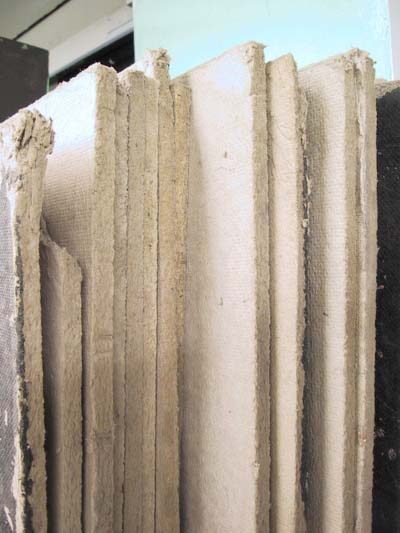
Recovered from web.archive.org — originally hosted at http://www.hstech.org/howto/material/homosote.jpg
Homosote is a gray board that is made out of paper. It comes in 4'x8' sheets and is 1/2" thick. You'll find it in almost any school being used as bulletin boards. you can push pins into it with ease.
very similar, in fact I think it's the same material just a different finish on one side.
Thanks John. The reason I asked is at one time I had made some clouds using those ceiling tiles, sandwiched between two tiles of of the yellow-insulation-backed variety. The resulting assembly was about 2 inches thick. I wrapped them in burlap and hung them from the ceiling. While I didn't perform any measurements, I can say they audibly helped the room I was using at the time to a worthwhile extent. I don't plan on reusing them, but I may do some measurements with and without them once I get into my new digs posted in the Design Forum. I will post the results of the tests, but it will obviously be a while.
Image not preserved: tile_clouds.jpg
one other option eric and john is diffraction
several factors contribute to absorption of sound by porous materials air motion induced by the sound wave occurs in the interstices between fibers or particles. the movement of air through narrow constrictions produces losses of momentum du to viscous drag (friction) as well changes in direction. this accounts for most of the high- frequency losses. at low frequencies absorption occurs because fibers are relatively efficient conductors of heat.fluctations in pressure and density are isothermal since thermal equilibrium is restored so rapidly. temperature increases in the gas cause heat to be transported away from the interaction site to dissipate. little attenuation seems to occur as a result of induced motion of fibers (mechel and Ver, 1992) A lower (isothermal)sound velocity with in porous material also contributes to absorption. Friction forces and the direction changes slow down the passage the wave and the isothermal nature of the process leads to different equation state. when sound waves travel parallel to the plane of the absorber some of the wave motion occurs within the absorber. waves near the surface are diffracted drawn into the material due to the lower sound velocity
there is so much area being touched by the panels that probably this one of the factors the core factor can be one more help of attenuation
If you moved one hanger they all moved in a ripple effect.
how is this reached are thy only hanging or is there some system in the bottom part of the trap tide together
Great quote about how sound absorption occurs! Thank you Valentin. Absorbingly: Andre
valentin wrote:
one other option eric and john is diffraction
several factors contribute to absorption of sound by porous materials air motion induced by the sound wave occurs in the interstices between fibers or particles. the movement of air through narrow constrictions produces losses of momentum du to viscous drag (friction) as well changes in direction. this accounts for most of the high- frequency losses. at low frequencies absorption occurs because fibers are relatively efficient conductors of heat.fluctations in pressure and density are isothermal since thermal equilibrium is restored so rapidly. temperature increases in the gas cause heat to be transported away from the interaction site to dissipate. little attenuation seems to occur as a result of induced motion of fibers (mechel and Ver, 1992) A lower (isothermal)sound velocity with in porous material also contributes to absorption. Friction forces and the direction changes slow down the passage the wave and the isothermal nature of the process leads to different equation state. when sound waves travel parallel to the plane of the absorber some of the wave motion occurs within the absorber. waves near the surface are diffracted drawn into the material due to the lower sound velocity
Valentine can you please STANDARD (means: always and everywhere) clearly refer and if possible link to a source when you quote someone or something. I know you mean well. This is related to Copyright and "Fair Use" (legal notion) and the fact that people can see these quotes in the context meant by the original Author. This is not even related with forum practices but with official legal acts (and respect for Author and readers) in the same manner that you can't illegally download and distribute music. It's not because you can find things on/in the net, a journal or book that they are in the "Public Domain". Mostly they aren't, even when you can't find any reference to that fact. I wrote some text about this in another forum: http://forum.studiotips.com/viewtopic.php?t=1159 Point 4 and further down. Please refer to this source. That lower bolt part is indeed partly the standard manner that splitter silencers work (where this situation standard occurs) but that does NOT explain why these low frequencies should be absorbed that much by relative thin hangers partly meant as bass traps. As long as these hangers are not studied thoroughly one can offer a lot of hypothesis, and as long one can't test this it remains guessing/assuming. And it remains miles away from quantifying things in function of design of the hangers and the mounting method. Hence we're stuck with general empirical experiences.
:oops: no harm intended and done to no one its from marshall long book http://www.amazon.com/Architectural-Aco ... 699&sr=1-2
I have a copy of Long's Architectural Acoustics and have read a number of sections. The book is remarkably complete and Long has correctly embodied current literature. I recommend it for professionals and architects who have some mathematics. Leo Beranek
i hope he sell a lot of books
Thank you. I have the book. It is fantastic. Andre
Dear Eric. If one were to test a certain "hanger" design, by what STANDARD would a Lab apply to the test. I ask sincerely. fitZ
Fitz, For the moment I don't have these standards available. So no nice numbers. The normal reverb room standards cover this. You normally just put these hangers or baffles on the ground in a matrix that you normally should mount them. They MUST be screened, hence that means a high stable frame around them. As such you can do different tests with different matrices en positioning versus one another. You can also alter density (number of elements per surface unit) You also can pot them on distant keepers to test the affect of hanging height versus ceiling (note that edge frame must be adjusted in height as well). You can measure them with and without core. Some labs have the possibility to hang them, but that's mostly provided for standard ceiling applications, meaning that edge framing is fixed for a standard height. For baffles without and very rarely with core such measurements exist a lot. I should have to check but I have a bunch of them (maybe >> 20 to 30). The strange thing is that when I put a core in baffles that they show a comparable result with baffles without (which does have an acoustic logic and is a known phenomenon). I think it's better to measure them as per ISO rather then ASTM, since the large height of the edge screening becomes a much more dominant factor in the ASTM approach. The smaller that factor the more one will approach reality. The absorption values are interpreted as discrete elements. One can present the absorption in 2 manners:
  1. Either in sabins per unit, but a clear description must be given of the exact setup and number of units per surface unit.
  2. But often they will be presented as absorption coefficient, where the calculation surface has nothing to do with the surface of the elements themselves, but with the covered floor area. Also here these numbers become only sensible with exact description of setup and number of units per covered surface area.
The reason for this is simple. The more elements you use (higher area coverage density) the higher the absorption coefficient per covered surface area becomes, but simultaneously the lower the absorption per unit. If you find numbers for baffles without exact setup description, these numbers are worth little, and possible presented that manner for commercial reasons. But here comes the clue. It's possible that a study of hangers needs another (to be investigated) approach, to quantify the effect in studios. Why? All measurements executed on baffles I know off agree on 1 thing: Baffles are a poor solution for low frequent absorption. And adding a core in them does not really change that. Hence no lab measurement I know off confirms the bass-trapping capabilities of hangers. I have a lot about baffles (including end-work from Univ here), nothing supports the low frequent qualities of hangers. Hence that text of Delta Acoustics referred here are more assumptions than knowing I have the feel. For me it feels I have more related background than what they show in that text. Hence there is something special going on, which must be investigated. By deduction I should assume it's related to that core somehow, while the by me previous referred study questions that, and my measurements with and without core also didn't show it. And it's possible that other measurement approaches than what is standard known/used are needed to understand and quantify these effects. But that's why I always said it should be investigated, and where that leads has to be decided based on in-between results, revealing whatever effects which can direct subsequent steps. Hence rather than a couple of measurements, the energy, background and resources involved justify a PhD study. If it was that easy, and could be quantified and physical/mathematical relationships defined (even empirically), that guy of the study I referred somewhere before shouldn't have gotten his masters degree based on an endwork with a conclusion that the effects of hangers noticed in studios are still a paradox.
Hello Eric. Thank you for your precise reply. Although, I'm a little confused about this statement
If it was that easy, and could be quantified and physical/mathematical relationships defined (even empirically), that guy of the study I referred somewhere before shouldn't have gotten his masters degree based on an endwork with a conclusion that the effects of hangers noticed in studios are still a paradox.
Please correct me or clarify if I am missing something. And please don't take me wrong. I am only trying to get a grip on the meaning of this.
Hence no lab measurement I know off confirms the bass-trapping capabilities of hangers.
IF, all the tests you are aware of, including your own investigations, agree that hangers are a poor choice for LF absorption, and IF the only thing that suggests there is something going on in studios that use them are PEOPLES OPINION, then WHERE IS THE PARADOX? :? It would seem to me that if its already been proved there is little value in using them for LF absorption, whats the problem? Either they do or they don't perform in that context, is that correct? Thank you again. fitZ
cadesignr wrote:
Hello Eric. Thank you for your precise reply. Although, I'm a little confused about this statement
If it was that easy, and could be quantified and physical/mathematical relationships defined (even empirically), that guy of the study I referred somewhere before shouldn't have gotten his masters degree based on an endwork with a conclusion that the effects of hangers noticed in studios are still a paradox.
Me too, and I do have this study, and this guy's reference list of the studied documents and literature is huge. He had contact with Hidley's company and the scale model he made was based on the original principles/design of a hanger application in a studio in design back then by Hidley's company. At least that's what I can gather from that study. Hence that guy didn't start from what he thought hangers should look like but what the inventer (direct or indirect) thought they should look like. Hence the main uncertainty in that study is in how far did the scaling something. I know the principles of scaling models where the study of preserving properties on scaled objects are a study in it's own. But they did this sub-study as well to simulate that core in a scaled model. The paradox seems that the reverb time in studios executed with them seems OK until the low frequencies (but without exactly knowing the individual contribution of the different parameters in the studio, but likely also the hangers, and the fact that we (at least with what is done for it already) can't seem to simulate that when having these things isolated from the rest. I have the feeling (but this doesn't mean a thing without further investigation) that such hangers more disrupt low frequent modes than really absorbing them. If this should be true (VERY conditional) such hangers should work as low frequent diffusers. This is NOTHING more than one of the many potential possible thoughts I had about them. And it's likely/surely a combination of phenomena (possible 1/4 and 1/2 wave effect depending on mounting?????).
cadesignr wrote:
Please correct me or clarify if I am missing something. And please don't take me wrong. I am only trying to get a grip on the meaning of this.
Hence no lab measurement I know off confirms the bass-trapping capabilities of hangers.
IF, all the tests you are aware of, including your own investigations, agree that hangers are a poor choice for LF absorption, and IF the only thing that suggests there is something going on in studios that use them are PEOPLES OPINION, then WHERE IS THE PARADOX? :? It would seem to me that if its already been proved there is little value in using them for LF absorption, whats the problem? Either they do or they don't perform in that context, is that correct?
There is some paradox, but I do believe that psychology plays a role as well. And there is more than opinions of course since overall measurements of studios/rooms also can point to certain hypothesis. Scientifically I don't find it responsible, and at least very strange that they are used that much but so poorly studied (but that's me). This goes to close for my taste to what's called pre-conceptual science. I'm still searching/hoping to find these publications proving me wrong. But what you also can see on the net that this use is emphasized in groups with closer relationship with Hidley's companies (direct and/or indirect) and SAE. Hence this group can statistically give a bit a false idea about the distribution of the principle.
Hence this group can statistically give a bit a false idea about the distribution of the principle.
:lol: From my perception as an acoustics "outsider", this ain't the ONLY one either. :P Eric, thanks for taking the time to apply your precise opinion to my questions. fitZ
In the early Hidley designs a reflecting canopy was introduced above the mixing console. The reason for this never became clear either, and the canopy was removed in his later designs.
It was called a "compression ceiling" and was supposed to increase bass response.
In order to obtain as much sound absorption in as broad a frequency range as possible, Hidley created his famous “bass traps” consisting of elements of mineral wool hanging vertically side by side at a height of maybe 2 or 3 metres.
He fails to mention the core. I've seen Hidely constructions in LA, Singapore, Sydney and in Melbourne. All had hanger traps and all were made from Homosote. If he could have used drywall or plywood or MDF he would have - but he didn't. Obviously the homosote was important.
The effect can be compared with the effect of the mineral wool wedges of an anechoic chamber. The wedges create an impedance matching between the air and the rigid boundaries of the room, so there will be no reflections from the boundaries back to the room. Because the length of the bass trap (or of the wedges) along the sound direction, the effect can be extended to rather low frequencies, e.g. 50 Hz. A peculiar detail is the name “bass trap”. The absorber is not especially effective at low frequencies; it is a broadband absorber, just like the wedge. The bass traps were never documented by laboratory measurements, maybe because of the difficulties of doing laboratory measurements at such low frequencies.
That's not the explanation I received when I asked back in 74. At the time I was staying with Dean Jensen who was the leading techo in LA at the time who did contract work for Westlake (Hidley's company) and who did all the installations for the major studios of the day - Record Plant, Paramount, Kendun, Motown, A&M etc. The explanation I was given for how they worked by Dean was that each sheet of Homosote had a resonant frequency and just like the opera singer shattering the wine glass each sheet resonated at it's frequency. The resonance was encouraged by hanging the sheet freely, the insulation wrapped around the homosote absorbed this resonance. The variance in hanger size accounted for the broadband effect of these traps. In his later studios Hidely used more and more of these traps and the size of the hangers got bigger and bigger as he claimed flatter response lower and lower. Another Hidely innovation was the quilted wall look - see the green wall finish under the left speaker and above the tape machine soffit.
External image, not preserved — original: http://johnlsayers.com/Pages/Images/music_farm_9.jpg
This is achieved by wrapping a sheet of homosote in insulation and cloth. This is pre 703 days and this treatment was supposed to lower the frequency of the wall absorption below 500hz. cheers john
John, Your question marks about the Delta paper quotes are certainly correct. I have the feeling they just entered assumptions to complete that page about so many years of studio history. I used, sold and measured anechoic room wedges, and this comparison feels very superficial. About the Homosote: This are rather damped boards and this type of board was extremely common in acoustics back then. Hence I wonder (not know) about the fact that it's so obvious that Homasote is THE board to use. Even when it has somewhat other properties, it should be hard to imagine that other cores should suddenly don't show comparable behavior. I noticed that Eastlake also loved (maybe still do) to integrate these same boards or comparable for sound isolation a bit based on the very old BBC approach (which BBC left for long already). I don't know Hidley, but what I once experienced was that they worked a lot on feel and past experiences. While this is a top world-wide known company, I did not feel physical acoustics to be their strongest side (and that's lovely expressed).
Well, I guess I should forget about using this design option for a rear wall "bass trap" in my control room :? Maybe if I eliminate one option at a time this way I can finally narrow it down to ONE that REALLY works. Lets see, which one is next...oh yea, option 5, the Space Coupler over superchunks :lol: fitZ
Image not preserved: OPTION 2 Fabric over Hanger Panels PLAN.gif
Image not preserved: OPTION 2 Fabric over Hanger Panels ELEV.gif