Can anyone point me in the direction of some cool looking absorbers and diffusors?
I don't want the typical 2x4 absorber look, or the typical diffusor look. I am looking for something kind of new age, artsy looking.
Thanks in advance
Make it yourself (-: You can do different fabric combinations, and also do different stuff that work as a whole design in your room- If you're into that, it's the best (-:
Heck, you can do other stuff then rectangular shapes!
got any links?
I'd definately like to build them myself. I've seen some great links and info here already. Mostly about bass traps though. I've got bass traps down...
I'm really interested in some plans to make cool difussors, wood diffusors, funky diffusors... And even though I've found good absorber designs, i'd like to see some funky absorbers.
I know, I am obsessed with funky, but I cant help it
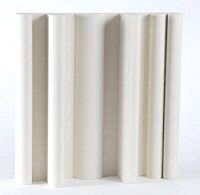
Funky? Well you could hang a bunch of ours on the wall and spray paint any funky color you would like. :lol::lol:Recovered from web.archive.org — originally hosted at http://www.gikacoustics.com/images/diffusor_1_sm.jpgGlenn
IMO, these guys take the cake on fuNky. Their, ahem, views on the science behind what they're building are, well, interesting I think is the right word.
Pseudoscience aside, I don't think there's any doubt these beasts will diffuse sound. And they look like something off the set of Alien!
Funky enough? I guess that's subjective. :)
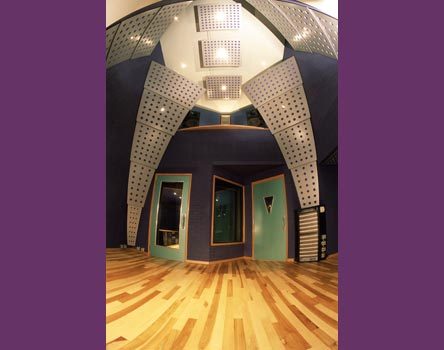
They are an English company but their products are used in America at least at Cristalphonic Recording Studio in Virginia :
Recovered from web.archive.org — originally hosted at http://www.crystalphonic.com/static/for_use/images/Tracking1big.jpg
IMO, these guys take the cake on fuNky. Their, ahem, views on the science behind what they're building are, well, interesting I think is the right word.
. :)
Interesting? Claim from website says 20 hz to 20 Khz effective. Interesting? I can think of a much better word, like misleading. :wink:
Glenn
Now now, Glenn. The full quote is, to their credit:
Golden Acoustics wrote:
Our broadband diffusers, depending on their method of installation can diffract <sic> the full audio spectrum, from 20 Hz to the upper limit of hearing, 20Khz <sic>.
(Emphasis mine; source.)
The largest panels they offer appear to be 18" deep, which is substantial for a diffuser. Factoring in the effects of certain mounting or installation methods could, in theory, give them diffusion down to 20 Hz. Good luck verifying it, though. :roll:
Now now, Glenn. The full quote is, to their credit:
Golden Acoustics wrote:
Our broadband diffusers, depending on their method of installation can diffract <sic> the full audio spectrum, from 20 Hz to the upper limit of hearing, 20Khz <sic>.
(Emphasis mine; source.)
The largest panels they offer appear to be 18" deep, which is substantial for a diffuser. Factoring in the effects of certain mounting or installation methods could, in theory, give them diffusion down to 20 Hz. Good luck verifying it, though. :roll:
well said and agree. But still find that statement a little misleading. And yes good luck on verifying it. :lol:
Glenn
Glenn
I don't think diffusing below a few hundred Hz is even useful. At least, not in the conventional sense of scattering sound to preserve liveness. I don't want live sounding bass! :shock:
--Ethan
Thanks, you reminded of an even greater oxymoron. How do you diffuse sound below the Schroeder or Davis frequency? They must have rented a roofed football stadium to confirm diffusion at 20 Hz.
Low down and touch down:
Andre
There have been a couple of AES papers on this. One I'm familiar with is (edited) "The Effect of Diffusers on Frequency Dependent Room Mode Decay" by Angus, et al (AES Preprint 5060). The merits of this paper were discussed in another thread somewhere (don't even ask me what forum - maybe here, maybe studiotips, maybe RO, maybe :?::?::?: ).
There are a couple of other papers I found, which - if I get a chance - I'll peruse this evening and comment.
In general, I think low frequency diffusion is not at all practical for small rooms (to say the least). The theory is solid, though. If a mode can be "diffused," then it would, in theory, more evenly distribute low frequency energy in the room. I don't ever see this catching on in studios, though. And, like y'all, I have trouble seeing where it would ever be truly practical, even for larger spaces.
{André: The authors used scaled electromagnetic simulation to confirm LF diffusion in the paper cited above. It can be done! :)}
i think Harris, Grant tends to use some very large diffrator walls in their designs. not sure how low they go but some of them are multiples of feet deep and 20 feet high...
here's one example:
http://www.harrisgrant.com/projects/rhi ... hino1.html
Note: I changed the AES citation above. The paper I had specifically in mind was #5060, not #3851, though both are good papers on this subject by Angus.
I also found another that might be of interest:
"Low Frequency Control end Acoustical Optomlsing of Small Rooms Using the Schroeder Diffuser" by Morton, AES Preprint No. 4034.
Morton's main point is that room design can be used to "build in" LF diffusion. I often have to disagree with this approach, however, for the same reason built-in "bass traps" are often a flawed notion. As Doug Jones (and I) pointed out in Chapter 4 of the Handbook for Sound Engineers (pp. 81, 3rd ed.):
"If there is enough space to build a 'bass trap' that is large enough to have an impact on wavelengths that large (lovecow note: authors are referring to 20 Hz "traps"), most likely one could move a wall, improving if not optimizing the modal distribution, obviating the need for 'trapping.'"
IMO, one could easily replace "bass trap" with "LF diffuser" and "trapping" with "diffusing LF" in the above statement.
Does that make sense?
i agree - if you could move/add a wall to change the room and achieve the same result as low end bass trapping, then it makes sense. however, a huge diffractal wall is pretty f*ing cool 8)
I don't want the typical 2x4 absorber look, or the typical diffusor look. I am looking for something kind of new age, artsy looking.
Well, here is a model of my studio which I am currently building. Note the use of linear 4" thick(scaled) Knauf rigid fiberglass to build ceiling/wall superchunk absorbers. The traps between the soffets and ceiling cloud, and side wall early reflection panels are 3". I used 1/2" thick 703 "tiles" to scale the model to. This model is only used to illustrate the idea. The real deal is actually "fixtures", which are frames covered with fabric, with the rigid fiberglass inserted, and then fastened to the walls/cieling..I am currently building these "fixtures". BTW, the color is only to contrast the fiberglass for pictures. You won't believe the REAL finishes. Pics to follow when finished.
Anyway, maybe this will give you some ideas.
fitZ
Oh, I forgot diffusers :D Here is my plan for a skyline type at the rear wall. Not ALL is shown, as there will be superchunk absorbers around the diffuser. Converting these files leaves a lot to be desired for posting on the net. Anyway, did someone say "artsy"? :?
fitZ
Image not preserved: Stingray floor plan option 1.jpg
just curious about the skyline in the closet design... you might be better served by building a substantial bass trap in the that space and then putting a layer of slats and diffusors over the front of it to work on the mid and high frequencies...
Image not preserved: example back wall treatments.jpg
Hello Glenn. Man, I've worked on that backwall till I'm blue in the face.
I've already covered your suggestions here"
http://onlineacoustics.com/onlineacoust ... ?topic=7.0
But NOBODY except andredebrito suggested anything. He is the one that suggested a diffuser at 50% and absorption at 50%. Take a look at that thread and tell me I haven't covered every concievable solution that has ever been discussed in these forums. Maybe I should post my "Rear Wall Options" here. Anyway, take a look and maybe you'll discover why I NOW don't give a damn what I put in. It seems like for every solution, there are nays and....well, you know. BTW, that diffuser is designed using an Excell spreadsheat for Skylines. I believe the thread has the frequency spread. Not bad either. Anyway, thanks again for your suggestion and time to draw, although the left door leads to a hallway staircase, so I can't put anything behind that door.
fitZ
based on what i've seen on the acoustics forum, your room depth is just on the edge of where diffusion works/helps. in my opinion, building that large skyline in the closet isn't going to be useful.
its ok if both or one side of the back is an entry, the center closet should still be a bass trap and i'd use 4 2'x2' (or equiv) skyline diffusers spaced about 8-12" apart (as shown) to add some high frequency diffusion (say 3.5K and up) and the rest of the trap face is absorbing. that's probably about 50-50. if you put a small couch in front of it it'll be slightly more than that in term of absorption with is probably ok.
if you wanted to hide the entry, you could slide the absorbing panel on the side with the door up a few feet and have the couch etc moved forward. then you have a path around and behind the couch...
Image not preserved: example back wall treatments 2.jpg
Hello again Glen. Wow, I didn't ex'pect anyone to spend that much time on drawing for me. But, apparently you didn't look at that thread. My drawing shows exactly how the room exists. Frankly, the entry door USED to be like you drew it. It completely screwed up the geometry of the rear wall . Thats why I moved it to a 45 degree and built a small closet to match on the other side to make it symetric. And seeing how I have hijacked this thread enough :oops: I won't carry this on here any longer. I guess I'll have to post my own thread. I'm curious though, why you think I should use a shallower Skyline. The frequency spread seems to be good to me, although I sure ain't no expert. But whats wrong with it? In the interest of clearing up the geometry question, I'll go ahead and post one final drawing of the floor plan as exists. The soffets are in place but the rear wall hasn't been configured, so take the diffuser with a grain of salt. :D I hope the author of this thread will forgive my manners here. Anyway, I'll start my own thread and we can hash this thing out, ok? Thanks Gllen. BTW, I planned on using broadband absorption panels on the doors. fitZ
a large QRD in the right-hand room should work because its a series of wells anyways (stacking several sizes together - nesting them - is called a "diffractal" and can increase the bandwidth of the diffuser). a skyline in the left-hand mix room closet would not be good since the shorter pieces will have virtually no effect as it would be constrained by the side walls and any absorption in there. the shallower diffuser in front of the bass trap will give you the bass trapping and most of diffusion you're looking for. or consider the use of a poly diffuser as both diffusion and bass trapping (which it look sort of like your drawing).
i did read a some of the thread but there's a lot going on there... while no doubt the history of how you got to this design decision is interesting, its not entirely relevant to correctly setting up your space... :wink: