Hi,
I wish to try panel absorbers to see how it works. I assume that if placed in a corner, I should calculate average depth from wall, is this precise?
How about the size factor?
Thanks
Adam
I wish to try panel absorbers to see how it works. I assume that if placed in a corner, I should calculate average depth from wall, is this precise? How about the size factor?
Just to clarify, wood panel traps are pressure absorbers. So the type describe in THIS article on my site is meant to go flat on the walls, not straddling corners. I've heard of panel traps mounted straddling corners, but I've never tried that so I can't comment knowledgeably.
Also, one panel trap straddling a corner has a front surface only two feet wide, versus two panels traps adjacent on both walls which is four feet wide.
--Ethan
You got a point Ethan, However, suppose I can put as much traps as I want in order to spread on different location in the studio, yet limited in amount of wood I can buy- if the depth of cavity increases, the panel can be thinner - less expensive.
Anyway, How do you calculate the size of the panel? Obviously if you brace a given panel you change the resonant frequency...
Yes, too much bracing can shift the frequency, so the obvious answer is don't do that. :)
The frequency of a wood panel bass trap depends on the mass of the front panel and the depth of the air gap (springiness). Not so much the panel's surface area. Yes, if the panel is small the edge bracing can dominate, and if it's too large it will flop around and flex in modes other than the main one you want. Others here can better explain the theory's fine points, but I'm certain it will work well if you simply build them as shown in my plans.
--Ethan
I don't understand the difference, besides what I said implies starting the calculation from a given depth and what you said implies starting it from the frequency, which is obviously what I'm going to do - did I miss anything?
I don't understand the difference, besides what I said implies starting the calculation from a given depth and what you said implies starting it from the frequency, which is obviously what I'm going to do - did I miss anything?
I messed up completely. One half depth. As in area of a triangle.
Andre
I don't understand the difference, besides what I said implies starting the calculation from a given depth and what you said implies starting it from the frequency, which is obviously what I'm going to do - did I miss anything?
I messed up completely. One half depth. As in area of a triangle.
Andre
Hmmm, I wonder what 2 panel absorbers in the corner mounted flush to the wall, as ethan describes, and then with a standard broadband absorber straddling the corner in front of those would work?
Perhaps the best of both worlds (pressure and velocity absorber) there....
Hmmm, I wonder what 2 panel absorbers in the corner mounted flush to the wall, as ethan describes, and then with a standard broadband absorber straddling the corner in front of those would work? Perhaps the best of both worlds (pressure and velocity absorber) there....
Yes, but if I were going to do that I'd tune the panel absorbers to a center frequency around 50 or 60 Hz. The "low bass" trap in my plans is centered around 90 or 100 Hz, which is where porous traps straddling corners also peak. So it makes more sense to use the panel traps to target the really low stuff where porous absorbers are less effective.
This is the big feature of wood panel traps - they absorb low frequencies with a relatively thin profile. A 4-inch deep panel trap hits 100 percent absorption around 100 Hz. Even if you aim for 50 Hz you'll get 100 percent absorption with a much thinner profile than any type of fiberglass.
--Ethan
I assume that calculator will give a good answer, but I never actually tried it. Tell you what - enter the specs for my high-bass and low-bass panel traps and see if you get 100 Hz and 180 Hz. If you get those frequencies, or something close, then the calculator is correct.
--Ethan
Yes, if you mean the one for calculating the center frequency for panel absorbers. It is for empty absorbers. If you putting absorbent material in the panel absorber, then multiply the result by 0.833.
I'm not Shirley;
Andre
Yes, if you mean the one for calculating the center frequency for panel absorbers. It is for empty absorbers. If you putting absorbent material in the panel absorber, then multiply the result by 0.833.
I'm not Shirley;
Andre
Yes, but if I were going to do that I'd tune the panel absorbers to a center frequency around 50 or 60 Hz. The "low bass" trap in my plans is centered around 90 or 100 Hz, which is where porous traps straddling corners also peak. So it makes more sense to use the panel traps to target the really low stuff where porous absorbers are less effective.
--Ethan
Hi, are you sure porous corner traps peak at about 90 or 100Hz ?
I don't see such improvement in my home measurements...and also I don't ear it...
Probaly I'm not good interpreting the graphics jet , but I do know that adding porous absorbers change everything except the sound of my Gretsch 22x22 cannon bass drum with Evans emad drum head!
page 2 and 3 in my post ...
http://www.johnlsayers.com/phpBB2/viewt ... 3&start=30
are you sure porous corner traps peak at about 90 or 100Hz ?
Yes, I am.
:)
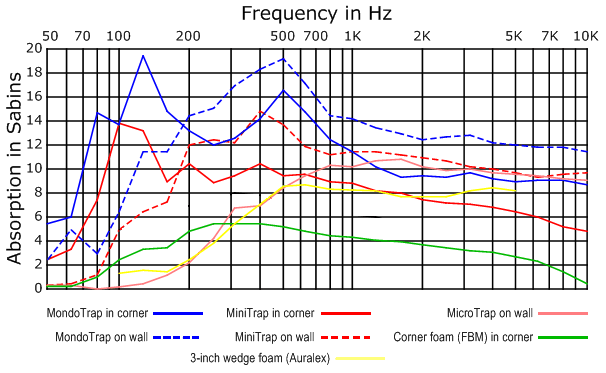
Seriously, the data below is from my company's web site, and you can see the absorption of our bass traps mounted flat on a wall with a modest air space, and also the same bass traps when mounted straddling a corner. In particular, look at the solid and dashed red and blue lines.
--Ethan
Recovered from web.archive.org — originally hosted at http://www.realtraps.com/abs-comp.gif
are you sure porous corner traps peak at about 90 or 100Hz ?
Yes, I am.
:)
Seriously, the data below is from my company's web site, and you can see the absorption of our bass traps mounted flat on a wall with a modest air space, and also the same bass traps when mounted straddling a corner. In particular, look at the solid and dashed red and blue lines.
--Ethan
Recovered from web.archive.org — originally hosted at http://www.realtraps.com/abs-comp.gif
Well I'm not familiar with that Sabin things... but where is the graphic of the untreated room ? With my measurements I guess you can compare the untreated room with the treated room.. I'm missing something?
You may be missing that absorption data versus frequency is not a graph of the frequency response you'll get.
Also, Sabins are the raw unit of absorption. A lot of treatment product vendors use absorption coefficients, but that is not an inappropriate way to assess bass traps meant for corner mounting. Especially if the bass traps are not flat panels.
--Ethan