Hello there!
Just found these forums, and I've only had about a day to do research around here, so excuse me for posting this prematurely but I'm quite frustrated and anxious.. A huge wealth of knowledge here, very overwhelming :)
Now, I'm not professional musician nor do I have any aspiration to be but I do have me a simple 'studio' I just assembled in an extra bedroom in a new house. Before I was in a huge industrial loft, and sound wasn't an issue there as my setup was exactly in the middle of an open 1,100 sq foot space. When it was filled with furniture, rugs, etc. it was quite an acoustic treat - so I was never fourced to learn about the topic.
NOW that I'm in this room is a different matter. And it's not exactly a normal shaped room so I'm a bit put off on what exact sizes to give to help come to a solution to my problem.
My #1 problem is bass. It's completely incosistant throughout the room (and outside the room even). I have KRK 8's, and a KRK 10" sub. The sub is my problem. When playing songs I've previously made, the bass in the room is loud in some areas and extremely quiet in others. Even in the listening position which is somewhat centered in the room is quite, compared to like the corner where the door to the hall is.. Hell, the hallway outside the door is LOUD.
My ideal place is the subwoofer to be centered between the monitors as I can very much tell WHERE the bass is coming from, obviously this didn't work out very well as the bass was quiet in that spot but damn loud in the corners, especially along the wall behind the listening position (where the monitors face).
I moved the sub to a corner, and parts of the room are still louder than others. The listening position volume did increase some. But the thing is, even the loud areas of the room, the bass seems muddy and undetailed.
I'm posting some sketchup images I did of the room. I'm assuming from my brief reading here is I'm dealing with standing waves? And that with multiple bass traps at the vertical corners and horizontal corners of the room would suffice for the solution to this problem? And at it this point it would just be a matter of choosing my flavor of basstrap/insulation?
Is there a particular brand/type of fiberglass/wool/whatever that is most ideal for very low frequencies? as it seems like the 40-80 Hz range is where this effect is most pronounced. I've read over numbers but it seems like anything under 110 Hz suddenly doesn't become a priority - or perhaps a limitation.
I will note radical modifications to the room isn't ideal because I'll only be keeping the house for about a year.
Now forgive me, I haven't bought a SPL meter yet. Nor sat thru and marked various freq. ranges/response, etc. This has been with a just a basic ears test. The bass problem is just so extremely pronounced and obvious I figured the more intricate tweaking can come after the fact.
Thank you for any help, even briefly, anyone can provide.
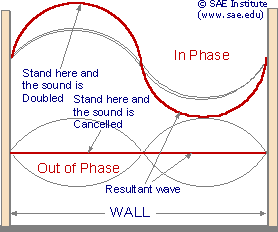
What you are experiencing is standing waves.
Recovered from web.archive.org — originally hosted at http://www.saecollege.de/reference_material/images/Standing%20Wave.gifwhat you need to do is break these parallel walls up by adding angled walls, preferably around 12 degrees or greater.
A simple method is to build angled slot resonators
http://www.saecollege.de/reference_mate ... encies.htm
the advantage of using these is that they also absorb the low-mid frequencies that are typically a problem in small rooms.
I hope this helps.
cheers
john
John - maybe you can get someone to edit the SAE site and correct the Helmholtz formula on it (and related Excel worksheet)? :shock:
its still the wrong one: f = 2160 x sqrt ( r / (( d x D ) + ( r + w ))) instead of f = 2160 x sqrt ( r / (( d x D ) * ( r + w )))
the correct calculation can be found here:
http://www.johnlsayers.com/phpBB2/viewtopic.php?t=1363
John,
Either I misinterpret this stuff, but I find that picture about standing waves very confusing.
I checked the site to get more info, and it's still confusing.
http://www.saecollege.de/reference_mate ... omodes.htm
In fact, I almost should feel it being wrong. I find the text on that page not OK either.
I also have the impression that you use standing waves and geometric acoustics through one another.
No matter how angled your walls are and how asymmetric your room, you still will have standing waves.
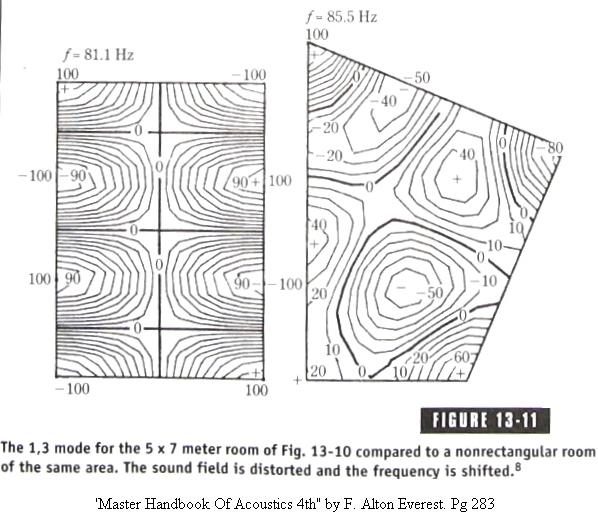
This is a picture made by Bob Golds from the Master Handbook (Everest).
Recovered from web.archive.org — originally hosted at http://www.bobgolds.com/MasterHandbookOfAcoustics_Modes_pg283.jpgYou just get very difficult to predict standing waves.
Coincidentally we just had a small discussion about this:
http://forum.studiotips.com/viewtopic.p ... ght=#41173
Here's another pictures of an open plan house for a 44.36 Hz mode.
This single standing wave even stretches over different rooms.
And of course they all do since these interconnected rooms influence the modal pattern of all of them.
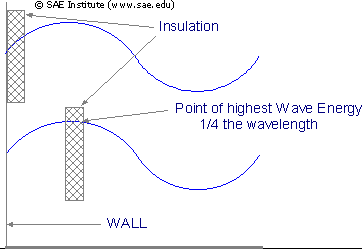
... if you actually lift the insulation off the wall because the point of maximum energy in a wave is at the highest point in the wave which is at the 1/4 wavelength point.
This point of highest Wave Energy is physically wrong. (where should that energy come from if surrounded by 2 low energy points?). Simplifying things, shouldn't make them wrong.
The Wave Energy over the whole wave as drafted there is equal. The referred point is the point of highest VELOCITY or point of highest KINETIC energy.
Energy is the sum of both POTENTIAL (pressure part) + KINETIC (velocity part) energy. A wave is a gradual oscillation/transformation between both, without altering the total energy (stylized as the picture is).
I'm assuming from my brief reading here is I'm dealing with standing waves?
Yes. That, and resonances.
I DO NOT want to start the same discussion again, but standing waves ARE resonances.
Ethan confuses static interference patterns (resulting from boundary interference based on geometric acoustics) with standing waves.
This will likely be disputed, hence Whaleboy up to you choose.
I'm not going further into this.
I'm assuming from my brief reading here is I'm dealing with standing waves?
Yes. That, and resonances.
I DO NOT want to start the same discussion again, but standing waves ARE resonances.
Ethan confuses static interference patterns (resulting from boundary interference based on geometric acoustics) with standing waves.
This will likely be disputed, and links and 1 quote selected which should prove otherwise, hence Whaleboy up to you to choose.
I'm not going further into this (again).
But from a practical point of view in function of treatment you're on the right track.
Eric - I'm sure you are correct - but for the purposes of explaining it to the non technical punter I think what I drew and wrote is close enough in explaining the problem.
cheers
john
Wow, didn't mean to kick up any intense debates there! :)
Thanks for help guys, this will point me in the right direction.
I'll try the corner bass trap approach first as it would be good to have them one way or the other, and it requires much less hassle in implementation all around.
Wow, didn't mean to kick up any intense debates there! :)
Not to worry, this is just a matter of semantics that has been going on for years between us geeky nerds.
I'll try the corner bass trap approach first
Exactly, and having bass traps is what really matters. If I go to a doctor and ask him to treat a boil on my butt, and he says it's really a pimple, either way the treatment will be the same. So think of this mainly treating a boil on someone's butt. :o
--Ethan
:mrgreen:
Jeff,
A bit off topic.
Do you (or others) know the origin of the word eigentones? (must be strange sounding for an English guy, .... no?)
I often had the feeling this is of Dutch origin:
The word eigen means own, and in Dutch we combine words belonging together, presenting a specific meaning/concept (much more than the English language).
Hence in Dutch: eigentonen
Literally translated this should be: own tones (tones belonging to oneselves)
Eric,
The origin you gave is the correct one. A "room's eigentones" would be translated as a "room's own tones."
To be fair, there is some ambiguity when it comes to the term standing wave. So, I've blogged about it in the hopes that we can avoid any serious thread destruction. :twisted:
Feel free to suggest changes. (You too, Ethan. Et al.) Not that I promise I will make any, but I will seriously consider any equally serious suggestions. I hope it helps clear things up!
Jeff,
That's the author I referred to when referring to the quote I expected.
I give up discussing this. When you link to this I will disagree.
Find me any other author from whatever educational institute (physical acoustics) distinguishing between resonant and non-resonant standing waves.
A static pattern based on traveling waves (which they all are) where also the resulting superposed waves travels, means the wave is NOT standing, notwithstanding the pattern is static is NO standing wave since it still transports energy.
Your example with with the speaker in front of a wall can only be true if the speaker is capable of creating a plane wave at straight incidence, since the condition for a standing wave is equal frequency AND amplitude of the reflected wave.
And a speaker in front of a wall is not capable of creating these conditions, since the reflected superposed wave will always have lower amplitude versus the incident wave, resulting from the geometric expansion/propagation from a point source, which by definition means that there is traveling energy with the direction of the strongest wave towards the weaker wave, no matter how limp this wave will move.
That superposed resulting wave is NOT standing, but moving. You never, not even theoretically can have a real 0.
Hence you can show a standing wave in front of a single wall, assuming the theoretical condition is fulfilled of a PLANE wave and the resulting equal amplitude. And that's the ONLY possibility a real standing wave and real 0 could occur.
I've written the word PLANE a thousand times on the net. It feels as this word and its meaning in context with waves is invisible somehow.
And what happens with an e.g. simple axial standing wave where one applies absorption is that that wave also starts traveling in the direction with the strongest wave, but oscillates around a nodal point since fraction in time later this direction is reversed. hence the area of that 0 increases in surface, which is why that pressure level measured at one static spot becomes higher (averaged with the surrounding non-0 areas), and that 0 less deep.
A static interference pattern is NOT synonym with standing wave.
Whenever finding the time and energy, I will make simulations showing and proving my point.
For me this is enough here. Studiotips is maybe better to continue this.
Eric,
First, I don't think the loudspeaker/wall example is restrictred to a plane wave. A standing wave pattern will also result from a spherical wave.
Second, I think it's important to remember context. Since the definition of a standing wave* does not presuppose resonance, I believe some qualification is merited when talking about standing waves in the context of small room acoustics. Otherwise, the confusion (and irritation) will continue.
Finally, it's important not to bog down the semantic debate with the relevance debate. Just because (non-resonant) standing waves can (and do) occur in a small room does not change their relevance. I was very careful not to touch on this in my blog. Statements to the effect of, "All low frequencies cause standing wave problems in small rooms," are still, IMO, ridiculous. The LF room response is governed by modes. SBIR (which I have not touched on) and other standing wave effects are relatively minor. Typically, there are only one or two "nulls" resulting from, say, the rear wall reflection - if there are any at all. And any treatment installed to control the modal problems will almost always, by default, take care of these non-modal nulls.
IMHO, the relative importance of the different LF phenomena is unchanged. And the focus on addressing the problems is also unchanged.
If you think it might be helpful, I can remove (or augment) the surfaces (walls) from the examples and instead consider two equal sound sources spaced some distance apart. Standing waves will result. These are not resonances. Would that be a better example than the loudspeaker/wall example?
I only wish to clarify this semantic silliness for the sake of these small room discussions. If we want to debate the relative importance of the different phenomena, we should all be speaking the same language, regardless of past conventions.
*From the American National Standard for Acoustical Terminology, ANSI S1.1-1994 (reaffirmed in 2004):
6.20 standing wave. Periodic wave having a fixed distribution in space which is the result of interference of progressive waves of the same frequency and kind. Such waves are characterized by the existence of nodes or partial nodes and antinodes that are fixed in space.
(Emphasis by me.)
Eric,
First, I don't think the loudspeaker/wall example is restrictred to a plane wave. A standing wave pattern will also result from a spherical wave.
No it can't, you get a static interference pattern, NO standing wave. That superposed wave moves towards the wall (not that pattern), and spread further spherically out when reflected from that wall.
A standing wave does not move energy.
The further the speaker from the wall, with constant mic position, the more you will approximate plane wave behavior, but that's not the point.
Eric,
First, I don't think the loudspeaker/wall example is restrictred to a plane wave. A standing wave pattern will also result from a spherical wave.
No it can't, you get a static interference pattern, NO standing wave.
The standing wave pattern is the static interference pattern, by definition. (See above.)
And this is the reason we're having the discussion (again). The ANSI definition of a standing wave is not consistent with what you're saying - or vice versa, if you prefer :). And the ANSI definition is inadequate when discussions of standing waves in the context of small room acoustics ensue.
What we need to work together on is resolving this so that it doesn't come up again. Now is as good a time as any. :):):)
OK. Perhaps we should slow down a pace. I see that your edits and my responses are overlapping somewhat... :?
Eric_Desart wrote:
That superposed wave moves towards the wall (not that pattern), and spread further spherically out when reflected from that wall.
And the spread out wave will interfere with the direct wave. I think what you're getting at has to do with energy losses due to spherical spreading, which I acknowledge. But spherical energy losses do not eliminate the standing wave patterns; they only make them weaker. And at the distances under consideration here (radial distance is not large compared to wavelength in a small room), there is an argument for near field effects dominating. This is a good point and I will change the example in my blog to account for this. :)
Eric,
First, I don't think the loudspeaker/wall example is restrictred to a plane wave. A standing wave pattern will also result from a spherical wave.
No it can't, you get a static interference pattern, NO standing wave.
The standing wave pattern is the static interference pattern, by definition. (See above.)
No it is not(but we speak about a standing wave, which is a live thing, if you want to call the interference pattern of a standing wave a "standing wave pattern" rather than "interference pattern" it's OK for me, that linguistics and just a matter of knowing. But the discussion is about: "what are standing waves?"), but yes/no brings little solution. Hence this doesn't solve anything.
I lost my simulations (CPU issues). I once sent some Flash simulations to Rod. I can't remember if they made this point clear, but if so, Rod you can enter the most clear one if you still have them.
These simulations showed the static interference pattern in a room next to the animated wave behavior, corresponding to this static pattern.
I made more and better ones later on, but have to restart this whole terrible time consuming business.
This includes the exact physical definition of standing waves.
http://mort.isvr.soton.ac.uk/SPCG/Tutor ... nature.htm
Note that they DO mention plane waves underneath these pictures (which is related to fulfilling the higher on that page described conditions).
And also note that they clearly state "NO net transport of energy".
Standing waves in room acoustics are a concept of physics. That page is a physics page from a serious educational institute.
http://mort.isvr.soton.ac.uk/
It's one of the biggest causes of confusion on the net related to standing waves: Style: I measure a static dip or peak, I know somehow the concept standing waves, this is seemingly standing as well, hence one should cover the other, as such they're equal.
We at least should agree that your speaker in front of a wall (spherical propagation) does not comply with the physical conditions described on this page I linked here, .... no? (even when you forget the word plane, because that's nothing else than a description to fulfill these conditions).
You of course can question that page and the institute.
For me what I see there is plain physics, no other reference needed.
Unless you want to see some more complicated ones, which are to be found on the same site (but the base principles remain: No net energy transport):
http://mort.isvr.soton.ac.uk/SPCG/Tutor ... -rooms.htm
Jeff if you simulate a spherical source radiating towards a wall, you will see that this superposed wave moves towards that wall, it looks almost as some cripple guy limping towards that wall (depends on difference in amplitude, the smaller the difference the slower, until there is no hypothetical reflection anymore, hence amplitude infinite low, causing the wave to travel at the normal speed of sound).
But noting is standing, neither the base opposed waves, nor the resulting superposed wave. And that's what the concept "standing waves" refer to.
And as such there is net energy transport.
Warm regards
Eric
Eric,
Check out Figure 1.11 on page 20 of Olson's book (just happens to be in the Google Books review :) ). This is what I'm talking about. Spherical waves interfere, too. :)
I do not (and would not) dispute the link you provided. Indeed, it is tantamount to the semantic debate.
******
But we're getting sidetracked. I think I'm right in saying that, whatever you want to call it, standing-waves-in-small-rooms-not-caused-by-modes(or, if you prefer, -resonance) need a name.
I hope you would agree at this point on the following two statements:
1. Excitation of room modes results in standing waves.
2. Existence of standing wave patterns in a room does not imply resonance.
I think we're OK on 1.
I think we're not, completely, on 2, but the argument is drowning in semantics—the physical phenomenon is solid.
What I think might be good at this point is for you to offer up your ideas on an appropriate moniker or descriptor for standing-waves-not-caused-by-modes. Would it be better to simply call this "wave interference" and restrict "standing waves" to resonances? (Note that I am not fond of "boundary interference" because of SBIR, which is not the same thing as what we're debating. But I'm not close-minded about it, either.)
Something else?
Remember, we are not debating whether standing-waves-not-caused-by-modes are a huge (or even relevant) problem. But the confusion will continue unless we can easily distinguish between standing waves and standing waves. :?:shock::)
Eric,
Check out Figure 1.11 on page 20 of Olson's book (just happens to be in the Google Books review :) ). This is what I'm talking about. Spherical waves interfere, too. :)
I do not (and would not) dispute the link you provided. Indeed, it is tantamount to the semantic debate.
******
OK I stop this here. I NEVER in my live disputed that spherical waves can interfere, all waves can, I NEVER in my live disputed static interference patterns, I referred to them countless times.
But that's not the discussion at all. And also no semantics.
Standing waves are a physical concept.
That the Audio/studio world uses notions as comb filtering which I wasn't familiar with years back, was just a matter of knowing. We still discussed exactly the same physical concepts.
But if the Audio/Studio world tries to change the physical concept then there's something wrong. That's not linguistics or semantics.
:) But I stop this here AND
As good friends
Shake hands
:twisted: But if you link to your Blog (if not altered) I still will disagree.