Intro
Hello, I'm an electronic music artist from Israel, currently doing everything in my (ex)bedroom converted into a studio. Horrible.
In a few months the entire family will be moving to a new house and I will have a dedicated studio room.
The room will be a control room - I'll be doing my mixes and entire composition in that room. Insulation from outside is not important. Fortunately there are no neighbors close enough to hear the thing and the family doesn't care (mostly).
Basically I need your advice on just about everything - location of the monitors, how big should the desk be, what acoustic treatment should be and where should I place it.
Size and materials
The room is 308cmx299cm, about 270cm high (give or take a few cm). The walls and ceiling are thick concrete walls. Floor is tiling upon sand.
What needs to go in
For the production part:
A pc and a screen, currently a 19" lcd, but I plan to get a dual 22" widescreen in the future - so I need a lot of space. Keyboard and mouse obviously.
A control keyboard, the size of a 5 octave one and a small mixer (8 channels max).
2 nearfields (Adam A7 in case it matters). They are active - so no need for an amp.
DJ part (doesn't have to be on the same wall as the monitors):
2 cd decks and a mixer in between, maybe a place for an extra mixer or a laptop in the future.
Others:
A sofa 190cm long and about 70cm wide, preferably in the opposite side of the pc screen and nearfields.
Acoustics
I plan on using rockwool.
What about a carpet?
The door is made of metal - does it matter?
Budget
Not much - but should be enough for the furniture+acoustic treatment, if I go for a DIY solution which is what I plan to do.
The first 4 pics were taken at different dates, so this is why it looks different.
sketchup file:
http://www.felis.co.il/ROOM.skp
Just one more thing about the furniture - I need a place to rest my entire hand when using the mouse, because I have some shoulder problems.
That's it.
Thanks for any help and suggestions :)
Here's a furniture idea:
http://www.argosyconsole.com/aura260.htm
Something in this style, maybe a bit smaller though. And something that I can build myself, 2000$ seems too much for a desk. Also nice position for the arm and lots of space available.
Hi mike,
If you doesn't have to deal with insulation take a look at this wonderfull Ethan Winer articule on room acoustics: http://www.ethanwiner.com/acoustics.html
Then, don't worry too much about furniture, it's not that important. The most important things are bass traps and the reflection free zone. The metal door doesn't matter, just don't put a mirror in front of it :P
There is another important point, the room dimensions. If you can move take a look at the ratios of the other rooms in your house (there is a list of recommended ratios in the link, in the ModeCalc). If you can't, don't worry and fill all the corners with bass traps. You can even build helmholtz resonators but that's more difficult.
Try to find rigid fiberglass in Israel and get a good DIY tutorial. There are some in the studiotips.com forum, maybe here too, I've not searched.
Don't worry about the ventilation, just turn off the A/C when mixing or recording something acoustic. And if you are handy enough build the desk!! do not pay $2000 for one :?
Anyway I would advise you to book an studio for 1 hour when you mix is ready to take a look at your low end. There is imposible for a bedroom to reproduce the low frequencies like a club will do.
Almost all you should know is in the link but feel free to ask.
Cheers!
Wow thanks for the link!
I'm sure it'll help me a lot.
A few things which I didn't see covered there though - the placement of the speakers (height, distance from wall, angle), and a carpet. It says there that a carpet is a good idea for a small room (like mine), but how thick should it be? Should it cover the entire floor or just a part of it?
do a search here. you'll find a lot of info on speaker placement. as far as carpet, depends on how much absorption you still need after treating the corners, walls, and ceiling. i wouldn't go with big carpeting but something small for aesthetics and minimal absorption.
gullfo, thanks for your answer.
I added the planned furniture in SketchUp.
http://www.felis.co.il/ROOM-furn.skp
a few questions:
1. Is the speaker placement ok? i left about 30cm between the back of the speakers and the wall. i'll also be putting them at an angle (ok?).
2. Is the sweet spot going to be limited only to the chair area, or will people sitting at the back sofa hear it properly?
3. Is there enough space left for all the bass traps, diffusers and absorbers? what should I do? I've read all those links and guides but it left me in even greater confusion.
4. I calculated the room modes - they seem really tight. does it mean i'll need frequency-specific absorbers? are those the helmholtz resonators?
thanks again :)
Well, it's a difficult room for its dimensions. The only thing you can do is filling it with bass traps.
If you build a bass traps with fiberglass covered by fabric they are going to be broadband absorbers too. If you put a lot of them you can suck off the live of the room and make it too much dead, so as gullfo said a carpet would be even worse. But it depends on how much absorbers you build.
Mike A wrote:
a few questions:
1. Is the speaker placement ok? i left about 30cm between the back of the speakers and the wall. i'll also be putting them at an angle (ok?).
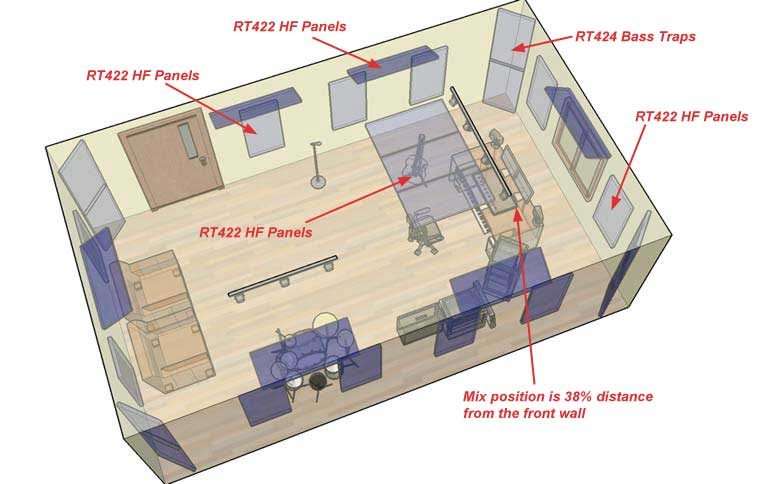
There is no simple solution. When a speaker is a node it excites that mode and when is in an antinode it doesn't, but the room is full of superimposed nodes and antinodes. There is a rule for speaker placement which says that you have to put the speakers at 38% of the largest dimension which is maybe a place with a good relation between nodes and antinodes.
Mike A wrote:
2. Is the sweet spot going to be limited only to the chair area, or will people sitting at the back sofa hear it properly?
If you don't treat your room it will sound very differently from one place to another. As you treat it it will sound more similar everywhere.
Mike A wrote:
3. Is there enough space left for all the bass traps, diffusers and absorbers? what should I do? I've read all those links and guides but it left me in even greater confusion.
this is a good image of bass traping placement:
Recovered from web.archive.org — originally hosted at http://www.readyacoustics.com/images/studio/full-view.jpg
4. I calculated the room modes - they seem really tight. does it mean i'll need frequency-specific absorbers? are those the helmholtz resonators?
If you are going to build a helmholtz resonator better take someone to measure your room first. Maybe you could build a resonator of 57Hz based on the modes calculation but the real problem is 43 Hz, the sound is a caotic thing difficult to predict.
If you can afford a software like ETF, and good flat onmidirectional mic (behringer does one very cheap) you can measure your room and be sure of a lot of things: speaker placement, speaker equalization for the mixer position, bass trap placement and quantity, carpet or no carpet, building resonators... etc.
Or.. you can just fill it with bass traps and go for the 38% placement. Nothing bad either :)
There is a rule for speaker placement which says that you have to put the speakers at 38% of the largest dimension
Unfortunately, this is not going to happen. I don't have enough space to afford somethng like that, if I wanna be able to walk around the room and not sit in a cockpit.
If you can afford a software like ETF, and good flat onmidirectional mic (behringer does one very cheap) you can measure your room and be sure of a lot of things: speaker placement, speaker equalization for the mixer position, bass trap placement and quantity, carpet or no carpet, building resonators... etc.
Well, according to your answers so far it is going to tell me "fill your room with bass traps" so I see no point in it actually. :P
If you are going to build a helmholtz resonator better take someone to measure your room first. Maybe you could build a resonator of 57Hz based on the modes calculation but the real problem is 43 Hz, the sound is a caotic thing difficult to predict.
I guess if I still have problems when I'm done I'll try to look into this solution. My monitors won't go that low anyway, so I don't think it's much of a problem.
Well, it's a difficult room for its dimensions. The only thing you can do is filling it with bass traps.
If you build a bass traps with fiberglass covered by fabric they are going to be broadband absorbers too. If you put a lot of them you can suck off the live of the room and make it too much dead, so as gullfo said a carpet would be even worse. But it depends on how much absorbers you build.
How much is too many absorbers? Obviously I'm not going to cover 100% of my wall. In the pic you added I'd say about 20% (or less) is covered - but in my tiny room I'll probably need more.
Will the basstraps also function as early reflection blockers?
What about the ceiling? Leave it just like that or add some panels in there as well?
My monitors won't go that low anyway, so I don't think it's much of a problem
Then another reason to get a good spectrum analyzer and to check your mix in a good studio :D
Mike A wrote:
How much is too many absorbers? Obviously I'm not going to cover 100% of my wall. In the pic you added I'd say about 20% (or less) is covered - but in my tiny room I'll probably need more.
Will the basstraps also function as early reflection blockers?
What about the ceiling? Leave it just like that or add some panels in there as well?
If you build them with fabric covering, yes, it will act as broadband absorbers. I would tell you to cover every corner (2 & 3 wall corners) as in the image above. Then add more in the walls (not directly in the wall, with an air gap) to create the refection free zone to avoid the comb filtering of the first reflections.
http://forum.studiotips.com/viewtopic.php?t=536
In this link you will find a comparison test with links to two more threads. They are the two common bass traps mountings for the corners. Choose what you prefer. In the end of one of those threads there is a pdf with a very good DIY tutorial.
Actually the "38% rule" is for the listening position, rather than speaker placement.
Anyhow, in such a small room, all rules can go down the drain (RT, modal placement) ;) Your only rule is "do what the pros do and hope it'll work" :). This room will probably ring hard - the walls are massive and it's basicly a square. Broadband absorbtion will be the way... Yes fiberglass basstraps will work as broadband absorbers too.
Insulate all 4 corners (there's a prob with 2 corners, door and window though) with some nice superchunks, put a massive ceiling "cloud" absorbtion over your head/monitors, the front wall (behind monitors) should also be massively treated in order to let the back wall left hardly treated (window), and put some nice absorbers on the side walls (including the door).
That'll be a nice start.
I can't think of basstraps placement due to the limitations - maybe someone else can turn on the light bulb? ;/
Actually the "38% rule" is for the listening position, rather than speaker placement.
Correct Trip! It should be pointed out that it is a starting point, and may need to be fine tuned if necessary.
You can also use the corners formed between the wall and ceiling for your bass trap placements if you need more bass trapping.
Aloha 8)
I've never used the 38% rule, just heard it, so thanks for the clarification :)
Here is a good image about the reflection free zone. You should put absorbers to avoid first reflexions. Anyway, it's explained by Ethan Winer in the first link.
ok, so what i reckon so far is basically "just fill the entire room with fiberglass and hope it'll work"?
makes it easier for me - less thinking - just a lot of construction work and money.
but is the room going to be too dead? i don't want to end up adding a lot of reverb to my music because my room is sort of an anechohic chamber.
i would start with the corner traps in each corner, a corner trap over the mix desk on the wall-ceiling join, and a cloud. then a pair of absorbers on each side for reflection control, and a pair of absorbers on the back wall. this way you can see what the treatments do before you overdo it.
so something like this:
http://forum.studiotips.com/viewtopic.php?t=535
for the corner traps would work, right?
and what about the wall absorbers? put fiberglass into rectangular wooden frames? what about sizes, distance from wall?
and the most important question - how am i going to attach everything to the ceiling and walls? this is concrete walls - not something you can just stick a nail into (irrelevant if i change the room).
Well, seems like this room is just too small to contain all the gear and the basstraps.
I'm considering maybe to move the entire thing to the 346x300 sized room, just to the top and left of the original room.
Pros:
* Less cubic room. Ringing should be lesser, and the broadband absorbers more effective?
* Walls (except outer wall) are bricks instead of thick concrete. Meaning less low frequencies gets thrown back into the room?
* I can work closer to the 38%, and put bigger basstraps on the front wall.
* Full sized corner absorbers can go on 3 corners instead of 2 (because of the window in the small room).
* A bit of extra room for any future gear I decide to get.
Cons:
* People are going to hear me when I work - so it means lower volume. Not that it matters in such a low room. Bad thing is that parent's bedroom is preety close to the studio room, so working at night becomes difficult.
Opinions?
and what about the wall absorbers? put fiberglass into rectangular wooden frames? what about sizes, distance from wall?
Yes, build wooden frames or buy something like the www.readyacoustics.com bags or chameleon frames. As I said, there is a very good tutorial in the end of this page: http://forum.studiotips.com/viewtopic.php?t=534
There is a paragraph related to the air gap in the Ethan Winer link very explanatory.
If you can and it's better, change the room. You couldn't finish a mix in the night but you can always do something else with headphones. Just spend a little money in a good ones.