Here's the link, its easier then posting a picture, but please take a look.
http://www.electrical.com/StudioA/membrane.php
As you can see, he's encicled the room wiith hanging OSB, lap jointed together, and line with insulation. Do you John, Kightfly, Eric and others think that this would be an effective bass absorption scheme?
It seems similar to Newell's desire to make the room a 'limp bag" for bass frequencies.
Or would it be too reflective for low mid/ high bass?
Mike,
I can see several principles at work, but have not enough related insight/experience to give you sensible info to compare it with other methods.
It's a combination of mass-spring system, possibly somewhat modal stuff within the panels itself, + absorption for mids and highs.
I know at SOS they sometimes use the idea for local bass traps (mass-spring for the lows and the absorption for what's higher). They often do it with a limp mass.
They use the idea mainly as space saver versus traditional absorption approach.
It look like nice studios:
but if I read one of the opening sentences in your link:
They are different from traditional "bass traps" in that they work by reducing the power of the sound waves rather than the velocity of the pressure front.
,that feels more as a nice, but questionable, collection of words to me.
Who/ what is SOS? do you mean that magazine sound on sound?
Yes, the magazine and forum.
:? Sometimes I've things in my head, but don't express them very well, wrongly assuming (better, not thinking) that others can read my mind.
:) Sorry.
It looks like what John Sayers and others call hangers, but using a denser and thicker wood refered as OXB. I suppose it's actually OSB as I couldn't find any reference about a wood called OXB.
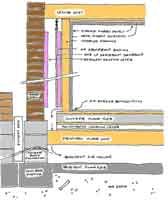
There's a nice drawing of the construction onthe site :
Recovered from web.archive.org — originally hosted at http://www.electricalaudio.com/StudioA/images/alcatraz-detail_tn.jpgThe venting in interesting too : using a basement as an extra volume for "bass trapping".
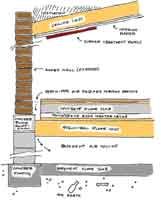
In the main rooms they used non parallel adobe brick walls with great visual effect. According to the SAE site and most sources brick is a highly reflective material. It looks like they were aiming at a BIG sound. They are snare sound sample available on the site, recorded in the various rooms. In the adobe brick wall rooms the sound is big indeed and seems very good too.
Recovered from web.archive.org — originally hosted at http://www.electricalaudio.com/StudioA/images/kentucky-detail_tn.jpgyou can find a bigger version of that picture on their site.
It looks like what John Sayers and others call hangers, but using a denser and thicker wood refered as OXB.
msikio,
What is used here as hangers does not work in the same manner as what they do there.
When you hang hangers free in space within a certain matrix, it's physically less clear which phenomena are at work. Hence that's more an empirical thing, which has proven it's value.
There they clearly make use of a mass spring system in front of a heavy wall, and add absorption on top for mids and highs. That's much clearer to grasp.
It's not because material looks comparable that it works the same. It depends on how you use it. Acoustics is more or at least as much technics and physics than materials or objects.
Hanging an absorber free in a room or on a cavity in front of a wall will make the same object acoustically an entirely different thing.
These studios look well thought through. If you're really interested maybe you can contact them, see if you can organize a visit or get in contact with the designer.
And hope you can get the information you want. Mostly what's published is more meant to convince people about the quality of their approach, but too little to get a grasp on the details to copy it (which is more than logical).
:twisted: What they give to the public, are sometimes nice sentences which are a collection of words remembered/assembled by the owner, but even for acousticians not understandable (my previous quote).
Not related to this studio: I've seen articles where is stated that the decoupling springs where calculated to last for 300 years. Since I designed them I asked the owner: can you explain me how I did do that, because I shouldn't know myself.
Brick is indeed reflective which can be great, when you control other sound problems in another manner. Just having a brick room, even asymmetric doesn't make that room right.
There are many ways to obtain the same goals.
Seeing the design of these hangers (without knowing more, hence with reservations), can also means that that room has too much high absorption.
The principle here at this forum is not that slat absorbers in itself should be that great or special as absorber, but that they prevent too much high absorption and add diffusion (more to the high-mid and harmonics range).
Hello Eric,
As usual very interesting.
I'm wandering how you can describe their system "Hanging an absorber ... on a cavity in front of a wall" as there is free air passage on top and bottom of the OSB panels : that "cavity" is coupled to the room. Quite different from a regular MSM system. On the other hand the proximity from the solid walls might have an effect on the resonant frequency of the panels even if the cavity is an open one... we'll call it a MSM system with an unusual spring ;)
Brick is indeed reflective which can be great, when you control other sound problems in another manner. Just having a brick room, even assymetric doesn't make that room right.
of course. I think they also use slanted absorptive ceiling. Did you listen to the samples ?
I've no plan to go to Chicago for the moment but who knows... I normally travel for work and as I'm not an US citizen the (not so) new regulations in the US makes it difficult, but I'd love to visit this studio one day.
Hello Eric,
I'm wandering how you can describe their system "Hanging an absorber ... on a cavity in front of a wall" as there is free air passage on top and bottom of the OSB panels : that "cavity" is coupled to the room. Quite different from a regular MSM system.
Quite different from the simple formulas, since difficult to calculate but still a normal MSM system.
That air can't escape and come back with the speed of this resonance (law of inertia). Hence that's still a MSM system but with weakened and asymmetric spring properties.
I often use(d) that shortcut with the environment to tune panel resonators.
As well panel resonators and slat resonators assume a plain wave at straight incidence and a lot of simplified boundary conditions. Reality includes more stuff. If not meant broadband (where it doesn't matter that much) I mostly will take care I have somehow a possibility to tune resonators. But I rather avoid narrow band stuff unless really needed.
That asymmetry in that spring in that studio will also broaden the range, lower Q, hence I think they wittingly used this.
It's not a hanger with a bit MSM as side effect. It IS an MSM system, but one which is difficult to calculate.
No I haven't listened to these samples.
I often use(d) that shortcut with the environment to tune panel resonators.
I remember you saying that somewhere else.
Thanks a lot the the info.
Talking about membranes I'm wandering how RPG or others measure their limp membrane "bass-trap" resonance ? Do the contact mike + sine wave generator blasted in front of the device would do the trick ?
Talking about membranes I'm wandering how RPG or others measure their limp membrane "bass-trap" resonance ? Do the contact mike + sine wave generator blasted in front of the device would do the trick ?
I don't know how they do it.
I assume (nothing more) that they do a lot of research via their impedance tube. They also have a reverb room (just fun: without RPG diffusers but with conventional polys).
I don't know exactly how these bass traps look like internally (limp... how limp?).
For window panes (stiff systems) you can use an accelerometer. If they are thin (light) one needs very small accelerometers since they influence the measurements, but it is done that way.
You can excite this with sound or shakers.
I don't know exactly how they work. I trust they know very well what they're doing.
Brian from GG does most R&D I think/assume with accelerometers and vibration measurements.