gentlemen,
book or no book, John, Rod, Glen, Steve and Eric, your legacy is in our industry (especially) the small/home studio. I don't think i need to ask or state the obvious, but there are hundreds (or thousands?) of people who extract information from your posts and put it to good (or otherwise;) use.
I appreciate and value your input and comments, my little project studio wouldn't be half of what it is if not for your guidance. I look forward to the future to put together a studio from scratch with the combined experience and accrued knowledge.
Thanks.
kevin
btw... i do have one related question to this post. I am still confused.. does the thickness of the slats (wood), and type (ex plywood vs oak vs pine) of wood play a role in the absorber... or is it only the slot depth and cavity volume that plays such a large role. and ... maybe not too scientific, but why is that?
btw... i do have one related question to this post. I am still confused.. 1a) does the thickness of the slats (wood), 2) and type (ex plywood vs oak vs pine) of wood play a role in the absorber... 1b) or is it only the slot depth and cavity volume that plays such a large role. and ... maybe not too scientific, but why is that?
Simple:1a+b) The slot depth and width defines the volume which count as a mass.
Hence the slot width and depth is defining (versus air volume acting as a spring).
For standard executions however the slot depth will normally equal the slat thickness. As such the slat thickness plays a roll since it defines mostly the slot depth.
But as a matter of speech you could make this with thinner slats and make some entrance (neck) which lengthen that slot depth. In that case the slot depth is defining.
As long as the slot depth equals the slat thickness, the slat thickness being directly related is indirect defining.
2) Whatever material you make this with, doesn't matter as long it is stable, since the whole construction is just a container for the mass-spring system which is the air in the slots as mass, and the air in the cavity as spring.
As such it (slats, frame, back) could be made in glass, wood (plywood, MDF, oak, pine, any), gypsum board or whatever other commercial panel, synthetic materials, whatever you like.
If stable, the material doesn't matter. That's just a matter of a 'practical construction' and aesthetic nature.
A cola bottle is also such an Helmholtz resonator and looks quiet different, yet the base principle is equal.
+++++++++++++++++++++++++++++++++++++++++++++++
Less simple:
When the construction isn't stable/stiff then a lot of other phenomena come into the picture since the resonating air volume will excite the container and interact with it.
You can compare that with a double leaf system which is a mass-spring system as well.
If you put a gypsum board at a cavity depth x in front of a heavy concrete wall (stable), you will get another resonance frequency than when you put the same gypsum board in front of a second gypsum board with the same cavity depth x (hence standard double wall).
The flexing of this 2nd board will interact with this resonance (becomes another system) and shift the resonance frequency.
In the same manner, a flexing slat resonator will shift the resonance versus a very stable/stiff resonator.
But it goes further: The shape of the slot influences the resonance. The distance between the slots can influence the resonance (related to the influence on the excitation of the masses (air in slots) outside the resonator).
But the latter you may all forget:
The standard published formulas assume a stylized construction with +/- sharp edges at the slots, and assume an infinite (read: stable) stiff construction, a plain wave at straight incidence etc., hence other phenomenas/parameters are ignored.
This becomes all less important if one aims at broadband absorption (wool, cloth, different slat and slot widths, angled cavities), but if one wants something accurate, narrow with high Q one better count on the necessity to have a possibility to fine tune them after being mounted.
It's a bit comparable with the standard published formulas for panel resonators which also assume an infinite stiff back wall and frame.
++++++++++++++++++++++++++++++++++++++++++++
:) You can limit yourself to reading the first part.
hi i want to build slat resonator like in this thread but i ask you is there a space of air beetween the cloth and the fiber glass and beetween the fiberglass and the slat or is the fiberglass is glued to the slat thanks and excuse me for my poor english; :?:
Eric Desart: I still wonder what exactly the class project was/is the OP is working on.
The class project went well, it was just about building a slat absorber and seeing how well it absorbed the particular frequency. anyway, i was just wonder what exactly the "Q" (of the absorber) is that you keep mentioning. The drawings are also very useful and i'm sorry i did not put one up of how the absorber i made looks like but i do not know how to put one up.
Maybe you should write a book - you are very good at explaining things :D
kayb7
Thanks,
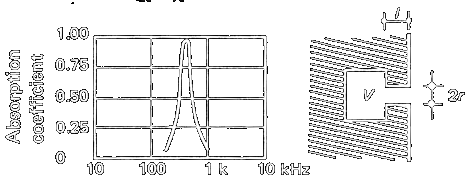
Look to these pictures:
Recovered from web.archive.org — originally hosted at http://www.kemt.fei.tuke.sk/Predmety/KEMT320_EA/_web/Online_Course_on_Acoustics/cavity_abs.gifSource: http://www.kemt.fei.tuke.sk/Predmety/KE ... rtion.htmlRecovered from web.archive.org — originally hosted at http://www.phys.unsw.edu.au/jw/graphics/helmholtz_freq.jpgSource: http://www.phys.unsw.edu.au/jw/Helmholtz.html
A Helmholtz resonator as the word says is a resonator.
This means that a specific frequency is excited by the principle (mass-spring).
In theory is this at a pure tone. This results in a very high absorption with the peak at this resonance and a fast decaying absorption around this peak.
This is called having a high Q (narrow band-width).
It is clear that things can easily go wrong here. If that resonator is tuned wrongly, it hardly absorbs the targeted frequency anymore.
By adding absorption this resonance is damped, it absorbs less but over a broader frequency range, still around this resonance frequency (but which is shifted somewhat just by adding the absorption in itself).
It's clear that mis-tuning has a less destructive effect, since the whole range around that resonance will not show this strong decay, and absorbs better.
Hence when you want maximum absorption efficiency from a resonator versus a specific discrete frequency, the high Q (narrow-band) resonator is best, but most sensitive to mis-tuning.
If you want broadband absorption over a larger frequency range, damping is better, and it becomes less sensitive to mis-tuning.
Except for damping (added mineral wool, cloth; etc.) one can make a slat resonator asymmetric (slats, slots, cavity) to make it more broadband.
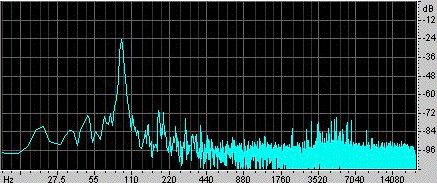
A cola bottle is also a Helmholtz resonator, and rather than with sound you can excite this phenomena by blowing over the top. This is a very high Q Helmholtz resonator, translating in an almost pure tone.
You indeed can use Cola bottles to absorb that very tone that you hear by blowing on it. And you even could tune it by filling it partly with water.
An Ocarina (musical instrument) is also a Helmholtz resonator. And there are multiple holes in it, which shows that being airtight isn't a necessity, but not being airtight influences the tuning.
http://www.pixelcomic.net/files/ocarina.pnghttp://www.phys.unsw.edu.au/jw/Helmholtz.html:) Sometimes, when browsing the net I see patents, wondering what's new about them.
http://www.freepatentsonline.com/6021612.html
I think I'm going to claim a patent on the wheel .....
Said object is round .... with some hole in the center of said object .....
Eric, just re-reading some of this discussion, please confirm my idea on this to see if i fully understand. I am/was confused on what type of wood to use on the back of the unit.
"If you put a gypsum board at a cavity depth x in front of a heavy concrete wall (stable), you will get another resonance frequency than when you put the same gypsum board in front of a second gypsum board with the same cavity depth x (hence standard double wall).
The flexing of this 2nd board will interact with this resonance (becomes another system) and shift the resonance frequency.
In the same manner, a flexing slat resonator will shift the resonance versus a very stable/stiff resonator."
I am goign to build broad band resonators... which will have an airtight back, but since it is a broad Q, I can probably get away with 1/4" plywood, since it is a broad Q, the flexibility would not hurt the function of the absorber, as long as it is a broad Q. If I was building a High Q absorber, then I would need to use a stiff material, such as 1" MDF. ???
So what do you think? Does this make sense?
:)
kevin
i think Eric is refering to the slats themselves needing some rigidity not so much the back panel. obviously some waves will penetrate to the back regardless so the panel resonance will impact overall absorption in the room but not something readily calculated (i think...). the 1/4" should be fine. it should be dampened though to prevent unwanted resonances from it...
ok,
thanks glen. yeah, it makes sense for the front. I thought the slat thickness had more to do with the depth of the opening, not necessarily to control the vibration of the slat. The rear however, I just wasn't sure about how the rigidity played a role in volume/ resonant control. I planned on putting 2" 8lb rockwool in the cavity, but not on the back, i can dampen the back with a additional layer of fiberglass though.
kevin
yes the slat depth is key to the fequency of the resonator. the back matters less. the 8lb may be too dense for the slots to breath unless you put it back ways from the slats. regular fiberglass can be used to dampen.
in that case, (8lb too dense) i'll prob alternate between the rw and the 703 (in alternated cavities, and put the rw towards the bottom to focus on bass freq, and put the 703 towards the middle of the absorber and focus those on the mid/higher freq...
thanks for the info :)
kevin
Tout d'abord je tiens à vous remercier, Eric, de nous faire profiter de vos connaissances, c'est vraiment très généreux de votre part. Now I am going to continue in English out of respect for all the non-French speakers here since it's an English-speaking forum, and also for the benefit of all here!
I have few questions regarding the black magic of slat resonators:
You make a comparison with a seringe that you block with your finger to demonstrate strength of air spring. What I don't understand is that the spaces between the slats make the unit non-airtight, so... how does that work? Is it the same principle as a shock absorber (amortisseur de voiture), pushing a lot of air and only a little can escape?
Also, when you put rockwool inside against the slats (well, against the acoustically transparent fabric which is itself against the slats) I take it that this rockwool has to be not to dense to let air through?
When you make a resonator with different widths slats and different width slots to make it more broadband, how much can the slats and the slots vary in terms of % for it to still be effective?
You say, so it is established, that the slats have to be of absolute stiffness. I understand that this is theoretical absolute as real absolute doesn't exist, so slats will always be a bit springy. So for the same space covered:
1/ Would the two designs below achieve the same absorption?
2/ Would the horizontal one be better because the shorter so stiffer slats?
I know it's almost rethorical, I'm just a very curious being!
Yes they will both work the same as long as the number of gaps is equal.
Guys- would I be right in saying that when the same bass freq hits the slat wall- there is a equal positive and negitive wave which occurs in the space behind the slat.
say it's 40dB + and 40 dB- which in theroy equal 0dB
thus the spring cancels out the frequency?
But... hang on, he said... In the two drawings in my post the number of gaps are not equal - but their total length is. Is it what you meant by equal number?
John, as you've designed/build a lot of slatted wall absorbers;
Do you 'calculate' the untuned/broadband resonaters or are you following your intuition on that? (variating wood size, gaps etc)
Love to hear your thoughts on that
Thanks John for those links. Lilith, the resonators will be about 1.10m X 2.40m each. I'll post an update of the design of the studio in my studio build thread soon, keep your eyes peeled :shock:
hey guys,
I'm new to this forum, as well as, building slat absorbers. i pretty much understand the way these things work and how to tune them.
one question though:
in dealing with the slot depth, would it work to use multiple layers of plywood or mdf to make it deeper, thus allowing them to be closer to the wall?
i'm imagining gluing 3 sheets of mdf together and then cutting the slats from the 2.25" "block"
the room i am dealing with is 9'8" x 7' 7" x 8'. pretty small but the axial modes are at some pretty critical frequencies. being able to tune these would help a lot.
also, in the formula for the resonators, its not so much the depth from the wall as it is the volume behind the slats correct? if that is the case, an angled resonator going from a depth of 12" to 4" would be the same as a square one with an 8" depth, right?
thanks a lot in adavance for any help.
wk
Angled resonators are not so "tuneable" since the depth varies. They are more like broadband resonators
You can glue and use whatever you want/have as long as its hard