Hello,
I am preparing/finishing the (basic) room for my studio (the studio/shell will be built in this room).
Unfortunately, the room's ceiling has a trouble (note: the walls, floor are already fixed, and now the room is ventilated, and heated as well).
Many years ago there was a formation of mould on the ceiling (until recently the room was never heated, neither was properly ventilated). The room is at grand level).
Someone has covered that mould with 2-3 layers of paint.
Now, I would like to remove that old painting, and apply chemicals to the moulding (I believe it is still alive under the painting). Please give me advises HOW the remove the layers of the old paintings.
Note: the ceiling is not a flat surface but it has some charming arching - so it is curved.
I have tried to use sandpaper, but that approach is unbelievable difficult and very much time consuming.
Any advice is very much welcome. The old paint is water resistant, I believe.
Stefan.
OK, so you are talking about a HEAT GUN. And using a scraper.
Well, is this possible to use a heat gun for a WALL/ceiling paint?
Have you done this?
Stefan.
Save your back and time, and hire a contractor to do this. Mold needs to be treated and contained so that it doesn't return (though you said its no vented so thats good). Mold also can cause respiratory issues so special care needs to be used when removing it. Also, the paint may be lead based which is another thing to think about. Having someone come in and take care of this is worth the money probably. As a DIY i'd like to do it myself if i were you, but i concede to the pro's and equipment when you deal with potentially dangerous things like asbestos, mold, lead, contaminated soils etc..
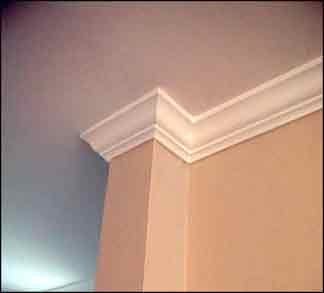
I'm pretty sure he's talking about mouldING...
Recovered from web.archive.org — originally hosted at http://www.santiagoafanadorphoto.com/crown_molding_large.jpg...not mold...
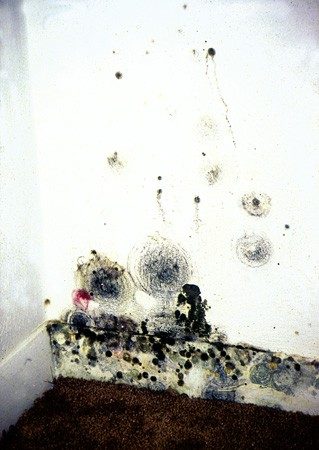
Recovered from web.archive.org — originally hosted at http://www.state.sd.us/denr/DES/WasteMgn/photo3a.jpg--Keith :mrgreen:
speaking from experience, remove the wallboard and replace it. use extreme care to keep yourself protected and dispose of properly. or as suggested get a pro involved. you will never be rid of the mold (not moulding unless there is a process to grow crown moulding in which case sign me up :D ) because it has penetrated the board and will always be there waiting for a time when the conditions are right to start growing and spreading again.
once you get the board removed, disinfect the area and make sure its dry before re-covering. ideally the best best is to remove the walls and rebuild so you can ensure circulation. there are also new "paperless" gypsum board with built in mold inhibitors. they're (in my area) about $4 more per pair of sheets for 1/2" and a bit more for 5/8" but at least you will be installing something more resistant.
bottom line it has to be removed to be sure. check the underlying framing, insulation etc... because if its ON the walls, its probably IN the walls as well.
I'm pretty sure he's talking about mouldING...
Recovered from web.archive.org — originally hosted at http://www.santiagoafanadorphoto.com/crown_molding_large.jpg...not mold...
Recovered from web.archive.org — originally hosted at http://www.state.sd.us/denr/DES/WasteMgn/photo3a.jpg--Keith :mrgreen:
Now re-reading his OP...it does sound like mold Sharward...
The room where I am going to build my studio is in a corner of a very big (huge) "stock" room = 4m x 5m space was separeted with 2 extra wall in one corner.
That huge room was used for a brewery factory. The brewery is gone (the beer as well, unfortunately), and the huge room is devided into small rooms and the places are used for different purposes: dentist, shop for food/drinks, stock room, atelier, ....,
In all those cases the people "simple" painted the existing ceiling.
I do not know if they (the other users) worry about the mould or not, but
I am more careful - perhaps because of my profession.
So, I am talking about mildew, mould (mold), kind of "fungus". It looks like small black spots.
According to the owner it is kind of rash/spot/"eruption" of the old plaster. For me it looks like a mold what i have seen the on the not well vented baathroom's ceilings.
Anyhow, the mould was also present under the paint on the 2 "old" walls (the room has 4 walls, and the 2 other walls are new). Form those 2 "old" walls the plaster is fully removed. So, I believe the mould is gone with the plaster. The bricks seams to be free from mould.
Next: I would remove the plaster from the arching ceiling as well, but I will have to plaster the ceiling if I remove the old plaster (request from the owner). The ceiling has arching (charming, but very difficult to plaster). So, I have been thinking: if I remove the paint from the ceiling, I can get to the mould, apply a product against it (what I have from a specialist), repaint the ceiling, and that is it.
In the paint shops (professional) they have recommended to use a sandpaper, what I do not like at all.
Any further comment is very much welcome.
Stefan.
Today I had a pro to look at the place/ceiling. He has measured the huminidity of the ceiling's plaster and he said the ceiling is not wet at all. According to him the mould is not active. For my biggest surprice he has suggested to not to remove the mould, just paint it with synhtetic paint.
Now I am puzzled...
trif.
Today I had a pro to look at the place/ceiling. He has measured the huminidity of the ceiling's plaster and he said the ceiling is not wet at all. According to him the mould is not active. For my biggest surprice he has suggested to not to remove the mould, just paint it with synhtetic paint.
Now I am puzzled...
trif.
Well if the professional said it isn't active, and there is no further moisture problems to create new issues, then you could clean up what mold you do see with Lysol, or a mild vinegar solution, prime and paint over it. But then again, you should really also have your inner walls tested if that hasn't been done. Make sure you have a handle on the mold before you do anything more, because it would suck to spend alot of $$ on a studio or whatever only to have to rip it apart to deal with the mold again.
and depending on the expense, get a second opinion from another pro in your area... if you're going to be there any length of time the risk to your health can be pretty high. the brewery explains a lot... warm moist food yeast yum... sounds a bit like a lambic ale :)
Decision is made - I do not want to have any trouble in the future.
I have started to remove the plaster form the ceiling.
The ceiling is made from bricks, and there is no mould on the bricks.
The room is vented, and will be vented in the future.
trif.
Decision is made - I do not want to have any trouble in the future.
I have started to remove the plaster form the ceiling.
The celing is made from bricks, and there is no mould on the bricks.
The room is vented, and will be vented in the future. I think there is very little chance to get back the mould. Am I correct?
trif.
Are you confident there are no existing leaks in the walls, attic or other adjacent rooms?? Mold will grow even in other rooms if conditions are right, and spread as they are spores which can go airborne. But i think you've made the right decision to remove the plaster and start from square one. Look into products that you can treat the inner walls with once you get the plaster off there, as this will ensure no further growth. And wear protective mask when removing and cleaning up the debris.
I work with protective mask & overal & gloves.
I have 2 adjacent rooms (one used as smaller stock room, another as huge stock room - bike room). In those rooms the ceiling is the same as I have/had in my room. However, those rooms are not "mine", so I can not do so much about them.
My room's walls/celing will be treated with a product against moulds. The walls/celing will be painted with a specail product - this will act as a sealent for tiny leaks/holes. Furthermore any bigger leak will be sealed with mortier and caulk.
After this the construction of the inner shell will start.
The inner shell/studio will be always vented (2 ventilator system, 1 ventilator (with higher airflow) pushing the air in, the 2nd ventilator (with smaller airflow) pulling the air out). The cavity between the shell and the existing walls/celing/floor will be vented as well.
Currently fresh air is constantly entering my room.
Is there anything else what I could do?
trif.
I work with protective mask & overal & gloves.
I have 2 adjacent rooms (one used as smaller stock room, another as huge stock room - bike room). In those rooms the ceiling is the same as I have/had in my room. However, those rooms are not "mine", so I can not do so much about them.
My room's walls/celing will be treated with a product against moulds. The walls/celing will be painted with a specail product - this will act as a sealent for tiny leaks/holes. Furthermore any bigger leak will be sealed with mortier and caulk.
After this the construction of the inner shell will start.
The inner shell/studio will be always vented (2 ventilator system, 1 ventilator (with higher airflow) pushing the air in, the 2nd ventilator (with smaller airflow) pulling the air out). The cavity between the shell and the existing walls/celing/floor will be vented as well.
Currently fresh air is constantly entering my room.
Is there anything else what I could do?
trif.
Without being there, i'd say this is about all i can offer you advice wise. Just use caution and don't ignore or sidestep any of the remedies. You should be fine.
If the normal relative humidity in your area gets higher than about 50%, I would consider looking for a dehumidifier to run in your space when not recording - mold generally can't survive under about 50%, and any wooden music instruments (piano, guitar, violin, etc) like 42% the best. I do this in my spaces, and both my instruments and my lungs thank me... Steve
If the normal relative humidity in your area gets higher than about 50%, I would consider looking for a dehumidifier to run in your space when not recording - mold generally can't survive under about 50%, and any wooden music instruments (piano, guitar, violin, etc) like 42% the best. I do this in my spaces, and both my instruments and my lungs thank me... Steve
Steve,
Good advice! I have checked and today here the relative humidity is 76%.
I agree, dehumidifier is necessary.
Can you give advice which type/model is suitable for studio/control room?
Stefan.
That would depend on whether you plan a complete air conditioning system built in with silenced duct work, etc - these will, if properly sized, run long enough to dehumidify your space.
If not, the quietest free-standing unit I've used is the Sharp portable air conditioner/dehumidifier, model # CV-P09FX - may be a different model # for your power system. Here's a pic - shown being used as an air conditioner, which unfortunately requires that it's 5" diameter hose gets vented to the outside.
As a dehumidifer, it does NOT need the exhaust hose to be run outside - instead, the exhaust will act as a small space heater, warming the room a bit. You'll also need a bucket to catch all the water that this unit removes from the air - in my case, a 4 gallon container fills up in about 36-48 hours.
This is by FAR the quietest unit I've used, I have a Whirlpool unit that is about 12 dB louder than this Sharp unit and an in-wall unit that's at least 8 dB louder than the Sharp.
Only downside for me is that the Sharp has no "humidistat" - you have to turn it off if the humidity gets lower than you want. Mine cost about $550 USD... Steve
Steve,
Thanks for pointing my attention to this unit/picture as I do not plan a complete airconditioning system.
So, if I understand it sorrectly the unit can be used with exhaust hose and in that case no container is needed to collect the water. Correct?
Stefan.