Hi all - I've been lurking for a while and this is my first post. Great site, and I wish I had found it BEFORE I started my construction!
I'm strictly a hobbyist and do recording/songwriting in my spare time. I'm finishing a small room in my basement that will be used as both a recording and control room (I usually record by myself so that's ok for me).
My main goal is to keep as much sound IN the room as possible as to not annoy my wife and daughter. I'm not going for a 100% soundproof room. I don't have a large enough budget, and my family and neighbors can can live with some amount of noise. Ideally I'd love to be able to play drums at night after my daughter goes to sleep (two floors above the studio).
Acoustic quality INSIDE the room is a secondary priority. I'm more interested in writing and creating music than the quality of the captured sound. Some of you will probably cringe when you read that, but that's a fact :)
My main instrument is drums, and I play pretty loud. I play guitar too but that's not quite as loud. I often use a Line 6 POD for guitar work, and when I want a real amp I don't play nearly as loud as on the drums.
Room dimensions are 11 x 13 x 8.5. Not a very big room. There is a long soffit in the ceiling and another box in a corner that encloses an air return duct. Three of the walls are against the concrete foundation, and the fourth wall is shared with the main family room in the basement (which is also not finished yet). The ceiling is I-beam joists. There is an egress window in one of the concrete walls. I'll try and add a picture here to help describe the room better...
I've already put up the framing. Nothing fancy.... again I'm on a small budget. I've used 2x4 frames on the concrete walls and a 2x6 staggered-stud frame on the common wall. All frames sit on a strip of sill foam and are bolted to the floor. Using a minimal amount of screws, I've secured the frames to the ceiling joists for more stability.
I've packed the room (frames, ceiling, and soffits) full of R-13 and R-19 insulation. I'm generally staying away from sound-blocking materials (e.g. "sheet-block") that you add to the walls. I just don't have the budget for that.
Now this is where I wish I would have come across this forum earlier - I've already fastened resilient channel to all four walls on the interior of the room. However I just finished reading that installing RC on frames that are facing the concrete foundation really won't help much. e.g. because RC helps reduce sound translation from drywall on one side to drywall on the other side of a wall - and doesn't matter if there is no drywall on the other side of the frame.
1. My first question is should I tear down all the RC on the concrete wall frames and eat the cost of it? In my amateur, uneducated opinion, the RC will still help because my frames are bolted to the floor and attached to my ceiling joists. The RC will help reduce sound translation from the drywall to the floor and ceiling. Correct? Is installing drywall on RC really difficult?
2. Second, how important is it to install RC on the other side of the common wall with the family room? Chances are that both the family room and studio room will not be used at the same time. But would RC on the other side of the common wall really be significant in reducing sound traveling through the family room, upstairs to the rest of the house?
3. Third, how easy is it to hang drywall on RC? It seems like it might be a bit tricky because you have to push kinda hard to get a screw to go through a solid piece of RC. Is there a trick to making it easy?
4. Last, should I try and use two layers of drywall on the interior of the room? Is that too heavy for RC?
What other things am I missing? Oh, about that window... I'm planning on building a "plug" that fits the window cavity that I can just set in the window while playing. I'm more concerned about not annoying the family inside my house than annoying the neighbors. The neighbors have lived with me playing without a soundproof room for 3 years without complaining.
Please let me know if I've missed any details that would be helpful. I appreciate any feedback.
- Mike
Effectiveness of RC and how to hang drywall on it
Originally posted at johnlsayers.com, topic 7294.
Mike -
all of the RC should come off your walls anyway - it's all installed upside-down and will fail in the end.....
The leg you fasten with is supposed to be on the bottom - not the top.........
Rod
You must use nails for framing, not screws. You won't pass your framing inspection if you used screws. See my thread for screw vs. nail discussion last week.
Definitely buy Rod's book (se the sticky thread) and note his dire warning about framing in basements.
"Sheet block," a.k.a. mass loaded vinyl, is a ripoff. But Green Glue is not. It isn't cheap but it may be helpful in your case.
Definitely get Rod's book before you do anything more!
Good luck...
--Keith :mrgreen:
Where I live, this isn't the case. My wife's uncle lives two blocks from us, just finished his basement and used screws for framing and his inspection passed. I helped him frame it all and basically copied his technique. I'm having trouble finding your screw vs. nail thread - I'll keep searching. If you have a quick Url that'd be cool. My big questions still aren't answered yet - assuming my inspection passes and I re-install my RC the right side up, is it worth it? Is it difficult to hang drywall on? Will I really get much benefit out of it? Are there other larger factors I'm missing that will cause sound leaks that would cancel out the effects of the RC?You must use nails for framing, not screws. You won't pass your framing inspection if you used screws. See my thread for screw vs. nail discussion last week.
Several threads on this here
http://www.johnlsayers.com/phpBB2/viewtopic.php?t=2125
Well, OK at least one :=)
If those don't help, ask again... Steve
Thanks everyone, you've been very helpful so far.
Next questions:
1. I didn't see a specific comment about how to fasten two layers of drywall to RC-1. Should the exterior screws on the 2nd layer be long enough to fasten into the channel? e.g. I want to fasten the 2nd layer into the RC - not just into the first layer of drywall, correct?
2. Any problem with using Green Glue in combination with 2 layers of drywall on RC-1?
Amen. Rod, I picked up your book today. In about 2 hours of reading I've learned a lot. I'm relieved to find that I've been on the right track so far with my framing. Now if only I'd installed that RC right-side-up :oops:Definitely get Rod's book before you do anything more!
1 - screws need to penetrate both layers and into the RC, you're correct. Use FINE thread screws, same as you'd use for steel stud framing.
2 - Not sure if RC AND GG would add much - you need to go to their site and read through the TONS of test data they've done.
http://www.greengluecompany.com/technology.php
That one page is a college education on sound isolation, so be prepared for several nights of study... Steve
There are some excellent reads at that Url, knightfly. Thanks. It looks like GG in combination with RC can yield better STC's, but according to their tests, only by 1 STC (GG only = 56, GG + RC = 57). Their "Using Green Glue" page says that GG + RC in combination can reach STC's in the 60's. Hrm... which page to believe.
Next question...
I keep hearing that RC performs poorly at low frequencies compared to GG or other wall types. To my amateur ear, I don't exactly know what "low frequencies" means. Sure, on paper it means frequencies around or less than 60-100 Hz (approximately), but what does that mean when I'm playing drums? Do bass drums hit around 80 Hz? Are we talking about really low frequencies like airplane noise outside, or frequencies where the drumset plays?
This seems to be my big deciding factor on whether to proceed with RC. If RC can add some STC benefit, I'll use it because it's already cut, and I just need to re-hang it right side up. However, if RC will LOWER the STC in low frequencies where drums are prominent, then I definitely do NOT want to use it.
Any input on the frequencies of drums?
Given your goal of banging on drums without disturbing the family I would favor the Green Glue over the RC for the exact reason of the Low Freq. Isolation. Being that you already have the RC though - might as well do both. It definitely wont hurt and may well be worth the effort. I'm lead to beleive that you will notice every db of reduction when your down to low levels.
Good luck and keep us all posted!
Andy
But at the low levels, might the RC hurt me - even in combination with Green Glue? e.g. RC by itself will perform poorly at the low levels, and in combination with GG will be worse than just plain GG treatment.
I know you're suggesting the opposite. There's just not a lot of data out there.
If I can avoid the effort of having to re-hang my RC, then I'd be happy. However, Andy you're suggesting that ANY dB reduction at the low levels will really help, so even if the reduction in terms of dB by the RC is small, to the ear it might be bigger.
Maybe I just need more patience - but I really don't want to re-hang that RC.
I honestly think that the GG is going to give you the biggest bang for your buck. You may be right about the RC - given that you don't want to have to go through the re-installation of it - I wouldn't. Particularly if it is questionable how much additional benefit it will provide. At least you know that there is data to support GG's benefit with the LF.
As a matter of interest, in my plan for most critical walls I have chosen to use GG over RC.
Andy
OK,
In the case of your walls - you are already using isolated construction - so (besides being installed wrong) you don't want RC because it will actually degrade the wall systems.
In the ceiling (however) it's a different situation.
The intent of RC is to try to duplicate isolated constuction - so there is a physical decoupling of the structures that takes place.
Although the green glue is a magnificent product - and I use it and reccomend it to my clients all of the time - it is not doing the same thing.
So on the ceiling - GG without RC will not decouple the above and below - and flanking directly through the structure will still take place.
My best advice would be to utilize both in your case - and don't be misled by the reported STC - because first of all - it has to do with an assembly as a whole - and 2nd - it is not indicative of the amount of LF isolation you gain - because it never measures those frequencies as a part of the equation.
Sincerely,
Rod
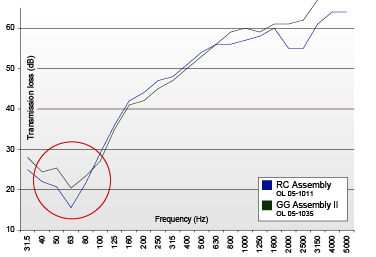
Rod - you mean this only for the ceiling correct? Because in your first sentence you recommended NOT using RC for the walls. I just want to be clear and make sure I understand. Also, what you say about being misled by the reported STC is a good point. However what about transmission loss in dB? Are dB's measured at the low freqs? GreenGlueCompany.com presents a number of charts in their comparison of GG and TC and the dB difference at the LF levels appears significant: http://www.greengluecompany.com/greenGlue-vs-ResilientChannel.phpMy best advice would be to utilize both (RC and GG) in your case
Bass drum hits sound nicer (most of the time, depending on a lot of variables and arguably) if we pump up the 80 Hz EQ on channel or main EQ. 80 hz typcially makes a lot of difference in EQ'n a bass drum. BUT that does not been the bass drum hits at 80 hz, the peak frequency of the bass drum could be anywhere in the low end (depending on size and tuning) and then harmonic frequencies are added above and below that peak mostly in octaves. IF bass drum peak is t 80hz then 160 hz (x2), 320 hz (x4) and 40 hz (divide by 2) are also strong frequencies which will effect sound. You could hear this on a well tuned tom with a long ring, the attack is a lower pitch and the ring has the upper harmonics in decay of hit. On a guitar harmonics... 1st one is at half way from neck to bridge, place finger on string at 12 fret not pressing on fret board, hit string and you get a pitch 1 octave above the open string... other harmonics are all over the string and ring with an open or fretted hit, giving the guitar part of it's color of sound. OK I am babbling... point is your bass drum and other drums hits peaks at certian frequencies (concert tuned snare is F#) and other frequencies related to harmonics and other variables are produced. If you were to add a sub harmonic (noise maker) proccesor to your bass drum or mix (BBE, DBX and others make hardware versions, many plugins are available) you could with recorded or micked drums accent let's say 40hz, although almost useless 20 hz and make other rumbly noises. Hope that helps, BTW we are talking about the frequencies your drums play, unless you live next to an airport and need to keep that noise out. MarcTo my amateur ear, I don't exactly know what "low frequencies" means. Sure, on paper it means frequencies around or less than 60-100 Hz (approximately), but what does that mean when I'm playing drums? Do bass drums hit around 80 Hz? Are we talking about really low frequencies like airplane noise outside, or frequencies where the drumset plays?
Rod did not recommend the RC on walls cause you's already built isolated, double frame or staggered frame walls, RIGHT? On places where you are not using a double frame (double frame= decoupled inner leaf with no hard attachment to outer leaf)... then use the RC. This would be you're ceiling and/or MAYBE the 2x4 walls next to the concrete walls IF you've hard attached 2x4's to block/concrete wall.
That chart measures TL at each (low) frequency. Notice how more TL in db's is gained with the higher frequencies. The lows are harder to stop.However what about transmission loss in dB? Are dB's measured at the low freqs?
Green Glue Company does not make data up, this is part of the reason why there product is more expensive... they do real tests producing real data. They even post to this and other forums as to how and as they are doing new tests, looking for insight.Are the Green Glue folks really measuring dB's at the LF's? Or are they making that data up?
I'm guilty of that :twisted: but this topic I would think hard about as if you're not doing this correctly the down side is you could have spent your money and time more wisely and achieved a better result. MarcAm I thinking too hard about something that in the end won't make a huge difference?
One of the frames is staggered stud. The other three are against concrete walls. All four frames sit on the foundation, and the three against concrete do make some light contact with the concrete - but they are not pressed hard against the concrete wall and are not hard-attached to the concrete wall (but they are bolted to the floor). I'd say that the frames against the concrete are isolated, but there is incidental contact (not fastened contact) being made against the concrete and with other framing members outside the room. So there is some contact my walls make with other framing outside the room. Would this warrant the use of RC? Should RC not be used ONLY if the walls are 100% isolated? Will my incidental contact with concrete make a big difference, and therefore I should use RC?Rod did not recommend the RC on walls cause you's already built isolated, double frame or staggered frame walls, RIGHT? ...then use the RC...IF you've hard attached 2x4's to block/concrete wall.
This is where I back out on giving advice. 8) But my bet is on RC ceiling only 8) At least all the info is there for someone else to advice... but will adviser ask more questions before giving the advice :? Marc...and therefore I should use RC?
Unless I hear any compelling arguments for using RC on the walls I'm going to go with using Green Glue only on the walls and RC + GG on the ceiling. I feel like I'm starting to split hairs with this decision. And for my goals in my house I don't feel like it's worth the effort of debating this much longer. I just wish I had some real world experience with these materials to help me decide.
Thanks everyone for all of your input. But if you have more I'll be listening :)
An STC rating is essentially the weighted average of noise loss through a barrier across a range of frequencies ( 125Hz to 4Khz) - they can (and did) measure TL loss above and below that range - BUT - when they report the STC rating for the wall - THOSE VALUES OUTSIDE OF THE 125Hz TO 4kHz ARE NOT TAKEN INTO THE EQUATION. Thus you could have a vry significant increase in TL value at 100Hz that would not affect the STC rating at all. That was my only point. As to the question of RC on the walls or not - I wouldn't bother in your case - I would (as I suggested above) just stick with the ceiling - and make absolutely sure that you completely seal all of the wall / ceiling layers EVERYWHERE to stop sound leakage through any potentiasl air passages. RodAlso, what you say about being misled by the reported STC is a good point. However what about transmission loss in dB? Are dB's measured at the low freqs? GreenGlueCompany.com presents a number of charts in their comparison of GG and TC and the dB difference at the LF levels appears significant: Are the Green Glue folks really measuring dB's at the LF's? Or are they making that data up? Am I thinking too hard about something that in the end won't make a huge difference?
Thanks Rod.
I'll go with RC on the ceiling and will definitely seal absolutely everything.
I think the next big question I'll have will be about the door, but that will be a different thread in the future. Thanks again everyone.
Here you go. That's a direct link to recent discussion in my thread. There's also a link within it that points to an earlier discussion back in July where I first covered it. Sorry I didn't include the URLs in the first place, but as I recall, I typed that post via my Treo 650, which obviously makes things much more difficult. Perhaps your municipality (like Marc/guitardad72) doesn't care what kind of fasteners you use on your interior framing. Bottom line: contact your building officials to see what is allowed and what is not. That's what I did, and I'm very glad I did. I'd have been up the creek without a paddle if I hadn't! :shock: (Well, truth be told, Rod probably would have saved my ass before I got too far along! :lol:) I know your itching to get moving again, kindohm, but you would be wise to get all this straight in your head and be absolutely convinced you are making the best decisions before going any further with your build. I am not exaggerating when I say that you could find yourself in a position of wasting or costing yourself thousands of dollars due to a critical error at this stage. Figure this -- you're already at a disadvantage of having made significant progress in your build without the benefit of this forum and Rod's book. It's now up to you to make sure that every decision you make going forward will contribute to your having the best outcome for the money and effort you're investing on the remainder of the journey. You may conclude that there are tweaks you can make now to what you have already built that will significantly improve the outcome -- opportunities that will cease to be available to you if you go back into gear right away. For example: where your inner leaf framing is making contact with your outer leaf concrete walls -- can those walls be moved inward a little so that there's no contact at all? :roll: --Keith :mrgreen:I'm having trouble finding your screw vs. nail thread - I'll keep searching. If you have a quick Url that'd be cool.
Just for the record, I passed my inspection with screws on all my framing. It just solidifies Keith's comment about checking with your municipality about codes... each city is different.You must use nails for framing, not screws. You won't pass your framing inspection if you used screws. See my thread for screw vs. nail discussion last week.