First off, thanks to everyone at the site who makes this possible.
A few friends and I are building a studio in the second floor of a commercial building. Most of my questions and concerns have been addressed by other's posts, but I can't seem to find much info on the subject of spray insulation.
We were thinking of possibly using the spray insulation on the ceiling rather than drywalling. The ceiling is directly below a flat roof and contains a slight pitch around 5-6 degrees. The rafters are 2"x12". Right now, before any construction has started the room has a 65dba level. According to the research i've done, the spray insulation can obtain an stc rating between 50-65 and an nrc of 0.6-0.9 The spray insulation would be a much easier route, the open cell formula acts as an absorber as well to reduce reflections and would look interesting too. Hopefully Steve or one of the other knowledgable guys here can shed some light on the situation.
We were thinking of possibly using the spray insulation on the ceiling rather than drywalling. The ceiling is directly below a flat roof and contains a slight pitch around 5-6 degrees. The rafters are 2"x12". Right now, before any construction has started the room has a 65dba level. According to the research i've done, the spray insulation can obtain an stc rating between 50-65 and an nrc of 0.6-0.9
x-t
I think you misunderstood some things in your research.
I assume you talk about fibrous spray insulation (exists in mineral wool and synthetic fibre).
This can never in itself increase insulation that much (it's the same as putting rockwool or fibreglass boards beneath your ceiling).
There is really no way this can substitute drywalling.
Check the conditions in which this 50 to 65 dB TL is obtained you found via your research.
Absorption and insulation are entirely different things. Absorption can be used inside a cavity to enhance insulation, but is no insulation in itself.
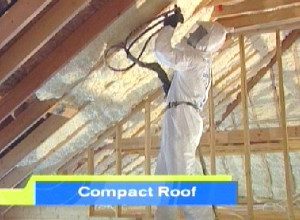
you mean this stuff?
Recovered from web.archive.org — originally hosted at http://images.scrippsweb.com/DIY/2004/03/22/dhiq112_2fe_e.jpg
does it have any acoustical value as far as using it in place of rockwool, 703, etc etc??
now coming to think of it. I have seen some type of spray foam on the ceiling of old warehouses and machine shops and it did kill a hell of a lot of sound(echos) that you would normally get inside a big open place. Maybe is was some of other type of foam...maybe its been banded????
Is that picture the kind of stuff you're talking about? If I'm not mistaken, that's CLOSED cell foam.
nukmusic - I think the reason it might have made a big difference (and unless you were in the building BEFORE they sprayed it, it would be hard to know what it was REALLY like before and after), was because of a thin metal roof. It could act as a dampener in that case and make it more difficult for the roof to vibrate.
In almost every case I've seen this used, it's been for INSUlation and not ISOlation.
len
In almost every case I've seen this used, it's been for INSUlation and not ISOlation.
Len,
Can you explain the exact difference?
In my language we only use one word. What is the difference between INSUlation and ISOlation?
When do you use one or the other?
Eric
Eric, in the US INsulation generally refers to controlling heat (or cold) loss from one area to another; while ISOlation refers to sound control from one space to another - just another case of English being "one rule with 5,893 exceptions" :?
In spite of the "typical" usage here, this (from the American Heritage Dictionary) does its best to confuse even further -
in·su·la·tion (¹n”s…-l³“sh…n, ¹ns”y…-) n. Abbr. ins. 1. The act of insulating or the state of being insulated. 2. A material or substance used in insulating: soundproof cork insulation; a layer of trapped air that serves as insulation.
and
in·su·late (¹n“s…-l³t”, ¹ns“y…-) tr.v. in·su·lat·ed, in·su·lat·ing, in·su·lates. 1. To cause to be in a detached or isolated position. See Synonyms at isolate. 2. To prevent the passage of heat, electricity, or sound into or out of, especially by surrounding with a nonconducting material. [Latin ºnsula, island + -ate1.]
Bottom line: damned if I know :cry: ... Steve
x-t,
You really are mixing up things here.
In your original post you say:
1)
the open cell formula acts as an absorber as well to reduce reflections
Here you say:
2)
it seams as though the closed cell formula
1) Does absorp sound and DOES exist as a spray application.
2) Does not absorp sound and exists also as a spray application.
Both are quiet different types of products: 1) is often a fibrous material (+special types of open cell plaster like products), 2) is a synthetic foam.
1) is good for absorption 2) is NOT
But both 1) and 2) can NOT substitute a drywall suspended ceiling for insulation.
What you hope fore is wrong, no matter how long you search any further.
If you think you found something proving otherwise, you either interpreted it wrong or they presented it wrong.
You are looking for significant TL enhancement. Those materials without a mass as e.g. drywall can not deliver you that.
:):):)
Thanks Steve ....
I just want to be sure I can't write anything wrong (which could be misinterpreted) using one or the other.
But as you said, your search still leaves a lot open.
Thanks again.
Eric,
In my last post I stated the same thing as my first. Open cell is shown to absorb while closed cell isolates (due to the lack of air passage). I don't feel that I switched them at all.
Thanks.
well, ....
INSulation is to break contact between 2parts while ISOlation is to actually seperate things.
Put a men into prison is like ISOlating him/her from other people
Keep the cold from coming into one's house is INSulating heat/cold
so keeping unwanted noise from going through walls is actually INSulation, imo. Just like INSulation heatpipes to prevend the heat escaping.
... :shock:
Eric,
In my last post I stated the same thing as my first. Open cell is shown to absorb while closed cell isolates (due to the lack of air passage). I don't feel that I switched them at all.
Thanks.
x-t,
Sorry then, if I got confused.
But you did link 1) to STC ratings as well, which clearly refers to insulation (or isolation, whatever) and 2) you didn't .
Anyhow my message stands.
None of both will help you increase TL as a substitute for the drywall application, which I thought was your goal.
And if you should use drywall (or whatever comparable) then 1) should be good in the cavity and 2) should be bad.
But again, also here, once you need the make an inside ceiling, it has little sense to use the spray technic at all, since that newly added ceiling can easily support standard absorption blankets or boards.
If I misinterpreted that also, then forget my messages.
Sorry
well, ....
INSulation is to break contact between 2parts while ISOlation is to actually seperate things.
Put a men into prison is like ISOlating him/her from other people
Keep the cold from coming into one's house is INSulating heat/cold
so keeping unwanted noise from going through walls is actually INSulation, imo. Just like INSulation heatpipes to prevend the heat escaping.
... :shock:
:mrgreen: Well Ro, I interpreted it about as you did, but therefore was confused reading Len’s message. He made a clear distinction which I didn't saw or felt.
:) But since we both are Dutch speaking, I rather asked the English guys.
The terms are synonymous - however - in the US - we always refer to insulation as the act of creating a thermal barrier - and isolation as the act of separating one space from another space acoustically.
In this manner it's always clear exactly what we are referring to.
Just as a point of intrest- The ANSI manual of Acoustic Terminology (ANSI S1.1-1994) defines isolation - but not insulation - as follows:
5.25 Isolation. Reduction in the capacity of a system to respond to excitation, attained by the use of a resilient support. In steady-state forced vibration, isolation is expressed quantitatively as the inverse of transmissibility.
As far as the claims of the spray insulation company regarding their product - this is indeed for their product used as a part of a 2 leaf system, and a critical part of that assembly is that the spray material is never the full depth of the stud or joist bay - otherwise (due to it's rigid nature upon curing) it creates a "short circuit" between the 2 leaves - creating (in effect) a one leaf system.
I considered using this in the high rise hotel I just completed - (for party walls separating guest units) but found that it was not cost effective when compared with standard wall assemblies using fire safing.
I also found (upon a deeper examination of the manufacturer's claims) that their tests indicate better results than reported in IR 761 - which I believe is attributable to specimen size - the manufacturers test a 4'x8' specimen - and thus have no interior joints which may affect leakage - whereas the IRC tests are performed with 8'x10' assemblies - which more accurately resemble real life conditions.
Sincerely,
Rod
Eric - Yeah, but when you asked the "English guys", look what Knightfly came up with: OFFICAL (acording to Webster) confusion! It sure looks like I opened a can of worms here!
I believe the point I was making is still valid though at least as far as common misconceptions people have about isolation vs insulation. Perhaps we should TL instead because it's less ambiguous.
I guess newbie have trouble with the idea the heat/cold "move" differently than sound. I don't think anyone would think of using drywall only to INSUlate thier house instead of FG.
len